4C Strategy Model
Find the Sweet Spot Where Company, Category, Customer & Culture Collide
Most strategy decks are four piles of research wearing a trench coat. There's a slide on the company, a slide on the competitors, a slide on the customer, a slide on some trend someone read about on a plane. Then a heroic slide that says "Strategy" and bears no obvious relationship to the four before it.
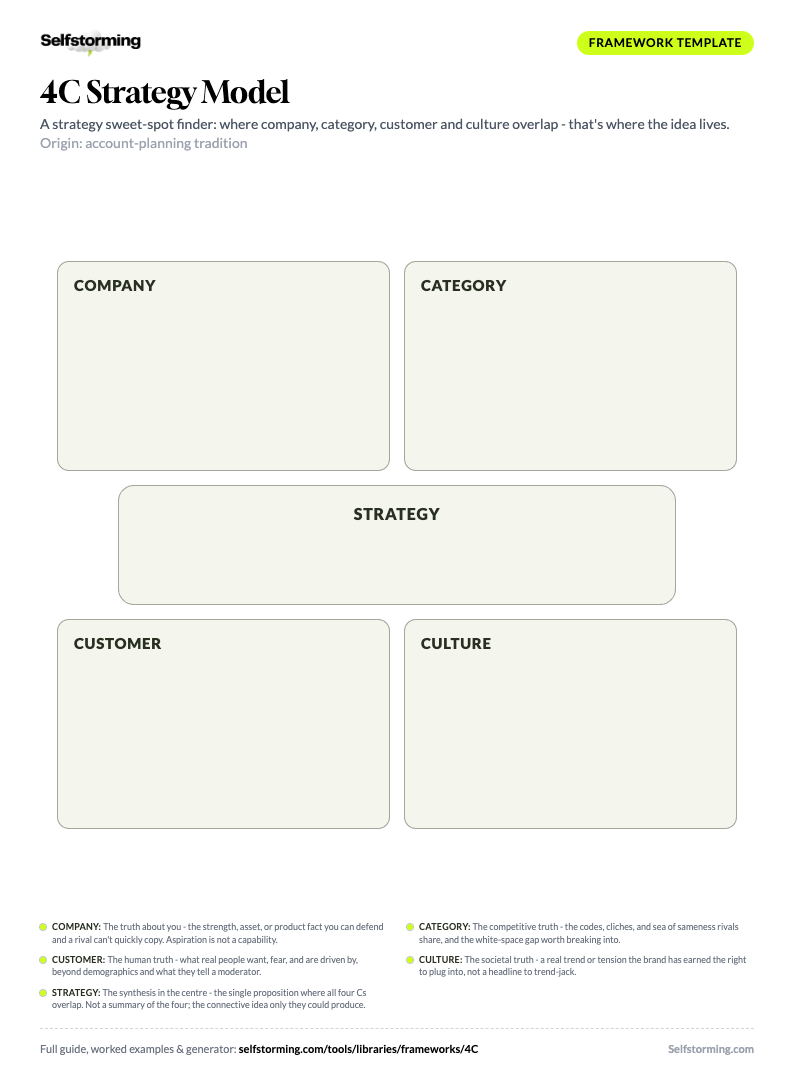
Print it. Fill it in.
The 4C Strategy Model as a printable A4 worksheet - write straight into the framework, on paper or in any PDF app.
Download the PDF templateKnowledge Worth Paying For
A working library of brand strategy frameworks - with worked examples on real brands, sources, and decision criteria. Not vibes.
One good deck covers the subscription. The rest is profit.
The 4C strategy model is the account planner's tool for finding a strategy by overlap rather than by guess. Map four lenses - Company (what you're great at), Category (how you stand out), Customer (what people want, fear, and are driven by), and Culture (the trends and tensions in society) - then synthesise the Strategy that sits where all four meet. Popularised in account-planning craft by strategists like Julian Cole and Mark Pollard. The win isn't four tidy summaries; it's the single insight where the four collide.
Cheetos
Snack food (USA, FMCG) - the heritage 4C exampleThe textbook sweet-spot story. Cheetos didn't win on 'tasty corn snack' - it found the one idea where all four Cs collide: an indulgent product, a category drowning in wholesome codes, a customer craving guilt-free mischief, and a cultural backlash against joyless self-optimisation.
Liquid Death
Canned water (USA, beverages / DTC)A near-perfect 4C overlap that looks insane until you see the lenses line up. The strategy - 'murder your thirst' - is only obvious once Company, Category, Customer, and Culture are laid over each other.

Dove
Personal care / beauty (global, FMCG)Shows the model when the Customer truth and the Culture tension carry the weight, and the Company has earned the right to speak to it. The strategy - real beauty - only holds because all four Cs agree, not because it's a nice sentiment bolted on at the end.

Cheetos, Liquid Death, Dove - filled in, line by line. Unlock to read them.
Cheetos (Snack food (USA, FMCG) - the heritage 4C example)
The textbook sweet-spot story. Cheetos didn't win on 'tasty corn snack' - it found the one idea where all four Cs collide: an indulgent product, a category drowning in wholesome codes, a customer craving guilt-free mischief, and a cultural backlash against joyless self-optimisation.
Company: A loud, messy, unapologetically artificial cheese snack with the most recognisable orange-dust fingerprint in the aisle - the mess is the product truth, not a flaw.
Category: A snack category obsessed with feel-good fuel, clean ingredients, and sunlit-kitchen wholesomeness, leaving the gleefully indulgent corner wide open.
Customer: People who don't want permission to indulge so much as freedom from the guilt - the small rebellious joy of not being a wellness project for ten minutes.
Culture: A quiet exhaustion with optimised, joyless self-improvement and a craving to just enjoy something dumb without a side of shame.
Strategy: Own indulgent mischief: the brand that hands grown-ups permission to be gleefully, messily uncool. Lives where the product's mess, the category gap, the guilt-free craving, and the anti-optimisation tension all meet.
Liquid Death (Canned water (USA, beverages / DTC))
A near-perfect 4C overlap that looks insane until you see the lenses line up. The strategy - 'murder your thirst' - is only obvious once Company, Category, Customer, and Culture are laid over each other.
Company: Plain water in a tallboy can with heavy-metal branding - the format and attitude are the asset, since the liquid itself is undifferentiated.
Category: A water and healthy-drink category that all looks the same: blue labels, mountains, dewdrops, serene wellness energy - a sea of sameness begging to be broken.
Customer: People (especially the sober-curious and the festival crowd) who want something to hold that doesn't make them look like they're trying to be healthy or boring.
Culture: A rising anti-plastic, anti-corporate-wellness mood plus the cultural pull of irony, edginess, and not taking yourself seriously.
Strategy: Make water the most entertaining brand in the room: hydration as a punk-rock joke. Sits exactly where the can format, the bland category, the want-to-look-cool customer, and the irony-loving culture overlap.
Dove (Personal care / beauty (global, FMCG))
Shows the model when the Customer truth and the Culture tension carry the weight, and the Company has earned the right to speak to it. The strategy - real beauty - only holds because all four Cs agree, not because it's a nice sentiment bolted on at the end.
Company: A mass-market soap-and-skincare brand with the scale, trust, and decade-plus 'Real Beauty' track record to make a stand on self-image credible rather than opportunistic.
Category: A beauty category built on aspiration and flawless retouched faces, selling the gap between how women look and how they 'should' look - a near-universal code begging to be broken.
Customer: Women who are quietly, habitually their own harshest critic - far more critical of their own faces than anyone else is, and exhausted by it.
Culture: A growing backlash against unrealistic, airbrushed beauty standards and a wider conversation about self-esteem, authenticity, and what advertising does to how women see themselves.
Strategy: Champion real beauty: the brand that's on women's side against the impossible standard, not selling it. Lives where the brand's earned credibility, the category's aspiration codes, the customer's self-criticism, and the cultural anti-airbrush mood all meet.
1. Company
What are we genuinely great at - the asset, story, or capability nobody can copy by Friday?
The first lens: the truth about you. Your real strengths, your history, the product fact you can actually back up, the thing you can deliver that rivals can't. This is the reality check that stops the strategy from promising something the business can't ship. Be honest - aspiration is not a capability.
Good answer: Company: we're the only player who roasts in small batches the same day, so 'fresher than anything on the shelf' is a fact we can defend, not a slogan we're hoping is true.
Wrong answer: Company: we're passionate, innovative, and customer-obsessed. That's a values poster, not a strength. None of it is something a competitor couldn't claim with a straight face by lunchtime.
2. Category
How does the category really behave - what does everyone say, do, and look like, and where's the gap to stand out?
The second lens: the competitive truth. The codes, cliches, and conventions of the category - how rivals talk, what the sea of sameness looks like, what everyone is fighting over. You map it not to copy it but to find the white space, the convention worth breaking, the place to zag.
Good answer: Category: every snack brand sells 'feel-good fuel' with sunlit kitchens and clean ingredients - so the gap is the un-wholesome, gleefully indulgent corner nobody wants to own.
Wrong answer: Category: a list of competitors and their market share. That's a spreadsheet. It tells you who's in the room, not what they all sound like or where the unguarded gap actually is.
3. Customer
What do real people actually want, fear, and get driven by - beyond what they tell a research moderator?
The third lens: the human truth. Not demographics, but desires, anxieties, tensions, and the gap between what people say and what they do. The job they're hiring the category to do, the social fear behind the purchase, the small irrational driver that actually moves them. This is where the emotional fuel comes from.
Good answer: Customer: people don't want permission to indulge, they want freedom from the guilt - the small rebellious joy of not being a wellness project for ten minutes.
Wrong answer: Customer: millennials aged 25-34, urban, mid-income, value convenience. That's a media-buying segment, not a person. There's no want, no fear, no driver - nothing a strategy could grab onto.
4. Culture
What trends and tensions in society right now does this brand have a real right to plug into?
The fourth lens: the societal truth. The bigger movements, shifts, and tensions in the world the brand can credibly attach to - not chase. Done well, culture is where a brand finds fresh relevance and a reason to matter now. Done badly, it's trend-jacking. The right to play has to be earned by the other three Cs.
Good answer: Culture: a growing backlash against optimised, joyless self-improvement - people quietly exhausted by being a better version of themselves and craving permission to just enjoy something dumb.
Wrong answer: Culture: AI is big right now, so we'll mention AI. That's surfing a headline, not a tension. There's no link to the customer's life or the company's strength, so it's decoration, not insight.
5. Strategy
What is the single idea that sits where all four Cs overlap - true to the company, sharp in the category, alive for the customer, and connected to culture?
The centre, and the only output that matters. The strategy is the synthesis - the one proposition that all four lenses agree on at once. It's not a summary of the four; it's the connective insight that could only exist where they intersect. If three Cs support it and one shrugs, you don't have it yet.
Good answer: Strategy: own indulgent mischief - the brand that gives grown-ups permission to be gleefully, messily uncool. It's true to the product, breaks the category's wholesome codes, taps the customer's craving for guilt-free fun, and rides the anti-optimisation cultural tension.
Wrong answer: Strategy: be the best-tasting, most innovative snack that customers love. That's a wish, not a sweet spot. It ignores the category gap, names no cultural tension, and could be said by any brand in the aisle.
Start from a draft, not four blank circles: You don't have to fill the model cold. Right here on Selfstorming you can generate a first-draft 4C in minutes, then pressure-test each lens against real evidence using the steps below. Drafting-then-sharpening beats staring at an empty diagram.
Write Company as a defensible fact, not a feeling: Open the first lens with the one strength you can prove and a rival can't quickly copy. If it reads like a values statement (passionate, innovative), cut it. Name the asset, the product truth, or the capability you'd bet money on.
Map the Category's codes, then hunt the gap: For the second lens, write how everyone in the category actually talks and looks - the cliches, the sea of sameness. Then circle the convention worth breaking. The value is the white space, not the competitor list.
Dig the Customer down to a fear or driver: In the third lens, push past demographics to the want, the anxiety, the irrational driver behind the purchase. Ask what they'd never admit to a moderator. If there's no tension, dig again - the emotional fuel lives in the tension.
Choose a Culture tension you've earned: For the fourth lens, name a real societal trend or tension, not a headline. Then ask the honest question: does the brand have a right to plug into this, given the other three Cs? If not, find one it has earned.
Find the overlap, don't average the four: The strategy is not a tidy summary of all four Cs. Lay the lenses over each other and look for the single place they collide. If only three support an idea and one shrugs, keep hunting - the sweet spot needs all four.
Say the strategy in one sentence, out loud: Force the centre into a single proposition you can speak without notes. If you need a paragraph and three caveats, you haven't found it yet. The sentence is the test that the four Cs actually connected.
Pressure-test by removal: Take your centre idea and ask, for each C in turn, would this collapse if that lens weren't true? If you can delete a C and the idea survives unchanged, that C wasn't load-bearing - which means it isn't really a 4C sweet spot.
Best for: Finding the strategic sweet spot at the start of a brief - brand strategy, campaign platforms, repositioning, and any time a team has lots of research but no centre to it. / Tactical execution, media optimisation, or quick decisions. The 4C finds the strategy, it doesn't write the ad or buy the placement.
Output: A single strategic proposition that sits in the overlap of four lenses, plus a one-page map of Company, Category, Customer, and Culture that justifies it. / A creative brief, a media plan, or a positioning statement. Those are downstream deliverables the 4C feeds, not what it produces.
Time to complete: A research phase plus a synthesis workshop - days to a couple of weeks if you need to gather real customer and cultural input, faster if you already have it. / Instant tactical calls or live optimisation. The 4C is a thinking step, not a real-time dial.
vs Get Who To By: The 4C is upstream - it finds the strategy by mapping four truths and locating their overlap before any campaign exists. / Get Who To By is the one-line campaign brief that turns that strategy into a single behaviour change. Run 4C to find the idea, Get Who To By to brief the work.
vs SWOT: The 4C is built to produce a strategy - the centre is a synthesised proposition, and Culture is a first-class lens. / SWOT is an inward audit of Strengths, Weaknesses, Opportunities, Threats that lists factors but rarely forces a single strategic conclusion or looks at culture at all.
vs Brand Onion: The 4C is an outward-looking diagnosis that finds where the brand should play by reading company, category, customer, and culture together. / The Brand Onion is an inward articulation of an already-decided brand - essence, values, personality. Use the 4C to find the strategy, the Brand Onion to express the brand it points to.
The 4C strategy model grew out of account-planning craft rather than a single academic paper. It belongs to the planning tradition of finding strategy at the intersection of four truths - the Company, the Category, the Customer, and the Culture - and synthesising the strategy where they overlap. Strategist Julian Cole has done the most to codify and teach it, framing the 4Cs as the opening research move of any brand strategy: company research, category research, consumer research, and cultural research, woven together into a window of opportunity. Strategist Mark Pollard teaches a close cousin - the four truths of company, category, consumer, and culture, with the thread between them as the strategy. The same intersection logic underpins much of modern brand thinking, from BBH's "when the world zigs, zag" instinct for the category gap to Havas's Meaningful Brands work on cultural relevance. A separate, unrelated marketing 4Cs by Robert Lauterborn (Customer, Cost, Convenience, Communication) shares the acronym and is a frequent source of confusion.
The honest critique of the 4C model is that the four circles are easy and the overlap is hard, so most 4Cs cheat. Teams produce four diligent piles of research and then drop a strategy in the middle that doesn't actually sit in the intersection of anything - the diagram flatters the work without doing it. The Cs also blur: Category and Culture, or Customer and Culture, overlap enough that a weak strategist can shuffle the same insight between boxes and look rigorous while saying nothing. Culture is the lens most often faked, reduced to a trend-jacked headline the brand has no right to touch. And because the model is a diagnosis, it can leave a room feeling finished when it has only found a sweet spot, not a single line of execution. The acronym clash with Lauterborn's marketing 4Cs adds avoidable confusion. The fix in every case is the same discipline: refuse to call it a strategy until you can point at the genuine overlap of all four lenses and say it in one sentence - and stress-test by removing each C in turn to check it was load-bearing.
What is the 4C model?
The 4C strategy model is an account-planning tool for finding a brand strategy at the intersection of four lenses: Company (what you're genuinely great at), Category (how you stand out from the pack), Customer (what real people want, fear, and are driven by), and Culture (the trends and tensions moving through society). The strategy isn't a fifth thing you add - it's the synthesis in the centre, the single idea where all four Cs overlap at once. Note this is the strategy 4Cs, not Lauterborn's marketing 4Cs (Customer, Cost, Convenience, Communication).
Who created the 4C model?
The 4C strategy model comes out of account-planning craft rather than one named inventor. It's been codified and taught most prominently by strategists like Julian Cole (Strategy Finishing School), who frames the 4Cs as the opening research move - company, category, consumer, and culture - and Mark Pollard, who teaches a close 'four truths' version. The intersection-of-truths logic is shared across modern planning. It should not be confused with the marketing 4Cs introduced by Robert Lauterborn in 1990, which is a different framework that happens to share the acronym.
How is the 4C model different from the marketing 4Cs (Lauterborn)?
They share an acronym and nothing else. The strategy 4Cs - Company, Category, Customer, Culture - is an account-planning tool for finding a strategy at the overlap of four truths. Lauterborn's marketing 4Cs - Customer, Cost, Convenience, Communication - is a customer-centric reframe of the 4Ps marketing mix, used to plan price, place, and promotion from the buyer's side. One finds the strategic idea; the other organises the marketing mix. When someone says '4Cs', it's worth asking which they mean.
Why is Culture one of the four Cs?
Because relevance is rented, not owned. Company, Category, and Customer can all be true and still leave a brand feeling tired if it isn't connected to anything happening in the world. Culture is the lens that asks what trends and tensions in society the brand has a real right to plug into - and it's where a stale brand most often finds a fresh reason to matter. It's also the C teams most often skip or fake, which is exactly why building it in as a first-class lens is part of the model's value.
What is the 'strategy sweet spot' in the 4C model?
The sweet spot is the single place where Company, Category, Customer, and Culture all overlap - the one idea that's true to your strength, sharp against the category, alive for the customer, and connected to culture at the same time. It's the whole output of the model. A good test: if you can delete any one C and the idea survives unchanged, you haven't found the sweet spot, because that C wasn't actually holding it up. Four piles of notes is research; the overlap is strategy.
Can you give a 4C model example?
Cheetos is the classic. Company: a loud, messy, unapologetically artificial snack with an iconic orange-dust fingerprint. Category: a snack aisle drowning in wholesome, clean-eating codes. Customer: people who want freedom from indulgence guilt, not permission for it. Culture: a quiet backlash against joyless self-optimisation. The overlap - the strategy - is owning indulgent mischief: the brand that gives grown-ups permission to be gleefully, messily uncool. No single C gets you there; the centre does.
Does the 4C model work for B2B and SaaS?
Yes, though the Culture lens looks different. In B2B and SaaS, Customer becomes the buyer's professional fears and drivers (looking foolish to a boss, career risk, integration anxiety), and Culture becomes the shifts moving the industry - new ways of working, regulation, the tension a category is wrestling with. The discipline is identical: find the strategy where your real capability, the category's conventions, the buyer's truth, and an industry tension all overlap, rather than leading with a feature list.
What are the limitations of the 4C model?
It's easy to fake - four tidy research summaries with a 'strategy' bolted into the middle that doesn't sit in any real overlap. The Cs blur, so weak teams shuffle one insight between boxes and look rigorous. Culture gets trend-jacked. And it's a diagnosis, not an execution - it finds the sweet spot but won't write the brief or the ad. Treat it as the front-of-process tool, pair it with Get Who To By to brief the work, and stress-test the centre by removing each C to confirm it was load-bearing.
A strategy sweet-spot finder: where company, category, customer and culture overlap - that's where the idea lives.
The 4C model is the fix. It says the strategy isn't a fifth thing you bolt on at the end. It's the overlap. You map four lenses - Company (what you're genuinely great at), Category (how you actually stand out), Customer (what real people want, fear, and are driven by), and Culture (the trends and tensions moving underneath everyone) - and then you hunt for the one spot where all four agree. That spot in the centre is your strategy.
It's the workhorse of account planning for a reason. It's how planners at the good shops stop themselves from falling in love with a clever cultural insight that the company can't deliver, or a brilliant product truth nobody in the category cares about. The discipline isn't the four circles. Anyone can fill in four circles. The discipline is refusing to call it a strategy until all four are pulling in the same direction.
The classic worked example is Cheetos - a brand that found its strategy not in "tasty corn snack" but in the messy, joyful, finger-staining chaos the four Cs pointed at together. This page walks each C, the question that cracks it open, and how to tell a real sweet spot from four notes shoved into a Venn diagram.
Generate this for your brief - or grab the template
Generate a ready 4C Strategy Model from your brief straight into editable slides, or start from the free template.