Get Who To By
The One-Line Creative Brief That Actually Moves People
Most creative briefs are three pages long, which is two-and-a-half pages longer than anyone reads. Get Who To By is the antidote - a single line that holds the whole brief together: GET this person TO do this thing BY giving them this reason. The WHO slots in the middle as the human truth that makes the rest believable.
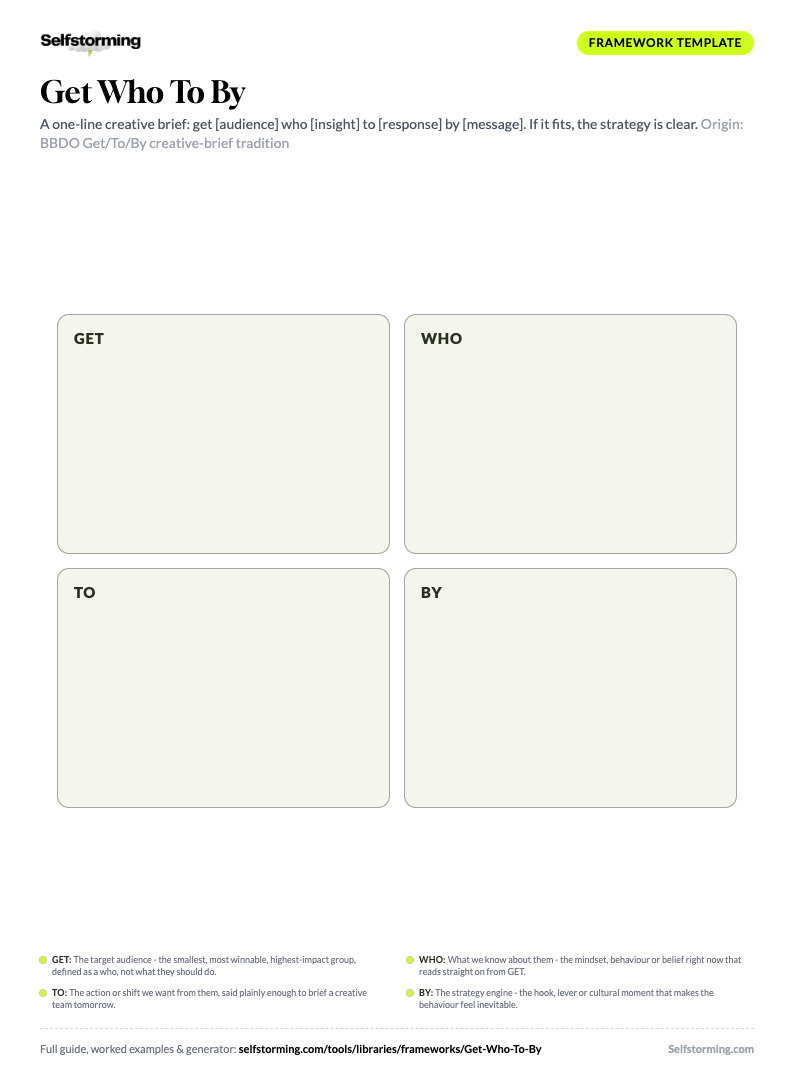
Print it. Fill it in.
The Get Who To By as a printable A4 worksheet - write straight into the framework, on paper or in any PDF app.
Download the PDF templateGET WHO TO BY
A one-line creative brief: get [audience] who [insight] to [response] by [message]. If it fits, the strategy is clear.
It looks almost insultingly simple. That's the point. The discipline isn't in the four words - it's in refusing to fudge any of them. A vague GET, a behaviour nobody can picture, a BY that's really just a brand promise in a trench coat - those are where briefs quietly die. The format won't let you hide. If you can't fill one line without flinching, the strategy underneath isn't finished yet.
This page walks through each slot, the question that unlocks it, and how to tell a sharp Get Who To By from one that's just four nice-sounding fragments stapled together.
What is Get Who To By?
A four-part one-line brief: GET (the business objective - what change you want), WHO (the specific person you're moving), TO (the single observable behaviour you want), BY (the insight or lever that makes them do it). Born inside BBDO New York around 2004-2005 to replace bloated briefs with one tight, behaviour-first sentence. Use it for campaign briefing and behaviour change, not for deep brand architecture.
Worked Examples
Three real brands. Different categories, different sizes. Same framework, filled in.
Reebok
Sportswear and footwear (global, retail)A clean line where each slot hands off to the next: the GET names a winnable audience, the WHO is a behaviour you could film, the TO is one action, and the BY weaponises the comfort of the sofa instead of listing shoe features.
Watch the BY do its work: the sofa springs to life and tries to swallow the guy whole, turning 'go for a run' into 'escape the monster' - the lever is the couch, not the trainers.
Volvo
Car manufacturer (Sweden, automotive)Volvo stretches safety past the people inside the car without a single product boast: the GET is a specific rider, the WHO is their blind spot, the TO is one act, and the BY turns invisibility itself into the enemy.
The BY is the whole demo: the paint is invisible until headlights hit it, then cyclists glow in the dark - safety reframed as a behaviour you can do tonight, not a feature you buy in a showroom.
headspace
National Youth Mental Health Foundation (Australia, nonprofit)A brief aimed at the half-second before someone hits send: the GET is a specific teen, the WHO is the impulsive moment, the TO is one act, and the BY intervenes at the exact point of friction.
The BY is the mechanism on screen: the abusive comment gets underlined mid-type like a spelling mistake, hijacking the spell-check reflex to buy the one second a kid needs to rethink.
The 4 Layers, One By One
Each one answers a specific question - here is how to fill it in, and how to tell a sharp answer from a lazy one.
1. Get
Who exactly are we trying to reach?
The target audience. The smallest, most winnable, highest-impact group you can name - defined as a who, never as what they should do. 'Young people' is not an answer; the tighter and more specific, the better. If the group still feels broad, you have not finished.
GET lapsed weekday gym members who joined in January and ghosted by March. Small, specific, findable.
GET everyone who might buy in the category. Too broad to brief against - it quietly tells the creative team to please no one in particular.
2. Who
What do we actually know about them?
The insight - their mindset, behaviour or belief right now. Not a demographic but an observable pattern you could catch them in. What do they already do, try, or quietly resent? This line should read straight on from GET, like the second half of one sentence about the same person.
WHO secretly eat half the kids' snacks themselves and feel a bit guilty about it. You can picture them mid-crime.
WHO are millennials aged 25-40, ABC1. A targeting spec, not a human truth - it hands the writer nothing to push against.
3. To
What action or shift do we want?
The behaviour or change of mind you are after, said plainly. This is the message, not brand poetry - people should instantly get what you want them to do and why now. One clear direction beats a manifesto of three.
TO book one free trial class this week. One action, time-bound, impossible to misread.
TO consider us, engage, and feel more positive about the category. Three vague wishes in a trenchcoat. A brief that asks for everything gets nothing.
4. By
How will we actually make it happen?
The strategy engine - the hook, lever, tension or cultural moment that makes the behaviour feel inevitable. Hijack a moment, remove a friction, weaponise something competitors ignore. If you cannot say it in one sentence, it is not sharp enough.
BY removing the price, the booking faff and the fear of looking unfit, all in the first visit. A specific lever aimed at a specific hesitation.
BY communicating our superior quality and trusted heritage. Not a lever, a brochure - it would fit any brand in the category unchanged.
Origin & Lineage
Get Who To By comes out of the account-planning and creative-brief tradition in advertising, where strategists have long fought to compress bloated briefs into a single usable line. The specific GET / WHO / TO / BY form is widely credited to BBDO New York around 2004-2005, when Martyn Straw - hired by then-CEO Andrew Robertson as the office's first head of planning - built a one-page, behaviour-first brief to replace the multi-page documents creative teams routinely ignored. The format was later popularised across the planning community by practitioners like Julian Cole (Strategy Finishing School, Planning Dirty) and shows up in agency toolkits worldwide. It belongs to the same lineage as the single-minded proposition and the one-line brief - tools whose whole value is the discipline of refusing to say more than one sentence's worth.
Critics
The fair critique of Get Who To By is that its simplicity is a trap as much as a feature. Because the format is so easy to fill, teams reach for it before they've done the thinking - and end up with four confident-sounding fragments built on assumptions nobody checked. The BY slot is where this shows up most: a weak insight gets dressed as a lever, the line reads beautifully, and the campaign moves nobody. Critics also note it briefs a campaign, not a brand - lean on it for strategy it was never meant to carry (identity, positioning, competitive choice) and it quietly fails. The honest use is to treat it as the compression step at the end of real research, not a substitute for the research itself.
How To Build It
A workshop flow that produces a usable v1 in a day - with the right people in the room, or just you and a Selfstorming strategy session right here.
Start from a draft, not a blank page
You don't have to crack the whole line cold in a meeting room. Right here on Selfstorming you can generate a first-draft Get Who To By in minutes, then pressure-test it against the real audience and business reality using the steps below. Drafting-then-sharpening is usually faster than staring at four empty boxes.
Pin the GET to a number first
Before anything else, write the business objective as something you could measure in 90 days. If the GET is "awareness" or "love," stop and ask what behaviour that awareness is supposed to cause - then make that the GET.
Find the WHO by watching, not segmenting
Describe the audience by something they actually do or feel, not their age. Good test: could you spot this person in a coffee shop from their behaviour alone? If not, the WHO is still a spreadsheet row.
Force the TO down to one verb
List every behaviour you secretly want, then cross out all but the one that matters most. One observable action. If you can't picture someone doing it, it isn't sharp enough to brief from.
Make the BY name a mechanism
Ask "what specifically makes them do the TO?" The answer should be a lever - a removed friction, a hijacked moment, a reframed tension - not a list of brand virtues. If your BY would survive being pasted onto a competitor's brief, rewrite it.
Compress the whole thing into one readable sentence
Stitch the four slots into a line that reads aloud naturally: "GET [who] TO [behaviour] BY [lever]." If it needs a comma splice and three subclauses, the thinking isn't done.
Use the line as the idea filter
Take every creative concept and check it against the line. Does it move this WHO TO this behaviour BY this lever? Ideas that drift off the line are interesting, but they're answering a different brief.
Keep it on one page in every brief that follows
The finished line goes at the top of the creative brief, the media brief, and the deck. When a debate starts, you point at the line. It's the cheapest alignment tool in the building.
How This Framework Compares
| Aspect | When It Works | When It Doesn't |
|---|---|---|
| Best for | Campaign briefs, behaviour-change tasks, and getting a team aligned on one audience, one action, and one reason fast. Distilling a finished strategy into a line creatives can actually use. | Brand architecture, long-term identity, or competitive positioning. Get Who To By briefs a campaign, not a whole brand. |
| Output | A single readable sentence: GET [objective] WHO [person] TO [behaviour] BY [lever]. One line that fits at the top of every brief and deck. | A multi-page strategy document, a positioning map, or a brand book. Those are different deliverables for different jobs. |
| Time to complete | An afternoon to draft, a few days to pressure-test the WHO and BY against real behaviour. Fast because the format forces decisions. | Multi-week research or strategy projects. The line is the compression step at the end, not the research project itself. |
| vs 4 Points Strategy | Get Who To By is action-first and campaign-scale - one behaviour, one line. Better when you already know the strategy and need to brief the work. | 4 Points Strategy frames the broader strategic terrain (objective, audience, insight, idea) before any single campaign. Use it upstream, then compress into a Get Who To By line. |
| vs Positioning Statement | Get Who To By is about moving one behaviour now. It changes per campaign and lives in the brief. | A Positioning Statement defines the brand's durable place in the market - it's stable across campaigns. Use positioning to set the frame, Get Who To By to act inside it. |
| vs Insight & Tension Statement | Get Who To By is the whole brief in a line - audience, behaviour, and lever together. The BY slot is where the insight gets put to work. | An Insight & Tension Statement isolates and sharpens the single human truth on its own. Use it to perfect the insight, then feed that insight into the BY of your line. |
Frequently Asked Questions
What is the Get Who To By framework?
Get Who To By is a one-line creative brief with four slots: GET (the business objective - the behaviour or outcome change you need), WHO (the specific person you're moving, defined by how they behave, not their age), TO (the single observable behaviour you want them to do), and BY (the insight or lever that makes them do it). The four slots read as one sentence, and the whole point is that the format won't let you fudge any of them.
Who created Get Who To By?
The GET / WHO / TO / BY form is widely credited to BBDO New York around 2004-2005, where Martyn Straw - brought in by CEO Andrew Robertson as the office's first head of planning - designed a tight, behaviour-first, one-page brief to replace the bloated documents creative teams kept ignoring. It sits in the older account-planning tradition of the single-minded proposition, and was later popularised across the planning community by practitioners like Julian Cole.
When should I use Get Who To By instead of the 4C model?
Use Get Who To By when you need to brief a specific campaign and a single behaviour change fast - it's action-first and lives in the creative brief. Use the 4C model when you're doing upstream strategic analysis (customer, cost, convenience, communication) to understand the market before any campaign. They're sequential, not rivals: 4C helps you understand the situation, Get Who To By turns that understanding into one line a creative team can run with.
What makes a strong WHO in Get Who To By?
A strong WHO is a behaviour or tension, not a demographic. "35-54, urban, ABC1" is a media target; "people who say they want to switch but keep putting it off" is a WHO. The test: could you spot this person in a coffee shop from how they behave? If the WHO only exists in a spreadsheet, it'll give the creative team nothing to grab onto.
How do I know if my BY is sharp enough?
Ask one question: would your BY survive being pasted onto a competitor's brief unchanged? If "by communicating our quality and heritage" works for them too, it's a brochure line, not a lever. A sharp BY names a specific mechanism - a removed friction, a hijacked moment, a reframed tension - that makes the behaviour feel inevitable for this exact WHO.
Does Get Who To By work for B2B?
Yes, and it's often more useful in B2B because it strips out the corporate fog. The GET is still a real business outcome, the WHO is the human decision-maker (not "the enterprise"), the TO is a concrete action like booking a demo or forwarding a case study, and the BY is the professional tension or inertia your product removes. B2B briefs drift into jargon; the one-line discipline pulls them back to a person doing a thing.
Is Get Who To By a tagline?
No. The line is internal scaffolding for the brief - it tells the team what to make and who for. The tagline is what the audience actually sees. Teams sometimes polish the BY until it sounds like ad copy and try to put it on the poster; that's a mistake. Keep the brief line and the creative output separate, even when they feed each other.
Can Get Who To By replace a full brand strategy?
No. Get Who To By briefs a campaign, not a brand. It has no leverage on identity, positioning, or where you choose to compete. Use a Brand Onion or a Positioning Statement to set the durable frame, then use Get Who To By to act inside that frame on a specific behaviour. Asking the line to carry brand architecture is the fastest way to make it fail.
Sources & Further Reading
Generate this for your brief - or grab the template
Generate a ready Get Who To By from your brief straight into editable slides, or start from the free template.
Read our guides for your use case
- A Clear Product Launch Strategy Using the Get Who To By Framework
- Rebuild Your Brand Positioning using the Get Who To By Framework
- Create a Sharper Campaign Brief in Minutes with Get Who To By
- Get Who To By vs 4C - Which Framework Fits Your Brief Best
- Get Who To By vs 4 Points Strategy: The Framework Showdown