5 Whys
Find the Root Cause by Asking Why Five Times
The 5 Whys is the cheapest diagnostic tool in business and the one most likely to embarrass everyone in the room. You take a problem, ask why it happened, then ask why again of that answer, and keep going - usually about five times - until you hit something you can actually fix instead of a symptom you keep re-treating. It came out of Toyota, seeded by inventor Sakichi Toyoda and formalised by the architect of the Toyota Production System, Taiichi Ohno, who believed the obvious cause of a problem is almost never the real one. The trap is stopping too early, at the first answer that lets everyone off the hook. Done properly, the fifth why is where the uncomfortable truth lives - the belief, behaviour, or broken assumption that has been quietly generating the symptom all along.
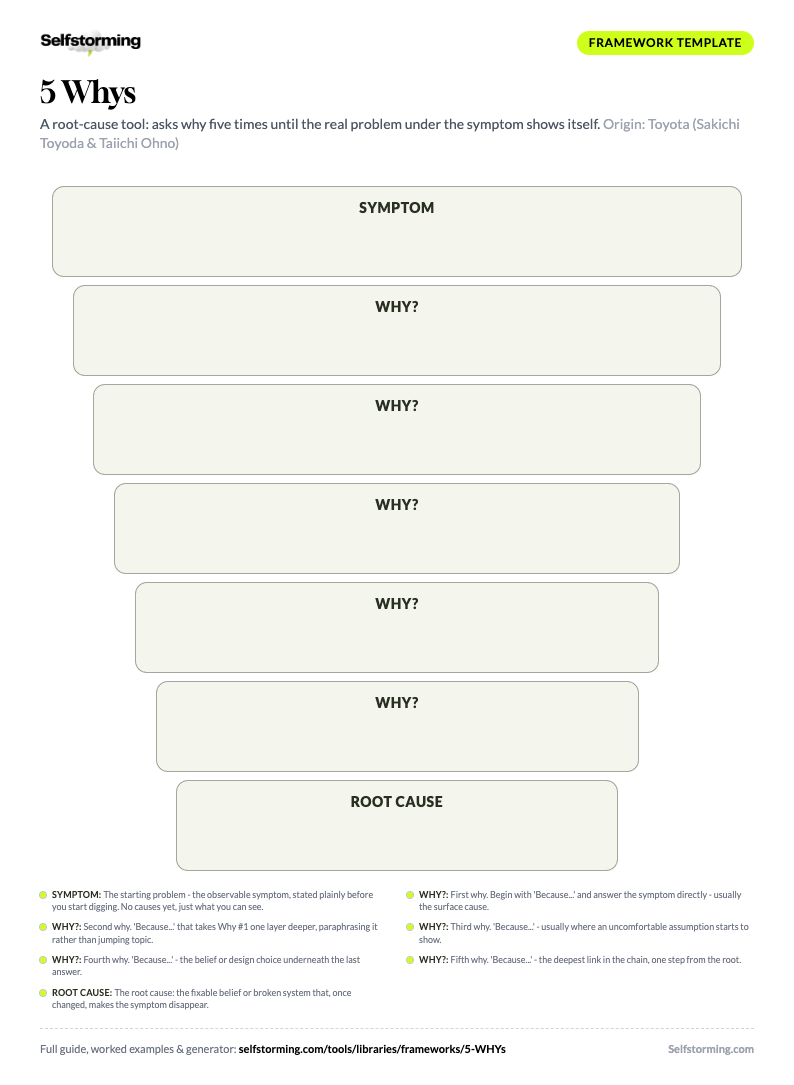
Print it. Fill it in.
The 5 Whys as a printable A4 worksheet - write straight into the framework, on paper or in any PDF app.
Download the PDF templateKnowledge Worth Paying For
A working library of brand strategy frameworks - with worked examples on real brands, sources, and decision criteria. Not vibes.
One good deck covers the subscription. The rest is profit.
Start with a clear symptom, then ask why five times in a row, each answer feeding the next question. Why #1 names the immediate cause, Why #2 through #4 peel back the layers, and the Root Cause at the bottom is the underlying belief or broken system you can finally act on. The rule that makes it work - keep going until you reach something you can change, not something you can blame.
Brightling
B2B project-management SaaS (founded 2021)A classic case of a metric problem hiding a belief problem. The symptom looked like a conversion issue, but five whys traced it to an onboarding assumption about what makes a product impressive - something the team could actually change.
Verdant Table
DTC meal-kit subscription (founded 2020)Shows the 5 Whys working on a churn symptom that everyone wanted to blame on price. The chain refused the easy answer and surfaced a perception problem the brand could fix with communication, not discounting.
Halden Tools
Industrial hand-tool manufacturer (founded 1998)A more operational example, closer to the framework's Toyota roots. A returns problem looks like a quality defect but resolves to a process gap, demonstrating how the chain points at a system rather than a culprit.
Brightling, Verdant Table, Halden Tools - filled in, line by line. Unlock to read them.
Brightling (B2B project-management SaaS (founded 2021))
A classic case of a metric problem hiding a belief problem. The symptom looked like a conversion issue, but five whys traced it to an onboarding assumption about what makes a product impressive - something the team could actually change.
Symptom: Trial-to-paid conversion has dropped 30 percent this quarter.
Why?: Because most new trials never reach a second session.
Why?: Because the first session ends on an empty dashboard with nothing to react to.
Why?: Because onboarding asks people to import their own data before showing any value.
Why?: Because the team assumes a full dataset is what makes the product impressive on day one.
Why?: Because the product is built to prove its value through data the user supplies, not value it delivers first.
Root Cause: Onboarding leads with work, not payoff - the fix is a sample project that shows the result before any import.
Verdant Table (DTC meal-kit subscription (founded 2020))
Shows the 5 Whys working on a churn symptom that everyone wanted to blame on price. The chain refused the easy answer and surfaced a perception problem the brand could fix with communication, not discounting.
Symptom: Month-two subscription churn has spiked sharply.
Why?: Because subscribers say the kits feel too expensive.
Why?: Because they compare the per-meal price to a supermarket basket, not a restaurant.
Why?: Because the brand never frames the kit as a night out replaced, only as groceries delivered.
Why?: Because marketing assumes convenience is the main reason people subscribe.
Why?: Because the brand has mistaken its category as groceries rather than affordable restaurant nights.
Root Cause: The real value is a low-effort restaurant night at home - the fix is repositioning and storytelling, not a price cut.
Halden Tools (Industrial hand-tool manufacturer (founded 1998))
A more operational example, closer to the framework's Toyota roots. A returns problem looks like a quality defect but resolves to a process gap, demonstrating how the chain points at a system rather than a culprit.
Symptom: Warranty returns on the flagship wrench have risen sharply.
Why?: Because the handle grip keeps detaching in use.
Why?: Because the adhesive bond fails under repeated torque.
Why?: Because the curing time on the line was shortened to hit a shipping deadline.
Why?: Because nothing on the line flags an out-of-spec cure before packing.
Why?: Because quality depends on someone noticing a problem, not a system catching it.
Root Cause: There is no in-line gate that stops product when a step falls out of spec - the fix is an automated cure-time check, not a new adhesive.
1. Symptom
What's the symptom we can actually observe - before we guess at causes?
The starting point. State the problem as something you can see or measure, with no theory attached. A clean symptom keeps the whole chain honest; a loaded one poisons every why after it.
Good answer: SYMPTOM: trial-to-paid conversion dropped 30% this quarter. Observable, specific, blame-free.
Wrong answer: SYMPTOM: the team isn't trying hard enough. That's a verdict, not a symptom - the analysis is over before it started.
2. Why?
Why is that happening - the first, most direct cause?
The first 'Because...'. Answer the symptom head-on with the most immediate cause. Resist leaping to the juicy root - the discipline of the chain is what surfaces it later.
Good answer: Because most new trials never reach a second session. Directly answers the symptom and opens the next why.
Wrong answer: Because our pricing is wrong. Skips five steps to a convenient villain you can't yet prove.
3. Why?
And why is THAT true - one layer down?
The second 'Because...'. Paraphrase Why #1 and push deeper, staying on the same thread. Each why should restate the last so the logic can't drift.
Good answer: Because the first session ends on an empty dashboard with nothing to react to. Builds straight off the previous answer.
Wrong answer: Because users are busy. A new, untethered topic - the chain just snapped.
4. Why?
Why does that keep happening - what choice or assumption causes it?
The third 'Because...'. Usually where it gets uncomfortable - a design choice or assumption the team made, not bad luck.
Good answer: Because onboarding asks people to import their own data before showing any value.
Wrong answer: Because the market is hard. Externalising blame stalls the dig.
5. Why?
And the belief underneath that decision?
The fourth 'Because...'. Name the shared belief that made the previous choice feel reasonable - the assumption most teams skip straight past.
Good answer: Because the team assumes a full dataset is what makes the product impressive on day one.
Wrong answer: Because nobody owns onboarding. A process gap can be real, but here it dodges the belief actually driving the behaviour.
6. Why?
One more - what's the deepest cause this points to?
The fifth 'Because...'. The last link before the root - the deepest cause the chain has earned, not a slogan.
Good answer: Because the product proves its value through data the user supplies, not value it delivers first.
Wrong answer: Restating Why #4 in fancier words. If it does not go deeper, cut it.
7. Root Cause
So what's the one fixable thing that, changed, makes the symptom disappear?
The synthesis. Name the belief or broken system at the bottom of the chain and the change that dissolves the symptom. If fixing it would not move the original number, you have not reached the root.
Good answer: ROOT CAUSE: onboarding leads with work, not payoff - open with a sample project that shows the result before any import.
Wrong answer: ROOT CAUSE: do better onboarding. Vague and unfixable - a wish, not a lever.
Decide your starting point. You do not have to run the 5 Whys cold in a meeting. Right here on Selfstorming you can pull prompts and direction, or generate a first-draft 5 Whys in minutes. Treat the draft chain as a hypothesis, then verify each link against real evidence with the steps below.
Write the symptom as one specific, observable sentence. Before any why, pin down the problem in concrete terms - a number, a behaviour, a complaint - not a feeling. A vague start ("sales are down") guarantees a vague root cause. The sharper the symptom, the deeper the chain can go.
Ask the first why and answer with evidence, not opinion. Each answer should be something you could in principle verify, not a guess. If you cannot point to data, a log, or a real observation behind an answer, flag it as an assumption to check before you trust the chain.
Tie every why to the previous answer. The 5 Whys is a chain, not a brainstorm. Each new why must interrogate the exact answer above it, or you quietly start investigating a different problem and end up with a root cause that explains nothing.
Push past the first comfortable answer. Teams instinctively stop at the why that protects everyone in the room. Notice that moment and ask once more. The useful root cause almost always sits one or two whys below where the conversation wants to end.
Watch for the blame swerve. Whenever an answer names a person ("because Dana forgot"), redirect it to the system ("because nothing caught the missing step"). A root cause you can fire is not a root cause you can fix.
Stop when you reach something actionable, not at exactly five. Five is a rule of thumb. Sometimes the real root is three whys down, sometimes seven. Stop when the answer is a belief or system you can change, and you can clearly see how fixing it dissolves the symptom.
Run a second chain if the problem has more than one cause. The 5 Whys follows one line of reasoning. For messy problems, start fresh chains from the same symptom along different paths, then compare roots before you decide what to fix first.
Best for: Diagnosing a specific, recurring problem - a churn spike, a quality defect, a stubborn perception issue - to find the one fixable cause underneath the symptom. / Wide situational analysis, opportunity discovery, or any question where you need a map of the landscape rather than the root of a single problem.
Output: A short chain of cause-and-effect statements ending in one actionable root cause - a belief or system you can change to dissolve the symptom. / A multi-factor matrix, a segmentation, or a strategy - the 5 Whys diagnoses one problem, it does not plan the response.
Time to complete: Minutes to an hour for one chain with the right people in the room - or seconds for a first AI draft you then verify against evidence. / Multi-week research programmes - the 5 Whys assumes the people in the room already hold most of the knowledge needed to trace the chain.
vs SWOT: Use the 5 Whys to drill down a single problem to its root cause along one line of reasoning. / Use SWOT to scan wide across strengths, weaknesses, opportunities, and threats - it surveys the situation but never digs into why any one problem exists.
vs Jobs To Be Done: Use the 5 Whys to diagnose why something is going wrong now and find the root cause to fix. / Use Jobs To Be Done to understand what progress a customer is hiring your product to make - it is forward-looking demand discovery, not backward-looking diagnosis.
vs Insight & Tension Statement: Use the 5 Whys to find the underlying cause of a problem through a chain of evidence. / Use an Insight & Tension Statement to crystallise a human tension into a sharp, briefable line - it expresses an insight, it does not excavate a root cause.
The 5 Whys was born at Toyota. The seed came from Sakichi Toyoda, the inventor and industrialist behind the Toyoda Automatic Loom Works (and father of Toyota's founder, Kiichiro Toyoda), who built a culture of going to the source of a problem rather than patching it. It was formalised and made famous by Taiichi Ohno, the engineer who architected the Toyota Production System through the 1940s to 1970s and wrote it up in Toyota Production System: Beyond Large-Scale Production. Ohno's line - ask why five times and the real cause and its solution become clear - turned a simple habit into a cornerstone of lean manufacturing. It later jumped industries: Eric Ries carried it into startups in The Lean Startup, and marketers borrowed it to dig under brand and perception problems.
The honest criticisms of the 5 Whys are well documented. First, it tends to stop at a single root cause, when many real problems have several independent drivers - one tidy chain can create a false sense that the case is closed. Second, the result depends heavily on who is asking: different people follow different lines of reasoning and reach different roots from the same symptom, so there is no guarantee the chain found the cause rather than a cause. Third, because it follows one linear thread, it can march confidently down a single path and miss interacting factors entirely. And it is only as honest and as evidence-based as the room allows - answer with opinion instead of proof, or stop at the first flattering explanation, and you get a confident diagnosis of the wrong thing. The fair way to use it is as a fast first dig, verified with evidence and supplemented by other tools when the problem is genuinely complex.
What is the 5 Whys?
The 5 Whys is a root-cause analysis technique: you take a specific problem, ask why it happened, then ask why of that answer, and keep going - usually about five times - until you reach an underlying cause you can actually fix rather than a symptom you keep re-treating. It came out of Toyota and is a staple of lean thinking and problem-solving.
Who created the 5 Whys?
The 5 Whys originated at Toyota. The idea traces to inventor Sakichi Toyoda of the Toyoda Automatic Loom Works, and it was formalised and popularised by Taiichi Ohno, the architect of the Toyota Production System, who described it in his book Toyota Production System: Beyond Large-Scale Production.
Does it have to be exactly five whys?
No. Five is a rule of thumb, not a rule. The real instruction in the 5 Whys is to keep asking why until you reach a cause you can genuinely act on - sometimes that is three whys deep, sometimes seven. Stopping at exactly five, or padding the chain to reach it, misses the point.
How do I know when I have hit the root cause?
You have reached the root cause when the answer is a belief or a system you can change, and you can clearly see how changing it dissolves the original symptom. If the answer is a person's name or a force of nature, you are not there yet - keep digging until you find something fixable.
Can the 5 Whys be used for marketing and brand problems?
Yes. Although it started on the factory floor, the 5 Whys works just as well on soft problems - a churn spike, a perception issue, low engagement. It is one of the fastest ways to get past the obvious answer ("it's the price") and down to the real cause ("we sell convenience when our value is a restaurant night at home").
Why should answers point at systems, not people?
Because a root cause you can fire is not a root cause you can fix. If the 5 Whys ends at "because someone forgot," nothing structural changes and the problem returns. Redirect every person-shaped answer to the system that let it happen - "because nothing flagged the missing step" - so you fix the cause, not the symptom.
How is the 5 Whys different from SWOT?
The 5 Whys drills down one problem to its root along a single chain of cause and effect. SWOT scans wide across strengths, weaknesses, opportunities, and threats. SWOT maps the situation; the 5 Whys diagnoses why one specific problem inside it keeps happening. They answer different questions and work well in sequence.
A root-cause tool: asks why five times until the real problem under the symptom shows itself.
Generate this for your brief - or grab the template
Generate a ready 5 Whys from your brief straight into editable slides, or start from the free template.