Build a Creative Strategy: Create a Tension Between Product & World
What is the Create a Tension Between Product & World Strategy and when should I use it?
This strategy is about shoving your product into a room where it clearly doesn't belong and watching the sparks fly. It’s not about "synergy" or "seamless integration"—it’s about friction. You use it when your brand is boringly functional or when the category has become a sea of beige sameness. If people are ignoring you, it’s because you’re playing by the rules. This strategy breaks them by creating a visual or conceptual clash that forces a double-take. It turns your product into a disruptor of reality, making the mundane suddenly feel dangerous, funny, or just plain weird. Do it!!
How to execute this strategy effectively
You start by identifying the most sacred or predictable environment for your category, then you drop your product in like a grenade. Don't be subtle. If you're selling water, don't show a mountain; show a rager where kids are chugging tallboys that look like beer but are actually just H2O. The effectiveness comes from the cognitive dissonance—the brain tries to resolve the conflict between what it sees and what it knows. Keep the product central but the context chaotic. If the tension isn't making your legal team sweat at least a little bit, you aren't pushing the contrast hard enough. !!
Example: Liquid Death - Kids Hydrating at a Party
Liquid Death’s "Dead at 21" campaign is the gold standard here. They took the "innocent" world of children’s birthday parties and collided it with the "hardcore" aesthetic of binge drinking. You see kids crushing tallboys, acting wild, and trashing the house. The tension lies in the visual language of a frat party used to sell mountain water to minors. It’s jarring, it’s hilarious, and it makes every other bottled water brand look like a joke! OK
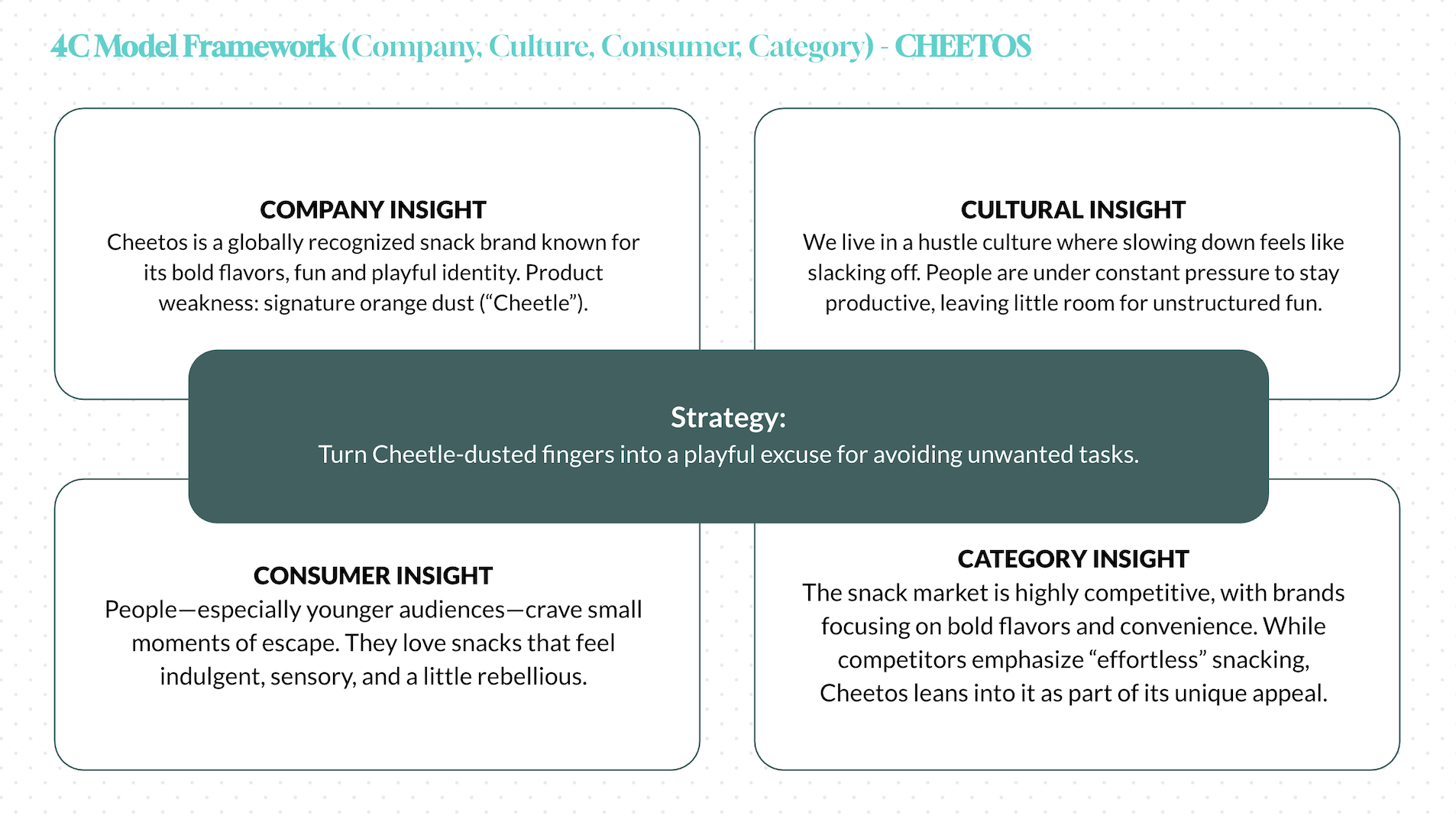
Creative Strategy Deconstructed in 4C Framework
Company INSIGHT
Liquid Death has a product that is literally just water but packaged in a tallboy can with aggressive, metal-inspired branding.
Category INSIGHT
The water category is obsessed with purity, soft blue aesthetics, and wellness tropes that feel increasingly clinical and soulless.
Strategy:
Use the visual language of extreme partying and alcohol consumption to sell the healthiest beverage on earth: water.
Customer INSIGHT
Customers want to stay hydrated but find traditional water marketing boring and lifestyle marketing often feels fake or overly polished.
Culture INSIGHT
There is a growing cultural appetite for anti-marketing and brands that do not take themselves seriously, especially among younger, cynical audiences.
Strategy:
Use the visual language of extreme partying and alcohol consumption to sell the healthiest beverage on earth: water.
Company INSIGHT
Liquid Death has a product that is literally just water but packaged in a tallboy can with aggressive, metal-inspired branding.
Category INSIGHT
The water category is obsessed with purity, soft blue aesthetics, and wellness tropes that feel increasingly clinical and soulless.
Customer INSIGHT
Customers want to stay hydrated but find traditional water marketing boring and lifestyle marketing often feels fake or overly polished.
Culture INSIGHT
There is a growing cultural appetite for anti-marketing and brands that do not take themselves seriously, especially among younger, cynical audiences.
Why is Create a Tension Between Product & World a Great Strategy?

It hijacks the brain’s pattern recognition to force engagement.
Stops the scroll with immediate visual friction
Turns boring product features into entertainment
Creates a memorable, high-contrast brand identity
Triggers emotional responses through sharp absurdity
By refusing to fit in, you become impossible to ignore. This strategy works because humans are wired to notice things that are out of place, turning your marketing into a puzzle they actually want to solve.
! When not to use the "Create a Tension Between Product & World" Strategy
Avoid this strategy if your brand is currently navigating a genuine safety crisis where unpredictable friction would look like a massive, tone-deaf legal liability instead of a clever joke.
Steps to implement: Stop Playing It Safe and Start a Fight
Identify your product's most boringly obvious setting
Look at where your product usually lives. If it’s water, it’s the gym or a hike. If it’s software, it’s a sterile office. This is your baseline for boredom. You need to know the 'right' place so you can avoid it like the plague. Your goal is to find the exact opposite of this environment to prepare for the upcoming collision.
Find a high-stakes, conflicting cultural sandbox
Pick a world with its own rigid rules, like a heavy metal concert, a high-society gala, or a kid's birthday party. The more established the 'vibe' of this world, the better. You want a setting that has a specific visual language that your product will eventually violate. Liquid Death chose the rowdy party scene because it’s the ultimate antithesis of 'pure' bottled water.
Force the product into the wrong scene
Place your product in that conflicting world without changing the product’s identity. The product must remain itself while the world reacts to it—or better yet, the world treats the product as if it perfectly belongs. This creates the 'glitch in the matrix' effect. When kids chug Liquid Death like it's cheap lager, the tension is born from that specific, uncomfortable visual overlap.
Lean into the resulting cognitive dissonance
Don't explain the joke. The power of this strategy is in the viewer’s confusion. If you highlight the 'clash' too much with voiceover or text, you kill the tension. Let the audience do the mental work of realizing that the 'beer' is actually water. That moment of realization is where the brand stickiness happens. Trust your audience to be smart enough to get it.
Commit to the bit until it hurts
Go all in on the execution. If you’re doing a parody of a beer commercial with water, use the same cameras, the same lighting, and the same aggressive editing. Half-assing the contrast results in a confusing mess rather than a strategic masterpiece. The tension only works if the 'wrong' world feels 100% authentic. If it looks like a fake ad, the friction disappears instantly.
Related Creative Strategy Techniques
Explore Strategy Frameworks
Use these proven frameworks to build your creative strategy and implement the Create a Tension Between Product & World approach effectively.