Develop a Creative Strategy: Exaggerate to Reveal the Truth
What is the Exaggerate to Reveal the Truth Strategy and when should I use it?
Look, people are numb to your "fresh" claims because every brand lies through its teeth. This strategy isn't about lying; it’s about cranking the volume on a single, boring truth until it’s loud enough to shatter glass. You take a benefit—like "no preservatives"—and push it past the point of comfort. If your product is actually good enough to rot naturally, you show it rotting. Use this when your USP is so standard it’s invisible. It forces the audience to stop scrolling and actually process the reality you’re selling. It’s for when being polite isn't working and you need to punch them hard. Go!
How to execute this strategy effectively
First, find the one truth your competitors are too scared to admit or too boring to highlight. Then, stop thinking about "beauty shots" and start thinking about impact. You need to visualize the extreme consequence of that truth. If you’re Burger King, you don’t just say "no preservatives," you show a burger looking like a science experiment gone wrong. Execution requires guts because your client will panic. You must defend the grotesque. It’s about making the ugly parts of the truth so undeniable that the benefit becomes the only logical conclusion. Don't blink. If you blink, it fails. Stop.
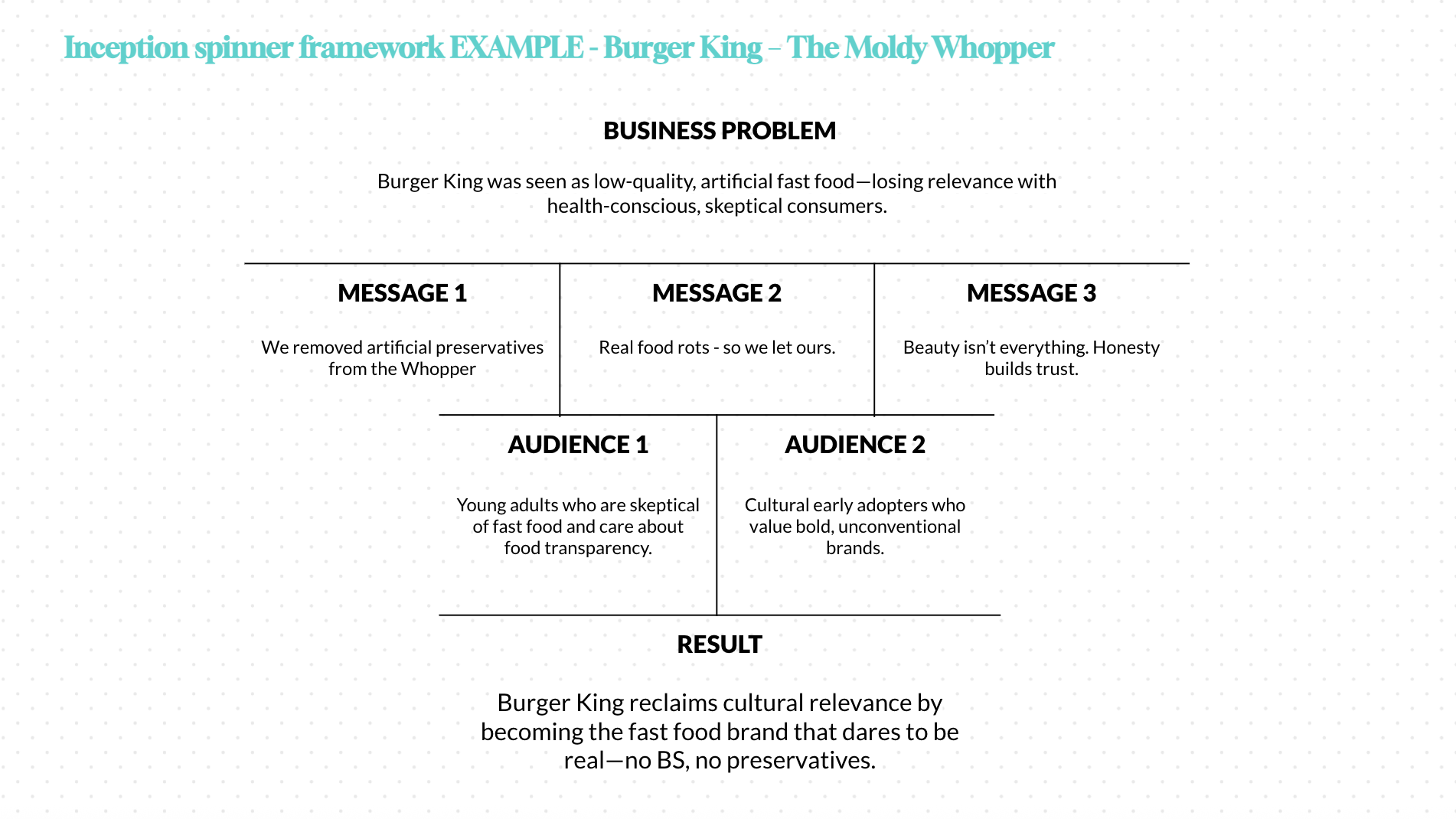
Example: Burger King: Moldy Whopper
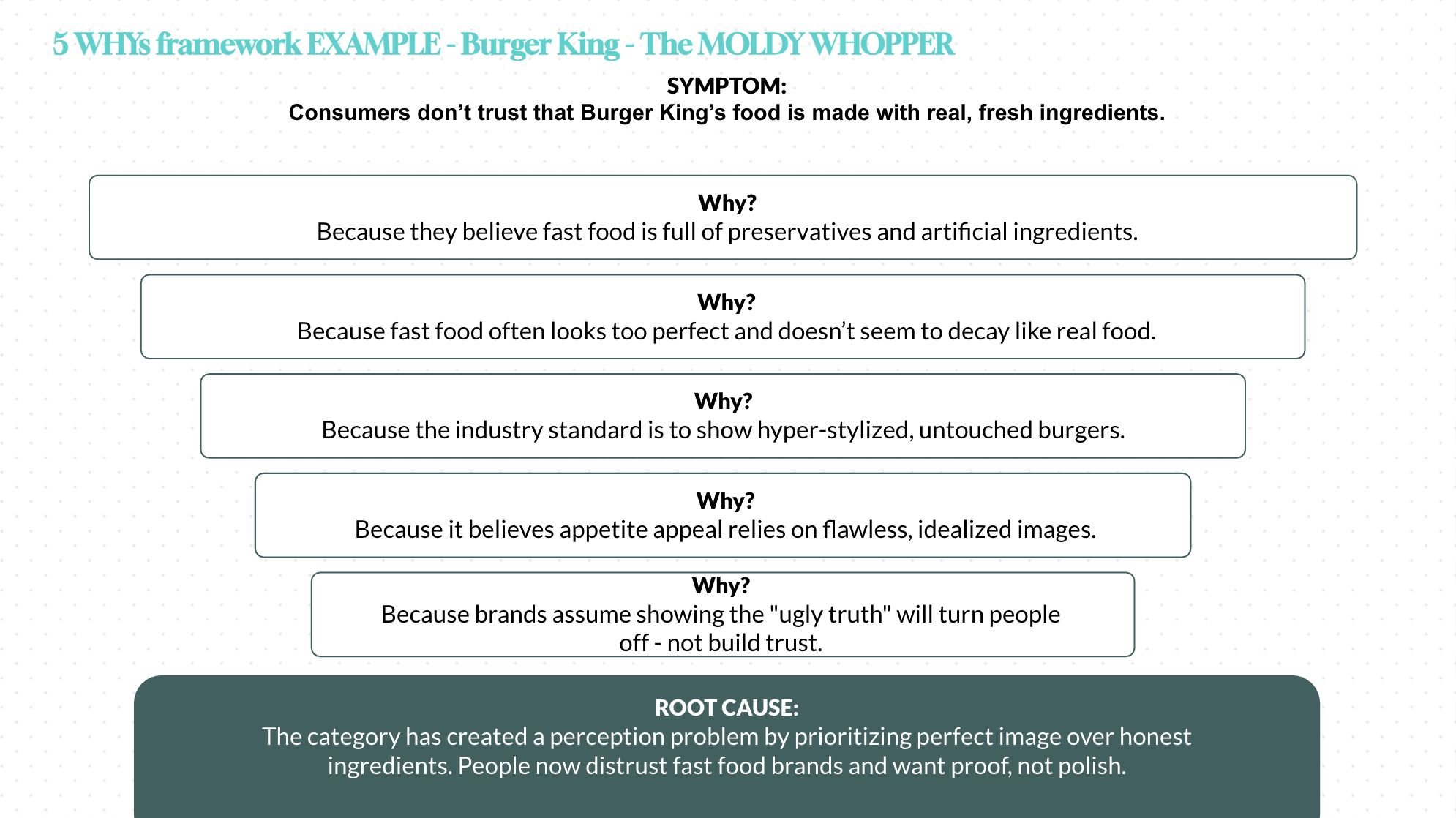
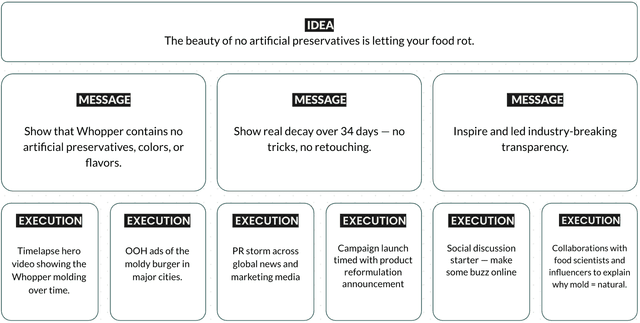
Burger King’s "Moldy Whopper" is the gold standard for this strategy. Instead of the usual airbrushed, plastic-looking fast food, they released a time-lapse of their flagship burger decaying over 34 days. It was covered in thick, green mold. Disgusting? Absolutely. But it proved a massive point: their food is real enough to rot because it has no artificial preservatives. It turned a "gross" visual into a badge of honor that rivals couldn't claim. OK.
Creative Strategy Deconstructed in 4C Framework
Company INSIGHT
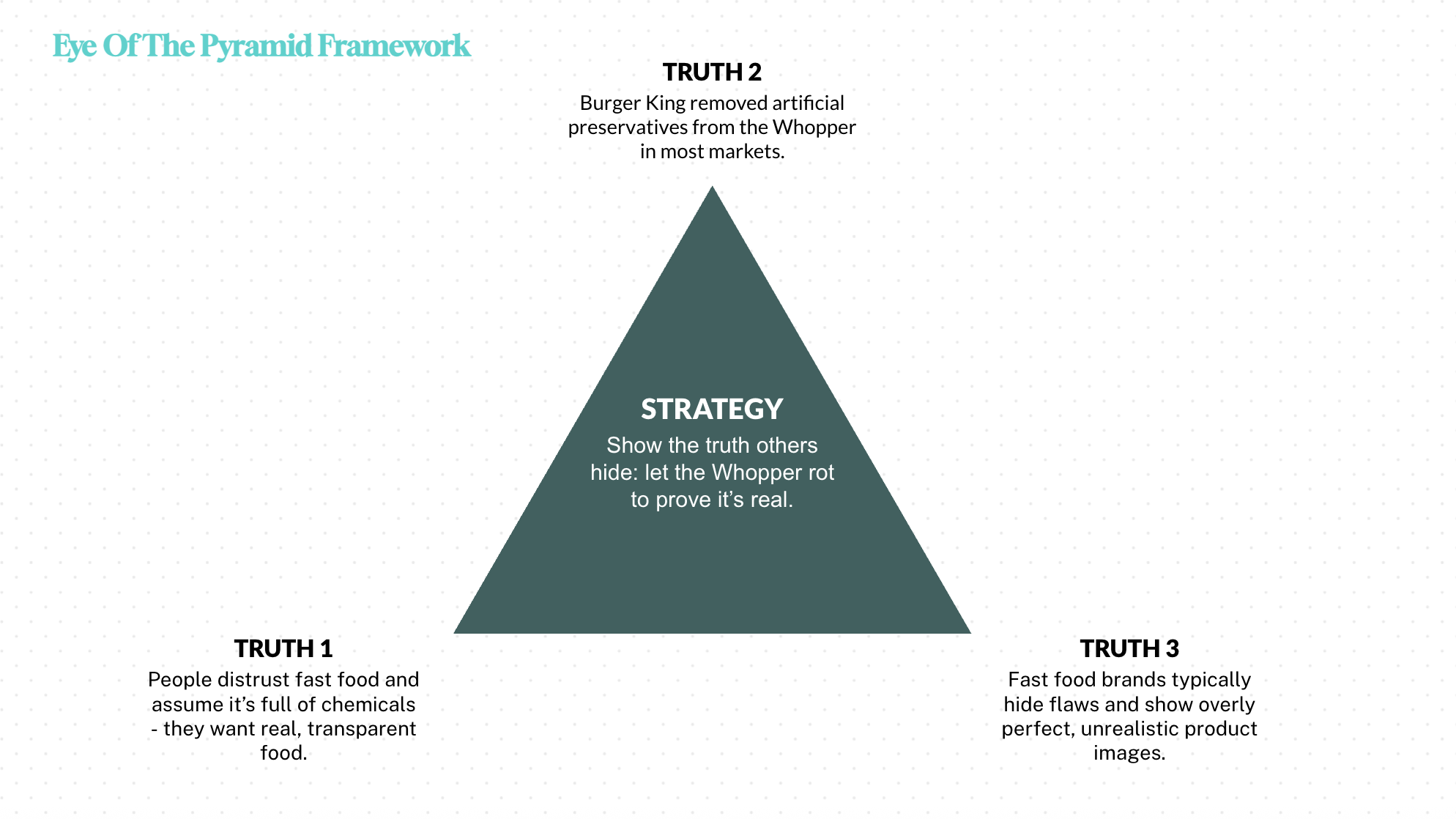
Burger King removed artificial preservatives from the Whopper across most major markets, creating a real product difference that was difficult for competitors to replicate quickly.
Category INSIGHT
Fast food brands traditionally use heavily styled, airbrushed food photography to make products look immortal and perfect, effectively hiding the chemical nature of the ingredients.
Strategy:
Prove the absence of artificial preservatives by showing the unedited, grotesque reality of natural food decay.
Customer INSIGHT
Health-conscious consumers are increasingly skeptical of "franken-food" and desire transparency, wanting to know their meals are made of actual food that behaves like food.
Culture INSIGHT
There is a massive cultural shift toward authenticity and "unfiltered" reality, where perfection is seen as a lie and raw, even gross, honesty is viewed as a mark of quality.
Strategy:
Prove the absence of artificial preservatives by showing the unedited, grotesque reality of natural food decay.
Company INSIGHT
Burger King removed artificial preservatives from the Whopper across most major markets, creating a real product difference that was difficult for competitors to replicate quickly.
Category INSIGHT
Fast food brands traditionally use heavily styled, airbrushed food photography to make products look immortal and perfect, effectively hiding the chemical nature of the ingredients.
Customer INSIGHT
Health-conscious consumers are increasingly skeptical of "franken-food" and desire transparency, wanting to know their meals are made of actual food that behaves like food.
Culture INSIGHT
There is a massive cultural shift toward authenticity and "unfiltered" reality, where perfection is seen as a lie and raw, even gross, honesty is viewed as a mark of quality.
Why is Exaggerate to Reveal the Truth a Great Strategy?
It cuts through the wall of polished, fake marketing by being aggressively, almost offensively, honest.
It commands attention through visual shock
Forces a logical conclusion on viewers
Proves your claim instead of shouting
Differentiates you from the airbrushed herd
Most brands are too cowardly to show anything less than perfection. By leaning into the "ugly" side of your truth, you build immediate credibility that a million glossy lifestyle shots could never achieve. It’s the ultimate flex of confidence.
! When not to use the "Exaggerate to Reveal the Truth" Strategy
Don't use this strategy if your product is actually garbage and the truth is just a lawsuit waiting to happen.
Steps to implement: How to break things until they work.
Identify the most boring, undeniable truth.
Stop looking for "innovation" and look for the basic fact everyone ignores. Burger King chose "no preservatives." It’s a standard industry move, but it’s the foundation. You need a truth that is fundamentally good but visually or conceptually dull. If you can't find a core truth that matters to the consumer's life, you're just putting lipstick on a very boring pig.
Push that truth to its logical extreme.
Ask yourself: "If this truth were the only thing that mattered, what would the world look like?" Don't settle for a mild exaggeration. If it's "durable," show it surviving a nuclear blast. If it's "natural," show it being reclaimed by the earth. This is where you stop being a marketer and start being a dramatist. Go further than your legal team is comfortable with.
Visualize the consequence, not the benefit.
This is the hard part. Instead of showing the happy customer, show the mold. Show the dirt. Show the struggle. The benefit—the "why"—should be the conclusion the audience reaches on their own. If you have to explain the joke, it’s not funny; if you have to explain the strategy, it’s not working. Let the visual do the heavy lifting while you sit back.
Prepare for the inevitable client panic.
Your client is going to see the "ugly" visual and have a minor heart attack. They’ll want to add a lens flare or a smiling model. Don't let them. Remind them that "safe" is just another word for "invisible." You are building a bridge of trust using the bricks of reality. If they want pretty, they can go back to the 1990s.
Strip away all the unnecessary fluff.
Once you have your exaggerated truth, remove everything else. No catchy jingles, no busy backgrounds, no secondary CTA. The Moldy Whopper worked because it was just the burger and the rot. Anything else would have diluted the impact. If the truth is strong enough, it doesn't need a hype man. Just put it out there and let the internet lose its mind.
Related Creative Strategy Techniques
Explore Strategy Frameworks
Use these proven frameworks to build your creative strategy and implement the Exaggerate to Reveal the Truth approach effectively.