Develop a Creative Strategy: Redefine the Competitor Set
What is the Redefine the Competitor Set Strategy and when should I use it?
It's the move you make when you're tired of losing a fair fight. Instead of trying to be a slightly better version of the market leader—which you aren't—you change the criteria for winning. You stop being a "shaving company" and start being a "value-driven convenience club." Use it when your product is functionally identical to the giants but you have more personality than a board meeting. If you can’t win on specs or budget, win by making the old guard look like dinosaurs. It’s about moving the goalposts so far that the competition is playing a game that no one cares about anymore..
How to execute this strategy effectively
First, find the one thing the big guys are too bloated to fix—usually price, complexity, or being incredibly boring. Then, stop comparing your features to theirs. Nobody cares about your 5th blade; they care that they’re being overcharged. Your job is to frame the industry leaders as the problem, not the benchmark. Use a voice that sounds like a human, not a legal department. Focus on the friction your competitors ignore. If they are the "luxury status symbol," you are the "common sense solution." You aren't competing for their shelf space; you are competing for their relevance. Do it.
Example: Dollar Shave Club
Dollar Shave Club didn't try to out-engineer Gillette's vibrating, multi-blade monstrosities. They redefined the competitor from "high-tech precision tools" to "overpriced nonsense you forget to buy." Their launch video featured a CEO who didn't look like a model, mocking the industry's obsession with useless tech. By focusing on the absurdity of razor prices and the annoyance of the locked cabinet, they made the giants look out of touch. Simple.
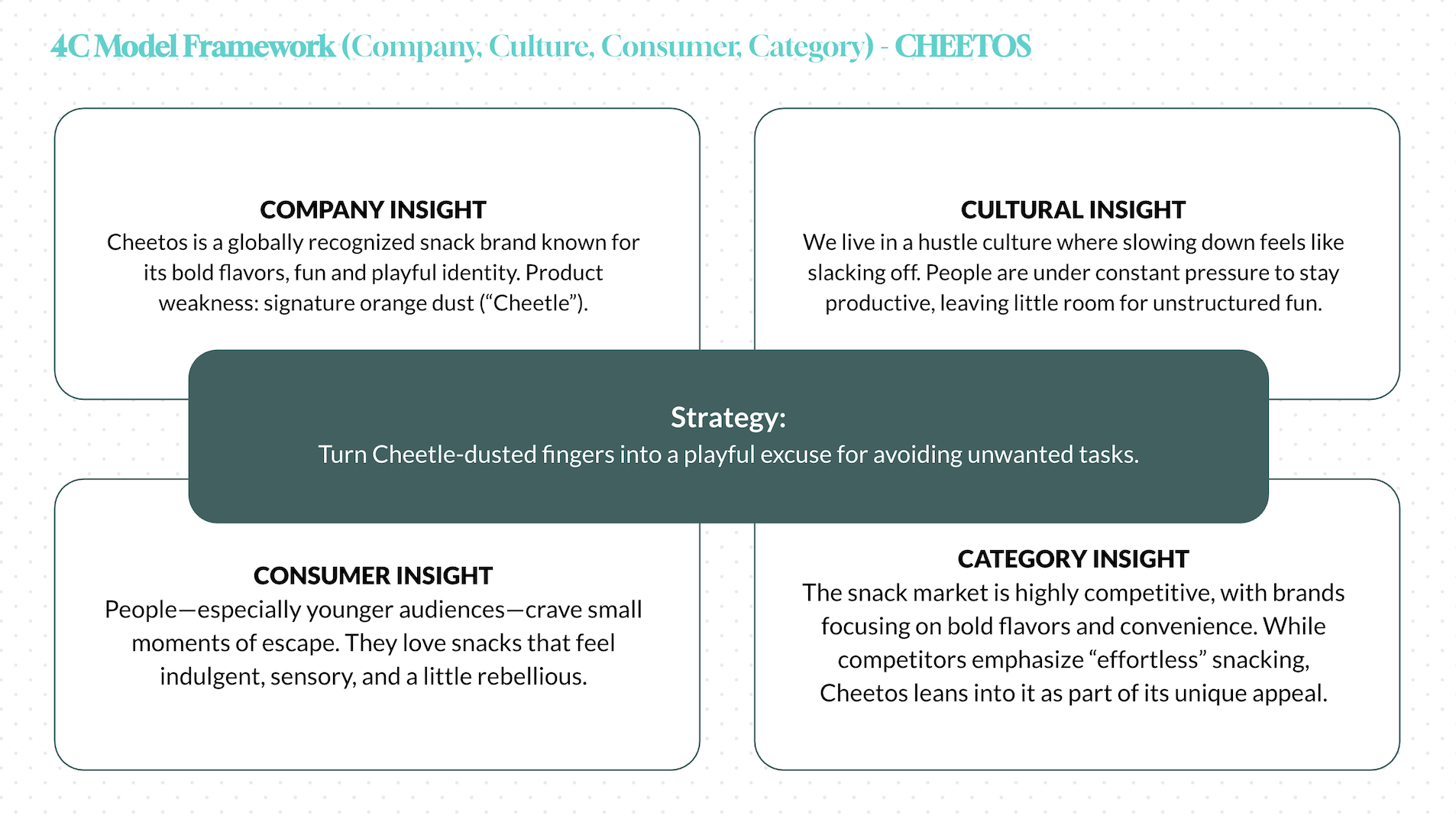
Creative Strategy Deconstructed in 4C Framework
Company INSIGHT
Dollar Shave Club had a simple supply chain and a charismatic founder who wasn't afraid to look like a lunatic on camera. They leaned into their lack of "prestige" to build an authentic, direct-to-consumer relationship.
Category INSIGHT
The shaving category was dominated by high-tech jargon and celebrity athletes. It treated shaving like a space-age ritual rather than a basic chore, justifying insane markups for marginal feature improvements.
Strategy:
Shift the conversation from "shaving technology" to "shaving convenience and common sense" to make the market leader look like an overpriced relic.
Customer INSIGHT
Men were tired of being treated like idiots who needed "vibrating handles" and "lubricating strips." They hated the high prices and the inconvenience of buying razors at a physical pharmacy.
Culture INSIGHT
The "no-BS" internet culture was rising, where people preferred raw authenticity over polished corporate ads. Subscription models were becoming the new standard for convenience and predictable value.
Strategy:
Shift the conversation from "shaving technology" to "shaving convenience and common sense" to make the market leader look like an overpriced relic.
Company INSIGHT
Dollar Shave Club had a simple supply chain and a charismatic founder who wasn't afraid to look like a lunatic on camera. They leaned into their lack of "prestige" to build an authentic, direct-to-consumer relationship.
Category INSIGHT
The shaving category was dominated by high-tech jargon and celebrity athletes. It treated shaving like a space-age ritual rather than a basic chore, justifying insane markups for marginal feature improvements.
Customer INSIGHT
Men were tired of being treated like idiots who needed "vibrating handles" and "lubricating strips." They hated the high prices and the inconvenience of buying razors at a physical pharmacy.
Culture INSIGHT
The "no-BS" internet culture was rising, where people preferred raw authenticity over polished corporate ads. Subscription models were becoming the new standard for convenience and predictable value.
Why is Redefine the Competitor Set a Great Strategy?
It turns your biggest weakness into the only thing that actually matters to the customer.
Neutralizes the competitor's massive R&D budget.
Highlights the absurdity of current market norms.
Creates a category where you are first.
Simplifies the decision-making process for customers.
When you stop playing by their rules, they have no move. You aren't trying to be "better," which is subjective and expensive. You're being "different," which is memorable and free. It forces the incumbent to either ignore you and lose market share or acknowledge you and look like a defensive bully.
! When not to use the "Redefine the Competitor Set" Strategy
Don't use this Strategy if your product is actually just a worse, more expensive version of the leader’s. Sarcasm can't fix a fundamentally broken business model, even here.
Steps to implement: Stop playing their game and start winning yours.
Identify the industry's most expensive lie.
Look at what the market leaders are bragging about. Is it "precision engineering" or "artisan craftsmanship"? Usually, it's just a mask for high margins. Find the thing they claim is essential but is actually just a pain in the neck for the user. Dollar Shave Club saw that "more blades" was just a way to charge twenty bucks for a piece of plastic.
Find the friction they chose to ignore.
Big companies love their processes more than their customers. They ignore the annoying stuff—like driving to the store or asking a clerk to unlock a plastic case—because they’ve always done it that way. That’s your opening. Map out the entire user journey and find the spot where the customer sighs in frustration. That’s where you build your new throne.
Mock the status quo with confidence.
You can't be polite about this. If you're redefining the set, you have to point out how stupid the old set is. Use humor, use bluntness, use whatever it takes to make the "standard" choice look like a mistake. If the competition is "serious," you should be "real." Show the customer you’re on their side against the corporate machine.
Strip away the unnecessary features.
To redefine the set, you usually have to simplify. If the leaders are adding bells and whistles to justify a price hike, you need to subtract them to prove a point. Focus on the core utility. Give the customer exactly what they need and nothing they don't. It makes the competitor's "advanced features" look like cluttered, expensive junk they never asked for.
Own the new category you built.
Once you've moved the goalposts, don't look back. Stop comparing yourself to the old guard entirely. You aren't a "cheap razor"; you're a "shaving club." Use language that reinforces this new identity in every touchpoint. If you keep referencing the old category, you’re just a budget alternative. If you own the new one, you’re the only logical choice.
Related Creative Strategy Techniques
Explore Strategy Frameworks
Use these proven frameworks to build your creative strategy and implement the Redefine the Competitor Set approach effectively.