Build a Creative Strategy: Reframe the Problem
What is the Reframe the Problem Strategy and when should I use it?
Look, most briefs are written by people who don't know what they want, but they’re sure it needs to be "disruptive." The Reframe the Problem Strategy is your get-out-of-jail-free card for when the initial ask is a dead end. Instead of trying to fix a product flaw or fight a losing battle against a competitor's budget, you change the perimeter of the fight. You use it when the current narrative makes your brand look like a loser or a commodity. It’s about shifting the focus from what the product does to why the world is broken without it. It’s high-effort, high-reward, and saves decks. Yes. Go.
How to execute this strategy effectively
Stop looking at the product and start looking at the friction in the consumer's life that the product accidentally solves. You need to find a truth that is bigger than the category. If you’re selling soap, don't talk about germs; talk about how society’s beauty standards are a literal poison for kids. You execute this by identifying the 'unspoken' anxiety and making your brand the only one brave enough to point it out. It requires a client with a spine and a creative team that can handle nuance without turning it into a Hallmark card. It’s about being right, not just being loud. Done. Go now.
Example: Dove – "Reverse Selfie"
Dove didn’t just sell soap; they attacked the digital distortion destroying self-esteem. In "Reverse Selfie," they showed a young girl meticulously editing a photo in reverse, stripping away the filters and makeup to reveal a child who should be playing, not airbrushing. By reframing the problem from "skin hygiene" to "the toxic impact of social media on girlhood," Dove transformed a commodity into a necessary cultural guardian. Just brutal. Yep.
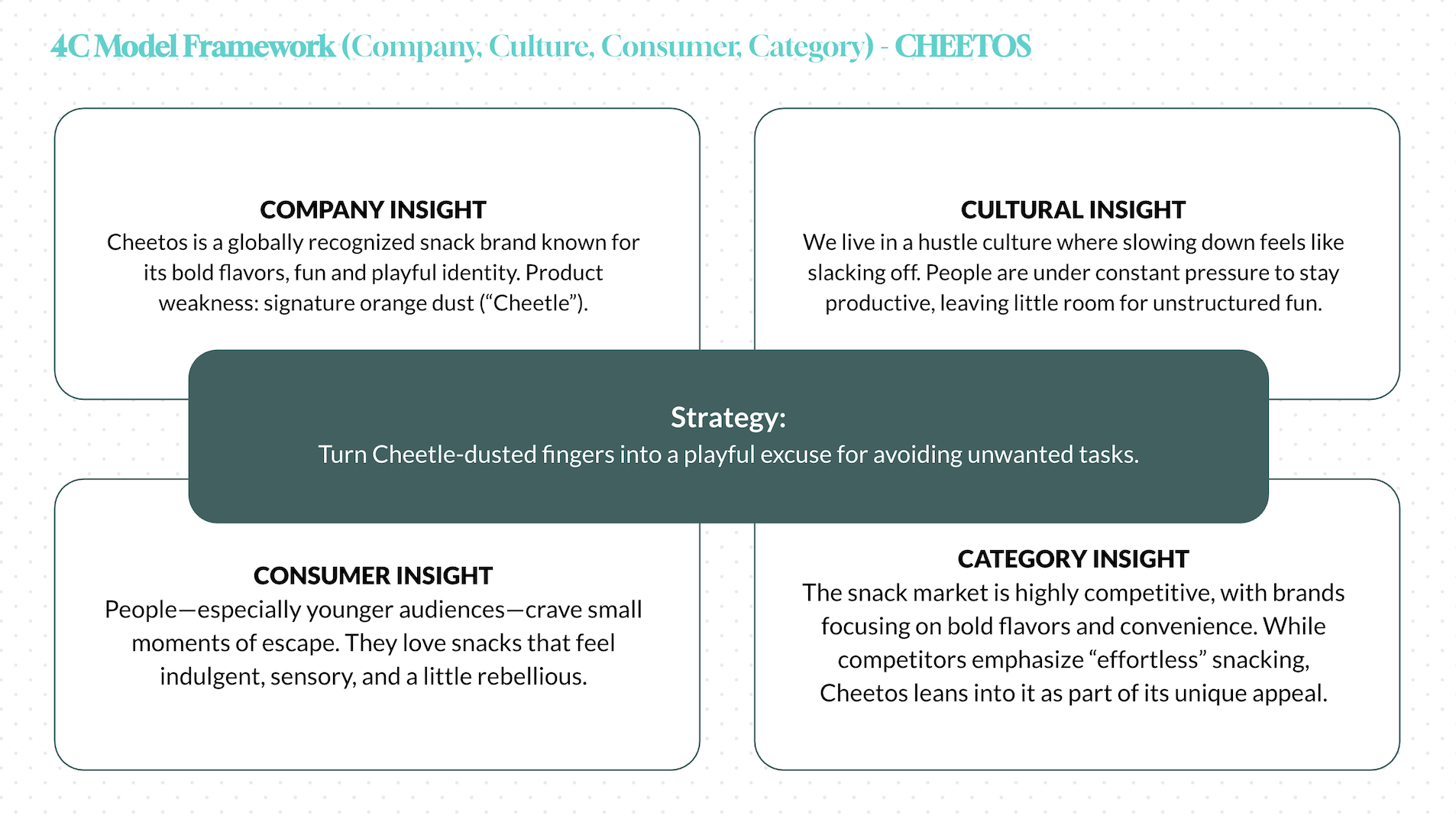
Creative Strategy Deconstructed in 4C Framework
Company INSIGHT
Dove has a long-standing commitment to "Real Beauty" and a product line focused on gentle care. They have the permission to talk about skin and self-image without sounding like they're just chasing a trend.
Category INSIGHT
The beauty category usually promotes perfection, filters, and unattainable standards to sell more product. Most brands are complicit in creating the very insecurities they claim to fix.
Strategy:
Reframe the beauty conversation from "enhancing appearance" to "protecting the self-esteem of the next generation" by exposing the artifice of digital perfection.
Customer INSIGHT
Young girls and their parents are increasingly anxious about the psychological toll of social media filters and digital distortion. They want to feel okay in their own skin, but the internet won't let them.
Culture INSIGHT
The "Selfie Culture" and the rise of AI-powered editing apps have reached a breaking point where digital reality and physical reality are dangerously blurred.
Strategy:
Reframe the beauty conversation from "enhancing appearance" to "protecting the self-esteem of the next generation" by exposing the artifice of digital perfection.
Company INSIGHT
Dove has a long-standing commitment to "Real Beauty" and a product line focused on gentle care. They have the permission to talk about skin and self-image without sounding like they're just chasing a trend.
Category INSIGHT
The beauty category usually promotes perfection, filters, and unattainable standards to sell more product. Most brands are complicit in creating the very insecurities they claim to fix.
Customer INSIGHT
Young girls and their parents are increasingly anxious about the psychological toll of social media filters and digital distortion. They want to feel okay in their own skin, but the internet won't let them.
Culture INSIGHT
The "Selfie Culture" and the rise of AI-powered editing apps have reached a breaking point where digital reality and physical reality are dangerously blurred.
Why is Reframe the Problem a Great Strategy?
It turns a boring product feature into a moral imperative that consumers can't ignore.
Escapes the feature-comparison death spiral
Creates instant emotional skin in the game
Forces competitors to look shallow and out-of-touch
High-level differentiation for low-interest categories
When you stop fighting on the ground everyone else is on, you win by default. It’s about making the audience realize they were worried about the wrong thing all along. Suddenly, you're the hero.
! When not to use the "Reframe the Problem" Strategy
Don't use this Strategy if your brand is actually the one causing the problem you're trying to reframe, unless you enjoy being ratioed into oblivion on social media.
Steps to implement: Stop polishing the turd and move the goalposts.
Identify the boring industry standard problem.
Most brands solve the obvious. If you're selling insurance, the 'problem' is risk. Boring. Everyone says that. Write down what the category thinks the problem is so you know exactly what to ignore for the rest of the week. You can't pivot if you don't know where you're standing. Just look at the mess and prepare to walk away from it.
Dig for the hidden human tension.
Look for the thing people feel but don't say. In Dove's case, it wasn't about being 'clean'; it was about the crushing pressure of looking perfect online. Find the anxiety that keeps your target audience up at 2 AM. If it doesn't hurt a little, it's not a real insight. You're looking for blood, not a focus group consensus.
Pivot the brand's role to protector.
Now that you've found a bigger problem, position your brand as the solution to that specific tension. You aren't just selling a product anymore; you’re providing a shield against the bullshit you just identified. This is where the strategy actually starts to take shape and feel like something worth presenting to the adults in the room. Make it count.
Execute with uncomfortable, visceral visual honesty.
Don't sugarcoat the new problem. Dove showed the "Reverse Selfie" process in a way that felt invasive and sad because it was true. If your creative looks like a stock photo, you've failed. It needs to feel as real as the problem you're trying to solve. Use high-contrast reality to make the audience feel the weight of the issue.
Ignore the legal team's initial panic.
Reframing usually involves saying something bold enough to make someone in a suit nervous. If your strategy doesn't make the brand feel slightly exposed, it's probably too safe. Push through the fear until you reach the point where the message becomes undeniable. Then go home and have a drink while the internet starts talking. You earned it.
Related Creative Strategy Techniques
Explore Strategy Frameworks
Use these proven frameworks to build your creative strategy and implement the Reframe the Problem approach effectively.