What is Acronymic Hybrids naming anyway?
Most names are either words or initials. Acronymic Hybrids are both — and that's why they work. Instead of calling your network 'Entertainment Sports Programming Network' (yawn) or just 'ESPN' (confusing), you mix them together and get something that's memorable and modern.
These names take the best of both worlds: the clarity of words and the punch of acronyms. When someone sees 'ESPN,' they know it's an acronym, but it feels like a real word. That hybrid quality is why this naming technique works so damn well for brands that want to sound established but modern.
Why do acronymic hybrids work so well in naming?
Acronymic hybrids solve the acronym problem. Regular acronyms are forgettable. Full words are descriptive but boring. Hybrids? They're the sweet spot. When done right, they create instant recognition, modern identity, and something that actually sticks in memory.
The trick is making the acronym feel like a word. If it's too random, it's just letters. If it flows, it becomes a name. ESPN nailed it. So did others who figured out that mixing formats gives you flexibility and memorability. That's the difference between a strategic hybrid and random letter soup in naming.
What is Acronymic Hybrids naming?
This is the part where you'd get the actual explanation — not fluff. Real naming insights you can use. But that's for subscribers. For everyone else: mystery and sadness.
The technique works by combining specific elements in a way that creates memorable, distinctive brand names. Learn exactly how with a subscription.
Real-World Examples
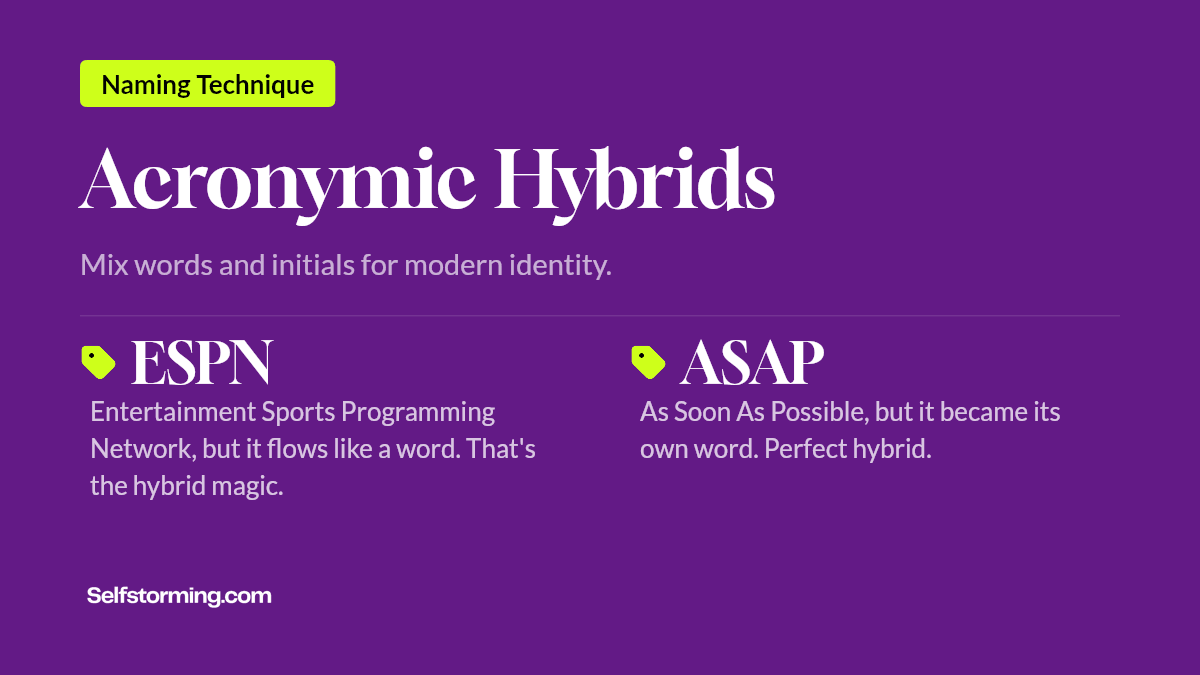
ESPN — Entertainment Sports Programming Network, but it flows like a word. That's the hybrid magic.
ASAP — As Soon As Possible, but it became its own word. Perfect hybrid.
IKEA — Ingvar Kamprad Elmtaryd Agunnaryd, but nobody cares.
NASA — National Aeronautics and Space Administration, but it feels like a brand, not just letters.
UNICEF — United Nations International Children's Emergency Fund, but it sounds like a real word.
SCUBA — Self-Contained Underwater Breathing Apparatus, but it became the word for diving.
RADAR — Radio Detection and Ranging, but it's just "radar" now. That's hybrid success.
LASER — Light Amplification by Stimulated Emission of Radiation, but it's just "laser" to everyone.
When should you use Acronymic Hybrids naming for your brand name or product name?
Combines clarity of words with punch of acronyms — best of both worlds
Sounds modern and established at the same time
Memorable when the acronym flows like a word
Works well for technical or industry-specific brands
When should you avoid Acronymic Hybrids naming for your brand name or product name?
Can feel forced if the acronym doesn't naturally flow
Might confuse people who can't figure out what it stands for
Less flexible than pure words if your business evolves
When this technique works best
Creates memorable brand associations
Works well for consumer products
Easy to implement consistently
When to consider alternatives
May not suit all industries
Requires careful consideration
Cultural context matters
Step by step guide
How to use Acronymic Hybrids in naming?
Figure out if a hybrid actually makes sense. Not every brand needs an acronym. If your full name is already memorable, maybe skip the hybrid route.
Selfstorm acronyms that flow like words. Use Selfstorm's naming creative session to explore combinations. What sounds good when you say it? What feels natural?
Test if people can pronounce it. Hybrids need to roll off the tongue. If it's clunky, it won't stick. Say it out loud. Does it work?
Make sure it's not too obscure. If nobody can figure out what your acronym means, you've got a problem. Balance mystery with clarity.
Check for existing usage. Acronyms get crowded fast. Make sure yours isn't already taken or too similar to competitors.
Plan how you'll explain it. Hybrids need context. How will you introduce what it stands for? If you can't answer this, reconsider.
Identify your brand values and attributes
Detailed explanation of how to execute this step effectively in your naming process.
Brainstorm initial name concepts
Detailed explanation of how to execute this step effectively in your naming process.
Apply the technique systematically
Detailed explanation of how to execute this step effectively in your naming process.
Test and refine your options
Detailed explanation of how to execute this step effectively in your naming process.
Here's an image card for your deck