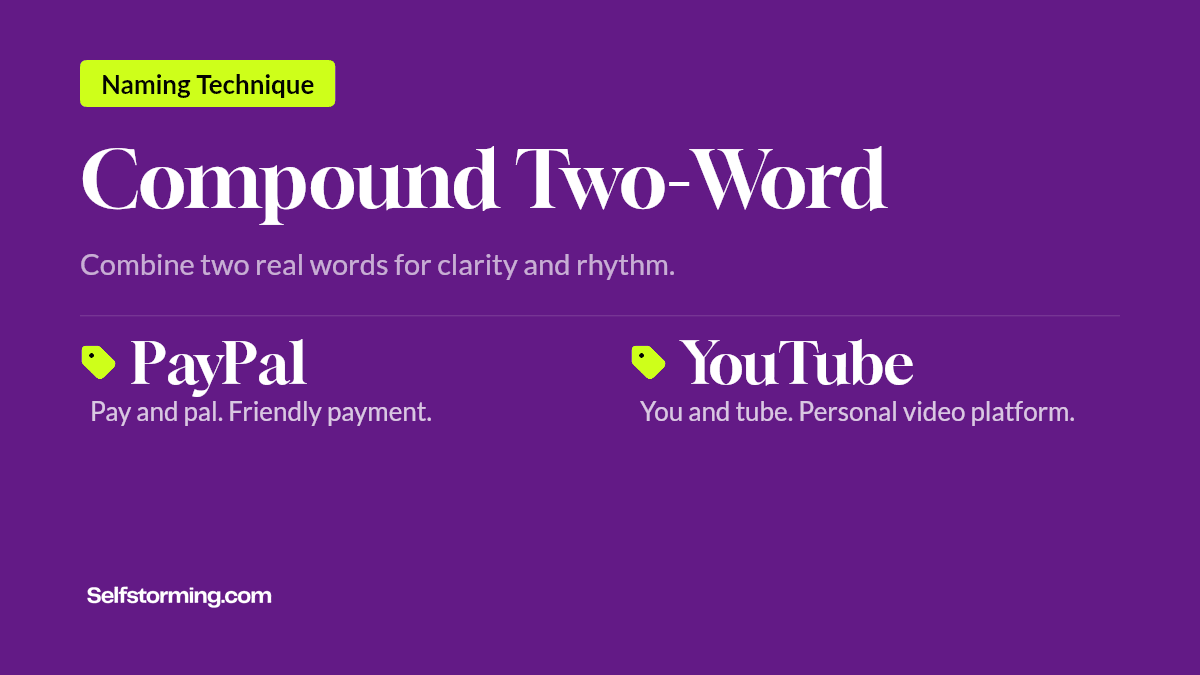
What is Compound Two-Word naming anyway?
Why use one word when two work better? Instead of calling your platform 'PaymentSystem' (boring), you combine 'Pay' and 'Pal' into 'PayPal' and suddenly it's friendly, clear, and memorable. That's compound two-word naming.
Compound names take two real words and create something that's more than the sum of its parts. When someone hears 'PayPal,' they don't think about payment or friends separately — they think about easy, friendly payment. That combination is why this naming technique works so damn well for brands that want clarity with personality.
Why do compound two-word names work so well in naming?
Compound names are the sweet spot between descriptive and abstract. They're clear enough to understand, but creative enough to be memorable. When done right, they create instant recognition, clarity, and names that actually stick because they combine familiar words in new ways. When done wrong? You get awkward word combinations that feel forced.
The trick is finding words that flow together. If they're too random, it's clunky. If they blend naturally, it's magic. PayPal nailed it. So did others who figured out that good compounds feel inevitable, not invented. That's the difference between strategic word combination and random word pairing in naming.
What is Compound Two-Word naming?
This is the part where you'd get the actual explanation — not fluff. Real naming insights you can use. But that's for subscribers. For everyone else: mystery and sadness.
The technique works by combining specific elements in a way that creates memorable, distinctive brand names. Learn exactly how with a subscription.
Real-World Examples
PayPal — Pay and pal. Friendly payment.
YouTube — You and tube. Personal video platform.
Facebook — Face and book. Social connection.
LinkedIn — Linked and in. Professional networking.
Snapchat — Snap and chat. Instant messaging.
Shopify — Shop and simplify. Easy commerce.
Netflix — Internet and flicks. Streaming entertainment.
Dropbox — Drop and box. File storage.
When should you use Compound Two-Word naming for your brand name or product name?
Clear and memorable — combines familiarity with creativity
Easy to understand — two words explain the concept
Works well for tech and modern brands
Allows for personality while staying clear
When should you avoid Compound Two-Word naming for your brand name or product name?
Can feel forced if words don't flow naturally
Might be too long for some contexts
Less distinctive than single-word names
When this technique works best
Creates memorable brand associations
Works well for consumer products
Easy to implement consistently
When to consider alternatives
May not suit all industries
Requires careful consideration
Cultural context matters
Step by step guide
How to use Compound Two-Word in naming?
Figure out if a compound actually makes sense. Not every brand needs two words. If you have one perfect word, maybe skip the compound.
Selfstorm word combinations that flow. Use Selfstorm's naming creative session to explore combinations. What words represent your brand? How do they sound together?
Test if it sounds natural. Good compounds roll off the tongue. If it's clunky, it won't stick. Say it out loud. Does it work?
Make sure both words add value. If one word is redundant, you've got a problem. Each word should contribute meaning.
Check for negative associations. Do your combined words accidentally create something bad? Test it. If it sounds wrong, try again.
Plan how you'll use it. Compounds need consistent expression. How will you present the name? If you can't answer this, reconsider.
Identify your brand values and attributes
Detailed explanation of how to execute this step effectively in your naming process.
Brainstorm initial name concepts
Detailed explanation of how to execute this step effectively in your naming process.
Apply the technique systematically
Detailed explanation of how to execute this step effectively in your naming process.
Test and refine your options
Detailed explanation of how to execute this step effectively in your naming process.
Here's an image card for your deck