What the hell is Visual Metaphor naming anyway?
Look, most naming techniques tell you what something is. Visual Metaphor naming shows you what it feels like. Instead of calling your app 'FastDeliveryApp' (yawn), you call it 'Amazon' and suddenly people picture this massive, flowing river of everything they could ever want. That's the power move here.
Your brain processes images way faster than words. So when someone hears 'Apple,' they don't think 'technology company' — they think crisp, simple, natural. That visual shortcut is why this naming technique works so damn well. It bypasses the rational brain and goes straight for the emotional gut punch.
Why do visual metaphors work so well in naming?
Visual metaphors aren't just pretty pictures. They're strategic shortcuts. When done right, they create instant recognition, emotional connection, and a story people can actually visualize. When done wrong? You get confused customers asking 'why is your tech company named after fruit?' (Spoiler: it worked out okay for Apple.)
The trick is picking images that actually mean something. Not just random pretty things, but symbols that connect to what your brand actually stands for. Nike didn't pick a wing because it looked cool — they picked it because victory, speed, and triumph are baked into that visual. That's the difference between a metaphor and a random word in naming.
What is Visual Metaphor naming?
This is the part where you'd get the actual explanation — not fluff. Real naming insights you can use. But that's for subscribers. For everyone else: mystery and sadness.
The technique works by combining specific elements in a way that creates memorable, distinctive brand names. Learn exactly how with a subscription.
Real-World Examples
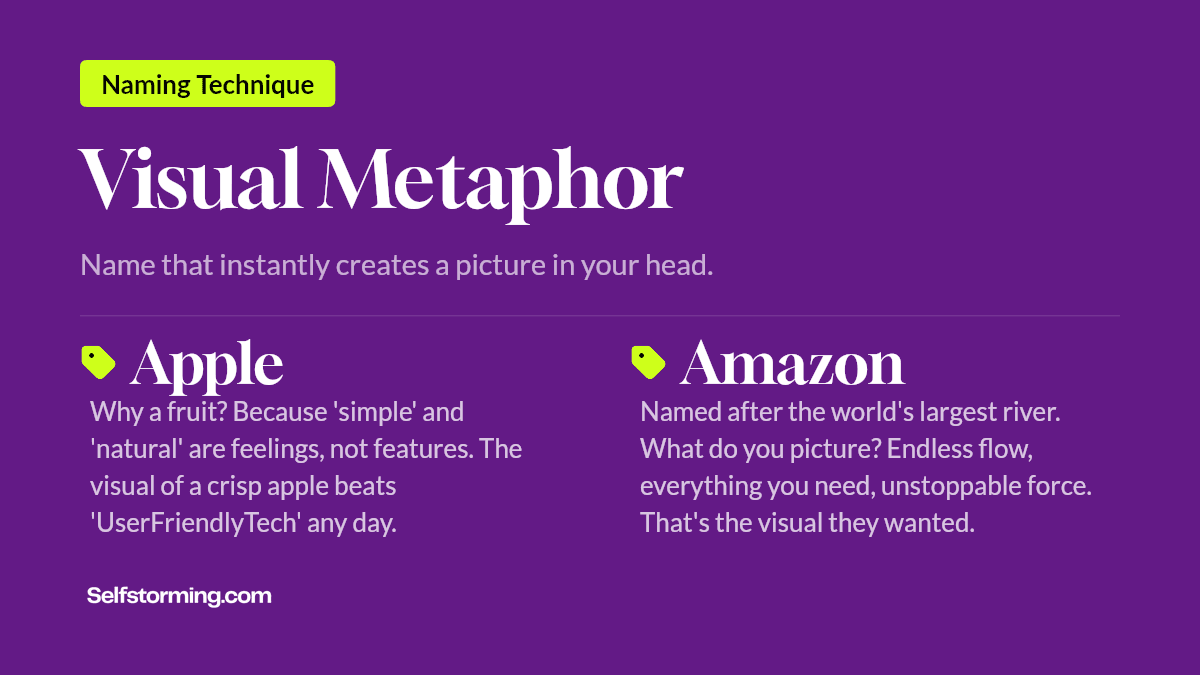
Apple — Why a fruit? Because 'simple' and 'natural' are feelings, not features. The visual of a crisp apple beats 'UserFriendlyTech' any day.
Amazon — Named after the world's largest river. What do you picture? Endless flow, everything you need, unstoppable force. That's the visual they wanted.
Red Bull — Bulls are strong, aggressive, powerful. The visual association is instant: energy drink = bull energy. No explanation needed.
Shell — Protection, strength, natural resource. The visual of a shell protecting something valuable.
Target — What do you picture? A bullseye. Precision, focus, hitting the mark. The visual does the work so the name doesn't have to.
Nike — Named after the Greek goddess of victory, symbolized by wings. Speed, triumph, winning. The visual association is baked in.
Twitter — Birds chirping, quick messages, fast communication. The visual metaphor of birds = instant messaging is so obvious it's genius.
Spotify — Sound waves, audio streaming. The name sounds like 'spot' + 'identify' but the visual association with audio is what sticks.
When should you use Visual Metaphor naming for your brand name or product name?
Sticks in memory like glue — visual associations are harder to forget than words in naming
Creates emotional connection without needing to explain yourself
Gives you room to tell a story instead of just describing features
Works globally if you pick universal symbols (everyone knows what a river means)
When should you avoid Visual Metaphor naming for your brand name or product name?
Can backfire if your metaphor is too abstract — nobody wants to Google 'what does my brand name mean?'
People might misinterpret your visual association (looking at you, every startup named after animals)
Less direct than just saying what you do — sometimes clarity beats creativity in naming
When this technique works best
Creates memorable brand associations
Works well for consumer products
Easy to implement consistently
When to consider alternatives
May not suit all industries
Requires careful consideration
Cultural context matters
Step by step guide
How to use Visual Metaphor in naming?
Figure out what you actually stand for. Not your features. Not your benefits. What's the feeling? What's the vibe? If you can't answer this, go back to the drawing board.
Brainstorm images that match that vibe. Don't just pick random pretty things. What visual actually represents your core idea? Rivers? Wings? Mountains? Pick something that makes sense.
Check if your symbol works globally. That cool local reference might mean nothing in another country. Universal symbols (nature, animals, basic shapes) travel better than cultural ones.
Test it on real humans. Show someone your name and ask what they picture. If they say 'I don't know,' you've got a problem. If they say something completely wrong, you've got a bigger problem.
Make sure it fits your brand personality. If you're selling luxury watches, 'Pebble' might not cut it. If you're selling casual apps, 'Pebble' might be perfect. Context matters.
Check for disaster scenarios. Does your visual metaphor accidentally mean something terrible in another language? Does it remind people of something you don't want to be associated with? Do your homework.
Identify your brand values and attributes
Detailed explanation of how to execute this step effectively in your naming process.
Brainstorm initial name concepts
Detailed explanation of how to execute this step effectively in your naming process.
Apply the technique systematically
Detailed explanation of how to execute this step effectively in your naming process.
Test and refine your options
Detailed explanation of how to execute this step effectively in your naming process.
Here's an image card for your deck