Category Entry Points
Map The Moments That Make People Think Of You
Category Entry Points (CEPs) are the everyday cues that drag your category into someone's head - the situations, moods, times, and people that make a brain go I could use a thing like that right now. The brand that gets thought of in the most of those moments tends to win, because most buying is not a careful comparison. It's a reflex. You feel hungry on a train, and one snack brand floats up before the others. That head start is mental availability, and CEPs are how you go after it on purpose.
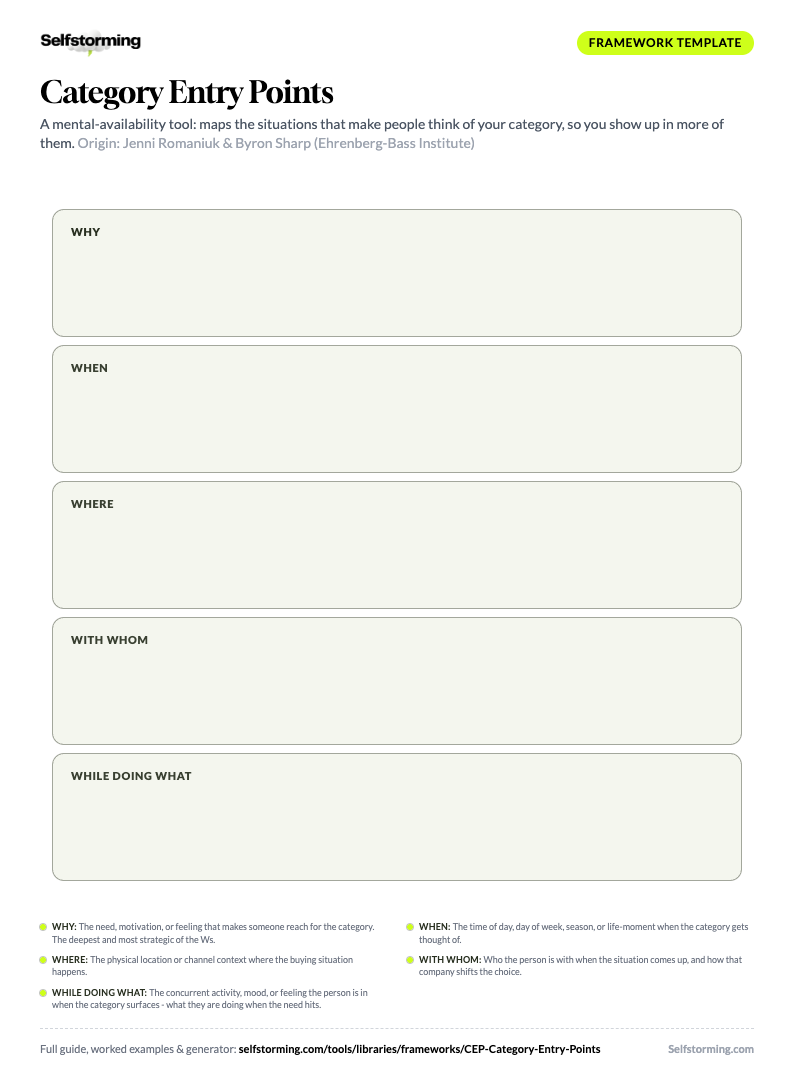
Print it. Fill it in.
The Category Entry Points as a printable A4 worksheet - write straight into the framework, on paper or in any PDF app.
Download the PDF templateKnowledge Worth Paying For
A working library of brand strategy frameworks - with worked examples on real brands, sources, and decision criteria. Not vibes.
One good deck covers the subscription. The rest is profit.
Category Entry Points are the buying situations that cue a category in memory, mapped across the Ws: Why (the motivation or need), When (the time or occasion), Where (the location or channel), With whom (who they are with), and While doing what (the concurrent activity or feeling). Brands grow by linking themselves to as many big, relevant CEPs as possible - this is mental availability. Use it to choose what to be remembered for, not to describe an audience.
Liquid Death
DTC canned water (USA, founded 2019)A masterclass in choosing a non-obvious CEP and owning it completely. Water is bought in countless situations, but Liquid Death ignored most of them and attacked one: the moment you want something with the social swagger of a beer or energy drink but without the alcohol or sugar. Bars, gigs, gyms, and parties - the With whom and While doing what doing the heavy lifting.

Duolingo
Language-learning app (global, founded 2011)Duolingo built mental availability around dead time. Instead of targeting 'people who want to learn a language', it owned a When and a While doing what: the small, repeatable gaps in a day - the commute, the queue, the sofa scroll - when you'd otherwise be doing nothing. The streak mechanic and the owl exist to win that recurring moment, not a demographic.

Snickers
Chocolate bar (global, Mars)The classic CEP play hiding in plain sight. 'You're not you when you're hungry' is not an audience - it's a situation: the irritable, low-energy moment between meals when you need fuel fast. Snickers anchored itself to hunger-outside-mealtimes so tightly that the feeling itself cues the brand. A textbook Why-and-While-doing-what entry point run for years without blinking.

Liquid Death, Duolingo, Snickers - filled in, line by line. Unlock to read them.
Liquid Death (DTC canned water (USA, founded 2019))
A masterclass in choosing a non-obvious CEP and owning it completely. Water is bought in countless situations, but Liquid Death ignored most of them and attacked one: the moment you want something with the social swagger of a beer or energy drink but without the alcohol or sugar. Bars, gigs, gyms, and parties - the With whom and While doing what doing the heavy lifting.
Why: I want the look and edge of a cool drink without the alcohol or sugar - and I want it to say something about me.
When: Nights out, gigs, workouts, and any moment a soft drink would feel boring or uncool.
Where: Bars, venues, festivals, gyms, and convenience fridges next to energy drinks - not the bottled-water aisle.
With whom: With friends at a party or show, where what you hold is a social signal.
While doing what: While socialising, partying, training, or watching live music - active, loud, social moments, never the quiet desk.
Duolingo (Language-learning app (global, founded 2011))
Duolingo built mental availability around dead time. Instead of targeting 'people who want to learn a language', it owned a When and a While doing what: the small, repeatable gaps in a day - the commute, the queue, the sofa scroll - when you'd otherwise be doing nothing. The streak mechanic and the owl exist to win that recurring moment, not a demographic.
Why: I want to feel I'm making progress on something worthwhile instead of doom-scrolling.
When: The daily gaps - morning commute, lunch queue, the last ten minutes before sleep.
Where: On a phone, anywhere there's a spare two minutes and a signal.
With whom: Usually alone, but pulled along by friends on a shared streak or leaderboard.
While doing what: While commuting, waiting, or winding down - any moment that would otherwise be idle scrolling.
Snickers (Chocolate bar (global, Mars))
The classic CEP play hiding in plain sight. 'You're not you when you're hungry' is not an audience - it's a situation: the irritable, low-energy moment between meals when you need fuel fast. Snickers anchored itself to hunger-outside-mealtimes so tightly that the feeling itself cues the brand. A textbook Why-and-While-doing-what entry point run for years without blinking.
Why: I'm hungry, grumpy, and running low - I need something filling and fast before I crash.
When: Mid-morning and mid-afternoon hunger gaps, between proper meals.
Where: Checkout queues, vending machines, petrol stations, corner shops - grab-and-go points.
With whom: Often solo and on the move, fixing your own hunger before it ruins everyone's day.
While doing what: While working, travelling, or pushing through - mid-task, energy dropping, no time to stop properly.
1. Why
What need, motivation, or feeling makes someone reach for this category in the first place?
The underlying job or emotional driver behind the buy. The most strategic of the Ws, because it cuts deepest into memory. A strong Why is specific enough to picture and broad enough to be frequent.
In practice: I want a treat that feels like a reward, not just fuel for a premium ice-cream brand. Concrete motivation, instantly picturable, and it rules other moments out.
Common mistake: People who like quality. That's a flattering audience description, not a motivation. It cues nothing and fits every brand in the category.
2. When
At what time of day, day of week, season, or life-moment does the category get thought of?
The temporal trigger. Anchoring to a specific time turns a vague brand into a habit. The best Whens repeat often and have a clear emotional texture.
In practice: The 4pm energy slump at work for an energy drink. Frequent, dateable, and it tells media exactly when to buy attention.
Common mistake: Whenever they feel like it. A non-time pretending to be a time. If it can't be put on a calendar, it can't cue a habit.
3. Where
In what physical location or channel context does the buying situation happen?
The place. Locations carry their own cues and constraints, and they often dictate format, pack size, and channel. Where you are reshapes what you'll buy.
In practice: On the beach on holiday for a light lager. The place itself sells the product, and it points straight at where to advertise.
Common mistake: Everywhere people are. Naming no place names no cue. Ubiquity is an ambition, not an entry point you can build against.
4. With whom
Who is the person with when this buying situation comes up - and does that change the choice?
The social context. We choose differently alone, with kids, with a date, or with a crowd. The company we keep is a powerful and under-used cue.
In practice: Sharing with friends at a backyard barbecue for a beer. Social, frequent, and it dictates pack size and tone of voice.
Common mistake: Anyone, really. Refusing to name the social setting throws away one of the richest sources of distinctiveness in the whole map.
5. While doing what
What is the person doing - the activity or mood - when the category comes to mind?
The occasion as an activity. What someone is doing, watching, or feeling when the category surfaces - the richest CEP for advertising, because you can actually dramatise it. Own the moment and you own the trigger.
In practice: WHILE DOING WHAT: snacking on the sofa, three episodes deep.
Common mistake: WHILE DOING WHAT: whenever. 'Any time' is not an occasion - it's the absence of one.
Decide your starting point: You don't have to brainstorm CEPs in a blank room. Right here on Selfstorming you can find inspiration and directions, or generate a first-draft Category Entry Points map in minutes. Treat that draft as a head start, then run it through the steps below to pressure-test it against real category behaviour and real data.
Define the category from the buyer's point of view, not the boardroom's: A CEP map only works if the category boundary matches how people actually substitute. Ask what someone would buy instead if your brand vanished. The honest answer is usually wider than your internal market definition - that wider frame is where the real entry points live.
Brain-dump the situations before you sort them: Get a long, messy list of buying moments out on the table first - quantity before quality. Use the Ws as prompts rather than columns: Why, When, Where, With whom, While doing what. Most are obvious once said out loud, which is exactly the point.
Pressure-test each candidate against the Ws: For every situation, fill in all five Ws. If you can't answer them, it isn't a real CEP yet - it's a vibe. The ones that snap cleanly into all five tend to be the ones worth building against.
Size them - frequency times relevance: Not all CEPs are equal. Estimate how often each situation happens and how relevant your brand can credibly be in it. Where you have category data or research, use it. A huge, frequent CEP you can't win beats a tiny one you own - but only just, so weigh both.
Pick the few to own, and be ruthless: Trying to be present in every CEP is how brands end up bland and present in none. Choose a short list - the big, frequent, winnable ones - and accept you are deliberately ignoring the rest for now. Focus is the strategy.
Turn each chosen CEP into a creative and media instruction: A CEP is a brief. The 4pm slump at the desk tells you when to buy media, what to say, and what to show. Translate each one into a concrete message and a concrete moment to reach people - otherwise the map just sits in a deck.
Build the link, then measure it: Mental availability is a link between brand and situation in memory, and it takes consistent, repeated work to build. Run the same CEP associations long enough to stick, then track which situations people actually connect to your brand over time. Adjust the priority list as the links strengthen or fail to land.
Best for: Building long-term mental availability - deciding which buying situations your brand should be remembered in, and pointing media and message at them. / Fixing a weak product, a pricing problem, or distribution gaps. CEPs route attention; they don't repair the offer underneath it.
Output: A prioritised map of buying situations across the Ws, each translated into a concrete creative-and-media instruction the brand can act on. / A single positioning line or a persona slide. CEPs are plural by design - one situation is not a strategy, it's a campaign.
Time to complete: A workshop to brain-dump and sort (a day or two), then ideally a research pass to size them before committing media. / A five-minute brainstorm with no data. Guessed CEPs feel finished but back the moments you wish existed, not the ones that do.
vs Distinctive Brand Assets: Use CEPs to choose which situations to be thought of in - the demand side of memory, the cues that should summon you. / Use Distinctive Brand Assets to make sure that, once summoned, you're actually recognised. CEPs win the thought; assets win the glance. You need both.
vs Jobs To Be Done: Use CEPs for mass-market memory and media - linking the brand to many situations to grow penetration across light buyers. / Use Jobs To Be Done to shape the product itself around the deep job a buyer is hiring it for. JTBD informs what to build; CEPs inform what to be remembered for.
vs Bullseye Customer: Use CEPs when growth comes from more situations and more light buyers - the Ehrenberg-Bass view that mass beats narrow. / Use Bullseye Customer to define a sharp core user for an early-stage product or a tight niche launch. Bullseye narrows; CEPs broaden.
Category Entry Points come from the Ehrenberg-Bass Institute for Marketing Science in Australia, the research group behind the evidence-based marketing movement. The concept is most associated with Professor Jenni Romaniuk, who formalised the Ws framework, and it sits at the heart of mental availability theory developed with Byron Sharp. It was set out in How Brands Grow Part 2 (Romaniuk & Sharp, 2016), expanded in Building Distinctive Brand Assets (Romaniuk, 2018), and developed further in her work on better brand health. The core claim, backed by the Institute's research across hundreds of categories, is that brands grow by linking themselves to more of the situations in which buyers think of the category - not by deepening the loyalty of existing users.
The honest caveats are real. CEPs are research-hungry: done properly, sizing them needs category data most teams don't have, so they get guessed in a boardroom and quietly become a list of moments leadership wishes existed. They also fragment - it's far too easy to generate dozens of entry points and chase all of them, spreading media so thin the brand owns none. Romaniuk herself has written about the common pitfalls, from over-listing to mistaking a CEP for a positioning line. And the framework is deliberately silent on the product: CEPs route attention beautifully but say nothing about whether the thing being remembered is any good. Used well, it's a discipline of ruthless prioritisation. Used badly, it's a very confident spreadsheet.
What are Category Entry Points?
Category Entry Points (CEPs) are the cues and situations that make a buyer think of a product category - the why, when, where, with whom, and while doing what of a purchase. They're the mental doorways into a category. A brand grows by linking itself to as many big, relevant CEPs as possible, so it gets thought of first when one of those situations arises. The idea comes from the Ehrenberg-Bass Institute and underpins mental availability.
Who created Category Entry Points?
The concept comes from the Ehrenberg-Bass Institute for Marketing Science in Australia, and is most associated with Professor Jenni Romaniuk, who formalised the Ws framework. It sits within mental availability theory developed with Byron Sharp, and was laid out in How Brands Grow Part 2 (2016) and expanded in Building Distinctive Brand Assets (2018). It's an evidence-based model built on research across hundreds of categories, not a single person's opinion.
How are Category Entry Points different from a target audience?
A target audience describes who someone is - age, income, attitudes. A Category Entry Point describes the situation they're in when the category gets thought of. The difference matters because people don't buy based on their demographic; they buy based on the moment. A banker and a student both reach for the same beer at a Friday barbecue. CEPs target the barbecue, not the banker - which is why media and creative built on them tend to travel further.
How many Category Entry Points should a brand target?
Fewer than you'll be tempted to. You can usually list dozens, but you can only credibly own a handful. The job is to prioritise by frequency times relevance and pick the few biggest, most winnable situations - then aim media and message at them consistently for years. Chasing every CEP at once is the fastest way to be present everywhere and remembered nowhere. Focus is the strategy.
Do Category Entry Points work for B2B?
Yes. B2B purchases still start with a trigger situation - a contract expiring, a team outgrowing a tool, a compliance deadline, a new hire who hates the incumbent. Those are CEPs. B2B buying cycles are longer and involve more people, so the With whom dimension matters more, but the core move is the same: link your brand to the situations that make the category get thought of, so you're on the shortlist before anyone runs a formal search.
How is this different from Jobs To Be Done?
They answer different questions. Jobs To Be Done digs into the deep job a buyer is hiring a product for, mostly to shape the product itself. Category Entry Points map the many situations in which the category gets remembered, mostly to shape media and message for mass reach. JTBD goes narrow and deep on one motivation; CEPs go broad across many. Many strong brands use JTBD to decide what to build and CEPs to decide what to be remembered for.
How do you actually measure Category Entry Points?
Through buyer research that asks people which situations they associate with which brands - effectively measuring the strength of the link between your brand and each CEP in memory. Ehrenberg-Bass uses metrics like mental market share and network size. In practice you track, over time, how many relevant situations bring your brand to mind, and whether your priority CEPs are getting stronger. If you can't measure the link, you can't tell whether the spend is building it.
Can Category Entry Points fix a weak brand?
No, and it's important to be honest about that. CEPs decide which situations summon your brand, but they say nothing about whether the product, price, or availability hold up once it's been thought of. If the offer is weak or you're out of stock, a perfectly mapped CEP just makes more people think of a brand that then lets them down. Fix the offer and distribution first; CEPs amplify a sound brand, they don't rescue a broken one.
A mental-availability tool: maps the situations that make people think of your category, so you show up in more of them.
Most teams quietly skip this and jump straight to who is our target audience. Useful, but it answers the wrong question. People don't buy because of who they are - they buy because of the situation they're in. A finance director and a student both want the same beer on a Friday night with friends. CEPs map those buying situations instead of demographics, so your media and your message can show up exactly when the category gets thought about.
The trick is not listing 200 of them. The trick is finding the handful that are big, frequent, and winnable for you - and then attaching your brand to them so relentlessly that the cue alone is enough to summon you.
Generate this for your brief - or grab the template
Generate a ready Category Entry Points from your brief straight into editable slides, or start from the free template.