Notpla: Notpla
Notpla tasked Superunion London with creating a brand identity to scale their seaweed-based material globally. They needed to differentiate from deceptive bioplastics and convince major brands to ditch single-use plastics. The goal was to transform a science startup into a mainstream packaging solution that consumers would emotionally trust, focusing on the material's unique ability to naturally disappear.
Creative Idea
Named the brand after what it isn't to highlight its natural, disappearing material properties.
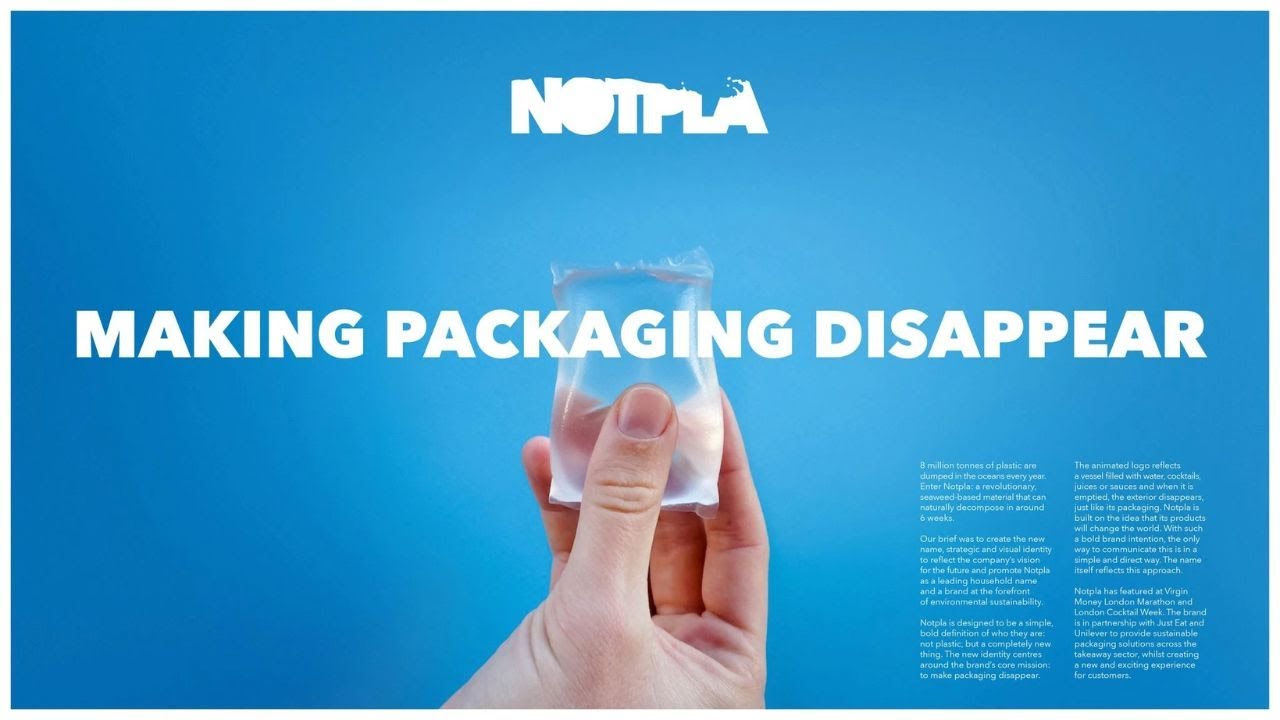
Notpla redefined sustainable packaging by naming itself after what it isn't - plastic. By using seaweed to create edible, biodegradable containers, the brand turned the 'disappearing' nature of its material into a bold, minimalist identity that directly challenges plastic pollution.
The Seaweed Brand That Passed The Whale Test
From Kitchen Experiments to Global Scale
Co-founders Rodrigo Garcia Gonzalez and Pierre-Yves Paslier began the journey by hand-making seaweed bubbles in a home kitchen while studying at Imperial College London. To scale this vision, Superunion (now Design Bridge and Partners) developed an identity centered on the "disappearing" nature of the product. The animated logo mimics a vessel filling with water; as it empties, the exterior lines vanish, visually reinforcing the mission of making packaging disappear. The material was engineered to "drop in" to existing plastic manufacturing machinery, allowing brands to switch materials without rebuilding entire factories.
Royal Endorsements and Viral Cocktails
The brand gained massive cultural traction through high-profile champions. Prince William and the Earthshot Prize Council - including Sir David Attenborough - selected Notpla for a £1 million prize, while David Beckham announced their win to a global audience. Beyond industrial applications, the brand entered the zeitgeist through a partnership with Glenlivet, creating edible cocktail capsules that became a viral sensation during London Cocktail Week.
Proving It in a Whales Gut
To validate its environmental claims for the Tom Ford Plastic Innovation Prize, Notpla’s material underwent rigorous biological testing. This included a "whale test" at the Seattle Aquarium, where the seaweed-based film was placed in a simulated whale’s digestive system to ensure it would safely break down if ingested by marine life. This scientific rigor led to a landmark 2023 ruling by the Dutch government, which officially recognized Notpla as the first and only material to be truly plastic-free under the EU Single-Use Plastics Directive, distinguishing it from synthetic bioplastics.
Creative Strategy Deconstructed
Company
A revolutionary seaweed-based material that is edible, home-compostable, and biodegrades as fast as a piece of fruit.
Category
Packaging brands often rely on confusing 'bioplastics' that still contain synthetic polymers and fail to decompose naturally.
Customer
Environmentally conscious consumers and businesses felt overwhelmed by plastic waste and skeptical of half-hearted 'sustainable' alternatives.
Culture
Global outrage over ocean plastic pollution reached a tipping point, making radical transparency and plastic-free solutions culturally essential.
Company
A revolutionary seaweed-based material that is edible, home-compostable, and biodegrades as fast as a piece of fruit.
Category
Packaging brands often rely on confusing 'bioplastics' that still contain synthetic polymers and fail to decompose naturally.
Strategy:
Define a revolutionary material by its absence of the category's primary pollutant to establish instant trust.
Customer
Environmentally conscious consumers and businesses felt overwhelmed by plastic waste and skeptical of half-hearted 'sustainable' alternatives.
Culture
Global outrage over ocean plastic pollution reached a tipping point, making radical transparency and plastic-free solutions culturally essential.
Strategy:
Define a revolutionary material by its absence of the category's primary pollutant to establish instant trust.
Results
The campaign achieved significant real-world impact and media attention. Key metrics include: 100,000 Lucozade Notpla pods distributed at the London Marathon, replacing the 650,000 plastic bottles used the year prior. The initiative generated over 300 million social impressions. It also secured high-profile partnerships with global brands including Just Eat, Tropicana, and The Glenlivet. The product's environmental efficacy is highlighted by its ability to biodegrade in 6 weeks, compared to the 750 years required for plastic.
300M
social impressions
100,000
pods used at London Marathon
6 weeks
biodegradation time
Strategy Technique
Drill Down to a Single Word
By condensing the brand's entire mission into the name 'Notpla' (Not Plastic), they created an instant mental shortcut that defines the category by what it excludes.
Explore Technique
Creative Technique
Simplicity
The brand uses a minimalist name and a logo that visually 'disappears' to mirror its product's core benefit: leaving no trace in nature, unlike traditional plastic packaging.
Explore Technique
Craft Breakdown
The campaign's excellence lies in its material innovation and the clear, visually compelling way it communicates a complex scientific solution to a global problem.
The industrial design of the Ooho pods creates a completely new, tactile, and intuitive way to consume liquids without waste.
The chemical engineering required to turn seaweed into a stable, edible, and biodegradable membrane is a significant technical feat.
The clean, minimalist aesthetic and bold typography effectively brand a 'natural' product as a high-tech solution.
Strategic placement at high-waste events like the London Marathon perfectly demonstrated the product's utility.
“The synergy between the radical material design and the strategic brand partnerships allowed the product to move from a lab concept to a scalable cultural phenomenon.”