Origin & Source
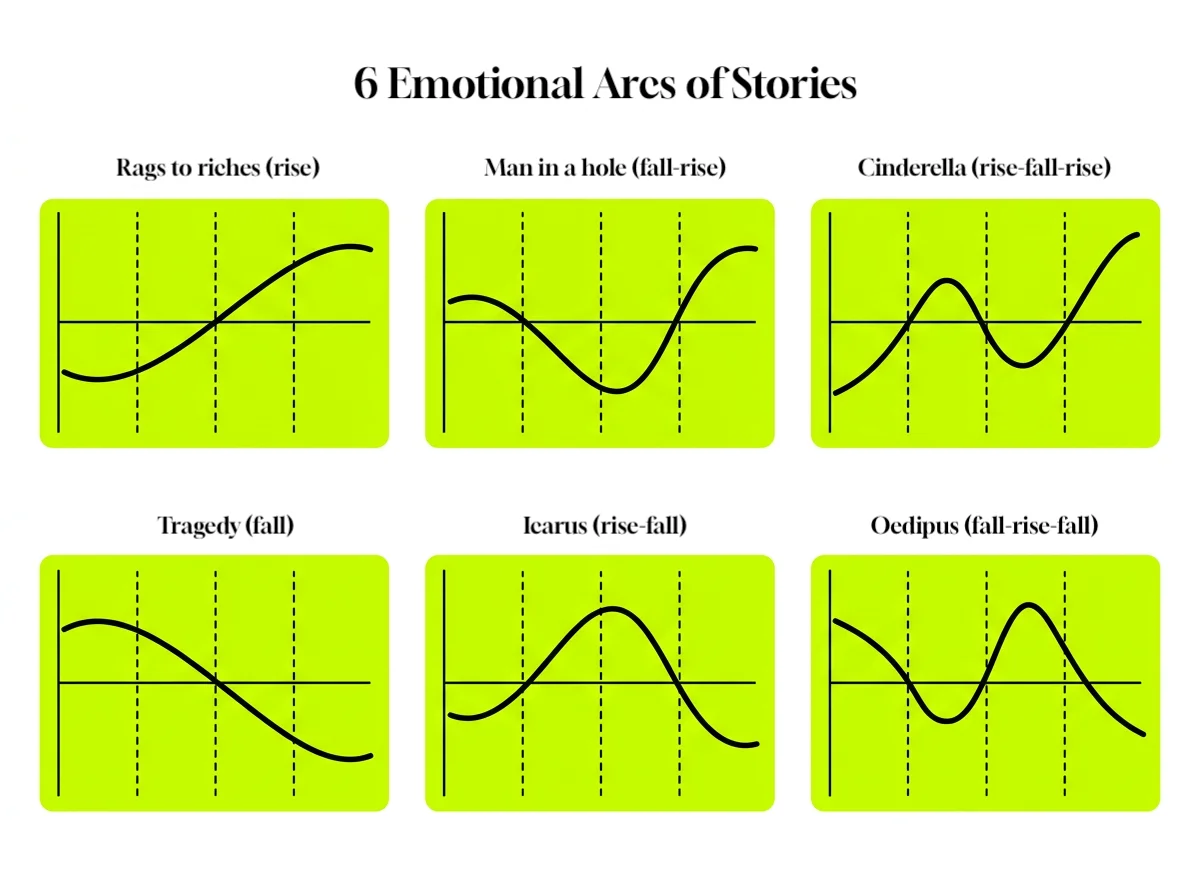
The concept originates from Kurt Vonnegut's 1995 lecture where he identified that stories have recognizable emotional shapes - and that some shapes are more powerful than others. Matthew Jockers at the University of Nebraska later proved this computationally, analyzing 40,000+ novels and identifying 6 core emotional arcs that account for the vast majority of successful stories.
The six arcs are: Rags to Riches (continuous rise), Riches to Rags (continuous fall), Icarus (rise then fall), Oedipus (fall then rise then fall), Cinderella (rise, fall, rise), and Man in Hole (fall then rise). Jockers' research found that Cinderella and Man in Hole are by far the most commercially successful shapes. Andrew Reagan at the University of Vermont confirmed these findings using sentiment analysis on 1,800+ Project Gutenberg texts.
Kurt Vonnegut - 'The Shape of Stories' lecture (1995).
Matthew Jockers - 'The Bestseller Code' (computational narrative analysis).
Andrew Reagan et al. - 'The emotional arcs of stories are dominated by six basic shapes' (University of Vermont, 2016).
The Framework
Fill in each step for your brand, product, or campaign.
1. Choose Your Arc Shape
Pick the emotional shape: Cinderella (rise-fall-rise), Man in Hole (fall-rise), Rags to Riches (steady rise), Icarus (rise-fall). Which shape serves your story's message?
2. Map the Emotional Baseline
Where does the audience start emotionally? What's the default feeling before the story begins? This is your emotional ground zero.
3. Design the First Emotional Shift
What's the first emotional move - up or down? What event, image, or line triggers the shift? How far from baseline do you move?
4. Engineer the Turning Point
Where does the emotion reverse direction? This is the most critical beat - the moment the audience's feelings pivot.
5. Calibrate the Peak
How high (or low) is the emotional peak? Does the ending resolve upward (hope, triumph) or downward (warning, urgency)? Match it to your intended audience action.
Why it matters now
Content that doesn't have an emotional arc is just information. And information alone doesn't drive action. The emotional arc is the invisible architecture that makes people share, remember, and act on a story. If you can't draw the emotional shape of your content, your audience can't feel it either.
Ready-to-Use Templates & Examples
TV Ad Script - 60-second spot for a children's hospital foundation (Cinderella arc: rise-fall-rise)
A little boy runs through a park. Laughing. Chasing a ball. His parents watch from a bench. Normal, happy, unremarkable. The audience feels warmth.
His birthday. Cake, candles, friends. He blows them out. Makes a wish. The audience feels joy - this is childhood at its best.
Hospital hallway. The boy is in a wheelchair now. His head is shaved. The park, the birthday - that was before. His mother holds his hand. Neither of them speaks. The audience feels the drop physically.
A doctor kneels to his level and says something we can't hear. The boy smiles - the first smile since the fall. The audience feels the pivot from despair to hope.
Months later. Same park. Same ball. He's running again - slower, but running. His mother watches from the bench, crying. The audience feels triumph. [Foundation logo]. 'Every child deserves a second run.'
B2B SaaS - Product launch video using Rags to Riches arc (steady emotional rise)
The audience starts neutral - they're watching a product video. Expectations are low. Open with: 'You open your analytics dashboard. Nothing surprises you. That's the problem.'
Show the first 'aha' moment: 'What if your dashboard could tell you what to do, not just what happened?' The audience moves from neutral to curious.
Demo the key feature in action. Real data, real insight. 'In 30 seconds, the platform identified a $40K revenue leak that had been invisible for 6 months.' Curiosity becomes excitement.
Show the human reaction: a team lead sees the insight, calls the CEO, presents in a meeting. The data becomes a story. Excitement becomes conviction.
Close on the transformation: 'Your dashboard wasn't built to inform you. It was built to move you.' The audience feels that this is different - and they want it. CTA feels natural, not forced.
Personal brand - Newsletter story using Man in Hole arc (fall then rise)
Start at ground level: 'Last Tuesday, I had the worst client call of my career.' The audience is neutral but curious - they know the fall is coming.
'The client said, in front of their entire leadership team: Your strategy didn't work. We wasted three months.' The audience feels secondhand embarrassment. They've been there.
'I hung up and sat in silence for 20 minutes. I considered refunding the entire contract. I questioned whether I was any good at this.' Maximum empathy.
'Then I pulled up the actual data. The strategy did work - the results were in a metric they weren't tracking. I called back the next day with screenshots.' Relief begins.
'The client apologized. Extended the contract. And added a new project. The lesson: the worst call of your career might just be a data problem. Don't refund - investigate.' The audience feels vindication and takeaway.
Quick-Start Prompts
Answer these to fill the framework for your own story.
What emotion should your audience feel at the end? Work backwards from there.
What's the emotional shape - Cinderella (rise-fall-rise), Man in Hole (fall-rise), or Rags to Riches (steady rise)?
Where is the emotional turning point? What moment pivots the audience's feelings?
How deep should the low go? How high should the peak reach?
If you drew the emotional line of your content, would it be a flat line or a compelling shape?
When to use
Any content longer than 30 seconds where you need to sustain emotional engagement
Brand films, keynotes, and campaigns where the emotional journey IS the strategy
Content planning - map the emotional arc before writing to ensure every section serves the feeling
When you know the story events but the content still feels flat or disconnected
When NOT to use
Pure informational content where emotional manipulation would feel inappropriate
Short-form social where you only have time for one emotional beat, not an arc
Technical documentation or legal copy that needs emotional neutrality
When the brand tone is deliberately understated - forcing emotional arcs can feel inauthentic
Related storytelling techniques
Story Roller Coaster
The roller coaster is one specific emotional arc (high-low-high) - use it when Cinderella shape fits your story
Story Mountain
Story Mountain gives you the event structure; Emotional Arc gives you the feeling structure - layer them together
Story Circle
Map the 8 Story Circle steps onto an emotional arc to control exactly how the audience feels at each beat
Hero's Journey
The Hero's Journey has a built-in emotional arc (comfort-chaos-transformation) - make it explicit
Frequently Asked Questions
What are the 6 emotional arc shapes?
Based on computational research by Matthew Jockers and Andrew Reagan: Rags to Riches (steady rise), Riches to Rags (steady fall), Icarus (rise then fall), Oedipus (fall, rise, fall), Cinderella (rise, fall, rise), and Man in Hole (fall then rise). Cinderella and Man in Hole are the most commercially successful across all media.
How do I choose which emotional arc to use?
Match the arc to your goal. Want to inspire action? Cinderella (rise-fall-rise). Want to build trust through vulnerability? Man in Hole (fall-rise). Want to cast a vision? Rags to Riches (steady rise). Want to create urgency or warn? Icarus (rise-fall). The arc should serve the action you want the audience to take.
Can I use emotional arcs in B2B content?
Absolutely. B2B buyers are still humans. A case study with a Man in Hole arc (things went wrong, then we fixed them) outperforms a flat 'challenge-solution-results' format every time. The emotion is what makes the data memorable.
How do I map an emotional arc onto short content?
Even a single social post has an emotional shape. A LinkedIn post might go: curiosity (hook) to frustration (problem) to relief (insight). You don't need long-form to have an arc - you just need deliberate emotional movement from start to finish.
What if my content feels emotionally flat?
Draw the emotional line. If it's straight, that's your problem. Add a drop (conflict, tension, unexpected turn) or raise the stakes. The fix is almost always: make the audience feel something uncomfortable before you give them the resolution. Comfort doesn't create engagement.
Related Creative Techniques
Spacetime Warp
Rip something out of its time and slam it into ours, or vice versa – caveman lawyers, robot gladiators, whatever. Watch the gears grind as old meets new and exposes the ridiculousness of "progress"… or just gets you some eyeballs. Nail this, and your campaign becomes the one everyone talks about.
Tell a story: Conflict
Exploit the oldest trick in the book - good old-fashioned conflict. Two opposing forces, clashing needs, a ticking clock - skip the fake kumbaya bullshit and show the raw, messy struggle everyone actually deals with. Nail this, and your campaign becomes the one everyone talks about.
Use Art
Find an artist willing to whore themselves out for your brand, then call it a "collaboration." It's still a commercial transaction, but now it's got a fancy frame and a velvet rope. Nail this, and your campaign becomes the one everyone talks about.
Backstage
Pull back the curtain and show how your product actually gets made. The hands, the choices, the reasons why. People are tired of polished bullshit - show them the real thing.