Origin & Source
Created by Joseph Campbell, a professor of comparative mythology at Sarah Lawrence College. He spent decades studying myths across every culture - Greek, Hindu, Native American, Norse, Buddhist - and found the same story repeating everywhere. He published his findings in 'The Hero with a Thousand Faces' (1949), calling the pattern the monomyth.
The framework went from academic to operational when George Lucas used it as the literal blueprint for Star Wars (1977). Lucas openly credited Campbell as his primary influence. Christopher Vogler, a Hollywood story consultant, then adapted Campbell's 17 stages into a practical 12-stage screenwriting tool in 'The Writer's Journey' (1992) - the version most marketers and brand strategists use today.
The Hero's Journey can be found across literature and culture: The Odyssey (Homer), The Lord of the Rings (Tolkien), The Lion, the Witch, and the Wardrobe (C.S. Lewis), The Hunger Games (Suzanne Collins), The Left Hand of Darkness (Ursula K. Le Guin), The Handmaid's Tale (Margaret Atwood), The Hero and the Crown (Robin McKinley), and of course Star Wars (George Lucas). From Nike campaigns to TED talks to startup pitch decks, the Hero's Journey is the default narrative operating system.
Joseph Campbell - 'The Hero with a Thousand Faces' (1949).
Christopher Vogler - 'The Writer's Journey: Mythic Structure for Writers' (1992).
George Lucas - credited Campbell as the structural foundation for Star Wars (1977).
Donald Miller - 'Building a StoryBrand' (2017) adapted the framework for brand marketing.
Notable works using the Hero's Journey: The Odyssey (Homer), The Lord of the Rings (Tolkien), The Hunger Games (Collins), The Handmaid's Tale (Atwood), The Left Hand of Darkness (Le Guin).
The Framework
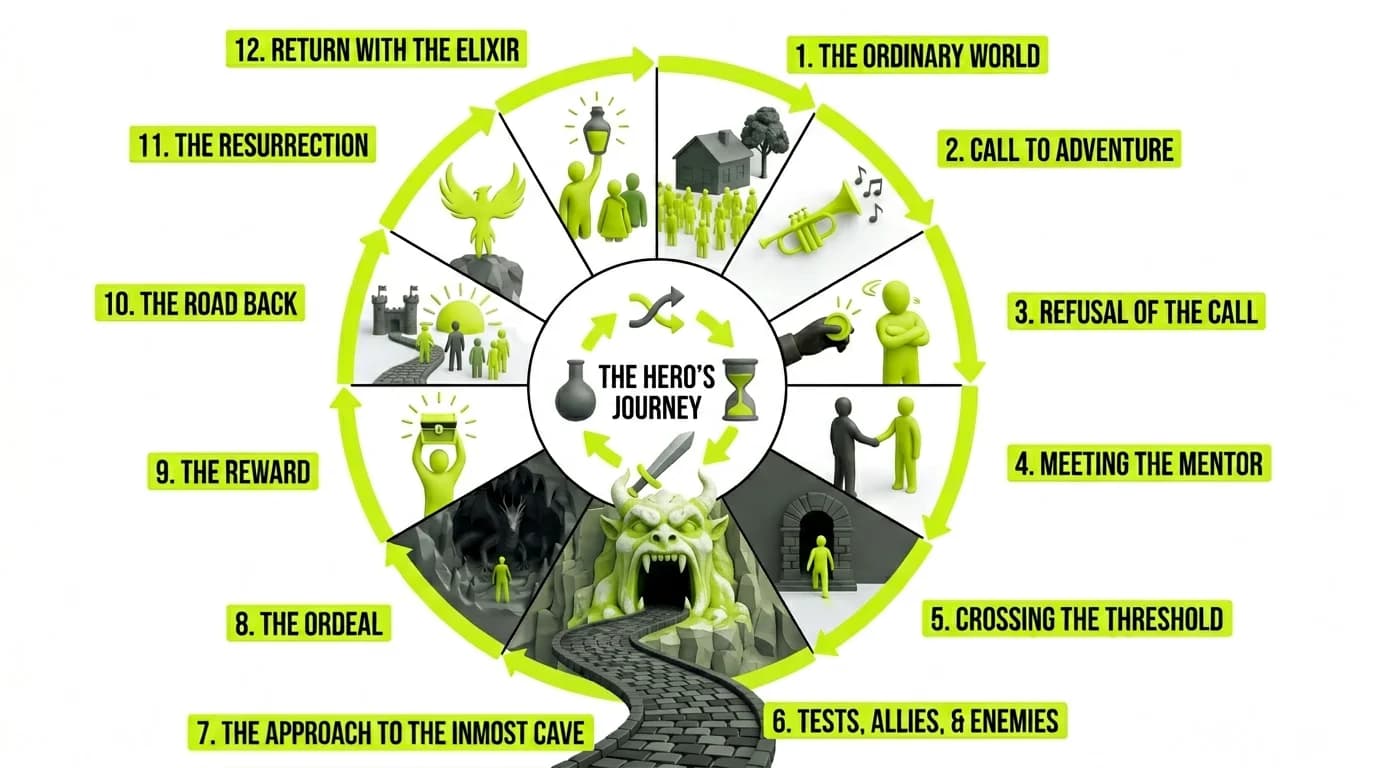
Fill in each step for your brand, product, or campaign.
The Ordinary World
Where is your hero before the journey? What's their normal? What's the status quo they've accepted - even if it's broken?
The Call to Adventure
What disrupts the ordinary? What event, problem, or realization forces them to notice that something needs to change?
The Refusal of the Call
Why do they hesitate? What fear, doubt, or excuse almost keeps them from acting? This is where your audience sees themselves.
Meeting the Mentor
Who or what gives them the confidence to move forward? A guide, a tool, a framework, a person who's been there. This is where your brand enters.
Crossing the Threshold
The hero commits. They leave the old world and enter the unknown. What's the first real action they take?
Tests, Allies & Enemies
What obstacles do they face? Who helps them? Who or what works against them? This is the messy middle where the real learning happens.
The Approach to the Inmost Cave
The hero approaches the heart of the challenge. What's the deepest fear, the core problem, or the moment of truth they must face?
The Ordeal
The biggest challenge. The moment where everything could fall apart. What's the crisis that tests everything they've learned?
The Reward
They survive the ordeal and gain something: knowledge, confidence, proof, results. What's the tangible win?
The Road Back
The hero begins the journey back. What new challenges arise as they try to bring their reward into the real world?
The Resurrection
A final test. The hero faces one last challenge that proves the transformation is real and permanent. What moment of death and rebirth seals the change?
Return with the Elixir
The hero returns home transformed, bringing something valuable for others. What insight, product, or proof do they share with the world?
Why it matters now
Brands keep telling stories about themselves. The Hero's Journey forces the opposite: your customer is the hero, your brand is the guide. In a market flooded with self-congratulatory messaging, this framework gives you the structure to make the audience the protagonist - which is the only way they'll actually care.
Ready-to-Use Templates & Examples
TV Ad Script - 60-second spot for a running shoe brand targeting everyday runners
5:45 AM. Alarm goes off. A woman in her 30s hits snooze. Lacing up old sneakers in a dark hallway. She runs alone. No music. Just breathing and footsteps on wet pavement.
She passes a billboard: 'City Marathon - 12 Weeks Out.' She slows. Looks at it. Keeps running. But her face says it all - something shifted.
She googles 'marathon training plan', then closes the laptop. Tells a friend at dinner: 'I'm not a marathon person.' The friend shrugs. She stares at her plate.
Running store. A former runner with a knee brace says: 'You don't need to be fast. You just need the right gear and a reason to show up.' Hands her a box.
She registers online. Credit card in hand. Deep breath. Click. The confirmation email fills the screen. She laces up the new shoes.
Rain runs. A blister. She joins a running group - awkward at first, then laughing at the back of the pack. A bad run where she stops at mile 3 and walks home. Her daughter hands her a water bottle at the door.
Week 8. The long runs start. She maps out the 16-mile route the night before. Lies awake. The voice in her head says: 'You've never run more than 10.'
Week 9. Mile 16. Her legs give out. She sits on a curb. Hands on knees. The voiceover she's been fighting the whole ad finally speaks: 'You're not a marathon person.'
She stands up. Starts walking. Then jogging. The voice goes quiet. She finishes the run. Not fast. But she finishes.
Race day morning. Pinning on her bib. Same hallway as the opening shot - but now there's light coming through the window.
Mile 24 of the marathon. Legs screaming. She sees the finish line and the voice tries one last time. She drowns it out with every step.
Next morning. 5:45 AM. Alarm goes off. She's already dressed. New shoes on. She opens the door and runs into the light. [Brand logo]. 'The run is yours.'
Agency - Brand origin story for a challenger skincare brand
The founder was a dermatologist who watched patients spend hundreds on products that didn't work - and felt guilty recommending them.
A 19-year-old patient came in with chemical burns from a 'clean beauty' product. The ingredient list was 47 items long and nobody could pronounce half of them.
She thought about launching her own line for two years but kept talking herself out of it: 'I'm a doctor, not an entrepreneur. The market doesn't need another skincare brand.'
A cosmetic chemist she'd worked with for years said: 'You know exactly what works and what doesn't. The market needs someone who'll actually say it.'
She formulated 3 products in her kitchen. 5 ingredients each. Published the full ingredient breakdown and the clinical reasoning behind every choice.
Big beauty brands ignored her. Influencers wouldn't touch a brand with no aesthetic packaging. But dermatologists started sharing her posts, and patients started asking by name.
She prepared to publicly call out misleading ingredients used by major brands - knowing it would make her enemies in the industry she wanted to join.
A viral TikTok accused her of 'shaming' other brands. Sales dropped 40% in a week. She had to decide: soften the message or double down on transparency.
She doubled down. Published a video explaining exactly why she called out misleading ingredients - with clinical studies. It became her most-shared content ever.
Retailers who'd previously passed on the brand reached out. Not because of the controversy - because doctors were recommending the products in-office.
A second wave of backlash hit when a competitor funded a 'debunking' campaign. She responded with a live ingredient analysis. The truth held.
She now publishes a quarterly 'Ingredient Truth Report' that other brands benchmark against. The industry standard shifted because one person refused to keep quiet.
DTC / Founder - Keynote talk opening for a bootstrapped SaaS founder
Three years ago, I was a product manager at a Fortune 500 company. Good salary, good title, good benefits. And every Sunday night, I dreaded Monday morning.
I kept seeing the same problem across every team I worked with: brilliant people spending 60% of their time on work about work - status updates, alignment meetings, context-switching between 11 tools.
I told myself it wasn't my problem to solve. I had a mortgage. A kid on the way. Quitting a stable job to build a productivity tool in the most crowded market in SaaS felt delusional.
My former CTO said something I couldn't unhear: 'You're going to spend the next 30 years building something. Shouldn't it be yours?'
I gave my notice on a Tuesday. By Friday, I had a Figma file, a Notion doc, and zero revenue.
The first 6 months were brutal. I built three versions nobody wanted. My savings account went from comfortable to concerning. Two potential co-founders dropped out.
Month 7. I had to decide whether to pivot completely or keep iterating on a product nobody was using. Every metric said stop. My gut said I was solving the wrong version of the right problem.
Month 9. No traction, no funding, no team. My wife asked - gently, but seriously - if it was time to go back to a real job.
That same week, a beta user sent an unsolicited email: 'This is the first tool my team actually adopted without me forcing them.' One email. That was the signal.
I rebuilt the entire product around that one insight - adoption without force. Stripped out 70% of the features. Shipped in 3 weeks.
A major prospect said no after a full demo. I almost reverted to the old feature-heavy version. Instead, I asked: 'What would make your team use this without being told to?' Their answer confirmed everything.
I'm not here to tell you to quit your job. I'm here to tell you that the thing you keep noticing - the problem that won't leave you alone - that's not a distraction. That's the signal.
Quick-Start Prompts
Answer these to fill the framework for your own story.
What was your customer's world like before they found you? What had they accepted as normal? (The Ordinary World)
What was the moment they realized the status quo wasn't working anymore? (The Call)
What held them back from making a change? What fears or doubts did they have? (The Refusal)
Who or what gave them the push to act? This is where your brand enters. (The Mentor)
What was the first real action they took - the point of no return? (Crossing the Threshold)
What obstacles, allies, and enemies did they encounter along the way? (Tests)
What was the core fear or deepest challenge they had to confront? (The Inmost Cave)
What was the moment everything could have fallen apart? (The Ordeal)
What did they gain - knowledge, confidence, proof, results? (The Reward)
What new challenges came when they tried to bring the reward back to their world? (The Road Back)
What final test proved the transformation was real and permanent? (The Resurrection)
What do they bring back to share with others - the insight, proof, or transformation? (Return with the Elixir)
When to use
Brand origin stories that need to show transformation, not just chronology
Customer case studies where the buyer went through a real journey of change
Founder narratives for pitch decks, About pages, or keynote talks
Long-form campaigns (video, documentary, brand film) that need a full narrative arc
When NOT to use
Short-form social posts where you have 3 seconds to hook - use Open Loop or In Medias Res instead
Product feature pages or technical documentation that need clarity, not narrative
Quick wins or simple before/after stories - use Story Spine for the compressed version
When the 'transformation' is trivial or forced - the framework exposes thin stories ruthlessly
Related storytelling techniques
Pixar's Story Spine
Story Spine is the compressed version of the Hero's Journey - use Spine to draft fast, then expand into the full arc for long-form
Story Circle
Dan Harmon's Story Circle is a simplified 8-step Hero's Journey - use it when 12 stages feels like overkill
Use Contrast (Before / After)
The Ordinary World vs. Return with the Elixir is the ultimate before/after - make the contrast vivid
Follow the Emotional Arc
Map the emotional curve onto the Hero's Journey stages to control exactly how your audience feels at each beat
Frequently Asked Questions
What is the Hero's Journey in brand storytelling?
It's a narrative framework based on Joseph Campbell's monomyth: a hero leaves the ordinary world, faces challenges, transforms, and returns changed. In brand storytelling, the customer is the hero and your brand is the mentor or guide. It works for case studies, founder stories, brand films, and any content where transformation is the core message.
How many stages does the Hero's Journey have?
Campbell's original had 17 stages. Christopher Vogler simplified it to 12 for screenwriting. For brand storytelling, you can compress further - most marketing applications use 6-8 key beats: Ordinary World, Call to Adventure, Mentor, Threshold, Ordeal, Reward, Transformation, and Return. Use as many stages as the story needs, not more.
What's the difference between the Hero's Journey and Pixar's Story Spine?
The Story Spine is a 6-prompt fill-in-the-blank shortcut that captures cause-and-effect. The Hero's Journey is the full 12-stage arc with character depth, mentor figures, and multiple crisis points. Use Story Spine to draft a story in 20 minutes. Use Hero's Journey when you need the full emotional architecture - brand films, case studies, keynotes, or long-form campaigns.
Who is the hero in brand storytelling - the brand or the customer?
The customer is always the hero. Your brand is the mentor - the Obi-Wan, not the Luke. Donald Miller's StoryBrand framework makes this explicit: brands that cast themselves as the hero lose the audience. Your role is to give the hero the tools, confidence, or insight they need to transform. The brand enters at 'Meeting the Mentor', not 'The Ordinary World'.
Does the Hero's Journey work for B2B marketing?
Extremely well. B2B buying is a journey - from recognizing a problem (Call to Adventure) through evaluating options (Tests) to committing to a solution (Crossing the Threshold). The framework turns flat case studies into narratives, gives pitch decks emotional structure, and makes customer success stories feel like real transformation - not feature checklists.
Related Creative Techniques
Action movie
Steal the structure of a blockbuster action movie - hero, villain, tension, resolution. Your brand saves the day. It's not original, but it works because everyone already knows the format.
Crash Someone Else's Party
Find a trending dumpster fire, and throw your product's unique solution on the flames. If you can solve a real problem better than the clowns already trying, you'll steal the spotlight and walk away with their audience.
Glorify somebody
Find some random human being who kinda, sorta lives up to your brand's aspirational BS and put them on a pedestal. Make a saint out of someone for doing their job competently, because apparently that's revolutionary these days. Do this right, and nobody forgets your brand.
Apply Social Pressure
Let everyone else do the selling for you. Show off the crowd already using your product, and watch the holdouts fall in line like dominoes. Nail this, and your campaign becomes the one everyone talks about.