La Voz Newspaper: Life Signs
La Voz Newspaper faced a challenge of high traffic violations and fatal accidents in Córdoba, Argentina, particularly during holiday seasons. They needed to create an impactful road safety campaign targeting drivers to significantly reduce dangerous behaviors and prevent future fatalities.
Creative Idea
They transformed real crashed cars into shocking, life-saving traffic signs on highways.
La Voz Newspaper transformed real crashed cars from a junkyard into shocking "Life Signs" - giant traffic billboards on highways - leveraging the visceral impact of actual tragedy to create unmissable warnings, dramatically reducing traffic violations and fatalities by turning destruction into a powerful, life-saving message.
Turning Junkyard Wrecks Into Life Saving Icons
From the Junkyard to the Highway
To achieve a visceral impact that abstract statistics could not, Ogilvy & Mather Buenos Aires bypassed traditional set design. The production team, led by La Jirafa, sourced authentic, mangled car wrecks from local junkyards - vehicles that had been destroyed in actual high - speed collisions. These cars were not modified or "staged" to look more dramatic; they were used exactly as found to maintain a haunting authenticity. Mounted onto massive billboard structures along the busiest highways in Córdoba, such as the high - traffic road to Carlos Paz, the wrecks were painted with standard traffic graphics like "Speed Limit 110" and "Keep Your Distance."
A Measurable Shift in Driver Behavior
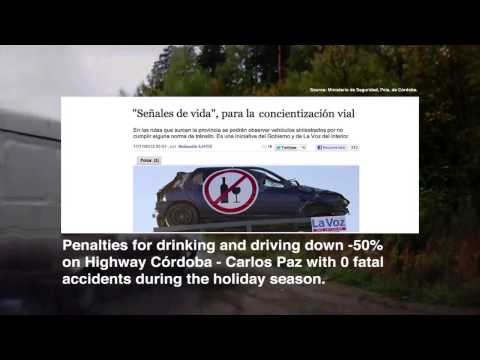 The campaign moved beyond mere awareness to achieve significant behavioral change. Following the installation, speeding violations dropped by 40% and drink - driving incidents were reduced by 50% in the targeted areas. This success led the Gunn Report to name it one of the "Cases for Creativity" in 2013, a distinction reserved for work that achieves both creative excellence and commercial effectiveness.
Redefining the Role of News
As the most popular newspaper in the region, La Voz del Interior typically reported on the aftermath of tragedies. Creative leaders Javier Mentasti and Maximiliano Maddalena pivoted the brand’s role from a passive observer of "bad news" to an active participant in public safety. By utilizing Ambient Media to turn the physical medium of the car into the message itself, the campaign proved that the environment could be more powerful than any written copy. As the creative team noted: "From the largest junkyard, we created life."
Creative Strategy Deconstructed
Company
La Voz Newspaper leveraged its authority as a news source to report on and prevent bad news, demonstrating a commitment beyond headlines.
Category
Traffic safety campaigns typically rely on generic signs, abstract statistics, or public service announcements, often failing to create a lasting, visceral impact.
Customer
Drivers often become complacent or feel immune to standard warnings, needing a powerful, visceral shock to truly internalize the severe consequences of reckless behavior.
Culture
A culture where traffic accidents are a common, tragic reality, especially during holiday seasons, creating a need for urgent, impactful intervention.
Company
La Voz Newspaper leveraged its authority as a news source to report on and prevent bad news, demonstrating a commitment beyond headlines.
Category
Traffic safety campaigns typically rely on generic signs, abstract statistics, or public service announcements, often failing to create a lasting, visceral impact.
Strategy:
Transform the abstract consequence of danger into a tangible, unavoidable warning to alter behavior.
Customer
Drivers often become complacent or feel immune to standard warnings, needing a powerful, visceral shock to truly internalize the severe consequences of reckless behavior.
Culture
A culture where traffic accidents are a common, tragic reality, especially during holiday seasons, creating a need for urgent, impactful intervention.
Strategy:
Transform the abstract consequence of danger into a tangible, unavoidable warning to alter behavior.
Results
The campaign achieved several significant results: - Penalties for speeding violations went down -40% on Highway Córdoba - Rosario. - Penalties for drinking and driving went down -50% on Highway Córdoba - Carlos Paz, with 0 fatal accidents during the holiday season. - All violations decreased by 25% on Interstate Highway 36, the busiest of the area. - Provinces Salta and Santa Fe joined the program, indicating broader adoption and success beyond the initial region.
-50%
drinking and driving penalties down
0
fatal accidents during holiday season
-40%
speeding violations down
Strategy Technique
Make the Invisible Visible
The campaign transformed abstract dangers of reckless driving into tangible, shocking "Life Signs." By making the horrific consequences of crashes physically visible on highways, it forced drivers to confront the unseen risks directly.
Explore Technique
Creative Technique
Dramatize the Problem
The campaign used real crashed cars, physically transforming them into traffic signs. This viscerally dramatized the horrific consequences of traffic violations, making the problem impossible to ignore and deeply impactful for drivers.
Explore Technique
Craft Breakdown
This campaign's craft is exceptional due to its bold and visually striking use of real crashed cars as public awareness tools, paired with compelling Art Direction and Production Design to create unmissable and potent 'Life Signs' on highways.
The creative vision of transforming mangled crashed cars into impactful traffic signs, strategically placed on major highways, demonstrates exceptional conceptual and visual art direction, turning destruction into a powerful message.
The execution of placing actual wrecked vehicles on tall structures along busy roads, carefully applying the traffic sign graphics, showcases strong production design in bringing this ambitious concept to life tangibly and safely.
The concise and potent messaging, from 'Some drivers are lucky... Others, are not.' to 'From the largest junkyard, we created life,' effectively frames the problem and solution with emotional resonance.
The stark contrast between the raw dashcam crash footage and the sweeping, dramatic shots of the installed billboards, particularly against the sunrise/sunset, powerfully captures the campaign's gravity and hope.
“The campaign's impact stems from the synergy between Art Direction and Production Design, transforming a stark creative idea into a tangible, large-scale, and highly visible public safety intervention.”