Columbia Journalism Review: The Fake News Stand
Columbia Journalism Review (CJR) wanted to highlight the danger of misinformation before the 2018 U.S. midterm elections. TBWA\Chiat\Day New York was tasked with creating a high - impact moment that would educate the public on media literacy. The goal was to reach a broad audience and reinforce CJR's role as a guardian of real journalism in an era of viral, fabricated news.
Creative Idea
Transformed a Manhattan newsstand into a physical gallery of viral digital misinformation.
To combat the digital spread of misinformation, CJR brought viral fake news into the physical world by taking over a Manhattan newsstand, using the authority of print design to expose how easily sensationalist lies can be mistaken for credible journalism.
The Newsstand Where Truth Was Hidden Inside Lies
100 Most Shared Lies in Print
To bridge the gap between digital "echo chambers" and reality, TBWA\Chiat\Day New York identified the 100 most-shared fake news stories of 2018 and gave them physical form. Designers at Design by Disruption meticulously mimicked the typography and paper stock of prestigious outlets like *The New York Times* and *TIME* to create fictional mastheads such as *The Informationalist* and *The Manhattan Daily*. The goal was to demonstrate how professional design can weaponize misinformation by giving it unearned authority.
The Bait and Switch Education
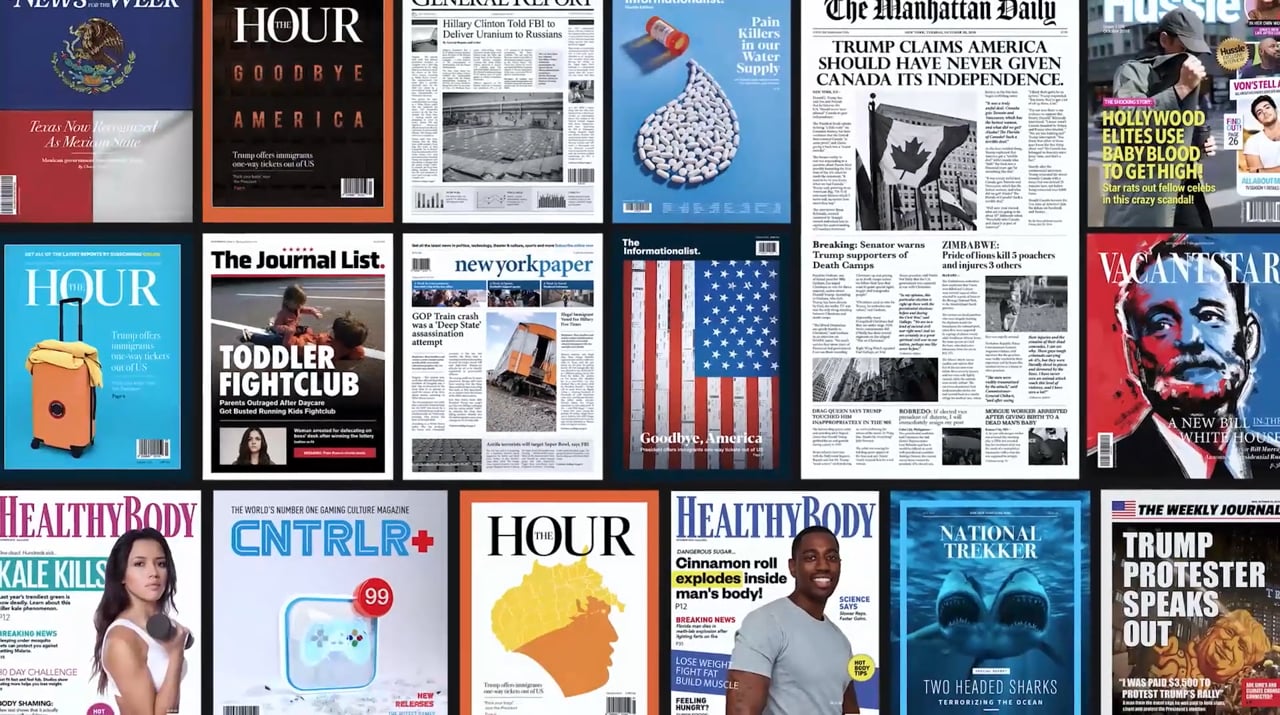
Impact Beyond the Sidewalk
The installation reached over 20 million people through earned media within just 24 hours. Beyond the thousands of physical guides distributed, Kyle Pope (CJR Editor and Publisher) reported a significant spike in site traffic and brand awareness. The campaign served as a physical manifestation of how easily "garbage" content can look like credible journalism when stripped of its digital context, successfully sparking a national dialogue about the "post-truth" era.
Creative Strategy Deconstructed
Company
CJR's status as a respected authority on media ethics and journalistic standards.
Category
Media outlets often report on fake news as an abstract, digital - only phenomenon.
Customer
Readers who feel confident in their media literacy but are subconsciously influenced by sensationalist headlines.
Culture
The 2018 U.S. midterm elections and the heightened anxiety surrounding political misinformation.
Company
CJR's status as a respected authority on media ethics and journalistic standards.
Category
Media outlets often report on fake news as an abstract, digital - only phenomenon.
Strategy:
Materialize digital abstractions into physical reality to expose the fragility of perceived authority and truth.
Customer
Readers who feel confident in their media literacy but are subconsciously influenced by sensationalist headlines.
Culture
The 2018 U.S. midterm elections and the heightened anxiety surrounding political misinformation.
Strategy:
Materialize digital abstractions into physical reality to expose the fragility of perceived authority and truth.
Results
The campaign achieved significant global impact, being covered in 103 countries. It reached over 2 billion people through earned media. The activation was executed with ZERO media dollars spent, relying entirely on organic reach and press coverage. It received positive mentions and 'Clever' accolades from major networks including CNN, ABC News, and The New York Times. The project sparked a massive social media conversation about media literacy and the nature of truth in the digital age.
2B+
people reached
103
countries reached
0
media dollars spent
Strategy Technique
Make the Invisible Visible
Misinformation often feels like a vague digital problem. By placing fake headlines in a physical, trusted context, the campaign made the scale and danger of the issue impossible to ignore.
Explore Technique
Creative Technique
Exhibit the Truth
By physically manifesting digital lies in a traditional newsstand, the campaign forced people to confront the absurdity of misinformation. The tactile experience made the invisible problem of online echo chambers undeniable.
Explore Technique
Craft Breakdown
The campaign's strength lies in its physical manifestation of a digital problem, using high-fidelity design to make the 'fake' feel dangerously real.
The meticulous recreation of magazine and newspaper aesthetics makes the misinformation tangible and credible in a physical space.
Transforming a mundane city newsstand into a provocative social experiment creates a powerful, unignorable public intervention.
The use of bold, authoritative typefaces in the educational inserts mirrors the 'seriousness' of journalism to reclaim the narrative.
The headlines are perfectly pitched to mimic the sensationalist clickbait of the internet while remaining grounded in actual viral lies.
“The synergy between the physical newsstand placement and the authentic-looking graphic design is what successfully 'duped' the public and the media.”