The Melbourne International Film Festival: The Emotional Trailer
The Melbourne International Film Festival tasked McCann Melbourne with increasing ticket sales for foreign-language films. These films often faced a subtitle barrier that intimidated mainstream audiences. The festival needed a way to prove that international cinema is accessible and emotionally resonant, regardless of language, to drive record-breaking attendance and social engagement among local film lovers.
Creative Idea
Used biometric data and facial electro-stimulation to let people physically experience a film's emotional arc.
MIFF bypassed the language barrier of foreign films by capturing critics' biometric data and using electrical facial stimulation to let audiences physically feel a movie's emotional arc, proving that while languages differ, human emotions are universal.
The Science of Feeling Subtitles Without Words
30 Million Dollars in Emotion
The campaign transformed MIFF into a global phenomenon, generating an estimated $30,165,012 in earned media value and reaching over 100 countries. By focusing on the visceral rather than the verbal, McCann Melbourne delivered the biggest ticket sales in the festival’s 65-year history. The "Emotion Simulator" sessions became the hottest ticket in town, selling out completely within just two days, while social shares for the festival skyrocketed by 800%.
From 1862 Science to Modern Cinema
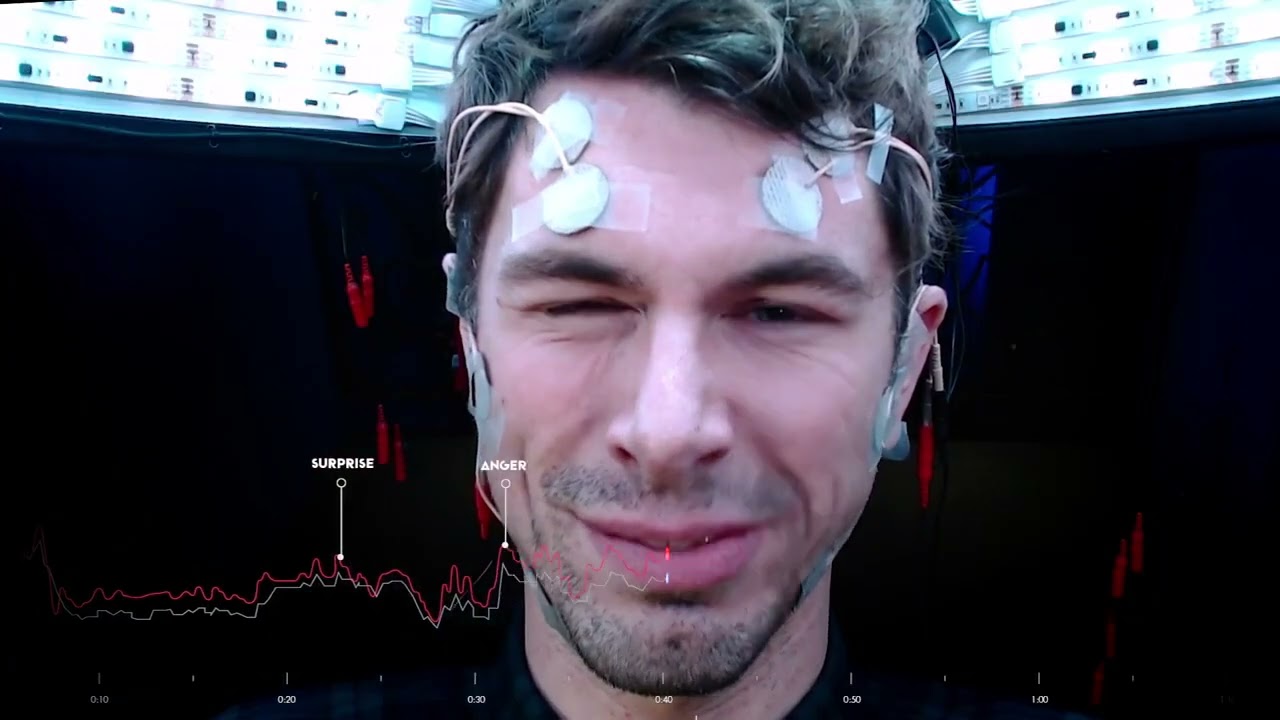 The production was rooted in the historical research of Guillaume-Benjamin-Amand Duchenne, whose 1862 study on human facial expressions provided the blueprint for the technology. To bridge the gap between data and feeling, the team used Fit-Bit pulse-rate monitors to track the biometric responses of prominent movie critics as they watched festival films. This data was then condensed into a precise one-minute "emotional script" that mapped the arc of a two-hour feature.
Twelve Electrodes and the Duchenne Smile
The "Emotion Simulator" was a custom-built movie chair equipped with 12 electrodes placed on the participant's major facial muscles. These electrodes used electro-stimulation to trigger involuntary expressions - such as the "Duchenne smile" or looks of genuine terror - entirely against the participant's will. As Executive Creative Director Pat Baron noted, the goal was to allow people to preview how a movie would make them feel rather than simply condensing the plot. This turned the human face into a technology display, proving that while languages differ, the physical experience of cinema is universal.
Creative Strategy Deconstructed
Company
A prestigious film festival with access to expert critics and a diverse catalog of international cinema.
Category
Category norms involve using plot-heavy trailers that often fail to bridge the cultural and linguistic gap.
Customer
Audiences want to know if a film is worth their time emotionally but feel intimidated by foreign-language barriers.
Culture
The universal nature of human emotion allows for a connection that transcends language through shared physiological responses.
Company
A prestigious film festival with access to expert critics and a diverse catalog of international cinema.
Category
Category norms involve using plot-heavy trailers that often fail to bridge the cultural and linguistic gap.
Strategy:
Leverage universal physiological responses to bypass linguistic barriers and demonstrate the visceral impact of international storytelling.
Customer
Audiences want to know if a film is worth their time emotionally but feel intimidated by foreign-language barriers.
Culture
The universal nature of human emotion allows for a connection that transcends language through shared physiological responses.
Strategy:
Leverage universal physiological responses to bypass linguistic barriers and demonstrate the visceral impact of international storytelling.
Results
The campaign achieved significant success, including an 800% increase in social media shares. It resulted in the biggest ticket sales in MIFF's 65-year history. The 'Emotion Simulator' sessions were completely sold out within two days. The campaign saw a 40% increase in mobile traffic to the festival website. It reached 14 million people and generated over $30,165,012 in earned media value. Critics and media outlets like Variety, Yahoo!, and Contagious praised it as an 'all new way to get all the feels.'
800%
increase in social media shares
$30M+
earned media value
14M
people reached
Strategy Technique
Turn Data Into Drama
By converting dry biometric data from film critics into involuntary physical reactions, the campaign turned statistics into a compelling human spectacle. This dramatization made the intangible feeling of a film tangible and shareable.
Explore Technique
Creative Technique
Technology
The campaign used biometric sensors and facial electro-stimulation to turn the human face into a data-driven display. This high-tech approach transformed abstract emotional data into a visceral, physical experience for the audience.
Explore Technique
Craft Breakdown
The campaign excels through its innovative use of biometric technology and physical experiential design to turn abstract data into a visceral human experience.
The integration of biometric sensors, custom app data, and electrical muscle stimulation creates a unique 'human interface' for marketing.
The creation of the 'Emotion Simulator' chair provides a physical, immersive touchpoint that translates the campaign's digital concept into a tangible event.
The visual language of the LED arrays and the 'Emotional Script' UI design gives the campaign a cohesive, futuristic look.
The core proposition 'Feel the film before you see the film' is a powerful, simple distillation of a complex technological execution.
“The synergy between the high-tech data collection and the raw, physical facial reactions makes the campaign both intellectually fascinating and emotionally arresting.”