HungerStation: The Subconscious Order
HungerStation, the leading Saudi food delivery app, faced intense competition from global giants. They needed to defend their market share by proving they were the most innovative player. The goal was to engage tech-savvy Saudi consumers who were tired of the choice paralysis caused by endless menu scrolling, ultimately turning a frustrating digital experience into a seamless, high-tech solution.
Creative Idea
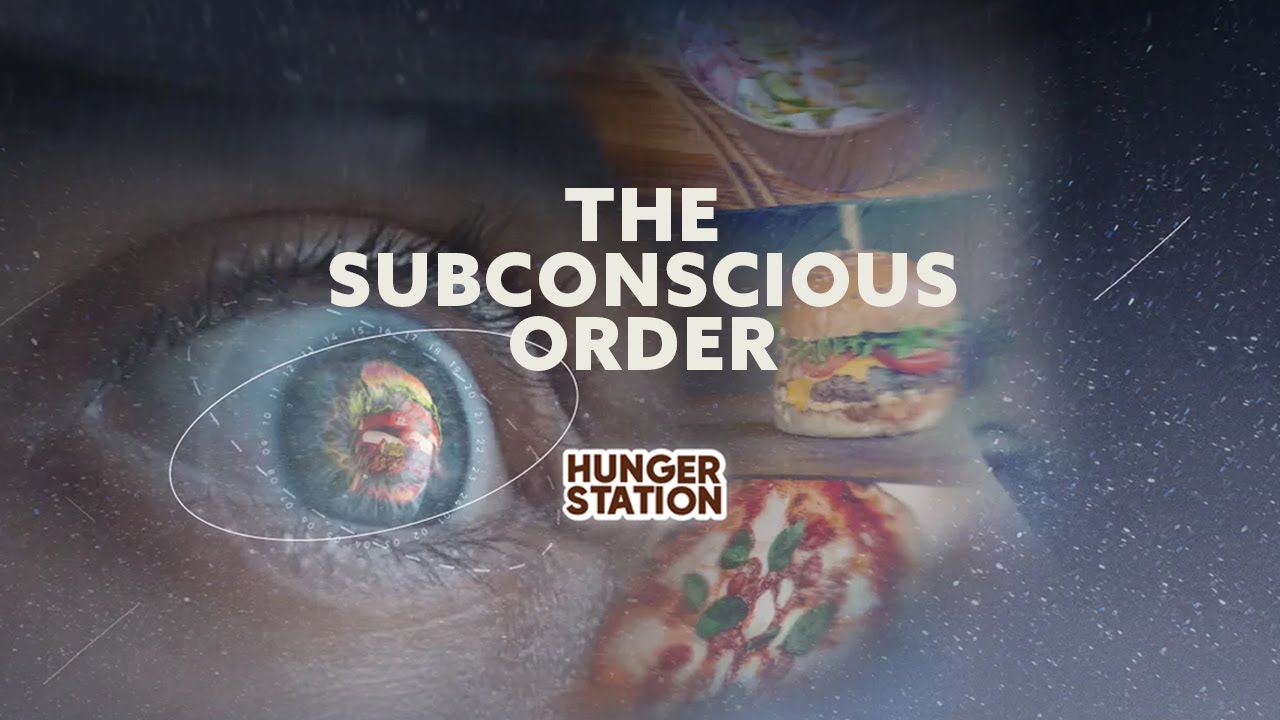
Used eye-tracking technology to let users' subconscious minds choose their food for them.
HungerStation solved choice paralysis by launching a tool that uses eye-tracking technology to monitor subconscious reactions to food images, automatically identifying what a user truly craves before their conscious mind can overthink the decision.
The Tech That Read the Saudi Subconscious
500,000 Times Faster Than Thought
The campaign was built on a staggering scientific premise - while the conscious mind processes only 40 bits of information per second, the subconscious mind operates 500,000 times faster. To bridge this gap, Wunderman Thompson Riyadh collaborated with their Seattle tech office and Global Creative Data team to develop a dual-AI system. The tool utilized Vision AI to track eye movements via the smartphone camera, while Topic Modelling AI categorized food images into "clusters." This allowed the app to identify a user's true craving the moment they began to experience "choice overload" - a state where adults typically spend 132 hours a year staring at menus.
A Global 24-Hour Production Cycle
 The development was a massive cross-continental effort involving Rayyan Aoun, Firas Ghannam, and tech leads Jason Carmel and Shawn Herron. By leveraging teams in Riyadh, Dubai, and Seattle, the project maintained a near-continuous production cycle. The resulting "compressed commerce" model yielded immediate business impact, acquiring 78,000 new customers in just the first two weeks and averaging 6,000 new users per day.
A Landmark for Saudi Vision 2030
Beyond the tech, the project holds significant cultural weight as a milestone for Saudi Vision 2030. Ahmad Chatila and Mohammed Jifri of HungerStation positioned the brand as a pioneer in AI-driven retail. Jury President Nancy Crimi-Lamanna noted that the work set a new global standard by making facial data feel "meaningful" rather than invasive. The campaign's success was further bolstered by a nostalgic companion film, "Blast to the Past," which contrasted this high-tech future with the era before delivery apps existed.
Creative Strategy Deconstructed
Company
HungerStation's position as a local pioneer with the agility to integrate biometric technology into their mobile platform.
Category
Food delivery apps typically compete on speed, price, or variety, often overwhelming users with endless, identical-looking menus.
Customer
HungerStation users spend more time scrolling than eating, eventually feeling frustrated by the choice overload of too many options.
Culture
A growing fascination with AI and bio-hacking where people seek technological shortcuts to optimize their daily lives and decisions.
Company
HungerStation's position as a local pioneer with the agility to integrate biometric technology into their mobile platform.
Category
Food delivery apps typically compete on speed, price, or variety, often overwhelming users with endless, identical-looking menus.
Strategy:
Eliminate cognitive friction by leveraging biometric data to bypass conscious indecision and streamline the path to purchase.
Customer
HungerStation users spend more time scrolling than eating, eventually feeling frustrated by the choice overload of too many options.
Culture
A growing fascination with AI and bio-hacking where people seek technological shortcuts to optimize their daily lives and decisions.
Strategy:
Eliminate cognitive friction by leveraging biometric data to bypass conscious indecision and streamline the path to purchase.
Strategy Technique
Solve a Daily Annoyance
By identifying choice overload as a major friction point in food delivery, HungerStation created a utility that removes the stress of decision-making, making the ordering process effortless.
Explore Technique
Creative Technique
Cutting-edge Tech
The campaign utilizes advanced eye-tracking and AI to turn a biological response into a functional interface, positioning the brand as a technological pioneer solving a universal human frustration.
Explore Technique