Over-Targeting Limits Growth
Tight targeting kills your growth.
Congratulations, you’ve optimized yourself into a corner. You’ve spent millions on 'laser-focused' segments and 'precision' tools, only to realize your growth has stalled harder than a budget car in a blizzard. You’re so busy high-fiving over your high conversion rates among existing fans that you’ve forgotten the rest of the world exists. Here’s the brutal truth: hyper-targeting is just a fancy way of saying 'I’m too scared to talk to new people.' If you want to actually grow, you need to stop preaching to the choir and start shouting at the crowd.
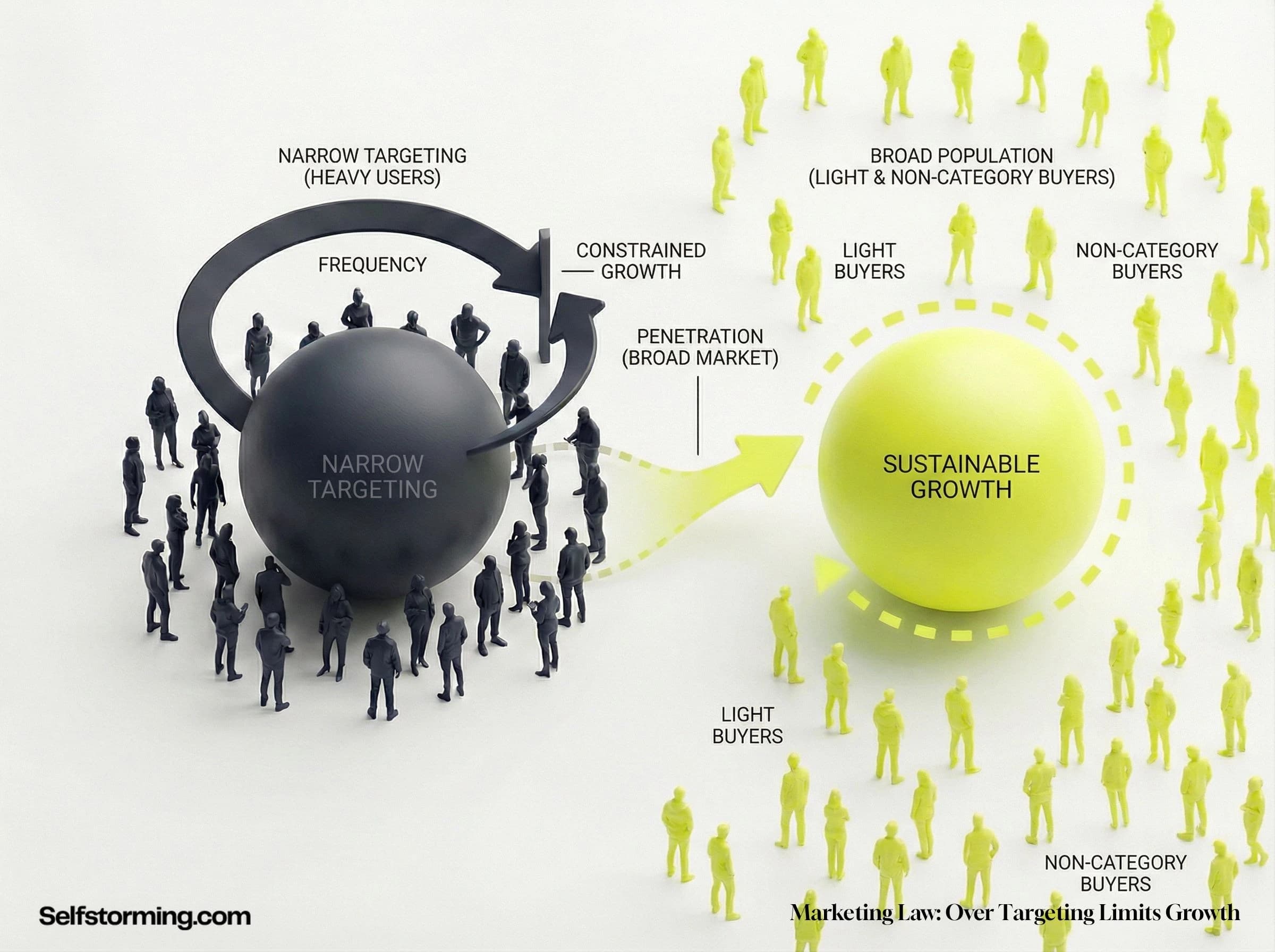
The marketing law 'Over-Targeting Limits Growth' establishes that narrow, hyper-segmented targeting strategies inherently constrain a brand's growth potential by ignoring the vast majority of the category buyers. While precision targeting often yields impressive short-term ROI and conversion metrics, it fails to build the broad mental and physical availability required for long-term expansion. Sustainable brand growth is mathematically dependent on increasing market penetration, which requires reaching 'light buyers'—those who purchase the category infrequently and are often excluded from narrow targeting parameters. By focusing exclusively on 'high-value' segments or existing loyalists, brands suffer from 'audience exhaustion' and fail to replenish the customer pipeline, eventually leading to stagnation as the pool of targeted individuals is depleted or reaches a ceiling of consumption frequency.
OVER-TARGETING LIMITS GROWTH
“Sustainable brand growth is mathematically constrained by narrow targeting because market share expansion depends primarily on increasing penetration among the broad population of light and non-category buyers rather than increasing purchase frequency among a small, heavy-user segment.”
Key Takeaways
- •Market share growth is driven by increasing penetration, not purchase frequency.
- •Light buyers are the primary engine of brand growth and market stability.
- •Hyper-targeting creates an artificial growth ceiling by excluding future customers.
- •Broad reach media is more effective for long-term brand building than precision targeting.
- •High ROAS often indicates low incrementality and a lack of new customer acquisition.
Genesis & Scientific Origin
The principle that over-targeting limits growth was formalized through the extensive longitudinal research of the Ehrenberg-Bass Institute for Marketing Science, most notably popularized by Professor Byron Sharp in the seminal work 'How Brands Grow' (2010). The law is rooted in the empirical observation of the Negative Binomial Distribution (NBD) of purchase frequencies, a statistical model first applied to marketing by Andrew Ehrenberg in the 1950s and 60s. Ehrenberg’s work demonstrated that brand growth is almost always a result of increasing the number of buyers (penetration) rather than getting existing buyers to buy more often. Sharp and his colleagues expanded this by showing that 'target market' mentalities often lead marketers to ignore the very people—light buyers—who are most responsible for driving market share gains.
“Brands typically find that 50% of their sales come from the bottom 80% of their customer base (light buyers).”
The Mechanism: How & Why It Works
The mechanism behind why over-targeting limits growth is both statistical and psychological. At its core, the law operates on the 'NBD-Dirichlet' model of brand competition. This model shows that in any given category, the majority of a brand's customers are 'light buyers' who buy the brand once or twice a year.
Mathematically, if you target only 'heavy users' or 'loyalists,' you are fishing in a very small pond. Because purchase frequency is subject to 'regression to the mean' (the Law of Buyer Moderation), heavy buyers today are likely to buy less tomorrow, while light buyers or non-buyers represent the greatest pool of potential growth. When a brand uses hyper-targeting—such as 'interest-based' or 'lookalike' segments—it creates an artificial ceiling. These algorithms prioritize people with the highest 'propensity to buy' in the immediate term. While this looks great for ROAS (Return on Ad Spend), it ignores the 'pre-search' phase of the consumer journey.
Psychologically, narrow targeting fails to build 'Mental Availability' across the whole category. If 80% of your future growth comes from people who don't currently think about you, but your ads only show up for the 5% who already do, you are effectively invisible to your future revenue. Broad reach ensures that when a light buyer eventually enters the market—perhaps months from now—your brand is already encoded in their memory. Over-targeting sacrifices this long-term memory building for short-term 'activation,' leading to a brand that is highly efficient at converting existing demand but utterly incapable of creating new demand.
Empirical Research & Evidence
A definitive study illustrating this law is found in the Journal of Advertising Research (Newstead, Taylor, Kennedy, & Sharp, 2009). The researchers analyzed the media reach and sales data of 880 brands across various categories. They found that brands with the highest growth rates were those that achieved the widest reach among the entire category-buying population, rather than those that achieved high frequency within a narrow niche.
Specifically, the data showed that 'niche' brands (those with high loyalty but low penetration) were extremely rare and usually represented a failing strategy rather than a successful one. The study demonstrated that for every 10% increase in reach among the total population, there was a significantly higher correlation with long-term market share growth compared to a 10% increase in frequency among a targeted 'core' segment. This research, published as 'The Power of Reach' in the Journal of Advertising Research (Newstead et al., 2009), proved that the 'heavy user' segments targeted by most marketers actually contributed less to total growth than the aggregate of the much larger 'light buyer' segment.
Real-World Example:
Adidas
Situation
For years, Adidas pivoted heavily toward 'digital transformation' and hyper-targeted performance marketing. They focused their budget on high-intent segments, social media retargeting, and 'loyal' enthusiasts, believing that precision would lead to efficiency and growth.
Result
In 2019, Adidas's Global Media Director, Simon Peel, admitted at the Effie Effectiveness Conference that the brand had 'over-invested' in digital and performance marketing at the expense of brand-building. By focusing on narrow, high-converting segments, they had neglected the broad reach needed to drive long-term demand. They found that while their 'targeted' ads had a high ROAS, they weren't actually driving incremental growth; they were just reaching people who were already going to buy. Upon realizing that 65% of their sales actually came from 'first-time' or 'light' buyers who weren't in their targeted performance buckets, Adidas shifted back to a 60/40 brand-to-activation ratio, focusing on broad-reach media to fuel the top of the funnel.
Strategic Implementation Guide
Ditch the 'Persona' Obsession
Stop creating fictional characters like 'Yoga-loving Mike' and start targeting the entire category. If you sell toothpaste, your target is 'people with teeth.' Period.
Prioritize Reach Over Frequency
In your media buying, optimize for unique reach. It is better to reach 100 people once than 10 people ten times. The first exposure does the heavy lifting for memory; the rest is often diminishing returns.
Audit Your 'Wasted' Reach
Most marketers call broad reach 'waste.' Start calling it 'prospecting.' If your ads are seen by people who won't buy today, that's fine—they might buy next year. That's how you build future demand.
Balance the 60/40 Rule
Allocate roughly 60% of your budget to broad-reach brand building (emotionally resonant, wide-net) and 40% to short-term activation. Do not let the efficiency of the 40% trick you into cannibalizing the 60%.
Measure Penetration, Not Loyalty
Change your KPIs. If your 'loyalty' metrics are up but your total customer count is flat, you are dying. Focus on how many *new* or *light* buyers you've touched this quarter.
Use 'Sophisticated Mass Marketing'
Use digital tools not to exclude people, but to ensure you are reaching everyone in the category as cost-effectively as possible. Use broad interests or broad geographic/demographic settings rather than hyper-layered exclusions.
Broaden Your Creative Appeal
Don't make ads that only 'insiders' understand. Your creative should be simple, distinctive, and accessible to someone who has never heard of your brand.
Frequently Asked Questions
Doesn't broad reach mean I'm wasting money on people who will never buy my product?
The 'waste' argument is a fallacy of short-termism. While some viewers may never buy, the cost of trying to perfectly exclude them usually exceeds the cost of just reaching them. More importantly, 'non-buyers' often become buyers later, or influence buyers (the 'social signaling' effect). If you only target current buyers, you never capture the 'entry' moments of new category participants.
Is there ever a time when hyper-targeting is actually better?
Hyper-targeting is effective for 'activation'—getting someone who is already in the market to click 'buy' right now. It is a tool for harvesting demand, not creating it. Use it for clearance sales, limited-time offers, or bottom-of-funnel retargeting, but never rely on it as your primary growth engine.
How do I explain to my CFO that a lower ROAS is actually a good thing?
ROAS is a measure of efficiency, not effectiveness. A high ROAS often means you are only targeting people who were already going to buy (low incrementality). Explain that to grow, the brand must reach 'expensive' new customers (light buyers) to expand the base, which naturally lowers the immediate ROAS but increases total long-term revenue and market share.
Doesn't the 'Long Tail' theory suggest we should target niches?
The 'Long Tail' works for retailers (like Amazon) who can aggregate thousands of niches. It does not work for individual brands. For a single brand, the 'Long Tail' of buyers (the light buyers) is where the volume is. You don't want to be a niche brand; you want to be a mass brand that is bought by many people occasionally.
If I target everyone, won't my messaging become too generic and weak?
Distinctiveness is not the same as targeting. You can have a very bold, unique brand identity (distinctiveness) while still speaking to a broad audience. Think of Nike or Apple—their messaging is universal but their brand is unmistakable. You don't need to change your message for every 'segment' if your brand stands for something fundamentally human.
Sources & Further Reading
Related Marketing Laws
Excess Share of Voice (ESOV)
Brands with higher share of voice than market share tend to grow.
Reach Beats Precision
Broad reach usually outperforms hyper-targeting for growth.
ESOV Multiplier in Recession
ESOV effect is stronger when competitors cut budgets.