Reach Beats Precision

Broad reach beats narrow targeting.

Congratulations. You’ve successfully used 'precision targeting' to stalk three people who were going to buy your product anyway, while the rest of the market forgot you exist. You’re not being efficient; you’re being invisible. If you want to grow, you need to stop whispering in corners and start shouting from the rooftops. In the world of actual data, reach doesn't just 'help'—it beats precision into a pulp every single time. Here is why your obsession with 'the right person at the right time' is the fastest way to a stagnant P&L.
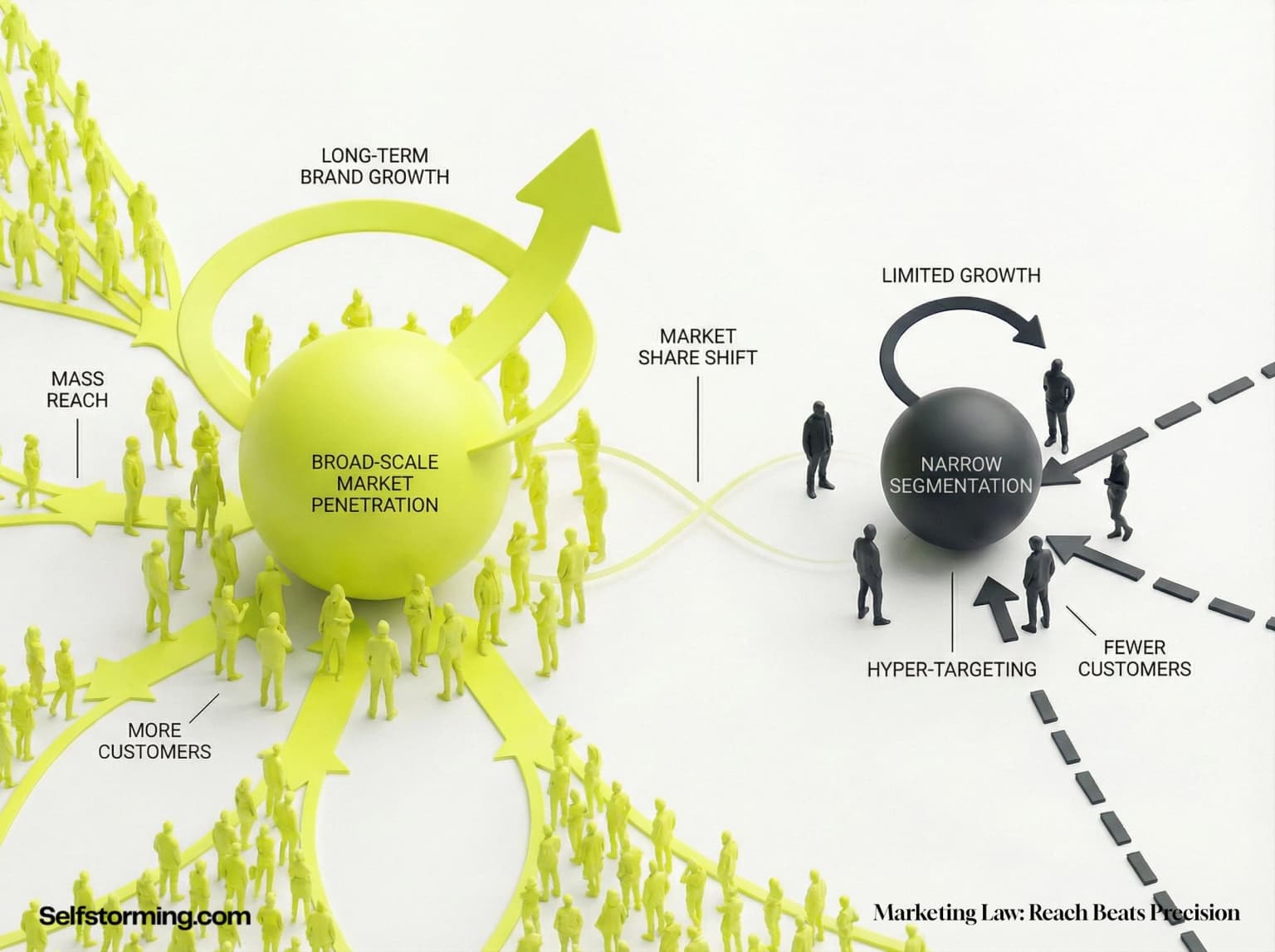
The 'Reach Beats Precision' law posits that broad-scale market penetration is the primary driver of brand growth, consistently outperforming narrow, hyper-targeted strategies. Grounded in the research of the Ehrenberg-Bass Institute and the IPA (Les Binet and Peter Field), this principle demonstrates that targeting 'light buyers' and non-users through mass reach is more effective than focusing on 'heavy users' or specific niches. While precision targeting promises efficiency, it often leads to 'target market fatigue' and ignores the vast majority of potential future buyers. For a brand to grow, it must maximize its mental and physical availability across the entire category, rather than optimizing for a small, already-converted segment. This law shifts the focus from short-term conversion metrics to long-term market share expansion.

REACH BEATS PRECISION

Broad-scale market penetration via mass reach consistently outperforms narrow segmentation and hyper-targeting in driving long-term brand growth and market share.

Reach Beats Precision marketing law: Broad reach beats narrow targeting. - Visual illustration showing key concepts and examples

Key Takeaways

  • Brand growth is driven by penetration, not loyalty or frequency.
  • Light buyers are the most important segment for long-term market share gains.
  • Hyper-targeting creates an 'echo chamber' that prevents new customer acquisition.
  • Mental availability requires being known by people who aren't currently buying.
  • Efficiency is the enemy of effectiveness; don't optimize yourself into irrelevance.

Genesis & Scientific Origin

The scientific foundation of 'Reach Beats Precision' emerged from the decades-long empirical observations of the Ehrenberg-Bass Institute for Marketing Science, led by Professor Byron Sharp. While the industry spent the early 2000s infatuated with 'one-to-one marketing' and digital precision, Sharp’s seminal work, 'How Brands Grow' (2010), utilized the NBD-Dirichlet model of buying behavior to prove that brand growth is a numbers game played across the entire category. This was further reinforced by Les Binet and Peter Field’s analysis of the IPA (Institute of Practitioners in Advertising) Databank. In their 2013 report, 'The Long and Short of It', and subsequent 2017 updates, they analyzed thousands of campaigns to show that reach-based strategies consistently delivered higher business effects, including profit and market share growth, compared to campaigns focused on narrow targeting or loyalty.

Campaigns targeting broad reach are 3x more likely to drive large market share gains than targeted ones (Binet & Field, 2013).

The Mechanism: How & Why It Works

The 'Reach Beats Precision' law functions through several interlocking statistical and psychological mechanisms. First is the Law of Double Jeopardy: smaller brands have fewer buyers, and those buyers are slightly less loyal. To move the needle, a brand must increase its number of buyers (penetration), which requires reaching people who don't currently buy the brand. Second is the 'Heavy Buyer Fallacy.' Marketers often target heavy users because they represent a large chunk of current sales, but heavy users are already at their limit; they have the least potential for growth. Conversely, 'light buyers' (who buy the category once or twice a year) are numerous and offer the greatest aggregate growth potential.

Mathematically, the NBD-Dirichlet distribution shows that a brand's customer base is dominated by light buyers. If you target with high precision, you inevitably exclude these light buyers, cutting off your growth engine. Psychologically, reach builds 'Mental Availability.' By reaching everyone in the category, you ensure that when a light buyer eventually enters a buying situation, your brand is the one that comes to mind. Precision targeting assumes we can predict exactly when someone will be 'in-market,' but data shows we are terrible at this. Broad reach acts as an insurance policy, ensuring the brand is present in the minds of the 95% of the market that isn't buying today, but will buy tomorrow. Furthermore, reach provides 'Signaling.' A brand that is seen by everyone carries more social proof and perceived authority than a brand that only appears in a private, targeted social feed.

Reach Beats Precision mechanism diagram - How Reach Beats Precision works in consumer behavior and marketing strategy

Empirical Research & Evidence

A definitive study on this principle is found in the research published by the Journal of Advertising Research (Romaniuk & Sharp, 2016). In their analysis of brand growth patterns across multiple categories and countries, they found that 100% of growing brands increased their penetration (reach), while loyalty metrics remained largely static. Specifically, Binet and Field's (2013) research published in the Journal of Advertising Research (The Long and Short of It) analyzed over 700 brands in the IPA Databank. They found that campaigns aimed at 'Reach' (broadly defined as targeting all consumers in a category) were nearly 3 times more likely to report very large market share gains compared to those aimed at 'Precision' (targeting existing customers or narrow segments). Their data showed that while precision targeting can drive short-term ROI (efficiency), it fails to drive the absolute volume of sales required for meaningful business growth (effectiveness).

Real-World Example:
Adidas

Situation

In the mid-2010s, Adidas shifted its strategy heavily toward digital performance marketing and hyper-targeting. They focused on 'efficiency'—using CRM data and precision digital tools to target people most likely to buy immediately. They optimized for short-term ROI and 'last-click' attribution, assuming this was the most 'precise' way to spend their budget.

Result

By 2019, Adidas' Global Media Director, Simon Peel, publicly admitted the strategy was a mistake. They discovered that while their 'precision' ads were efficient on paper, they weren't actually growing the brand. By over-investing in targeting existing fans and 'ready-to-buy' segments, they had neglected the broad reach needed to build brand desire among the wider market. They found that 65% of their sales were actually driven by brand-building (reach) rather than performance (precision). Adidas subsequently pivoted back to a 60/40 budget split favoring broad-reach brand advertising, realizing that 'precision' was simply preaching to the choir while the congregation stayed the same size.

Strategic Implementation Guide

1

Stop the 'Niche' Fetish

Define your target audience as 'everyone who buys the category.' If you sell sneakers, your target isn't 'left-handed urban marathon runners'; it's anyone with feet who occasionally buys shoes.

2

Budget for the Unconverted

Allocate at least 60% of your media spend to broad-reach channels (TV, OOH, Broad Digital) that reach non-users and light buyers. The other 40% can be your 'precision' toys.

3

Creative for the Masses

Design your creative to be understood by someone who doesn't care about your brand. Avoid 'insider' language or niche references. It needs to work for the person who sees it once every six months.

4

Measure Reach, Not Clicks

Replace 'Click-Through Rate' and 'Conversion Rate' as your primary KPIs with 'Unique Reach' and 'Share of Voice.' If you aren't reaching 60-80% of the category annually, you aren't growing.

5

Ignore the Loyalty Siren Song

Stop spending money on 'loyalty programs' for your heavy users. They already love you. Spend that money reaching the person who hasn't heard of you yet.

6

Sync Physical and Mental Availability

Ensure that your broad-reach advertising is supported by wide distribution. There's no point in reaching everyone if they can't find your product when they finally look for it.

7

Embrace 'Wasted' Reach

Accept that reaching people who won't buy today isn't 'waste'—it's future-proofing. That 'wasted' impression today is the memory structure that triggers a purchase three years from now.

Frequently Asked Questions

Isn't precision targeting more cost-effective because I'm not wasting money on people who won't buy?

Precision is more *efficient* (lower cost per click), but it is less *effective* (lower total growth). If you only target people 'ready to buy,' you are competing in a hyper-expensive auction for a tiny sliver of the market. Broad reach allows you to reach the 95% of the market that isn't in a competitive bidding war yet, building a preference before they even start the search.

Does Reach Beats Precision mean I should never use Facebook or Google's targeting tools?

No, it means you should use them differently. Instead of using them to find a 'lookalike' of your 100 best customers, use them to reach the broadest possible cross-section of your category. Use digital tools for their scale, not their filters.

Does this law apply to B2B marketing where the 'buying committee' is very small?

Actually, it’s even more critical in B2B. Research by the LinkedIn B2B Institute shows that B2B brands grow by reaching the entire industry, not just the current 'decision makers.' People change jobs, committees rotate, and entry-level employees become directors. Broad reach ensures you are the 'safe' choice across the whole organization.

If I have a small budget, shouldn't I be precise because I can't afford mass reach?

This is the 'Small Brand Trap.' If you have a small budget and you spend it on precision, you will stay a small brand. You are better off reaching a large percentage of a specific geographic area or a specific sub-category broadly than reaching a tiny, 'precise' group nationally.

How do I explain to my CFO that 'wasted' reach is actually an investment?

Explain that 'precision' is a harvest strategy, while 'reach' is a planting strategy. You can't keep harvesting the same 5% of the market forever; eventually, the soil goes dry. Reach is the process of seeding the other 95% of the market so that next year's harvest is bigger.

We use cookies on our site to enhance your user experience, provide personalized content, and analyze our traffic. Cookie Policy