Mental Availability

Being famous is better than being loved.

Look, your 'meaningful differentiation' is a fairy tale you tell yourself to sleep at night. While you're busy polishing your brand purpose and sniffing your own strategic farts, your customers are forgetting you even exist. If you aren't the first thing that pops into their head when they're hungry, tired, or bored, you’re invisible. Mental Availability isn't about being loved; it's about being remembered when it actually matters. Stop trying to win hearts and start trying to colonize neurons, because in the real world, out of mind means out of business. You don't have a 'loyalty problem'; you have a 'they-forgot-you-exist' problem.

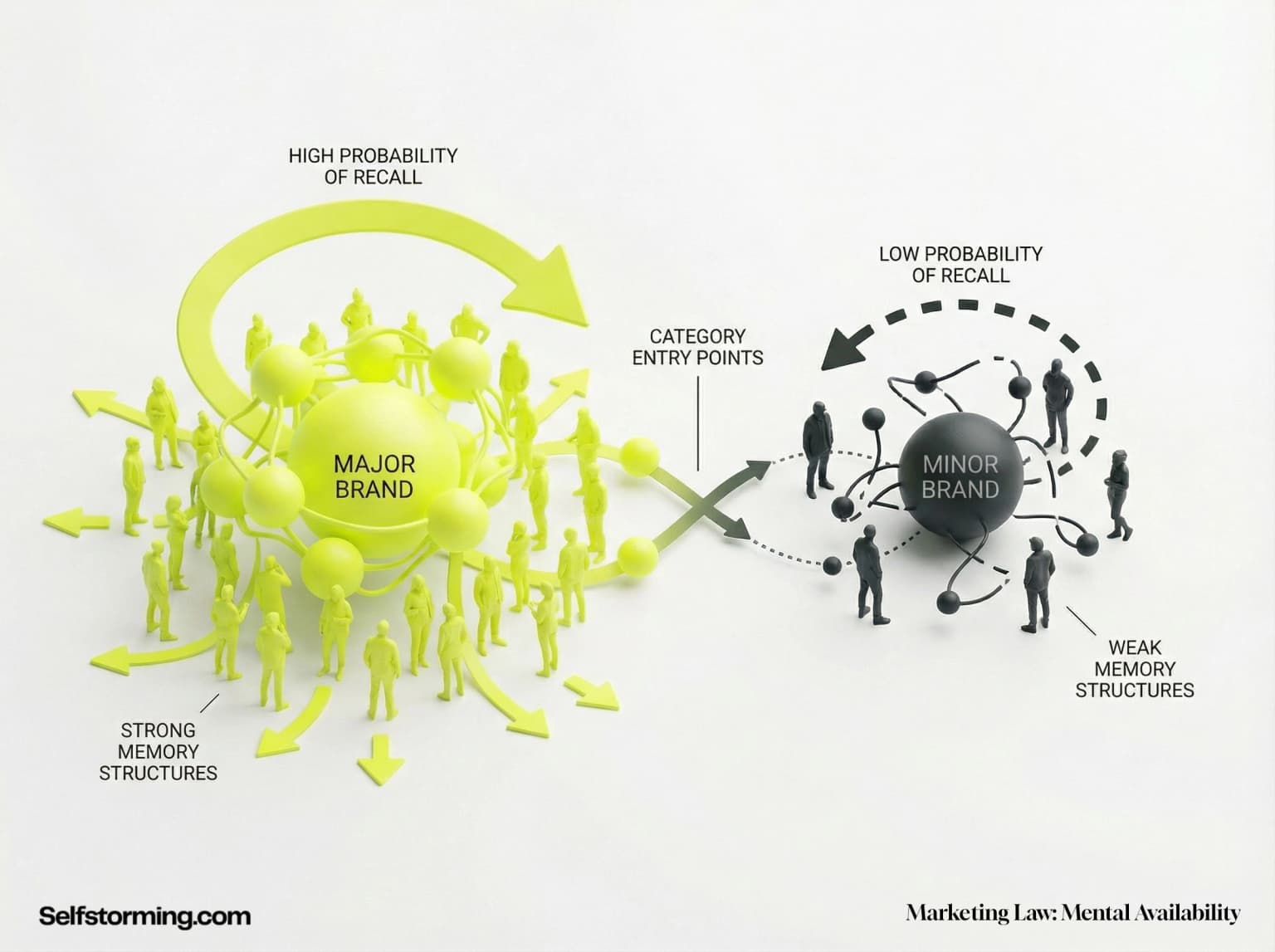
Mental Availability is the propensity of a brand to be thought of in buying situations. Unlike 'brand awareness,' which is a generic measure of recognition, Mental Availability is situational and linked to Category Entry Points (CEPs)—the cues (needs, emotions, locations, or times) that trigger a consumer to consider a purchase. Grounded in the Associative Network Theory of Memory, it posits that brands grow by building and refreshing a vast network of memory structures across the entire category buyer base. High Mental Availability means that when a need arises (e.g., 'I need a quick caffeine hit'), your brand is the one that surfaces from the subconscious. It is the primary driver of market share, as most consumers choose the 'easiest' brand to think of rather than the 'best' brand based on rational evaluation.

MENTAL AVAILABILITY

The probability that a buyer will notice, recognize, and/or think of a brand in a buying situation, dependent on the strength and quality of the brand's memory structures and their linkage to specific category entry points.

Mental Availability marketing law: Being famous is better than being loved. - Visual illustration showing key concepts and examples

Key Takeaways

  • Brands grow by increasing the probability of being thought of during purchase.
  • Category Entry Points (CEPs) are the situational cues that trigger brand recall.
  • Distinctive assets are essential for anchoring brand memories in the consumer's mind.
  • Continuous reach-based advertising is required to prevent memory structure decay.
  • Mental market share is a leading indicator of future physical market share.

Genesis & Scientific Origin

The concept of Mental Availability was formalized and popularized by Professor Byron Sharp and Professor Jenni Romaniuk at the Ehrenberg-Bass Institute for Marketing Science. While the roots of the idea lie in earlier work on brand salience and cognitive psychology, it was the publication of 'How Brands Grow: What Marketers Don't Know' (Sharp, 2010) that shifted the industry paradigm. Sharp and Romaniuk moved the focus away from 'brand image' and 'differentiation'—which they argued are often indistinguishable between competing brands—and toward 'distinctiveness' and 'salience.' Their research leveraged decades of longitudinal data from the Ehrenberg-Bass Institute, demonstrating that brand growth is almost entirely a function of increasing the number of people who think of the brand and the number of situations in which they do so. This work challenged the prevailing Philip Kotler-era obsession with STP (Segmentation, Targeting, Positioning) by proving that brands are mostly 'repertoire' driven and that mental competition is the primary battlefield for market share.

Brands with the highest Mental Availability are 3x more likely to be considered in the final purchase stage (Ehrenberg-Bass Institute).

The Mechanism: How & Why It Works

To understand how Mental Availability works, we must look at the Associative Network Theory of Memory. In the human brain, information is stored in a web of 'nodes' (concepts, brands, colors) connected by 'links.' When a consumer experiences a Category Entry Point (CEP)—a specific trigger like 'I'm at the airport and I'm bored'—their brain activates nodes associated with that situation. If your brand node is strongly linked to that CEP node, you have high Mental Availability in that moment.

There are two dimensions to this: 'Quality' and 'Quantity.' The quantity of Mental Availability refers to how many different CEPs are linked to the brand. A brand like Coca-Cola has massive quantity; it is linked to 'thirst,' 'socializing,' 'meals,' 'holidays,' and 'caffeine.' The quality refers to the strength and freshness of these links. Memory structures are not permanent; they decay over time. This is why continuous, high-reach advertising is essential—not to 'persuade' people with new information, but to 'refresh' existing memory structures and prevent them from fading into the subconscious background.

Crucially, Mental Availability is about 'Salience' rather than 'Awareness.' While awareness is a binary 'Do you know this brand?', salience is the brand's 'share of mind' in a specific context. A consumer might know a brand exists (Awareness) but never think of it when they are actually standing in front of a vending machine (Salience). This mechanism explains why 'Distinctive Assets' (logos, colors, jingles) are more important than 'Differentiation.' Distinctive assets act as the anchors for these memory structures, making the brand easier to identify and retrieve from the mental clutter. When a brand is 'easy' to think of, it reduces the cognitive load for the consumer, making it the path of least resistance in the purchase journey.

Mental Availability mechanism diagram - How Mental Availability works in consumer behavior and marketing strategy

Empirical Research & Evidence

Journal of Advertising Research (Romaniuk & Sharp, 2004). In this seminal study, Romaniuk and Sharp investigated the relationship between brand salience and purchase behavior across multiple categories. They utilized a methodology that moved beyond simple 'Top of Mind' (TOM) metrics, which often only capture the most recent brand used. Instead, they measured 'Brand Salience' as the number of cues (CEPs) a brand was linked to within a consumer's memory. The research involved 1,200 consumers across categories including banking, fast food, and soft drinks.

The data revealed a near-linear correlation between the number of mental links (CEPs) a brand possessed and its market share. Specifically, they found that heavy buyers of a category had more links to more brands, but that the market leader consistently held the highest 'Mental Market Share'—the aggregate number of links across the entire population. One key figure from the study showed that for a leading fast-food brand, 72% of category buyers linked it to more than five distinct CEPs (e.g., 'quick lunch,' 'kids' treat,' 'late night'), whereas a smaller competitor was linked to only 1.2 CEPs on average. The study concluded that brands do not grow by becoming 'more liked,' but by becoming 'more thought of' across a wider variety of situations. This empirical evidence debunked the idea that brands could survive on a 'niche' positioning, proving that without broad mental availability, a brand is statistically destined for the 'Double Jeopardy' trap of low penetration and low loyalty.

Real-World Example:
Snickers (Mars, Inc.)

Situation

In the mid-2000s, Snickers was struggling with stagnating growth. They had been focusing on various 'differentiation' campaigns that highlighted product quality and taste, but they were failing to capture the 'hunger' occasion effectively against competitors like KitKat or local brands.

Result

Mars pivoted to the 'You’re Not You When You’re Hungry' platform. This was a masterclass in Mental Availability. Instead of talking about chocolate quality, they anchored the brand to a universal Category Entry Point: the feeling of being 'hangry' or depleted. By using a highly distinctive, humorous, and consistent creative hook, they built a massive memory structure that linked Snickers to the 'mid-afternoon slump' and 'irritability.' The result was a global increase in sales of over 15% in the first year of the campaign, and it became the top-selling candy bar in the world. They didn't change the product; they just ensured that whenever a human felt a specific type of hunger, the 'Snickers' node in their brain lit up like a Christmas tree.

Strategic Implementation Guide

1

Identify Your CEPs

Conduct research to map the 'Category Entry Points'—the who, what, where, when, and why of your category. Don't guess; find out what people are actually doing when they realize they need a product like yours.

2

Audit Your Distinctive Assets

Identify the non-copy elements (colors, shapes, sounds, characters) that consumers uniquely associate with your brand. If you don't have them, build them. If you have them, never change them.

3

Prioritize Reach Over Frequency

To build Mental Availability, you need to reach as many category buyers as possible. Targeting 'heavy users' or 'loyalists' is a waste of money; you need to remind the 'light buyers' (who make up the bulk of the market) that you exist.

4

Create 'Always-On' Presence

Memory structures decay. Intermittent 'burst' campaigns allow your mental availability to erode. Aim for a continuous presence to keep memory structures refreshed throughout the year.

5

Link Assets to CEPs in Creative

Your advertising shouldn't just be 'pretty'; it must explicitly link your distinctive assets to the CEPs you want to own. Show the situation, show the trigger, and show the brand as the solution.

6

Avoid the 'Differentiation' Trap

Stop trying to prove you are 'better' or 'different' in a way that requires complex logic. Use 'Distinctiveness' to be easily recognized. People buy what they recognize, not what they’ve rationally analyzed as being 2% better.

7

Measure Mental Market Share

Use 'Brand Salience' metrics rather than just 'Awareness.' Track how many CEPs your brand is associated with compared to competitors. If your 'Mental Share' is lower than your 'Market Share,' you are headed for a decline.

Frequently Asked Questions

Isn't Mental Availability just a fancy word for Brand Awareness?

No, and that's the mistake that gets CMOs fired. Awareness is 'Do you know who we are?' Mental Availability is 'Do you think of us when you're actually ready to spend money?' You can have 90% brand awareness but 0% mental availability in a specific situation. If I know your software company exists, but I don't think of you when my server crashes, your awareness is worthless. Mental availability is situational and associative.

Can we own every Category Entry Point (CEP)?

Unless you have a Coca-Cola sized budget, no. You need to prioritize. Start by identifying the 'high-volume' CEPs in your category—the ones most people experience most often. Own those first. As you grow, you can expand your 'mental footprint' into more niche or emerging CEPs. It's a land grab for brain space; start with the most valuable real estate.

Does social media help with Mental Availability?

Only if it reaches a broad audience and uses consistent distinctive assets. Most social media strategy is obsessed with 'engagement' and 'community,' which usually just means talking to the same 500 fans over and over. That does nothing for Mental Availability. To build mental structures, you need scale. If your social content is 'on-trend' but looks nothing like your brand, you're building mental availability for the trend, not your business.

Is Mental Availability more important than Physical Availability?

They are the two pillars of growth, but they are useless without each other. Mental availability makes the brand 'easy to think of,' and physical availability makes it 'easy to buy.' If people think of you but can't find you, you've just done the marketing for your competitor who *is* on the shelf. If you're on the shelf but nobody thinks of you, you're just taking up space until the retailer kicks you out.

Does 'Brand Purpose' build Mental Availability?

Rarely. Most 'purpose' work is too abstract and disconnected from the actual buying situation. Unless your 'purpose' is intrinsically linked to a Category Entry Point (e.g., Patagonia and 'buying durable outdoor gear'), it's just expensive vanity. Consumers don't think about your 'commitment to sustainability' when they are frantically trying to buy a snack before their train leaves. They think about what's familiar and available.

Sources & Further Reading

We use cookies on our site to enhance your user experience, provide personalized content, and analyze our traffic. Cookie Policy