Brand Purpose Rarely Drives Choice

Purpose rarely drives the purchase.

Look, if you actually think people are choosing their laundry detergent based on your stance on global geopolitical stability, you’ve been drinking too much of your own kombucha. Most consumers can barely remember your brand's name, let alone your manifesto. This isn't about being a villain; it's about being realistic. People buy stuff because it works, it's there, and it's familiar—not because you promised to save the rainforest with every click. Let’s stop pretending your corporate 'Why' is anything more than a slide in an HR deck and look at the actual math of how people spend their money.
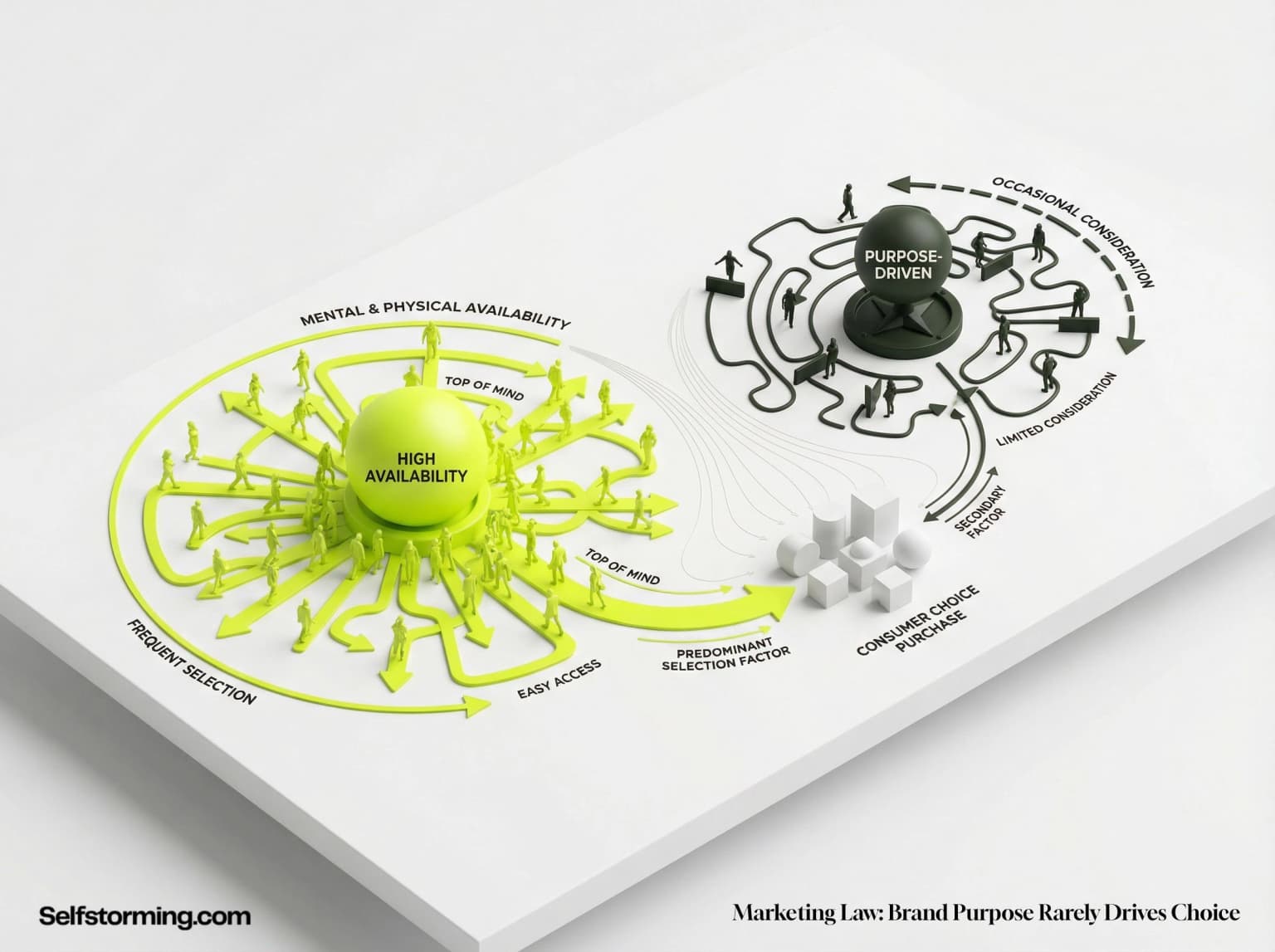
Despite the industry obsession with 'Purpose-led growth,' empirical evidence from the Ehrenberg-Bass Institute and Kantar proves that brand purpose is a negligible factor in the vast majority of consumer purchase decisions. Consumers primarily buy based on mental and physical availability—essentially, can they think of you and can they find you? While purpose can serve as a powerful internal motivator for employees or a shield for ESG compliance, it lacks the 'Category Entry Point' (CEP) relevance required to drive mass-market penetration. For most categories, functional benefits and distinctive brand assets outperform social messaging by a massive margin. Growth is driven by reaching light buyers who don't care about your 'soul,' they just want a product that solves a problem with zero friction.

BRAND PURPOSE RARELY DRIVES CHOICE

Consumers predominantly select brands based on mental and physical availability rather than alignment with a brand’s stated social, environmental, or ethical purpose.

Brand Purpose Rarely Drives Choice marketing law: Purpose rarely drives the purchase. - Visual illustration showing key concepts and examples

Key Takeaways

  • Availability wins: Physical and mental availability drive growth, not moral alignment.
  • The Say-Do Gap: Consumers claim to care about purpose but buy on convenience.
  • Functional first: Categories are defined by needs, not social causes.
  • Light buyers matter: Growth requires reaching people who don't care about your soul.
  • Internal vs External: Purpose is an HR tool, not a consumer magnet.

Genesis & Scientific Origin

The critique of the 'Brand Purpose' movement gained scientific rigor through the work of Byron Sharp and Jenni Romaniuk at the Ehrenberg-Bass Institute for Marketing Science. While the concept of purpose was popularized by consultants like Simon Sinek (2009) and Jim Stengel (2011), their methodology was heavily criticized for 'survivorship bias' and 'correlation-causation fallacies.' In the late 2010s and early 2020s, the Ehrenberg-Bass Institute, alongside longitudinal data from Kantar’s BrandZ database, began publishing findings that dismantled the 'Purpose Paradox,' showing that growth for so-called purpose-led brands was actually driven by standard market laws like Double Jeopardy and Penetration, rather than moral alignment.

Functional attributes are 10x more likely to drive brand choice than social purpose (Vaughan et al., 2021).

The Mechanism: How & Why It Works

The 'Brand Purpose Rarely Drives Choice' law operates on several psychological and statistical foundations. First is the concept of 'Cognitive Miserliness.' Human beings are evolved to minimize the energy spent on trivial decisions. Choosing a toothpaste is a System 1 (fast, intuitive) process. Evaluating a brand's supply chain ethics requires System 2 (slow, analytical) thinking, which consumers almost never apply at the supermarket shelf.

Second is the 'Say-Do Gap.' In surveys, consumers claim they want to buy from ethical brands (social desirability bias). However, sales data consistently shows that price, convenience, and brand familiarity are the actual drivers. This leads to the 'Purpose Paradox': marketers invest in what people say they want, rather than what people actually do.

Third, the mechanism of 'Category Entry Points' (CEPs) explains why purpose fails. People think of brands when they have a specific need (e.g., 'I need a quick caffeine hit' or 'I need to clean this stain'). 'Saving the planet' is almost never a CEP for a functional category. If your brand is linked to 'sustainability' but not to 'effective cleaning,' you will be filtered out of the consideration set before the moral argument even begins.

Finally, the 'Niche Brand Trap' shows that purpose-led messaging often appeals only to a small, high-involvement segment. Because brand growth requires reaching the 'long tail' of light buyers (The Light Buyer Law), a purpose-led strategy that alienates or confuses the mass market is mathematically destined to limit growth potential. Large brands are large because they are easy to buy for everyone, not because they are deeply meaningful to a few.

Brand Purpose Rarely Drives Choice mechanism diagram - How Brand Purpose Rarely Drives Choice works in consumer behavior and marketing strategy

Empirical Research & Evidence

A pivotal study conducted by the Ehrenberg-Bass Institute for Marketing Science (Romaniuk & Sharp, 2022) analyzed the growth of Unilever’s 'Sustainable Living' brands compared to their non-purpose-led counterparts. While Unilever claimed their purpose-led brands grew 69% faster, the Institute's independent analysis revealed that these brands were simply in faster-growing categories or had higher initial penetration levels. When controlled for category growth and the 'Double Jeopardy' law, the 'purpose' effect vanished.

Furthermore, research published in the Journal of Advertising Research (Vaughan, Cook, & Beal, 2021) examined consumer associations across dozens of categories. They found that 'Purpose' attributes were among the least likely to be linked to brand choice. In a study of over 50,000 consumer responses, functional attributes (e.g., 'tastes good', 'reliable') were 10x more likely to be cited as a reason for purchase than social or ethical purpose. The data showed that even for brands with high 'purpose' scores, the majority of their buyers were unaware of the brand's social mission, proving that purchase happened despite the purpose, not because of it.

Real-World Example:
Unilever (specifically Hellmann’s Mayonnaise)

Situation

Unilever's CEO Alan Jope famously declared that every brand in their portfolio must have a 'purpose,' suggesting Hellmann’s purpose was 'fighting food waste.' This became a flashpoint for the evidence-based marketing community.

Result

Terry Smith, a major Unilever investor, publicly lambasted the strategy, noting that the focus on 'purpose' was a distraction from fundamental marketing. Analysis showed that Hellmann’s growth was driven by its dominant market share and physical availability, not because consumers were thinking about food waste while making a sandwich. When the 'purpose' messaging was dialed up, there was no statistically significant lift in penetration that couldn't be explained by traditional media spend and distribution gains. Eventually, Unilever's new leadership pivoted back to 'performance-led' growth, acknowledging that while purpose is good for the world, it is not the primary engine of the P&L.

Strategic Implementation Guide

1

Stop the Purpose-First Budgeting

Audit your marketing spend. If more than 10% of your creative budget is going toward 'manifesto' films that don't mention a product benefit, you are burning cash. Reallocate that to building Mental Availability.

2

Map your Category Entry Points (CEPs)

Identify the actual moments people need your product (e.g., 'late night snack', 'emergency gift'). Ensure your advertising links your brand to these moments, not to abstract social goals.

3

Treat Purpose as a Hygiene Factor

If you want to be ethical, do it in your supply chain and HR policies. Don't make it your lead advertising message unless your product is literally 'Social Justice in a Bottle.'

4

Focus on Distinctive Assets

Spend your energy making your brand recognizable in 0.5 seconds. A distinctive color or logo does more for your bottom line than a 3-minute documentary on your carbon offset program.

5

Target the Light Buyer

Stop trying to deepen the 'relationship' with your super-fans who love your purpose. They already buy you. Talk to the people who don't know you exist and give them a functional reason to care.

6

Measure What Matters

Stop tracking 'Brand Love' or 'Purpose Alignment.' Track Penetration, Mental Availability, and Physical Availability. These are the only metrics that correlate with long-term market share.

7

Internalize the Mission

Use your brand purpose to recruit talent and motivate the team. It belongs in the 'Culture' handbook, not the 'Consumer' campaign.

Frequently Asked Questions

But what about Patagonia? They are huge because of their purpose!

Patagonia is the exception that proves the rule, and even then, you're misreading why they win. They win because they make high-quality gear (functional), have incredible retail footprints (physical availability), and have spent decades building a distinct visual identity (mental availability). People buy the jacket because it’s a status symbol and it’s warm; the 'Save the Planet' stuff is the justification, not the driver.

Doesn't Gen Z only buy from ethical brands?

Gen Z says they only buy ethical brands while they refresh their Shein cart for the third time today. Survey data is a lie. When you look at actual transaction data, Gen Z is just as price-sensitive and convenience-driven as Boomers. They want the 'vibe' of ethics without the 'cost' of ethics.

Are you saying we should be an 'evil' brand?

No, I'm saying you should be a 'competent' brand. Being a good corporate citizen is the baseline for staying in business (ESG), but it's not a marketing strategy. Don't confuse your 'license to operate' with your 'reason to buy.'

Can purpose ever be a tie-breaker?

Rarely. In a world of infinite choice, the 'tie-breaker' is usually whoever is at the front of the shelf or whoever was the last ad the person saw. The mental energy required to use purpose as a tie-breaker is more than most consumers are willing to spend on a $5 purchase.

If purpose doesn't drive choice, why do so many CMOs talk about it?

Because it's easier to win an award at Cannes with a tear-jerker film about saving the whales than it is to grow market share by 1% in a stagnant category. Purpose is 'marketing for marketers.' It makes the job feel more noble, even if it makes the P&L more fragile.

We use cookies on our site to enhance your user experience, provide personalized content, and analyze our traffic. Cookie Policy