Strategy Is Not Messaging

Messaging is the end, not start.

Congratulations on your new tagline. It’s cute, it’s punchy, and it’s also completely useless because you’ve confused a linguistic flourish with a business objective. Most marketers spend six months arguing over the font size of a slogan while their actual market share is being eaten by competitors who actually know who they’re targeting. Strategy is the bloody, boring work of making choices; messaging is the shiny wrapper you put on those choices once they're actually made. If you can't tell the difference, you're not a strategist; you're a copywriter with a terminal case of delusions of grandeur. Let’s fix that before you waste another million dollars on a 'brand refresh' that changes absolutely nothing.

The law of 'Strategy Is Not Messaging' dictates that the tactical output of communication (slogans, copy, creative) must be strictly decoupled from the strategic process of diagnosis, targeting, and positioning. In Evidence-Based Marketing, strategy is defined as the 'where to play' and 'how to win'—a series of hard choices involving market mapping, segmentation, and objective setting. Messaging, conversely, is merely a subset of the 'Promotion' tactic within the broader marketing mix. When marketers lead with messaging, they skip the essential diagnosis phase, resulting in 'empty' creative that lacks commercial utility. High-performance marketing requires a sequential flow: first, a cold-blooded diagnosis of the market; second, a clear strategy that defines targets and positions; and only then, the development of messaging to deliver that strategy to the audience.

STRATEGY IS NOT MESSAGING

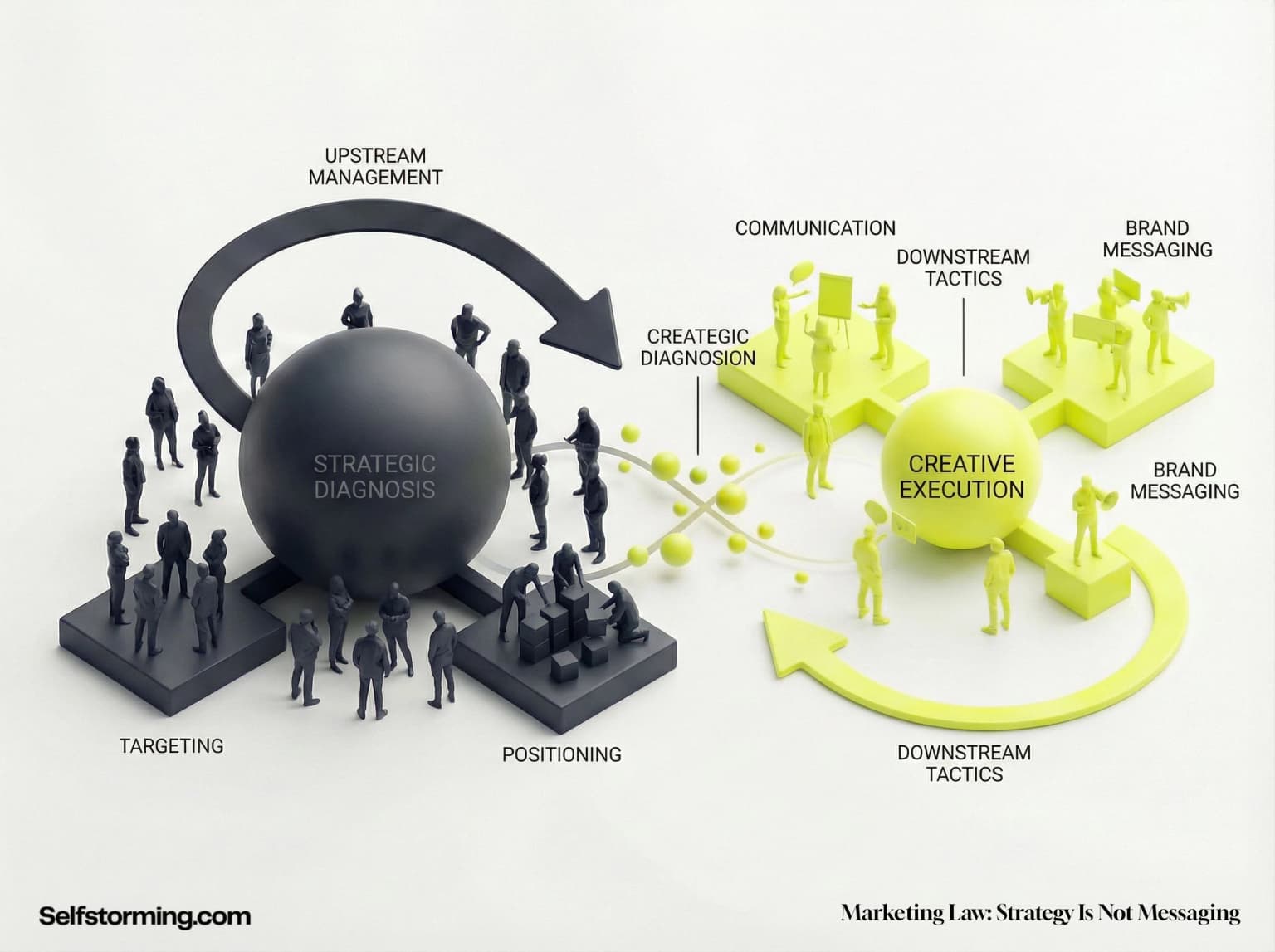
Strategic marketing management is an upstream process of diagnosis, targeting, and positioning that remains distinct from, and prerequisite to, the downstream tactical execution of creative communication and brand messaging.

Strategy Is Not Messaging marketing law: Messaging is the end, not start. - Visual illustration showing key concepts and examples

Key Takeaways

  • Strategy is the 'where to play'; messaging is the 'what to say.'
  • Diagnosis must always precede strategy, and strategy must always precede tactics.
  • A slogan is a tactical output, not a strategic foundation.
  • Strategy requires making hard choices about who you are not targeting.
  • Messaging without strategy is the most expensive way to fail in marketing.

Genesis & Scientific Origin

The distinction between strategy and tactics—and specifically the error of conflating the two—was most rigorously defined in the marketing context by Professor Mark Ritson, drawing heavily on the work of Richard Rumelt. Rumelt’s seminal work, 'Good Strategy/Bad Strategy' (2011), established that strategy requires a 'diagnosis' of the challenge, a 'guiding policy' for dealing with it, and 'coherent actions.' Ritson applied this to the marketing cycle, formalizing the 'Diagnosis -> Strategy -> Tactics' framework. This approach has been championed by the IPA (Institute of Practitioners in Advertising) as a cornerstone of marketing effectiveness, moving the industry away from 'tactical-led' thinking toward 'strategic-led' value creation.

Strategy-led campaigns achieve 2.5x the business impact of tactical-led campaigns (Binet & Field).

The Mechanism: How & Why It Works

The mechanism of this law relies on the hierarchical structure of marketing planning. To understand why strategy is not messaging, one must dissect the three-stage process of Evidence-Based Marketing.

1. The Diagnosis Phase: This is the intellectual heavy lifting. It involves market mapping, where the strategist identifies the total available market and how consumers move through it. It requires U&A (Usage and Attitude) studies, brand tracking, and a brutal SWOT analysis that isn't just a list of bullet points but a genuine assessment of competitive advantage. Without diagnosis, messaging is just guessing.

2. The Strategy Phase: Strategy is about making choices. It consists of three specific levers: Segmentation (grouping the market), Targeting (choosing which segments to ignore), and Positioning (deciding what specific 'mental real estate' the brand should occupy in the mind of the target). This phase is silent. There are no ads here. There are no slogans. There are only spreadsheets, maps, and hard decisions about where the budget will be allocated. If you haven't decided who you aren't targeting, you don't have a strategy.

3. The Tactics Phase: This is where messaging finally appears. Tactics are the 4 Ps: Product, Price, Place, and Promotion. Messaging is a sub-component of Promotion. Its job is to execute the positioning decided in the strategy phase. The 'mechanism' of failure occurs when marketers start at stage 3. When you start with messaging, you are essentially building a bridge without knowing how wide the river is or what’s on the other side. You end up with 'hollow' campaigns that might win creative awards but fail to move the needle on penetration or market share because they aren't anchored in a strategic choice.

Furthermore, the psychological foundation of this law rests on the 'Action Bias.' Marketers feel productive when they are making things (ads, posts, slogans). Strategy, which looks like thinking and saying 'no,' feels like stagnation. However, the data from the IPA Databank consistently shows that campaigns with a clear strategic 'why' (e.g., aiming for penetration rather than loyalty) outperform those that are purely tactical by a factor of nearly 3x in terms of long-term business effects.

Strategy Is Not Messaging mechanism diagram - How Strategy Is Not Messaging works in consumer behavior and marketing strategy

Empirical Research & Evidence

The most compelling empirical evidence for the separation of strategy and messaging comes from the 'The Long and the Short of It: Balancing Short and Long-Term Marketing Tactics' research published in the IPA (Binet & Field, 2013). Their analysis of over 30 years of IPA Databank entries revealed a stark correlation between strategic clarity and commercial success. Specifically, their research demonstrated that campaigns which prioritized the strategic objective of 'Brand Building' (a long-term strategy) over 'Sales Activation' (a short-term tactic/messaging play) achieved significantly higher levels of profit, share, and penetration. Binet and Field's data showed that while messaging-led 'activation' can drive immediate spikes, it has a decay rate that prevents long-term growth. Conversely, strategy-led campaigns—those that defined their target as the 'whole category' (sophisticated mass marketing) and their positioning as emotional and broad—achieved 2.5x the business impact of those that led with tactical messaging or narrow targeting. This confirms that the 'choice' of strategy (broad reach vs. narrow activation) is the primary driver of effectiveness, not the specific creative execution of the message itself.

Real-World Example:
Quibi

Situation

Quibi launched in 2020 with $1.75 billion in funding and a massive messaging campaign focused on 'quick bites' of high-quality content for people on the go. Their messaging was ubiquitous, featuring A-list celebrities and high-production-value ads.

Result

The service folded in just six months. The failure was a classic case of confusing messaging for strategy. Quibi had a 'message' (short-form content for mobile), but it lacked a 'strategy' based on a real diagnosis of consumer behavior. They failed to account for the fact that their target audience already had 'quick bites' (YouTube, TikTok, Instagram) for free. Their positioning didn't solve a problem, and their targeting was based on a demographic myth rather than a behavioral reality. They spent hundreds of millions on 'messaging' a product that had no strategic place in the market.

Strategic Implementation Guide

1

Conduct a Cold-Blooded Diagnosis

Before writing a single word of copy, map your market. Use category data to see who is actually buying, how often, and what the competitive landscape looks like. If you don't have a map, you're lost.

2

Define Your Segments

Break the market down by behavior, not just useless demographics. Understand the 'Jobs to be Done' for each group.

3

Make the 'Targeting' Choice

This is the hardest part. Choose which segments you will actively ignore. Strategy is the art of sacrifice. If you're targeting everyone with the same message, you're not being strategic; you're being lazy.

4

Set Clear Positioning

Determine the one or two distinctive associations you want your brand to own. This is not a slogan; it's a strategic intent (e.g., 'The most reliable' or 'The fastest').

5

Establish Commercial Objectives

Define what success looks like in terms of penetration, market share, or mental availability. 'Increasing engagement' is a metric, not a strategic objective.

6

Brief the Tactics

Only now do you bring in the creatives. Your brief should be: 'Here is our target, here is our positioning, and here are our objectives. Now, give us the messaging that makes this happen.'

7

Measure the Strategy, Not Just the Message

Don't just track ad recall or click-through rates. Track whether you are actually moving the needle on the strategic positioning and penetration goals you set in step 4 and 5.

Frequently Asked Questions

Can't a great slogan actually be the strategy?

Absolutely not. A slogan like 'Just Do It' is a tactical execution of a positioning strategy centered on 'authentic athletic performance.' The strategy is the decision to target every athlete and position the brand as the enabler of their potential. The slogan is just the linguistic vehicle. If Nike didn't have the distribution, product innovation, and athlete endorsements to back it up, the slogan would be meaningless noise.

What if my client/boss demands a 'messaging strategy'?

Politely point out that 'messaging strategy' is an oxymoron. You have a 'Communication Plan' that supports a 'Marketing Strategy.' When people ask for a messaging strategy, they usually mean they want to skip the diagnosis and get straight to the 'fun' part. Your job is to pull them back to the diagnosis phase before they burn the budget.

Does this mean creative doesn't matter?

Creative matters immensely, but only as a multiplier of strategy. A brilliant ad for a fundamentally flawed strategy (e.g., targeting the wrong people with a price they won't pay) just helps the brand fail faster. Strategy sets the direction; creative provides the engine. An engine without a steering wheel is just a dangerous explosion.

How do I know if I'm doing strategy or just messaging?

Ask yourself: 'Have I made a choice that involves saying no to a specific group of people or a specific product feature?' If the answer is no, you're doing messaging. Strategy is defined by exclusion. Messaging is often about inclusion and trying to please everyone.

Is 'Brand Purpose' a strategy or messaging?

In 95% of cases, it's messaging—and usually bad messaging. Purpose only becomes strategy if it fundamentally changes the 4 Ps (e.g., Patagonia's supply chain and business model). If it's just a 'purpose-driven' ad campaign while the business operates as usual, it's just tactical fluff.

We use cookies on our site to enhance your user experience, provide personalized content, and analyze our traffic. Cookie Policy