Loyalty Programs Rarely Drive Growth

Loyalty cards don't create new fans.

Look, I get it. You want to feel loved. You want a 'meaningful relationship' with your customers. Newsflash: they don't want a relationship with your detergent brand; they want to buy it and forget you exist. Your loyalty program isn't 'driving engagement'; it's a glorified subsidy for people who were already going to buy from you. You’re essentially paying your best customers to keep doing exactly what they’re already doing, while your competitors are out there actually growing by talking to people who don't know they exist. It’s a statistical suicide note written in points and rewards. Your CRM is a very expensive digital paperweight, and it's time we talked about why.
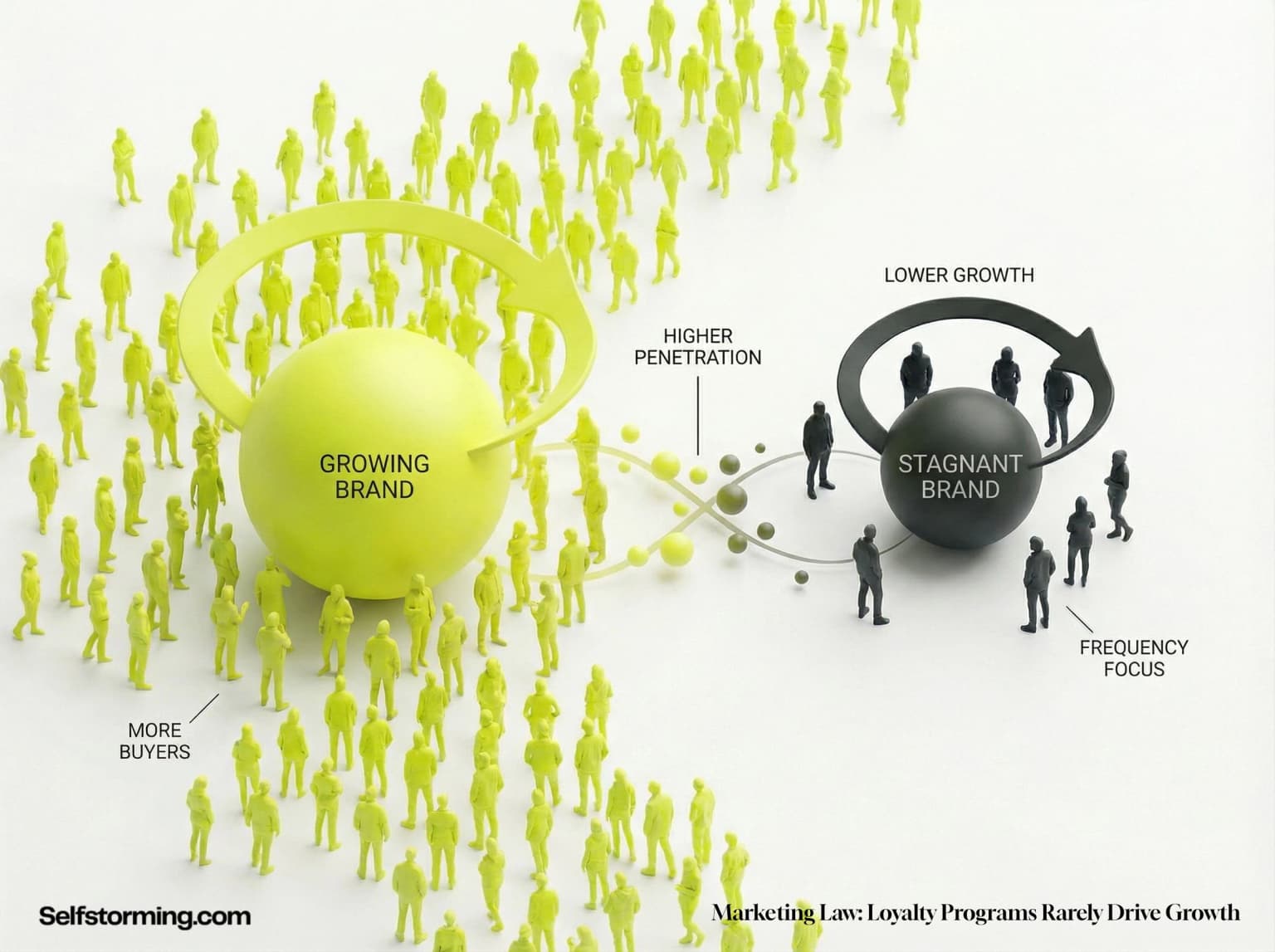
The 'Loyalty Programs Rarely Drive Growth' law, rooted in decades of research by the Ehrenberg-Bass Institute, posits that loyalty is a byproduct of brand size (Double Jeopardy) rather than a driver of it. These programs primarily attract and reward a brand's heaviest existing users—those who would have purchased anyway—while failing to recruit the 'light buyers' essential for market share expansion. Mathematically, loyalty levels are remarkably stable across a category; therefore, attempting to 'buy' loyalty through rewards is an inefficient use of capital. Instead of changing consumer behavior, these schemes act as a 'loyalty tax,' increasing costs without significantly altering the brand's penetration or long-term growth trajectory. Real growth comes from increasing mental and physical availability, not from gamifying the behavior of your most frequent fans.

LOYALTY PROGRAMS RARELY DRIVE GROWTH

Brand growth is fundamentally driven by increasing the number of buyers (penetration) rather than increasing the purchase frequency of existing customers through loyalty-based incentives.

Loyalty Programs Rarely Drive Growth marketing law: Loyalty cards don't create new fans. - Visual illustration showing key concepts and examples

Key Takeaways

  • Loyalty is a result of market share, not a cause of it.
  • Loyalty programs primarily reward existing heavy users who would buy anyway.
  • Growth requires reaching light buyers, who rarely join loyalty programs.
  • The Dirichlet model accurately predicts loyalty based on brand penetration.
  • Retention-focused strategies cannot offset the natural 'Leaky Bucket' rate of customer loss.
  • Loyalty programs often act as a 'loyalty tax' on profitable existing customers.

Genesis & Scientific Origin

The scientific debunking of loyalty programs as growth engines was pioneered by Andrew Ehrenberg and further codified by Professor Byron Sharp and the team at the Ehrenberg-Bass Institute for Marketing Science. The foundational logic was laid out in Ehrenberg's 1988 book 'Repeat-Buying' and later popularized in Sharp’s seminal work 'How Brands Grow' (2010). The law is a direct corollary of the 'Double Jeopardy Law,' which Ehrenberg first observed in the 1960s. The institute's research, spanning dozens of categories and countries, consistently shows that loyalty programs do not provide a competitive advantage in terms of customer retention or purchase frequency. Key publications include research from the Journal of Advertising Research and the European Journal of Marketing, which have repeatedly demonstrated that loyalty program members behave almost identically to non-members when you control for their prior purchase frequency.

Loyalty program members typically show no 'excess loyalty' beyond what is predicted by their brand's market share.

The Mechanism: How & Why It Works

The mechanism behind this law is rooted in the Dirichlet model of brand competition, a NBD (Negative Binomial Distribution) based statistical framework. This model demonstrates that 'loyalty' is not a psychological state but a statistical outcome of market share. Because of the Double Jeopardy Law, brands with smaller market share naturally have fewer buyers who also buy the brand slightly less often. Conversely, large brands have many more buyers who buy the brand slightly more often.

When a brand implements a loyalty program, it attempts to bypass this law by artificially increasing purchase frequency. However, the 'Leaky Bucket' theory proves that all brands lose customers at a rate proportional to their market share; you cannot 'plug' the bucket with rewards. Furthermore, the 'Heavy Buyer' fallacy leads marketers to focus on the top 20% of customers. In reality, these customers are already at their ceiling of consumption for the category. You cannot make someone who eats cereal every morning eat it twice a day just because they have a reward card.

Most importantly, loyalty programs fail because of 'Repertoire Buying.' Consumers are not 100% loyal to one brand; they have a portfolio of 3-5 brands they find acceptable. A loyalty program might slightly shift the timing of a purchase, but it rarely expands the repertoire or increases the total category spend. Consequently, the program ends up rewarding 'polygamous' loyalty rather than creating 'monogamous' devotion. The costs of the rewards, the infrastructure, and the communication often exceed the marginal profit gained from any slight increase in frequency, leading to a net loss in ROI compared to penetration-focused activities.

Loyalty Programs Rarely Drive Growth mechanism diagram - How Loyalty Programs Rarely Drive Growth works in consumer behavior and marketing strategy

Empirical Research & Evidence

One of the most definitive studies on this topic is Sharp and Sharp's (1997) research published in the Journal of Advertising Research. The researchers analyzed data from a large-scale panel in Australia, examining 11 different loyalty programs across various consumer goods categories. The study utilized the Dirichlet model to predict what loyalty levels should be based on market share and compared them to the actual loyalty levels of program members.

The results were staggering: the loyalty programs provided almost no 'excess loyalty.' The repeat-purchase patterns of members were almost entirely predictable based on the brand's market share alone. Specifically, the study found that members of loyalty programs were already heavier buyers of the brand before joining the program. The programs were not creating new behavior; they were merely identifying and discounting the behavior of existing heavy users. The research concluded that loyalty programs are ineffective at changing the fundamental structure of brand competition and that the 'loyalty' observed is a function of the brand's existing penetration, not the program itself.

Real-World Example:
Tesco (Clubcard)

Situation

Tesco launched its Clubcard in 1995, often cited as the 'gold standard' of loyalty programs. For years, it was credited with Tesco's rise to market dominance in the UK. Competitors scrambled to launch their own versions (Sainsbury’s Nectar, etc.), leading to a 'loyalty arms race' in the grocery sector.

Result

Long-term analysis by the Ehrenberg-Bass Institute and other researchers showed that Tesco's growth was actually driven by massive physical expansion (opening more stores/penetration) rather than the Clubcard itself. As the market matured and competitors matched the rewards, Tesco's market share began to stagnate and eventually decline in the face of Aldi and Lidl—brands with zero loyalty programs but superior physical and mental availability (and lower prices). The Clubcard became a massive fixed cost—a 'loyalty tax'—that Tesco eventually had to significantly restructure because it was no longer driving incremental growth, only subsidizing the existing shopping habits of a declining base.

Strategic Implementation Guide

1

Step 1

Stop treating your loyalty program as a growth strategy. It's a data-collection tool and a defensive tactic, nothing more. If you expect it to grow your market share, you're delusional.

2

Step 2

Audit your current 'loyalists.' Map out how much they were buying before they joined. You’ll likely find you’re just giving discounts to people who were already your biggest fans. That’s not marketing; that’s a charity.

3

Step 3

Reallocate the 'Loyalty Tax.' Take 30-50% of the budget you spend on points and plastic cards and put it into broad-reach media. You need to talk to the 'light buyers'—the people who buy you once a year or haven't even heard of you.

4

Step 4

Simplify the rewards to minimize friction. If a customer needs a PhD to understand your points system, they won't change their behavior; they'll just ignore you. Make it invisible or get rid of it.

5

Step 5

Use the data, ignore the 'loyalty.' The only real value of these programs is the first-party data. Use it for supply chain optimization and physical availability planning, not for sending 'We miss you' emails that people delete immediately.

6

Step 6

Focus on Mental Availability. Instead of rewarding a purchase after it happens, spend your energy making sure your brand is the first one they think of at the moment of choice. Points don't build memory structures; distinctive assets do.

7

Step 7

Measure Penetration, not Retention. Change your KPIs. If your penetration isn't growing, your brand is dying, regardless of how many people are 'enrolled' in your rewards club.

Frequently Asked Questions

Doesn't it cost 5x more to acquire a new customer than to retain an existing one?

This is one of the most persistent and damaging myths in marketing. It's based on flawed accounting that ignores the reality of the 'Leaky Bucket.' You cannot 'retain' your way to growth because all brands lose customers. Furthermore, the 'cost' of acquisition is often exaggerated because marketers fail to account for the long-term value of a new buyer who enters the repertoire. In reality, the only way to grow is to acquire more customers than you lose, which requires focusing on acquisition (penetration) rather than retention.

What about Starbucks? Their loyalty app is incredibly successful.

Starbucks is a high-frequency habit, not a loyalty program success story. People use the app because it reduces friction (Physical Availability)—ordering ahead and paying easily. The 'loyalty' is a byproduct of their massive physical presence and the convenience of the app, not the free lattes. Most people in the Starbucks program were already daily coffee drinkers. The app just made it harder for them to switch to a competitor on a whim.

Can loyalty programs work for niche, high-end brands?

Even for niche brands, the Dirichlet model holds. Small brands have small loyalty. A luxury brand grows by becoming more well-known (Fame) and accessible to a wider audience of occasional buyers, not by giving its three best customers a free leather keychain. Niche brands are just small brands waiting to grow or die; they aren't exempt from the laws of marketing science.

If loyalty programs don't drive growth, why does every big brand have one?

It's largely due to 'Alienation Paranoia' and 'FOMO.' Marketers are terrified that if they stop their program, they'll lose their best customers to a competitor who has one. It’s a defensive stalemate. Most brands are stuck in a 'loyalty trap' where they spend millions to maintain a program that doesn't grow the brand, simply because they don't have the guts to be the first to quit and spend that money on something that actually works.

Should we just cancel our loyalty program entirely?

Not necessarily. If you use it purely for data collection and it's cost-effective, keep it. But stop calling it a 'growth engine.' Recognize it for what it is: a customer service feature or a data play. If the cost of the rewards is eating into your ability to fund broad-reach advertising, then yes, kill it or scale it back significantly.

We use cookies on our site to enhance your user experience, provide personalized content, and analyze our traffic. Cookie Policy