Repertoire Buying Behaviour

Your customers are cheating on you.

Look, I hate to be the one to tell you this, but your 'loyal' customers are cheating on you. Probably right now. They aren't the brand-obsessed disciples your agency's mood board promised. They are busy, distracted humans who keep a mental shortlist of 'good enough' brands and pick whichever one is easiest to grab. You aren't their soulmate; you're just a recurring guest star in their lives. If you want to grow, you need to stop acting like a jealous ex and start understanding the cold, hard math of repertoire buying. It’s not personal; it’s just how brains work.
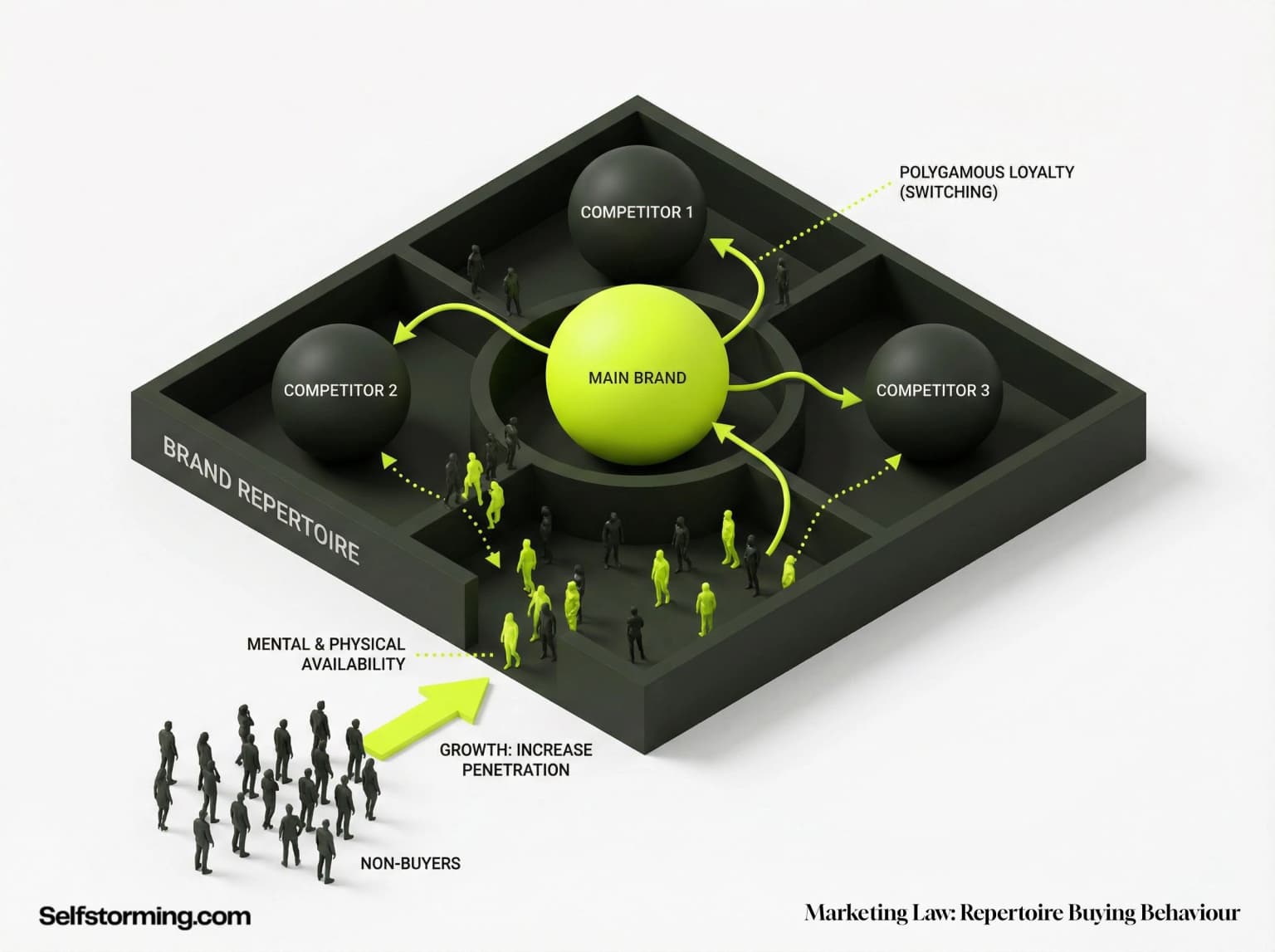
Repertoire Buying Behaviour is the empirical reality that consumers in almost all categories do not buy exclusively from one brand. Instead, they maintain a 'repertoire' of acceptable brands and switch between them over time. This 'polygamous loyalty' is the norm, not the exception. The Dirichlet model mathematically predicts this behavior, showing that even the most 'loyal' customers of a brand also purchase from competitors. For marketers, this means the goal isn't to create 'brand love' or exclusive loyalty—which is statistically rare—but to ensure your brand is part of the consumer's mental repertoire and is physically available at the point of purchase. Growth is driven by increasing the number of people who include you in their repertoire, rather than trying to increase the 'share of wallet' of existing buyers.

REPERTOIRE BUYING BEHAVIOUR

Consumers systematically rotate their purchases across a set of acceptable brands within a category, exhibiting polygamous loyalty rather than exclusive commitment to a single brand.

Repertoire Buying Behaviour marketing law: Your customers are cheating on you. - Visual illustration showing key concepts and examples

Key Takeaways

  • Consumers buy multiple brands in a category, not just one.
  • Exclusive loyalty is a myth driven by low purchase frequency.
  • Your customers are actually category buyers who occasionally buy you.
  • Growth requires increasing penetration, not increasing frequency of existing buyers.
  • Mental and physical availability determine which repertoire brand is chosen.

Genesis & Scientific Origin

The concept of Repertoire Buying Behaviour was pioneered by Andrew Ehrenberg and his colleagues at the London Business School, eventually forming the cornerstone of the Ehrenberg-Bass Institute for Marketing Science. While early marketing theory (and many modern textbooks) assumed that consumers were either 'loyal' or 'switchers,' Ehrenberg’s research in the 1950s and 60s revealed a different pattern. The definitive formalization came with the development of the NBD-Dirichlet model of brand choice, most notably detailed in the landmark paper 'The Dirichlet: A Comprehensive Model of Buying Behaviour' published in the Journal of the Royal Statistical Society (Goodhardt, Ehrenberg, & Chatfield, 1984). This work proved that brand choice is a stochastic (probabilistic) process, not a result of deep-seated psychological commitment.

In most categories, less than 10% of buyers are 'sole loyalists' over a year.

The Mechanism: How & Why It Works

The mechanism behind repertoire buying is rooted in both cognitive psychology and statistical probability. Humans are cognitive misers; we don't want to spend precious mental energy evaluating every single option every time we buy toothpaste or cloud software. Instead, we develop a 'repertoire'—a subset of brands we've tried and found acceptable.

Mathematically, this is explained by the Dirichlet model. The model assumes that: 1. Consumers have different long-run 'propensities' to buy from the category (some buy often, some rarely). 2. Consumers have different long-run 'probabilities' of choosing a specific brand within that category.

Crucially, these choices are independent of the previous purchase. If you bought Brand A last time, your probability of buying Brand B next time remains constant based on your long-term repertoire. This leads to 'polygamous loyalty.' A consumer might buy Brand A 60% of the time, Brand B 30% of the time, and Brand C 10% of the time. They aren't 'switching' in the sense of leaving Brand A; they are simply fulfilling their repertoire.

Psychologically, this is driven by 'Mental Availability.' A brand enters the repertoire through distinctive assets and consistent memory building. Once in the repertoire, the specific choice at the shelf or screen is often determined by 'Physical Availability'—is the brand there, and is it easy to buy? The 'Sole Loyalist' (someone who buys only one brand) is almost always a 'Light Buyer' of the category. They look loyal only because they've only made one purchase in the data window. As soon as they buy more frequently, they inevitably become repertoire buyers.

Repertoire Buying Behaviour mechanism diagram - How Repertoire Buying Behaviour works in consumer behavior and marketing strategy

Empirical Research & Evidence

The most robust evidence for repertoire buying comes from the long-term analysis of consumer panels across hundreds of categories. One seminal study published in the Journal of the Royal Statistical Society (Goodhardt, Ehrenberg, & Chatfield, 1984) analyzed purchase data for FMCG brands in the UK and US. The researchers found that the Dirichlet model accurately predicted the brand-switching patterns of consumers with startling precision. For example, in the breakfast cereal category, the data showed that 'sole loyalists' (those buying only one brand over a year) accounted for less than 10% of total sales. Furthermore, the study demonstrated that the customers of any given brand bought other brands in the category in direct proportion to those other brands' market shares. This 'Duplicate of Purchase Law' is the ultimate proof of repertoire buying: your customers are simply the category's customers who happen to buy you occasionally.

Real-World Example:
Coca-Cola vs. Pepsi

Situation

For decades, the 'Cola Wars' were fought on the premise of 'The Pepsi Challenge'—the idea that you could convert a Coke lover into a Pepsi lover through a taste test. Marketers believed in 'Brand Monogamy'—that a household was either a 'Coke House' or a 'Pepsi House.'

Result

Analysis of panel data by the Ehrenberg-Bass Institute revealed the 'Repertoire' reality. It turns out that the vast majority of heavy cola drinkers buy both Coca-Cola and Pepsi over a 12-month period. When Coke is on sale, they buy Coke. When they are at a restaurant that only serves Pepsi, they buy Pepsi. The 'loyalty' wasn't a psychological barrier; it was a matter of which brand was mentally and physically available at the moment of choice. Coca-Cola's growth didn't come from 'stealing' Pepsi's loyalists and making them exclusive; it came from ensuring Coke was the most prominent and easiest-to-find option in the repertoire of every cola drinker.

Strategic Implementation Guide

1

Stop Tracking 'Brand Love'

Switch your KPIs from 'Brand Affinity' or 'Net Promoter Score' to 'Mental Availability' and 'Category Entry Points.' Your job isn't to be loved; it's to be thought of.

2

Maximize Physical Availability

Since consumers switch between a repertoire of brands, being 'out of stock' or 'hard to find' is a death sentence. You must be where the category is bought, 100% of the time.

3

Build Distinctive Assets

Use colors, logos, and taglines consistently. In a repertoire world, the consumer needs to recognize you instantly on a crowded shelf or search results page without thinking.

4

Target the Whole Category

Don't just target 'your' buyers. Target everyone who buys the category. Since everyone is a repertoire buyer, every category buyer is a potential 'you' buyer next Tuesday.

5

Embrace the 'Duplicate of Purchase' Law

Accept that your buyers will buy your competitors. Don't waste budget trying to 'win them back'—they never left; they're just participating in the category.

6

Focus on Acquisition, Not Retention

Growth comes from increasing penetration (more people putting you in their repertoire) rather than trying to squeeze more volume out of existing 'loyalists.'

7

Identify Category Entry Points (CEPs)

Map out the situations in which people buy your category (e.g., 'I need a quick snack,' 'I'm hosting a party') and link your brand to these cues to enter more repertoires.

Frequently Asked Questions

Does Repertoire Buying mean brand differentiation is useless?

Not useless, but misunderstood. You don't need to be 'meaningfully different' in a way that makes people love you more; you need to be 'distinctive' so they can find you easily. Differentiation often fails because consumers don't perceive the 'meaningful' part, but they can't ignore a bright orange box. Differentiation is for the strategy deck; distinctiveness is for the checkout line.

What about 'Superfans' or 'Brand Evangelists'?

They exist, but they are statistically insignificant for growth. They are the 'heavy buyers' who represent a tiny fraction of your total buyer base. If you focus your entire strategy on them, you ignore the 90% of your market (the light buyers) who actually drive your market share growth. Don't build a business on the exceptions.

Is sole loyalty ever possible?

Yes, but it's usually a function of lack of choice (monopoly) or very low purchase frequency. If someone only buys a car once every 10 years, they look 'solely loyal' to the brand they bought. If they bought a car every week, you'd see a repertoire. Sole loyalty is a data artifact, not a marketing goal.

Does this apply to B2B as well as FMCG?

Absolutely. B2B buyers have 'vendor lists' which are essentially repertoires. A company might use AWS for some services, Azure for others, and Google Cloud for a specific project. They rotate based on project needs, pricing, or existing contracts. The Dirichlet model holds up across almost every category where there is competition.

Should I stop my loyalty program?

Most loyalty programs are actually 'heavy buyer rewards programs.' They don't change behavior; they just subsidize the people who were going to buy you anyway. If your loyalty program helps with data collection or physical availability (like a 'one-click' app), keep it. If you think it's creating 'emotional' loyalty that prevents switching, you're dreaming.

We use cookies on our site to enhance your user experience, provide personalized content, and analyze our traffic. Cookie Policy