Physical Availability

Convenience beats loyalty every time.

Stop obsessing over your brand's 'soul' or whatever other fluff your agency sold you during that expensive retreat. Your customers aren't loyal; they're lazy. If they can't find you in three seconds while juggling a screaming toddler and a mid-life crisis, you don't exist. Physical availability isn't about being 'present'; it's about being unavoidable. If you aren't where the money is, your fancy 'purpose-driven' campaign is just expensive wallpaper. You're not losing because your 'why' isn't strong enough; you're losing because you're out of stock or buried on page four of the search results.

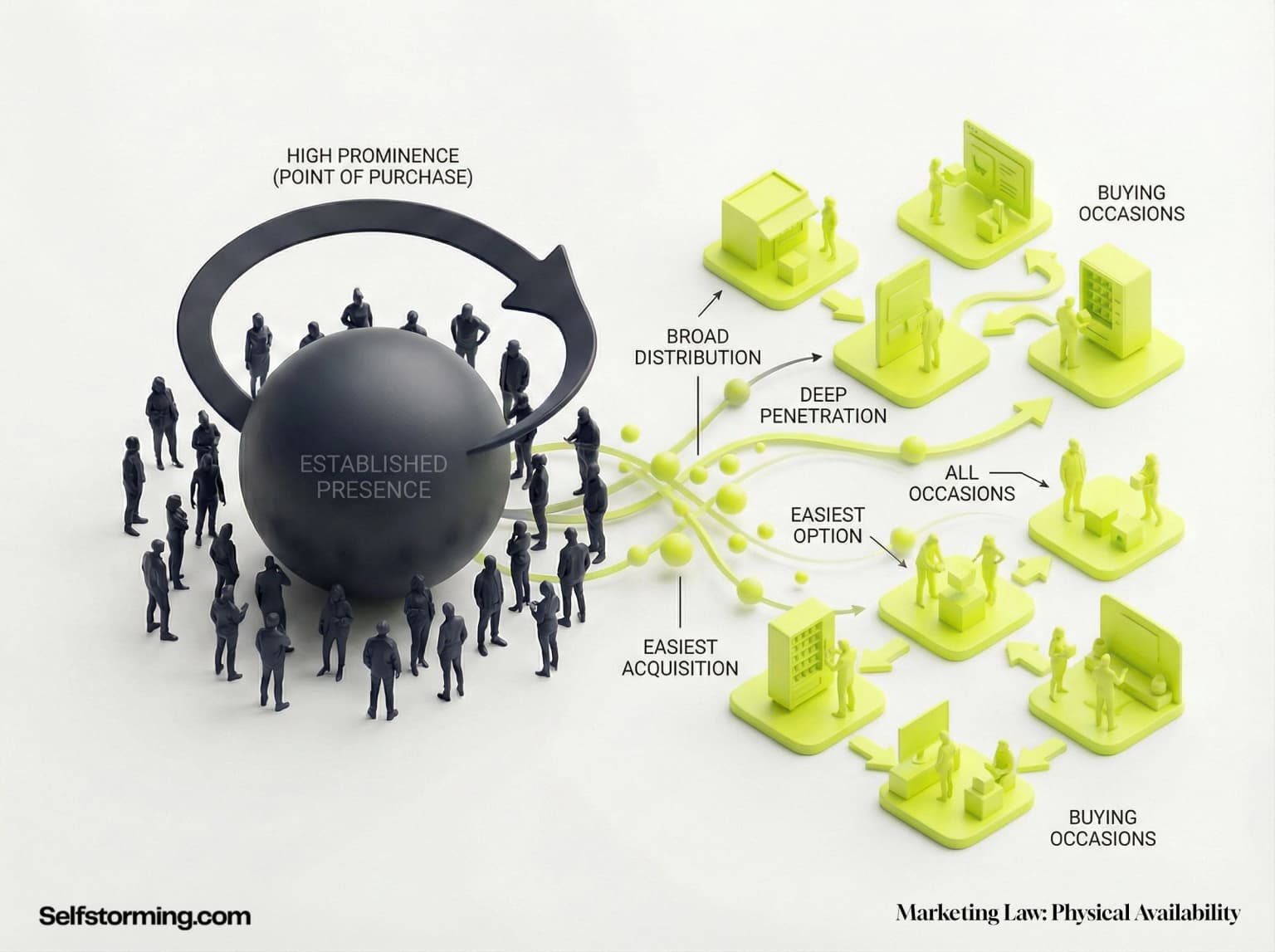
Physical Availability is the logistical half of the growth equation, working in tandem with Mental Availability to drive market share. It dictates that for a brand to grow, it must be easy to find and buy across as many purchase occasions as possible. This involves three core dimensions: Presence (being in the right stores/channels), Prominence (being visible on the shelf or screen), and Portfolio (offering the right formats for the occasion). Scientific evidence from the Ehrenberg-Bass Institute proves that the primary difference between big and small brands isn't the 'depth' of consumer love, but the 'breadth' of their physical distribution. Growth is achieved by removing friction and maximizing the probability of being the easiest choice at the moment of truth.

PHYSICAL AVAILABILITY

A brand’s market presence is defined by the breadth and depth of its distribution and its prominence at the point of purchase, ensuring it is the easiest option to acquire across all potential buying occasions.

Physical Availability marketing law: Convenience beats loyalty every time. - Visual illustration showing key concepts and examples

Key Takeaways

  • Distribution is not a tactic; it is the primary engine of market share growth.
  • Buyers are lazy; they will choose the easiest acceptable option over a 'preferred' one.
  • Growth requires being present in more locations, not just selling more in existing ones.
  • Out-of-stocks are the silent killers of brand equity and long-term growth.
  • Physical and Mental Availability are two sides of the same coin; both are mandatory.

Genesis & Scientific Origin

The scientific conceptualization of Physical Availability was pioneered by Professor Byron Sharp and the researchers at the Ehrenberg-Bass Institute for Marketing Science. While traditional marketing focused on 'distribution' as a mere tactical P, Sharp's seminal work, 'How Brands Grow' (2010), elevated it to a fundamental law of marketing science. The institute's research, building on the earlier work of Andrew Ehrenberg, shifted the focus from 'brand positioning' to 'brand availability.' They identified that market leaders do not necessarily have more 'loyal' customers, but they do have significantly higher physical reach, making them the default choice for the 'light buyer' who dominates the market.

Brands in the top quartile of distribution are 4x more likely to maintain market leadership.

The Mechanism: How & Why It Works

The mechanism of Physical Availability operates on the psychological principle of the 'Law of Least Effort.' Humans are cognitive misers; we evolved to conserve energy by making the easiest acceptable choice rather than the 'optimal' one. In a retail or digital environment, this translates to choosing the brand that is most physically accessible at the moment the need arises.

Physical Availability is structured across three critical pillars: 1. Presence: This is the 'Where.' It refers to the geographic and channel-based footprint of the brand. If a brand is not stocked in the supermarket where a consumer shops, or is not listed on the delivery app they use, it has zero probability of being purchased, regardless of how much the consumer 'likes' the brand. 2. Prominence: This is the 'How Visible.' Once a brand is present, it must compete for the consumer's limited attention. This involves shelf-facings in physical stores or 'above-the-fold' placement in e-commerce. Prominence acts as a trigger for Mental Availability; seeing the brand reminds the consumer of the brand's existence and its associated 'Category Entry Points' (CEPs). 3. Portfolio (Relevance): This is the 'What.' It refers to whether the brand offers the right stock-keeping units (SKUs) for the specific occasion. A brand may be present and prominent, but if it only offers a 2-liter bottle when the consumer needs a chilled 500ml bottle for immediate consumption, it is physically unavailable for that specific purchase occasion.

Statistically, Physical Availability works as a multiplier. If Mental Availability is the probability that a consumer thinks of your brand, Physical Availability is the probability that they can actually find it. If either is zero, the sale is zero. Because most buyers are 'light buyers' who do not have strong brand preferences, they will almost always substitute their 'preferred' brand for whatever is easiest to buy in the moment. Therefore, increasing Physical Availability directly increases the brand's 'surface area' for catching these infrequent, low-involvement purchases that collectively drive market share.

Physical Availability mechanism diagram - How Physical Availability works in consumer behavior and marketing strategy

Empirical Research & Evidence

In a comprehensive study published in the Journal of Strategic Marketing (Romaniuk & Sharp, 2016), researchers analyzed the relationship between distribution metrics and market share across multiple consumer goods categories. The data consistently showed a near-linear correlation between a brand's 'Numeric Distribution' (the percentage of stores stocking the brand) and its market share. Specifically, the research highlighted that for every 10% increase in distribution, brands saw a disproportionate rise in penetration, particularly among non-users and light buyers. The study also utilized the 'Weighted Distribution' metric, which accounts for the volume of sales going through the stores where the brand is present. The findings confirmed that market leaders maintain a significant 'Physical Availability Gap' over smaller competitors, often appearing in 3 to 4 times more locations and occupying 50% more shelf space on average. This structural advantage makes it mathematically difficult for smaller brands to grow through 'loyalty' alone, as they simply lack the physical touchpoints to capture the majority of category purchase occasions.

Real-World Example:
Coca-Cola

Situation

For decades, Coca-Cola has operated under the strategic North Star of being 'within an arm's reach of desire.' While competitors focused on niche positioning or lifestyle branding, Coke focused on radical ubiquity.

Result

By ensuring the product is available in every vending machine, corner store, restaurant, and digital delivery platform globally, Coca-Cola maximized its Physical Availability. Even when consumers might 'prefer' a craft soda in a blind taste test, the sheer ease of buying a Coke—combined with its high Mental Availability—ensures it remains the global market leader. Their success isn't just a result of advertising; it's a result of a logistical empire that ensures you never have to work hard to give them your money.

Common Misconceptions

What is the most common mistake marketers make regarding Physical Availability?

Thinking it's 'not their job.' Marketers often leave distribution to the 'Sales' or 'Logistics' teams. In reality, Physical Availability is the most powerful marketing lever you have. If you aren't influencing where the product is sold and how it's displayed, you're only doing half your job. You're throwing seeds (advertising) on a field that hasn't been plowed (distribution).

Strategic Implementation Guide

1

Conduct a Distribution Audit

Map your current retail and digital footprint against your category's top purchase occasions. Identify 'black holes' where your target audience is shopping but your brand is missing.

2

Optimize for Prominence

Move beyond mere 'listing.' Negotiate for eye-level shelf placement, end-cap displays, or 'top-of-search' sponsored spots on e-commerce platforms. If they can't see you, you aren't there.

3

Occasion-Based Portfolio Planning

Ensure you have the right formats for the right moments. If your category is often consumed 'on-the-go,' but you only sell bulk packs, you are physically unavailable for the highest-frequency occasion.

4

Eliminate Out-of-Stocks

A consumer who finds your shelf empty won't wait for a restock; they will buy your competitor. Treat 'Out-of-Stock' as a catastrophic failure of marketing, not just logistics.

5

Digital Shelf Mastery

In the GEO/AI era, Physical Availability means being the first result for 'near me' searches or voice-assistant queries. Optimize your local SEO and merchant feeds to ensure digital 'nearness.'

6

Reduce Transactional Friction

Make the 'buy' button as close to the 'thought' as possible. This includes implementing one-click checkouts, subscription models, or physical proximity through rapid delivery partnerships.

7

Expand Geographic Reach

Don't just go deep into existing territories; go wide. Growth comes from finding new buyers, and new buyers are often found in new locations.

Frequently Asked Questions

Doesn't Physical Availability only matter for low-cost impulse buys like snacks?

Absolutely not. While it's most obvious in FMCG, Physical Availability is critical for high-ticket items too. If you're an enterprise software company and you're not on the 'approved vendor' list or integrated with the client's existing stack, you are physically unavailable. If you're a luxury car brand but the nearest service center is 300 miles away, you've created a physical barrier that most buyers won't cross. Ease of purchase is a universal driver of choice.

Can I substitute Physical Availability with extremely high Mental Availability?

Only if you want to be a 'starving artist' brand. You can have the most famous, loved brand in the world, but if the consumer goes to the store and you're not there, they will buy the next best thing. Mental Availability creates the itch; Physical Availability is the only thing that can scratch it. Relying on 'brand love' to overcome poor distribution is a recipe for bankruptcy.

How does Physical Availability work in the age of Amazon and E-commerce?

Digital Physical Availability is even more brutal. In a physical store, a consumer might walk past 20 brands to find yours. On Amazon, if you aren't in the top three results or the 'Buy Box,' you are effectively invisible. Digital availability is about search prominence, fast shipping (Prime), and being integrated into the platforms where people already spend their time (social commerce).

Is 'Premium' or 'Exclusive' distribution a violation of this law?

Intentional scarcity is a specific strategy, but it's a play for higher margins, not mass-market growth. If your goal is to be a multi-billion dollar brand, you cannot be 'exclusive.' Even luxury brands like Louis Vuitton maximize their physical availability within their target 'luxury' corridors. Scarcity might build 'desire,' but ubiquity builds 'empires.'

Sources & Further Reading

We use cookies on our site to enhance your user experience, provide personalized content, and analyze our traffic. Cookie Policy