Memory Building

Don't win arguments, win brain space.

You’re still operating under the delusion that consumers are rational jurors weighing your product’s features in a court of law. They aren't. They’re tired, distracted humans making split-second decisions based on whatever brand pops into their head first. If you think your job is 'persuasion,' you’ve already lost. Your real job is construction: building permanent, hard-wired neural shortcuts that link your brand to a specific need. Stop trying to change minds and start building the mental scaffolding that ensures you’re the only option they remember when the credit card comes out.
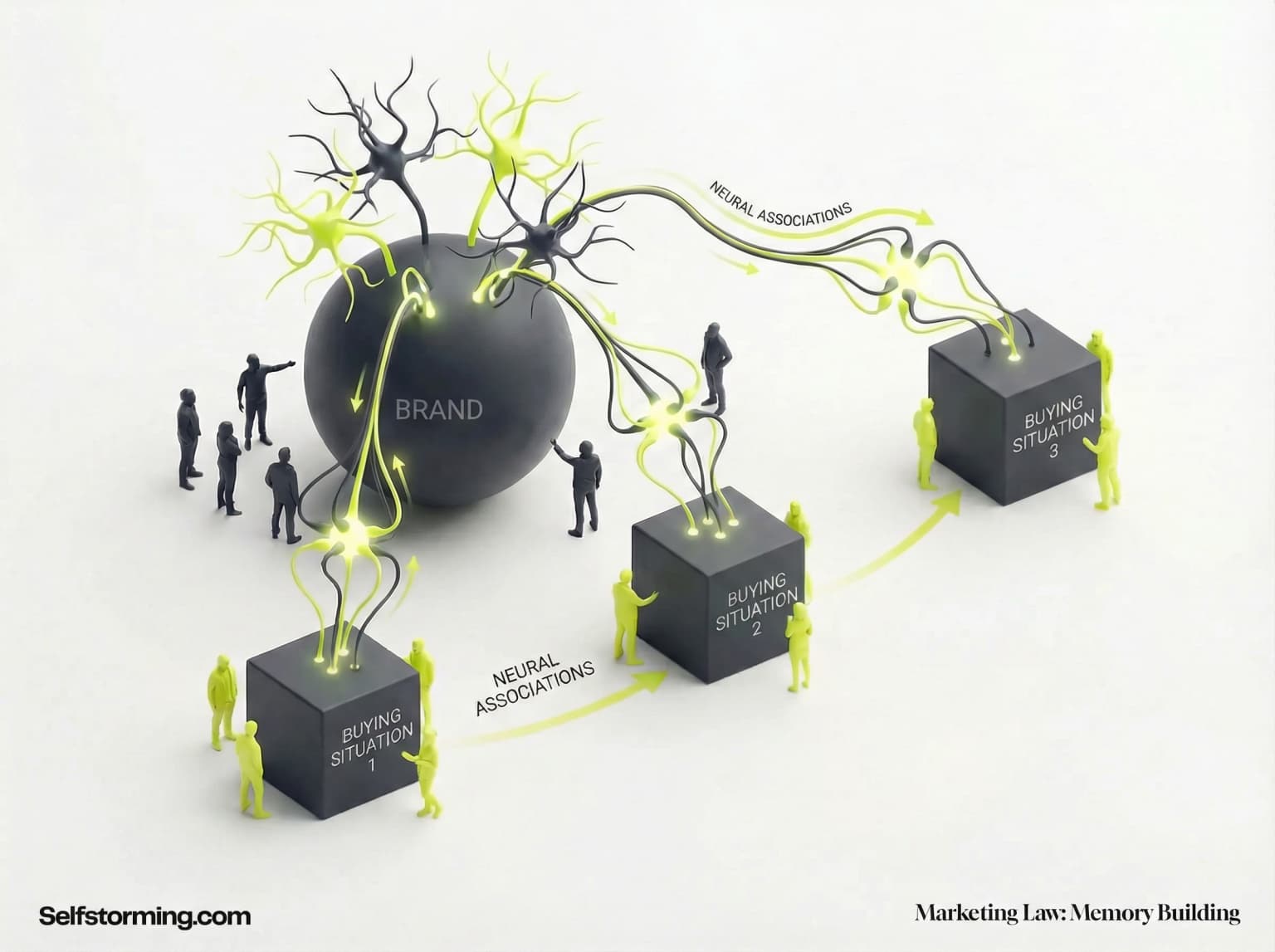
Memory Building is the fundamental principle that advertising's primary function is to create, refresh, and strengthen neural associations between a brand and its Category Entry Points (CEPs). Unlike short-term 'activation' which seeks an immediate response, Memory Building is a long-term investment in Mental Availability. It acknowledges that most consumers are not in the market at any given moment; therefore, advertising must work by depositing 'memory capital' that pays off months or years later. This process relies on emotional resonance and distinctive brand assets to bypass the consumer's rational filters, ensuring the brand is retrieved from long-term memory during the buying window. In essence, brands do not grow by winning arguments; they grow by being the most easily recalled solution in a sea of cognitive clutter.

MEMORY BUILDING

Long-term brand health is predicated on the creation and reinforcement of neural associations that link a brand to specific buying situations, rather than the immediate rational persuasion of the consumer.

Memory Building marketing law: Don't win arguments, win brain space. - Visual illustration showing key concepts and examples

Key Takeaways

  • Advertising builds mental structures, it doesn't win rational arguments.
  • Emotional resonance is the glue that makes brand associations stick.
  • Most buyers are 'out-of-market'; memories are your only way to reach them.
  • Distinctive assets are the triggers that retrieve your brand from memory.
  • Growth comes from Mental Availability, which requires constant memory refreshment.

Genesis & Scientific Origin

The scientific foundation of Memory Building was solidified by Les Binet and Peter Field through their extensive analysis of the IPA (Institute of Practitioners in Advertising) Databank, most notably in their seminal work 'The Long and the Short of It' (2013). This research was further bolstered by the work of Orlando Wood and the team at System1, who utilized facial coding and emotional response data to demonstrate how 'right-brain' creative features are essential for long-term memory encoding. These findings built upon the earlier 'Double Jeopardy' and 'Mental Availability' frameworks established by Byron Sharp and the Ehrenberg-Bass Institute, shifting the industry focus from the 'message' to the 'memory structure.' Key institutions involved include the IPA, the Ehrenberg-Bass Institute for Marketing Science, and the World Advertising Research Center (WARC).

Emotional campaigns are 2x more likely to produce large profit gains than rational ones (Binet & Field).

The Mechanism: How & Why It Works

The mechanism of Memory Building is rooted in cognitive psychology and Hebbian theory—the idea that 'neurons that fire together, wire together.' When a consumer sees an advertisement, they are not storing a transcript of the ad; they are forming or strengthening a network of associations.

Firstly, the law operates through the creation of Mental Availability. This is the probability that a buyer will notice, recognize, and think of a brand in a buying situation. This probability is entirely dependent on the strength and quantity of memory associations.

Secondly, it leverages Category Entry Points (CEPs). These are the 'cues' that people use to access their memory when a need arises (e.g., 'I need a quick lunch,' 'I'm feeling stressed,' 'I want to look professional'). Memory Building works by repeatedly pairing the brand with these CEPs using distinctive assets—colors, logos, characters, or sounds—until the link becomes reflexive.

Thirdly, the law acknowledges the 'Decay of Memory.' Human memory is volatile. Without constant reinforcement, associations wither. Effective marketing science dictates a 'continuous presence' strategy rather than 'burst' campaigns, ensuring that the brand is always being refreshed in the consumer’s mind.

Finally, the role of emotion is critical. Emotional content is processed by the limbic system, which has a direct line to long-term memory storage. Rational, 'left-brain' information is often filtered out as 'noise' or discarded after the immediate need passes. Emotional advertising creates a 'halo' that protects the memory structure from being overwritten by competitors. In a statistical sense, Memory Building is the process of increasing the 'prior probability' of a brand being selected from the consumer's mental repertoire.

Memory Building mechanism diagram - How Memory Building works in consumer behavior and marketing strategy

Empirical Research & Evidence

The Journal of Advertising Research (Binet & Field, 2007) published a comprehensive study titled 'Marketing in the Era of Accountability,' which analyzed nearly 1,000 campaigns from the IPA Databank. The researchers found a stark divergence between 'activation' and 'brand building.' Campaigns designed to build memories (emotional, broad reach) were found to be 2.5 times more likely to report very large profit gains over a three-year period compared to those focused on rational persuasion or immediate response. Furthermore, System1’s research (Wood, 2019) in the book 'Lemon' utilized a database of over 25,000 ads, proving that ads with 'broad-beam' attention features (character, story, sense of place) generated significantly higher long-term market share growth (an average of 1.2% per year) compared to 'narrow-beam' ads focused on product features, which showed negligible long-term growth. The methodology involved correlating creative 'fluency' scores with actual market performance data, proving that the strength of the memory structure is the single greatest predictor of long-term commercial success.

Real-World Example:
Cadbury

Situation

In the mid-2000s, Cadbury faced stagnant growth and a need to move beyond functional 'glass and a half' messaging. Instead of listing ingredients or taste benefits, they released the 'Gorilla' ad in 2007.

Result

The ad featured a gorilla playing drums to Phil Collins, with zero mention of chocolate until the final frame. While critics called it 'nonsense,' the ad was a masterclass in Memory Building. It achieved an 8% increase in sales and a 20% increase in brand favorability. By ignoring rational persuasion and focusing on a high-arousal, emotional memory anchor, Cadbury refreshed its mental availability across the entire UK population, proving that a strong, weird memory beats a 'logical' reason to buy every time.

Strategic Implementation Guide

1

Prioritize Reach Over Frequency

Stop talking to the same 10% of your audience. To build memories that matter, you need to reach the 'light buyers' who don't think about you often. Broad reach is the only way to build category-wide mental structures.

2

Weaponize Distinctive Assets

Pick a color, a sound, or a character and never, ever change it. Your logo is a trigger for a memory. If you change your 'look' every two years, you're effectively deleting your own hard drive.

3

Adopt a 60/40 Budget Split

Allocate 60% of your budget to long-term memory building (emotional, broad reach) and 40% to short-term activation. If you flip this, you'll see a spike today and a slow death tomorrow.

4

Own Category Entry Points (CEPs)

Identify the 3-5 most common situations where people buy your category. Your creative must explicitly link your brand to these moments. Don't just say you're 'good'; say you're 'the one for the 3 PM energy slump.'

5

Ditch the USP for Fame

No one cares about your 'Unique Selling Proposition.' They care that they've heard of you. Aim for 'Fame'—the feeling that the brand is everywhere and 'moving.' Fame is the strongest memory signal.

6

Emotional Priming

Use music, humor, or storytelling to lower the consumer's guard. Emotional ads aren't 'fluff'; they are the delivery mechanism that allows your brand to slip past the brain's 'spam filter' and into long-term storage.

7

Measure Mental Availability, Not Just ROI

If you only measure immediate sales, you're only measuring activation. Use brand tracking to measure 'Share of Mind' and 'Spontaneous Awareness.' These are your leading indicators of future revenue.

Frequently Asked Questions

Does this mean I should never talk about my product features?

Not exactly, but realize that features are for the 'Short' (activation). They help close the deal for people already in the market. But features don't build long-term memories. Use features in your bottom-of-funnel ads, but keep them out of your brand-building work where they just act as cognitive clutter.

How long does it take for 'Memory Building' to show results?

It’s a slow burn. You’ll see the impact in 6 to 18 months. If you’re looking for a result by Friday, go run a discount code. But remember: discounts don't build memories; they just train people to wait for the next sale.

Can I build memories with a small budget?

Yes, but you have to be twice as weird. High-arousal, creative work (System 1) acts as a force multiplier for small budgets. If you can't outspend them, you have to out-memory them by being the most distinctive thing they've seen all year.

Is 'Memory Building' the same as Brand Awareness?

Awareness is just 'I've heard of them.' Memory Building is 'I think of them when I'm hungry/bored/scared.' It's about the *link* between the brand and the situation, not just the existence of the brand in a vacuum.

Why do marketers ignore this law so often?

Because of 'Short-Termism.' Most CMOs are on a 2-year contract and need to show 'growth' next month. Memory building is an investment in the future, and most people are too scared of their quarterly reviews to invest in anything that doesn't have a 'Buy Now' button.

We use cookies on our site to enhance your user experience, provide personalized content, and analyze our traffic. Cookie Policy