Emotion Outperforms Rational Messaging

Feelings sell better than features do.

You’re still trying to sell features like it’s 1955. Stop it. Your customers aren't rational calculators; they're walking bundles of anxiety, ego, and nostalgia. If you think a 10% discount or a list of bullet points is going to build a brand, you’re not just wrong—you’re expensive. Emotional resonance is the only thing that sticks in the lizard brain long enough to matter when they're actually standing at the shelf. Welcome to the real world, where feelings pay the bills and logic is just the excuse people use to justify their impulses to their spouses. If your creative doesn't make them feel something, you're just paying for the privilege of being ignored.
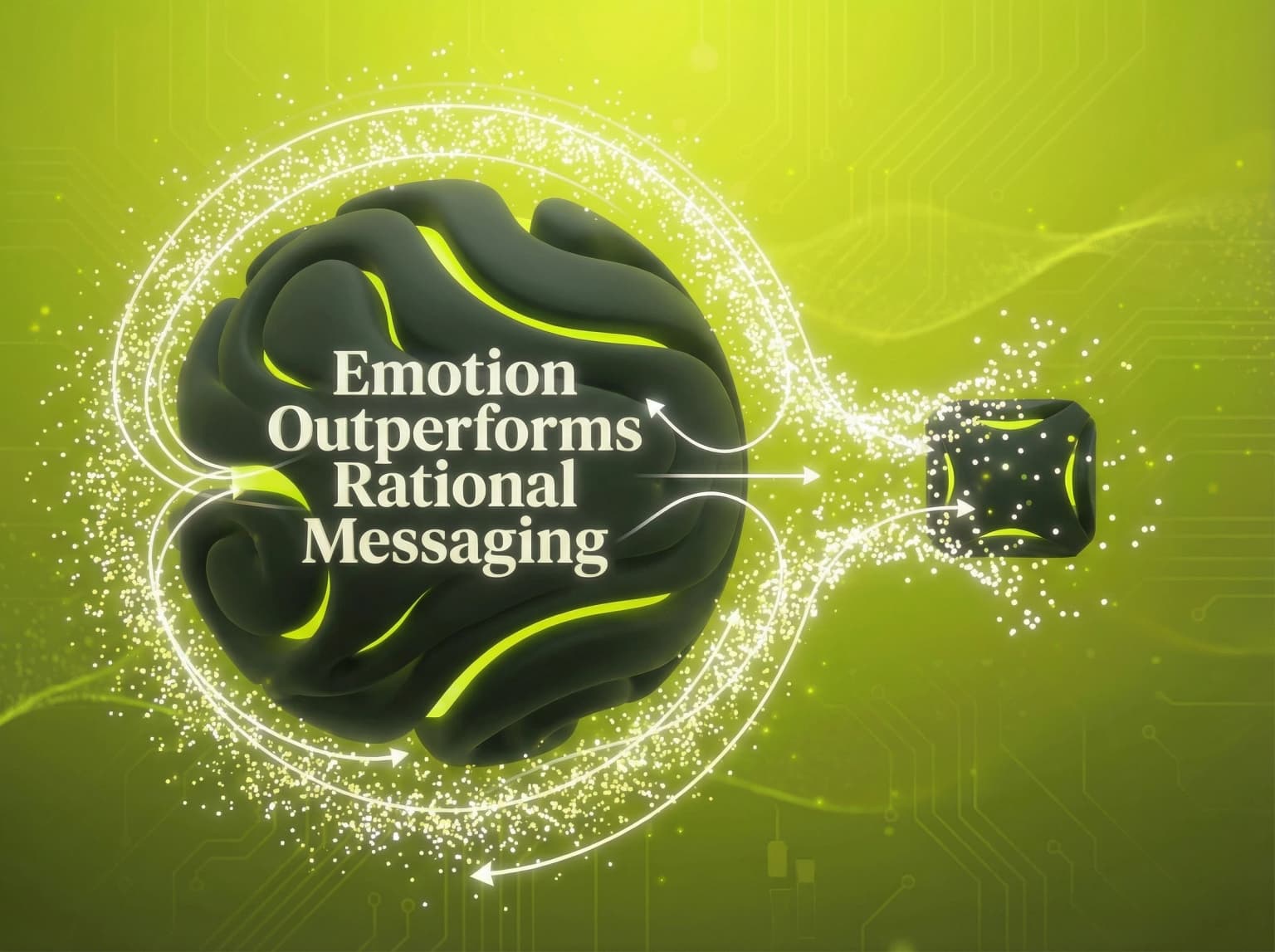
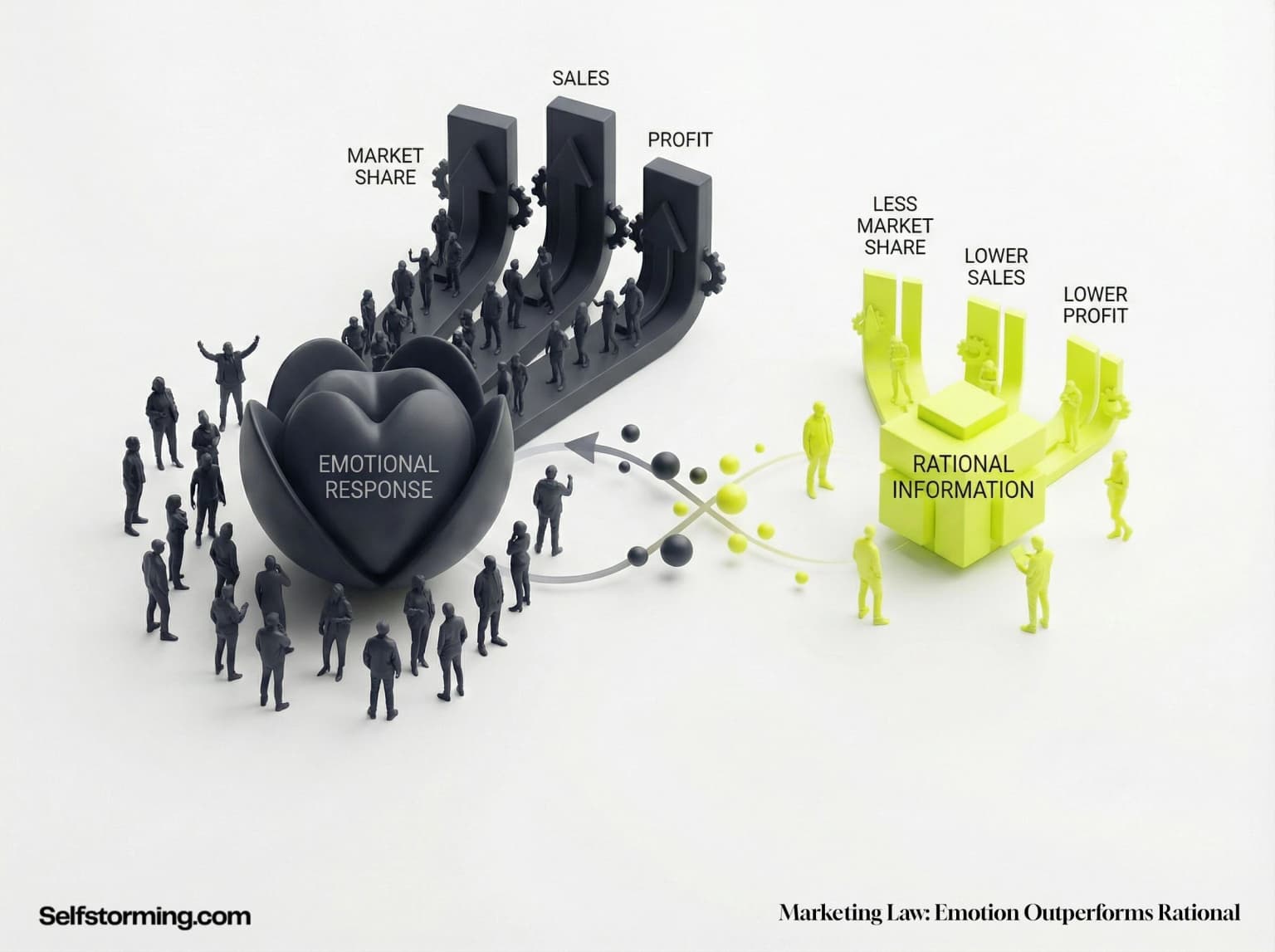
The law of 'Emotion Outperforms Rational Messaging' establishes that advertising designed to elicit an emotional response is significantly more effective at driving long-term business growth than advertising based on rational persuasion or information. Based on decades of data from the IPA Databank, researchers Les Binet and Peter Field demonstrated that emotional campaigns are more likely to result in large gains in market share, profit, and pricing power. While rational ads can drive short-term sales 'spikes' through immediate calls to action, they fail to build the enduring memory structures required for long-term brand preference. Emotional messaging works by creating 'fame' and broad-reach mental availability, bypassing the critical filters of the conscious mind to embed the brand within the consumer's subconscious decision-making framework, ultimately yielding a higher Return on Investment (ROI) over time.

EMOTION OUTPERFORMS RATIONAL MESSAGING

Advertising campaigns designed to trigger emotional responses generate more powerful and enduring business effects—including market share, sales, and profit—than those relying on rational information or logical persuasion.

Emotion Outperforms Rational Messaging marketing law: Feelings sell better than features do. - Visual illustration showing key concepts and examples

Key Takeaways

  • Emotional ads drive 2x the profit of rational ads over the long term.
  • Rational messaging is for short-term sales; emotion is for long-term brand health.
  • System 1 processing allows emotional ads to bypass consumer skepticism and build memory.
  • Fame-based emotional campaigns are the most effective way to grow market share.
  • B2B buyers are just as influenced by emotion as B2C consumers, if not more.

Genesis & Scientific Origin

The empirical foundation for this law was primarily established through the exhaustive analysis of the Institute of Practitioners in Advertising (IPA) Databank, a repository of over 1,000 detailed case studies of advertising effectiveness spanning several decades. The most definitive articulation of this principle appeared in the landmark study 'The Long and the Short of It' (2013), authored by Les Binet and Peter Field. Their research analyzed the relationship between creative strategy and business outcomes, categorizing campaigns as 'emotional' (aimed at building brand feelings), 'rational' (aimed at providing information/product benefits), or 'combined.' This work built upon earlier findings from their 2007 publication, 'Marketing in the Era of Accountability,' which first signaled the declining effectiveness of purely rational, short-term activation strategies in favor of emotional brand-building.

Emotional campaigns are twice as likely to report very large profit gains (31%) compared to rational campaigns (16%).

The Mechanism: How & Why It Works

The mechanism behind emotional dominance is rooted in the neurobiological distinction between System 1 (fast, instinctive, emotional) and System 2 (slow, logical, effortful) thinking, as popularized by Daniel Kahneman. Rational messaging targets System 2. It requires the consumer to pay attention, process information, weigh benefits, and reach a logical conclusion. This process is cognitively expensive and easily rejected by the brain's natural skepticism. Furthermore, rational information is stored in semantic memory, which decays rapidly unless constantly reinforced.

Emotional messaging, conversely, targets System 1. It operates through 'low-attention processing,' where the brain absorbs associations and feelings without active critical evaluation. Emotions act as 'somatic markers'—biological signals that tell the brain 'this is important' or 'this feels right.' When a brand is associated with a strong emotion (joy, pride, belonging, or even a specific type of humor), it is encoded into episodic and associative memory structures. These structures are far more durable than product facts.

Mathematically, emotional ads drive growth through the 'Halo Effect' and 'Broad Reach.' Because emotional themes are more universal than specific product features, they appeal to a wider audience, including light buyers who are not currently in the market. This builds 'Mental Availability'—the likelihood of a brand coming to mind in a buying situation. While a rational ad might convince a consumer that a car has 'best-in-class fuel economy' (a fact that can be superseded by a competitor tomorrow), an emotional ad makes the consumer feel that the car represents 'freedom' or 'safety.' The latter creates a price-insensitive preference that rational competitors struggle to disrupt. In the long run, this emotional priming lowers the cost of future acquisition and allows the brand to maintain higher margins.

Emotion Outperforms Rational Messaging mechanism diagram - How Emotion Outperforms Rational Messaging works in consumer behavior and marketing strategy

Empirical Research & Evidence

The most rigorous evidence comes from the research published in the IPA Databank (Binet & Field, 2013). In their analysis of nearly 1,000 campaigns, Binet and Field compared the business impacts of purely emotional campaigns versus purely rational ones. The data revealed a staggering disparity: emotional campaigns were nearly twice as likely to report 'very large' profit gains (31% for emotional vs. 16% for rational). Furthermore, emotional campaigns outperformed rational ones on every single business metric tracked, including sales volume, market share, pricing power, and customer loyalty. Specifically, the research showed that while rational campaigns are effective at driving immediate, short-term sales (often referred to as 'activation'), they do not contribute to the long-term 'base' of sales. Emotional campaigns, however, build a compounding effect over time. By year three of a campaign, the market share growth of emotional-led strategies was found to be more than double that of rational-led strategies. This finding is consistent across various categories, including B2B, where emotional messaging was found to be just as—if not more—effective than in B2C, contrary to the industry myth of the 'rational B2B buyer.'

Real-World Example:
John Lewis (UK Department Store)

Situation

In the mid-2000s, John Lewis faced a competitive retail landscape where most advertising focused on price promotions, product ranges, and seasonal discounts (rational messaging).

Result

Working with agency adam&eveDDB, the brand shifted to a purely emotional 'Christmas' strategy, starting with campaigns like 'The Long Wait' and 'The Bear and the Hare.' These ads focused entirely on the 'feeling' of gifting, often without mentioning prices or specific products until the very end. The result was a cultural phenomenon that delivered an estimated £8 of profit for every £1 spent. The emotional resonance created such high mental availability that John Lewis became the default destination for Christmas shopping in the UK, allowing them to maintain premium pricing while competitors were forced into margin-eroding discount wars. The campaign didn't just sell toasters; it built a brand identity that consumers felt a personal, emotional connection to, proving that 'fame' generated through emotion is the ultimate commercial multiplier.

Strategic Implementation Guide

1

Prioritize 'Fame' over 'Persuasion'

Design creative that aims to be talked about and remembered, rather than creative that tries to convince the viewer of a specific product benefit.

2

The 60/40 Budget Split

Allocate approximately 60% of your budget to long-term emotional brand-building and 40% to short-term rational activation. This ensures you are building future demand while capturing current demand.

3

Kill the 'Reason to Believe' (RTB) Obsession

Stop cluttering ads with three or four product features. Focus on a single emotional 'truth' or story. If you must include rational info, keep it secondary to the emotional hook.

4

Target the 'Category Entry Points'

Use emotional storytelling to link your brand to specific situations or feelings that occur right before a purchase decision (e.g., 'the feeling of relief after a long day' for a beverage brand).

5

Measure the Right Metrics

Don't judge emotional campaigns by Click-Through Rates (CTR) or immediate conversions. Use Brand Tracking to measure changes in 'Mental Availability,' 'Fame,' and 'Emotional Connection' over 6-12 month periods.

6

Use Music and Visuals as Primary Drivers

In emotional messaging, the soundtrack and cinematography are not 'background'—they are the message. Invest in high-quality production that triggers visceral reactions.

7

B2B is Not Immune

If you are in B2B, lean into emotions like 'reduction of professional risk' or 'career pride.' Decision-makers are still humans who fear making a mistake in front of their boss.

Frequently Asked Questions

Does this mean I should never use rational information in my ads?

Not at all. Rational messaging is excellent for 'activation'—the nudge that gets someone to buy *now* when they are already in the market. However, rational ads should be the 'short' part of your strategy. If you only use rational ads, you'll never build a brand that people choose instinctively. Use emotion to build the brand (the long) and rational info to close the sale (the short).

Is emotional messaging only for big brands with huge budgets?

Actually, it's even more important for smaller brands. If you have a small budget, you can't afford to be ignored. Emotional work is 'sticker' and travels further through word-of-mouth and social sharing (earned media). A rational ad with a small budget is just a quiet whisper in a hurricane.

How do I convince my CFO that 'feelings' are worth the investment?

Don't use the word 'feelings.' Use the data from Binet & Field. Show them that emotional campaigns drive 'pricing power' (the ability to charge more than competitors) and 'long-term profit growth.' Frame it as 'reducing price sensitivity' rather than 'making people happy.' Numbers talk, and the IPA data has the numbers.

What if my product is boring, like insurance or software?

There are no boring products, only boring marketers. Insurance is about the fear of loss and the peace of mind of protection—those are massive emotions. Software is about the frustration of inefficiency and the triumph of being a hero at work. The more 'functional' the category, the more an emotional approach will stand out against the sea of boring competitors.

Can an ad be both emotional and rational at the same time?

Yes, but there is a hierarchy. The emotional hook must lead to ensure the ad is processed and remembered. If you lead with logic, the brain's 'critical filter' turns on, and the emotional resonance is often lost. Think of emotion as the carrier wave that allows the rational message to actually reach its destination.

We use cookies on our site to enhance your user experience, provide personalized content, and analyze our traffic. Cookie Policy