Alienation Paranoia
Playing it safe is remarkably dangerous.
You’re terrified of a tweet. You’re sitting in your ergonomic chair, paralyzing your brand's growth because you’re worried a handful of people who were never going to buy from you anyway might find your new campaign 'too much.' It’s the ultimate marketing neurosis: the belief that being liked by everyone is the same as being successful. Spoiler alert: it’s not. It’s a fast track to being the brand that everyone recognizes but no one remembers. You’re trading salience for a lack of complaints, and that’s a trade that will eventually bankrupt you. Stop being a coward and start being a brand.
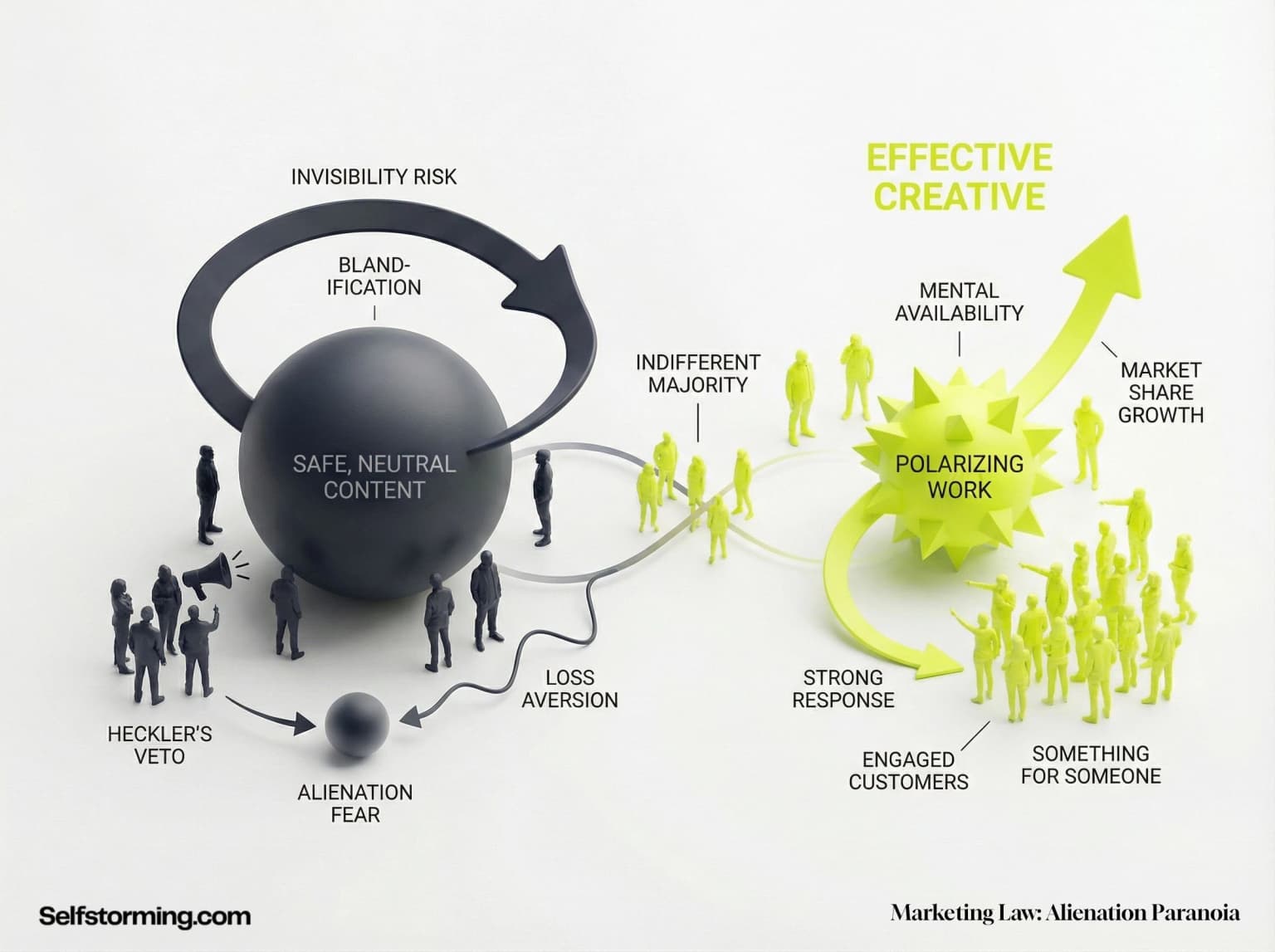
Alienation Paranoia is a documented cognitive bias where marketing professionals and brand managers significantly overestimate the negative commercial impact of distinctive, bold, or polarizing creative work. While marketers fear a vocal minority of detractors—often referred to as 'The Heckler's Veto'—empirical evidence from the IPA Databank suggests that the primary risk to brand growth is not alienation, but invisibility. Most consumers are indifferent to brands; therefore, creative work that triggers a strong emotional response, even if it is polarizing, is far more effective at building mental availability than safe, neutral content. This summary explores how loss aversion leads to 'bland-ification,' why the fear of offending non-buyers stifles market share growth, and why the most profitable campaigns are often those that risk being 'not for everyone' to ensure they are 'something for someone.'
ALIENATION PARANOIA
“The cognitive overestimation of the commercial risk associated with distinctive brand communications, leading to a strategic preference for neutral, low-salience marketing that fails to build mental availability.”

Key Takeaways
- •Being ignored is a far greater financial risk than being disliked by a minority.
- •Mental availability requires high-arousal creative that safe marketing simply cannot provide.
- •Fame-driving campaigns are 4x more efficient at growing market share than safe ads.
- •Focus groups naturally punish distinctive work and reward the 'Bell Curve of Boredom.'
- •Growth comes from light buyers; these buyers only notice brands that stand out.
Genesis & Scientific Origin
The term 'Alienation Paranoia' was formally popularized by Les Binet and Sarah Carter in their seminal 2018 publication, 'How Not to Plan: 66 Ways to Screw It Up', published by the Account Planning Group (APG). Binet, the Head of Effectiveness at adam&eveDDB, and Carter, a veteran strategist, identified this phenomenon through decades of analyzing the IPA (Institute of Practitioners in Advertising) Databank. Their research observed a recurring pattern: brands that attempted to appeal to everyone by smoothing over 'edgy' or distinctive creative assets consistently underperformed compared to those that embraced a more 'spiky' identity. The concept builds upon the work of Byron Sharp and the Ehrenberg-Bass Institute regarding the importance of distinctiveness over differentiation, suggesting that the fear of alienation is a primary barrier to achieving the 'Fame' status necessary for long-term brand growth.
“Fame-based campaigns are 4x more efficient at driving market share than non-fame campaigns (Binet & Field, 2013).”
The Mechanism: How & Why It Works
The mechanism of Alienation Paranoia is rooted in several psychological and structural failures within modern marketing departments. At its core is 'Loss Aversion'—the human tendency to prefer avoiding losses to acquiring equivalent gains. In a marketing context, the 'loss' of a few vocal complainers feels more significant than the 'gain' of millions of indifferent consumers suddenly noticing the brand. This is compounded by 'The Availability Heuristic,' where marketers judge the risk of a campaign based on how easily they can imagine a negative reaction (e.g., a viral boycott) rather than the statistical likelihood of that reaction impacting sales.
Mathematically, the law operates on the principle of 'Mental Availability.' To be bought, a brand must first be thought of. Neutral, safe creative fails to trigger the neurobiological arousal necessary to encode a brand in long-term memory. By contrast, 'polarizing' creative often uses high-arousal emotions or 'Distinctive Brand Assets' (DBAs) that cut through the noise. While 10% of the population might explicitly dislike a bold ad, the other 90% are finally seeing the brand for the first time. The 'paranoia' stems from focusing on the 10% (who likely weren't buyers anyway) while ignoring the massive opportunity cost of remaining invisible to the 90%.
Furthermore, the 'Heckler’s Veto' plays a role in corporate approval chains. A single negative comment in a focus group or a cautious remark from a legal department often results in the 'sanding down' of creative edges. This results in 'The Average Joe Fallacy,' where creative is designed to be inoffensive to everyone, which inadvertently makes it interesting to no one. The structural reality is that most brands suffer from a lack of salience, not an excess of notoriety. Alienation Paranoia is the psychological wall that keeps brands in the 'Zone of Indifference,' where they spend millions to be ignored.

Empirical Research & Evidence
The most robust evidence for the fallacy of Alienation Paranoia comes from the IPA Databank (Binet & Field, 2013), specifically their meta-analysis of over 30 years of marketing effectiveness data. In their research published in 'The Long and the Short of It', Binet and Field compared 'Fame' campaigns (those that get people talking and generate earned media, often through bold or polarizing creative) against 'Information' or 'Persuasion' campaigns (those that are safe, rational, and inoffensive).
The data revealed that 'Fame' campaigns are significantly more effective at driving every key business metric. Specifically, fame-based campaigns were found to be 4x more efficient at driving market share growth per point of Extra Share of Voice (ESOV) compared to non-fame campaigns. Furthermore, the research showed that campaigns which triggered strong emotional responses—even if those responses included a degree of controversy—were 10x more likely to deliver large profit gains than those that focused purely on rational benefits.
Another critical study is the 'Marmite Effect' analysis. Marmite, a brand that built its entire strategy around being polarizing ('Love it or Hate it'), saw its brand power increase specifically because it leaned into alienation. By acknowledging that many people hate the product, they strengthened the mental structures of those who love it and ensured the brand was unmissable to the general public. Research by the Ehrenberg-Bass Institute also supports this, showing that 'disliking' an ad has a very low correlation with 'failing to buy' the brand, whereas 'failing to notice' the ad has a 100% correlation with the ad being ineffective.
Real-World Example:
Nike
Situation
In 2018, Nike featured Colin Kaepernick in its 'Dream Crazy' campaign. The decision was met with immediate, massive 'Alienation Paranoia' from pundits and even some internal stakeholders. Critics predicted a total brand collapse as videos of people burning Nike shoes went viral under the hashtag #BoycottNike. The perceived risk was that Nike would alienate its core 'patriotic' customer base in the US.
Result
The result was a masterclass in the law of Alienation Paranoia. While the 'haters' were vocal, they were a minority of non-buyers or low-value buyers. Nike's stock price hit an all-time high within weeks of the campaign, and the brand added $6 billion to its market value. Sales grew by 31% in the period immediately following the ad's release. The 'alienation' of a small segment was a small price to pay for the massive surge in mental availability and brand 'fame' among its primary growth demographic (young, urban consumers). Nike proved that being 'the brand that took a stand' was infinitely more profitable than being 'the brand that sells sneakers to everyone but nobody cares about.'
Strategic Implementation Guide
Step 1
Audit your 'Safety Bias' by reviewing the last three creative concepts your team rejected; if they were rejected for being 'too risky' or 'potentially offensive,' they are likely your most valuable assets.
Step 2
Redefine 'Risk' in your internal documentation from 'the probability of a negative comment' to 'the probability of being ignored by the 95% of the market who currently doesn't think about us.'
Step 3
Kill the 'Liking' metric in your creative pre-testing. People don't have to like an ad to remember it. Replace it with 'Spontaneous Recall' and 'Distinctive Asset Recognition' tests.
Step 4
Brief your agency for 'Fame' rather than 'Persuasion.' Specifically ask them to provide at least one execution that makes your legal department uncomfortable.
Step 5
Identify your 'Hater Persona'—the type of person who will never buy your product. Explicitly give your creative team permission to alienate this persona if it helps reach the 'Light Buyer' more effectively.
Step 6
Protect the 'Spiky' bits of the creative during the approval process. When a stakeholder asks to 'tone it down,' explain the mathematical cost of neutrality in terms of lost ESOV efficiency.
Step 7
Measure the 'Polarization Index' of your campaigns. If everyone 'sort of likes it,' you’ve failed. If 20% love it and 10% hate it, you’re on the path to brand fame.
Frequently Asked Questions
Doesn't 'cancel culture' make Alienation Paranoia a legitimate concern in the 2020s?
Cancel culture is largely a phantom risk for brands. While a 48-hour social media firestorm feels intense to the marketing team living in the notifications, the actual impact on long-term buying behavior is statistically negligible for almost all brands. Most 'boycotts' are performed by people who weren't customers to begin with. The real danger is 'The Sea of Sameness' where you spend your budget to be invisible.
Is there a difference between being 'distinctive' and being 'offensive'?
Absolutely. Distinctiveness is about being unmissable and recognizable. Offensiveness is often a lazy shortcut to attention. The goal of overcoming Alienation Paranoia isn't to be a jerk; it's to be bold enough to have a point of view. You aren't trying to offend people for the sake of it; you're accepting that having a strong identity will naturally alienate those who don't align with it.
How do I explain the value of 'polarizing' creative to a conservative CFO?
Don't use the word 'polarizing.' Talk about 'Efficiency.' Show them the Binet & Field data that proves 'Fame' campaigns are 4x more efficient at driving profit. Explain that safe creative is effectively 'wasted' media spend because it fails to build the memory structures required for future sales. It's a financial argument, not a creative one.
Does this law apply to B2B marketing where 'professionalism' is key?
It applies even more in B2B. Most B2B marketing is a graveyard of blue logos and stock photos of people shaking hands. Because the category is so boring, the 'risk' of being distinctive is even lower, and the rewards are even higher. Professionalism doesn't mean being forgettable; it means being the most salient solution in a sea of beige.
What if the 'alienated' group is a protected class or a core customer segment?
This is where common sense applies. Alienation Paranoia refers to the fear of being 'too bold' or 'too different,' not the fear of being bigoted or incompetent. If your creative is alienating your core buyers, you've failed at targeting or brand strategy. But if you're alienating the 'category traditionalists' while winning over the 'future buyers,' you're doing your job.
Sources & Further Reading
Related Marketing Laws
Distinctive Assets Law
Consistent brand cues drive recognition faster than differentiation claims.
Emotion Outperforms Rational Messaging
Emotional advertising drives stronger long-term effects than rational ads.
Fame Beats Persuasion
Being noticed matters more than convincing people with arguments.
Distinctiveness Over Differentiation
Being recognisable matters more than being meaningfully different.