Loss Aversion
Fear of loss beats hope for gain.
Most of your marketing assumes people are rational calculators seeking 'value.' They aren't. They’re terrified primates clutching their current pile of shiny rocks, terrified that someone—or some brand—is going to snatch them away. If you’re still trying to sell the 'joy of gain' without addressing the 'terror of loss,' you’re leaving money on the table for competitors who actually understand human biology. It's time to stop being a coward in your copy and start being honest about how much it hurts to let go.
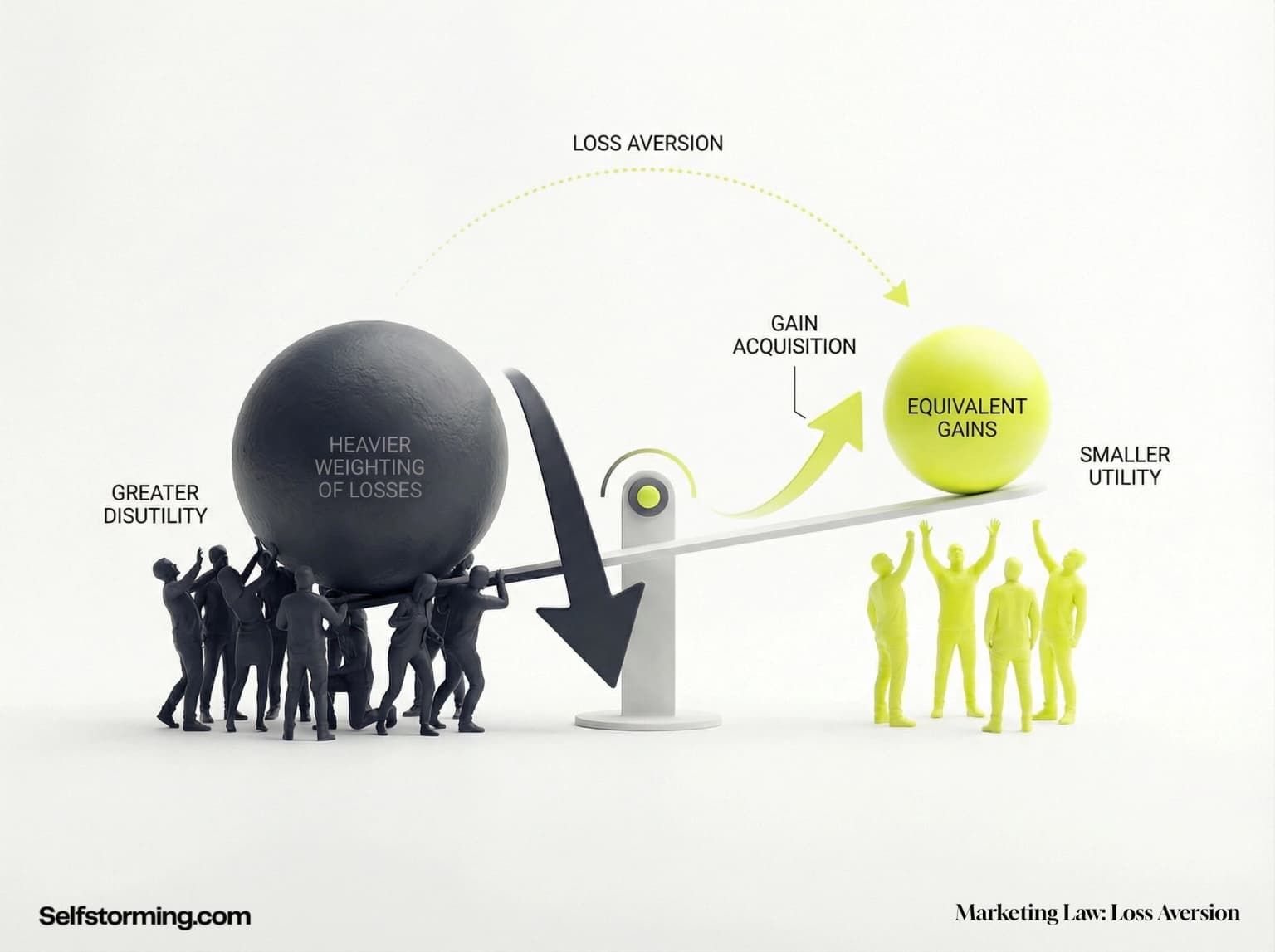
Loss Aversion, a cornerstone of Prospect Theory, posits that the psychological pain of losing something is approximately twice as powerful as the pleasure of gaining an equivalent amount. In marketing, this means consumers are significantly more motivated to act to avoid a disadvantage than they are to achieve a benefit. This fundamental asymmetry explains why 'limited-time offers' create panic, why 'free trials' are so sticky (the Endowment Effect), and why framing a price as a 'discount lost' is more effective than a 'savings gained.' To master this law, marketers must shift from highlighting the aspirational benefits of their products to dramatizing the cost of inaction and the erosion of the customer's current status quo. It is the definitive engine of urgency and the primary reason humans are hard-wired to choose the 'safe' option over the 'better' one.
LOSS AVERSION
“The psychological phenomenon where the disutility of giving up an object is greater than the utility associated with acquiring it, typically manifesting as a weighting of losses roughly twice as heavily as equivalent gains.”

Key Takeaways
- •Losses hurt twice as much as gains feel good; frame offers accordingly.
- •Move customers from 'prospective buyers' to 'owners' as fast as possible.
- •The 'Cost of Inaction' is a more powerful B2B hook than ROI.
- •Use 'grandfathered' status to prevent churn during price increases.
- •Fear of losing a 'streak' or 'status' drives more loyalty than rewards.
Genesis & Scientific Origin
The formal conceptualization of Loss Aversion emerged from the collaborative work of Daniel Kahneman and Amos Tversky, two of the most influential figures in behavioral economics. While the intuition that 'losses loom larger than gains' has existed in folk wisdom for centuries, it was mathematically and psychologically codified in their seminal 1979 paper, 'Prospect Theory: An Analysis of Decision under Risk,' published in Econometrica. This work was a direct challenge to Expected Utility Theory, which assumed humans were rational actors. Kahneman and Tversky, working primarily out of the Hebrew University of Jerusalem and later Stanford, demonstrated through rigorous experimentation that the human 'value function' is steeper for losses than for gains. This research eventually led to Daniel Kahneman receiving the Nobel Prize in Economic Sciences in 2002 (Tversky had passed away by then, making him ineligible). Their work shifted the entire paradigm of marketing from 'information provision' to 'choice architecture,' proving that the context of a decision—specifically whether it is framed as a gain or a loss—determines the outcome more than the objective value of the offer itself.
“Losses are psychologically 1.5 to 2.5 times more powerful than equivalent gains (Kahneman & Tversky, 1979).”
The Mechanism: How & Why It Works
The mechanism of loss aversion is rooted in the asymmetric nature of the human psychological value function. In mathematical terms, the value function is S-shaped: it is concave for gains and convex for losses, but—crucially—it is significantly steeper in the domain of losses. This steepness is represented by the 'loss aversion coefficient' (lambda), which empirical studies typically place between 1.5 and 2.5. This means that losing $100 feels as bad as winning $200 feels good.
From an evolutionary perspective, this is a survival heuristic. For an organism living on the edge of subsistence, a loss of resources (food, shelter, status) could mean death, whereas a gain of the same magnitude only offers a marginal improvement in comfort. This 'survival bias' is hard-wired into the amygdala, the brain's emotional processing center, which reacts more violently to negative stimuli than positive ones.
Furthermore, loss aversion is closely tied to the 'Endowment Effect,' where individuals ascribe more value to things merely because they own them. Once a consumer enters a 'free trial' or even just holds a product in their hands, the psychological 'reference point' shifts. The product is no longer a potential gain; it is a current possession. Giving it back at the end of the trial is processed by the brain as a loss, triggering a defensive reaction to maintain the status quo. In marketing, this manifests as 'status quo bias,' where consumers stick with inferior current providers simply because the perceived 'loss' of switching (time, effort, perceived risk) outweighs the potential 'gain' of a better service.

Empirical Research & Evidence
One of the most striking applications of loss aversion in a professional setting was documented in the research of Roland G. Fryer Jr. and colleagues. Their study, published in the American Economic Review (Fryer, Levitt, List, & Sadoff, 2012), titled 'Enhancing the Efficacy of Teacher Incentives through Loss Aversion: A Field Experiment,' demonstrated the power of framing. The researchers divided teachers into two groups. The 'Gain' group was promised a traditional end-of-year bonus if their students' test scores improved. The 'Loss' group was given the bonus at the beginning of the year and told they would have to pay it back if their students' scores did not improve.
Mathematically, the incentives were identical. However, the results were not. Teachers in the 'Loss' group—those who feared having to return the money—achieved significantly higher student performance gains, equivalent to increasing teacher quality by more than one standard deviation. This study provides empirical proof that the fear of losing an existing asset (the 'pre-paid' bonus) is a far more potent motivator than the prospect of gaining an identical future reward. For marketers, this validates the 'pre-emptive reward' strategy: give the customer the benefit first, then threaten to take it away if they don't act.
Real-World Example:
HBO (now Max)
Situation
HBO utilized a 'Free Preview Weekend' strategy for decades to drive premium subscriptions. Unlike traditional advertising that showed 'what you could have,' they gave non-subscribers full access to the entire library for 48-72 hours.
Result
By the end of the weekend, viewers had 'endowed' the service. They had set up recordings, started series, and integrated the channel into their weekend routine. The decision on Monday morning was no longer 'Should I buy HBO?' but 'Am I willing to lose access to these shows I’m currently watching?' This shift from a gain-frame to a loss-frame consistently resulted in higher conversion rates than any standard discount or 'buy now' promotion, as the pain of the 'blackout' triggered loss-averse behavior.
Strategic Implementation Guide
Reframe Your Discounts
Instead of 'Save $20 if you buy today,' use 'Don't lose your $20 early-bird credit—it expires at midnight.' Shift the focus from what they get to what they are currently bleeding or about to forfeit.
Leverage the Endowment Effect with Trials
Get the product into their hands. Use 'freemium' models or $1 trials where the customer fully integrates the product. Once it is part of their 'endowment,' the psychological cost of cancelling is perceived as a loss of utility.
Dramatize the Cost of Inaction (COI)
In B2B marketing, stop talking about ROI (Return on Investment) and start talking about COI. Show the prospect exactly how much money they are losing every month by sticking with their current, inefficient process.
Use 'Grandfathered' Pricing
When raising prices, tell existing customers they are 'grandfathered' in at the old rate for a limited time. This creates a powerful 'asset' they now own (the lower price), making them less likely to churn because they don't want to 'lose' their special status.
Highlight Scarcity and Reservation
When a customer puts an item in a cart, tell them 'We've reserved this for 10 minutes.' This creates a temporary sense of ownership. If they don't check out, they 'lose' their reserved item to someone else.
Visualise the Loss
Use progress bars or 'points' systems that show what they will lose if they don't complete an action. Duolingo is the master of this; the 'streak' is a psychological asset that users are terrified to lose, driving daily engagement far more than the 'gain' of learning a language.
Audit Your Language for 'Risk-Free'
Remove the friction of perceived loss by using 'Guaranteed' or 'Money-back' offers. This doesn't just lower the barrier; it reframes the purchase as a situation where there is 'nothing to lose,' which is the only way to bypass the loss-aversion filter.
Frequently Asked Questions
Is Loss Aversion the same thing as Scarcity?
They are cousins, but not twins. Scarcity is a market condition (limited supply), while Loss Aversion is the psychological reaction to that condition. Scarcity works *because* it triggers loss aversion—the fear of losing the opportunity to buy. However, loss aversion applies to things you already have (like a free trial or a current habit), whereas scarcity usually applies to things you haven't acquired yet. You can have loss aversion without scarcity (e.g., fearing a price hike on a product that is in infinite supply).
Does Loss Aversion work better in B2B or B2C?
It is arguably more powerful in B2B. In B2C, it's about personal money. In B2B, it's about professional survival. A B2B buyer isn't just buying software; they are buying the 'safety' of not getting fired. The fear of a failed implementation (a loss of reputation and career trajectory) is a massive loss-aversion trigger. This is why 'No one ever got fired for buying IBM' is the greatest loss-aversion slogan in history. The pain of a potential mistake far outweighs the gain of a slightly better, unproven startup.
Can you overdo Loss Aversion in marketing?
Absolutely. If you constantly scream 'Last Chance!' or 'You're losing out!' every single day, you trigger 'Reactance.' This is when customers realize they are being manipulated and consciously push back to regain their sense of autonomy. It also erodes brand equity, making you look desperate. Loss aversion should be a surgical tool—used at the point of conversion or during price changes—not a blunt instrument used for every top-of-funnel ad.
What is the 'Loss Aversion Ratio' and why does it matter?
The ratio is typically cited as 2:1. This means that for a customer to take a risk (like switching brands), the potential gain needs to be at least twice as large as the potential loss. If your product is only 10% better than the competitor, loss aversion will keep the customer where they are. You need to either make your product 100% better (unlikely) or use framing to make the 'loss' of staying with the current provider feel much bigger than it currently does.
How does Loss Aversion interact with the Sunk Cost Fallacy?
They are deeply intertwined. The Sunk Cost Fallacy is the tendency to continue an endeavor once an investment in money, effort, or time has been made. We do this because stopping would mean 'realizing' the loss. Loss aversion is the engine behind this; we'd rather throw 'good money after bad' than face the psychological pain of admitting the initial investment is gone. Marketers can use this by creating 'small wins' or 'setup costs' that make the customer feel invested early on.
Sources & Further Reading
Related Marketing Laws
Anchoring Effect
The first number you see influences all subsequent judgments.
Price-Quality Heuristic
Higher price signals higher quality in consumers' minds.
Decoy Effect
A third option changes preferences between the original two.
Pain of Paying
Payment method affects perceived value and spending behavior.