Peak-End Rule
End on a high note.
You’re burning through your marketing budget trying to make every single touchpoint 'seamless' and 'pleasant.' Newsflash: nobody cares about your smooth middle. Humans aren't high-fidelity recording devices; we’re highlight-reel editors with terrible memories and a bias for drama. If you don't nail the emotional climax and stick the landing with a flawless exit, your brand is just expensive background noise. Stop trying to be 'good enough' across the board and start being legendary exactly twice. The rest is just filler that your customers will conveniently delete from their brains anyway.
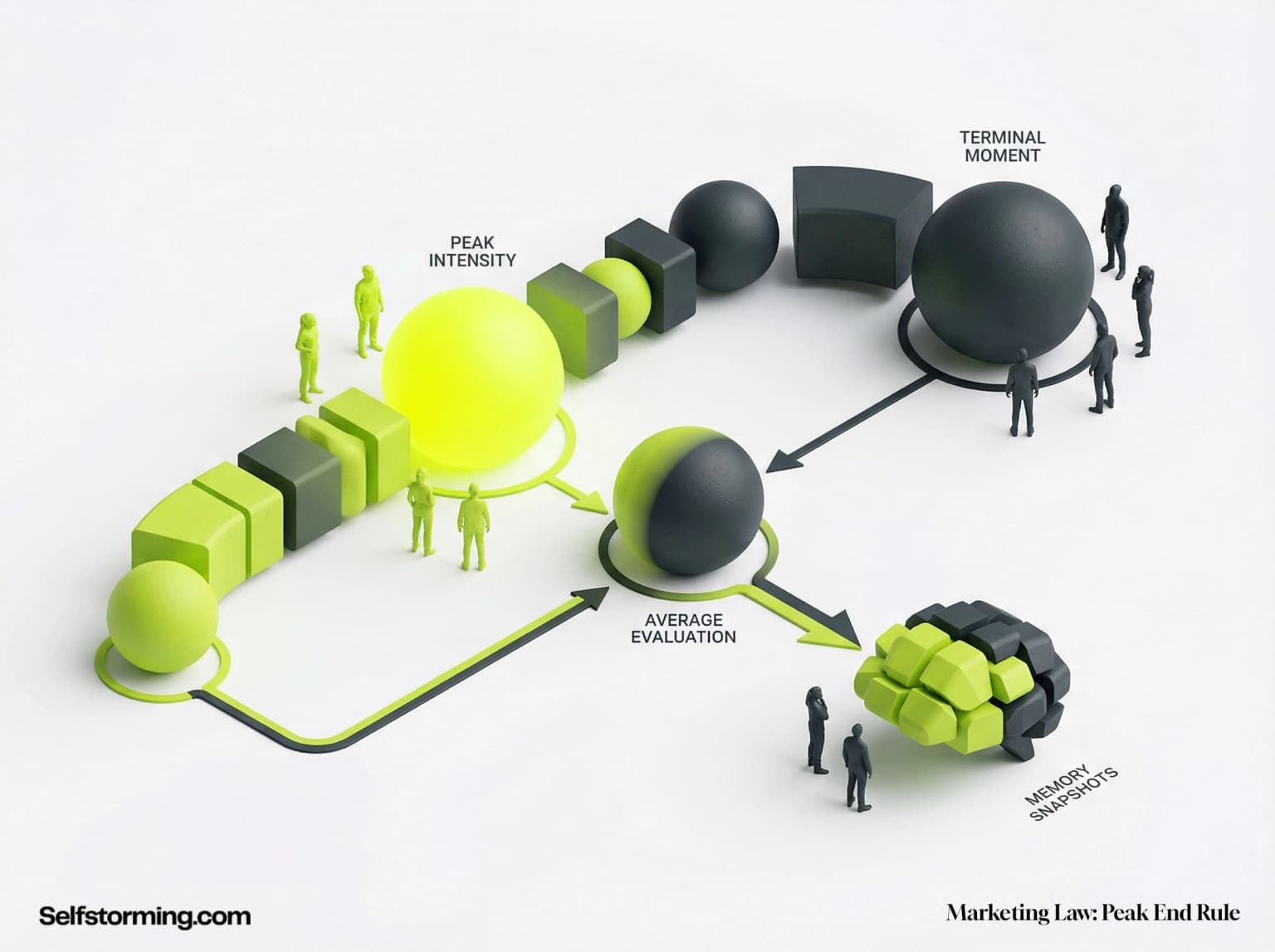
The Peak-End Rule is a psychological heuristic that dictates how humans evaluate past experiences. Instead of calculating the mathematical average of an entire event or its total duration (a phenomenon known as 'duration neglect'), the human brain stores memories based on two specific data points: the most intense emotional moment (the peak) and the final moment (the end). This means that a long, mediocre experience is remembered less fondly than a shorter, potentially more painful experience that concludes on a high note. For marketers, this implies that resource allocation should be disproportionately weighted toward creating 'signature moments' and perfecting the final interaction, rather than striving for uniform excellence across a linear customer journey. If the peak and the end are positive, the consumer will perceive the entire brand interaction as positive, regardless of minor frictions encountered in the middle.
PEAK-END RULE
“Human memory encodes experiences not as a continuous stream of data, but as a series of representative snapshots where the retrospective evaluation is determined by the average of the most intense emotional point and the terminal moment of the episode.”

Key Takeaways
- •Memory is a highlight reel, not a full-length documentary of the customer journey.
- •The average quality of an experience matters less than its best and final moments.
- •Duration neglect means people forget how long a wait was if the end was great.
- •One intense positive moment can neutralize multiple minor points of friction.
- •The 'End' is your last chance to rewrite the entire memory of the brand.
- •Stop wasting money on 'consistent' mediocrity; fund 'Signature Peaks' instead.
Genesis & Scientific Origin
The Peak-End Rule was formally identified and defined by Daniel Kahneman, a Nobel Prize-winning psychologist and economist, alongside colleagues Barbara Fredrickson, Charles Schreiber, and Donald Redelmeier. While the concept of memory bias had been discussed in various psychological circles, it was the 1993 study titled 'When More Pain is Preferred to Less: Adding a Better End' that solidified the rule. Kahneman’s work, primarily conducted at Princeton University, sought to understand why human choices often deviate from rational utility. He discovered that our 'remembering self' is a completely different entity from our 'experiencing self.' The remembering self does not care how long an experience lasted; it only cares about the peaks of intensity and the final impression. This research fundamentally challenged the 'utility integration' model, which assumed people sum up their experiences over time. Instead, Kahneman proved that we are biologically hardwired to be 'duration-blind' and 'intensity-focused,' a finding that later became a cornerstone of behavioral economics and modern marketing science as popularized by practitioners like Richard Shotton in 'The Choice Factory.'
“80% of participants chose a longer painful experience over a shorter one because the ending was less intense (Kahneman et al., 1993).”
The Mechanism: How & Why It Works
The mechanism behind the Peak-End Rule is rooted in cognitive efficiency and evolutionary survival. The human brain is an energy-intensive organ that seeks to minimize the processing of redundant information. Storing every second of a three-hour flight or a two-week vacation would be computationally expensive and largely useless for future decision-making. Instead, the brain employs a 'snapshot' heuristic. It identifies the most salient emotional data—the 'peak'—because high-intensity moments (whether pleasurable or painful) typically signal the most important information for survival or reproduction. The 'end' is prioritized because it signifies the final status of the situation, providing a summary of whether the encounter was ultimately successful or dangerous.
Mathematically, this can be expressed as a simple average: (Peak + End) / 2 = Remembered Utility. Notice that 't' (time/duration) is absent from this equation. This leads to 'duration neglect,' where the length of an experience has almost no impact on the retrospective memory of it. In a marketing context, this means a customer who experiences 10 minutes of frustration but ends with a 30-second 'wow' moment will likely rate the experience higher than a customer who had 10 minutes of 'okay' service that ended with a neutral 'goodbye.'
Furthermore, the 'Peak' can be either positive or negative. A 'negative peak' (a moment of extreme frustration) can poison the entire memory, even if the rest of the experience was flawless. This is why a single rude waiter can ruin a five-star dining experience. The brain uses these snapshots as shortcuts for future behavior: 'Should I buy from this brand again?' The remembering self checks the snapshots, sees the negative peak, and ignores the 59 minutes of competence that preceded it. From a statistical perspective, this creates a non-linear relationship between service quality and brand loyalty, where extreme variance (as long as it's positive) is often more valuable than low-variance mediocrity.

Empirical Research & Evidence
One of the most famous and definitive studies on the Peak-End Rule is the 'Cold Pressor Task' conducted by Kahneman and colleagues. Psychological Science (Kahneman, Fredrickson, Schreiber, & Redelmeier, 1993) published the research where participants were subjected to two uncomfortable experiences. In Trial A, participants submerged their hand in 14°C water (painful) for 60 seconds. In Trial B, participants submerged their hand in 14°C water for 60 seconds, but then kept it in the water for an additional 30 seconds as the temperature was gradually raised to 15°C (still uncomfortable, but slightly less so).
Logically, Trial B contains more total pain (90 seconds vs. 60 seconds). However, when asked which trial they would prefer to repeat, a staggering 80% of participants chose Trial B. They chose more total pain because the ending was less intense than the ending of Trial A. This proved that the 'ending' of an experience has a disproportionate weight on memory and preference, effectively overriding the actual duration of the discomfort.
Another significant study published in the journal Pain (Redelmeier & Kahneman, 1996) followed patients undergoing colonoscopies. Patients were asked to rate their pain every 60 seconds. One group had the procedure end normally. For the second group, the physician left the colonoscope in place for an extra minute without moving it (uncomfortable but not painful). Despite the second group experiencing a longer procedure with more total discomfort, their retrospective evaluations of the experience were significantly more positive because the 'ending' was less painful. This study demonstrated that by strategically extending an experience with a lower-intensity period, you can actually improve the overall memory of that experience.
Real-World Example:
IKEA
Situation
The IKEA shopping experience is notoriously exhausting, often described as a 'maze' that requires customers to walk through every department, deal with flat-pack logistics, and navigate crowded warehouses. This journey is filled with 'negative peaks'—decision fatigue, physical tiredness, and the stress of self-service.
Result
IKEA counteracts this by engineering a deliberate 'Positive Peak' and a 'Positive End.' The peak is often the 'Showroom' phase where customers can dream and visualize, but the most famous application is the 'End.' At the exit, after the stress of the warehouse and checkout, IKEA offers extremely low-priced hot dogs, ice cream, and cinnamon rolls. By providing a high-value, pleasurable reward at the very last moment of the journey, IKEA ensures the 'End' snapshot is positive. This 'cheap treat' overrides the memory of the two-hour trek through the store, leading to high repeat rates and a positive brand perception. They don't try to make the warehouse walk 'fun'; they just make the ending delicious.
Strategic Implementation Guide
Identify Your Current Peaks
Map your customer journey and use emotional sentiment analysis to find where the current 'peaks' (positive or negative) are. Don't guess; use data to find the moment of highest tension or delight.
Audit the 'Exit' Strategy
Look at the very last interaction a customer has with your brand—the confirmation email, the unboxing, the 'thank you' page, or the cancellation flow. If it's neutral or bureaucratic, you're failing the rule.
Reallocate 'Middle' Budget
Identify 'filler' touchpoints that are 'good enough' but consume significant resources. Siphon 20% of that budget to fund a single, high-impact 'Signature Peak' that competitors can't replicate.
Engineer a 'Surprise and Delight' Peak
Create a moment of disproportionate value that occurs mid-journey. This could be an unexpected free gift, a personalized video, or a high-tier service intervention that happens when the customer expects standard treatment.
Softening the Landing
If your service involves a 'negative peak' (like a high price or a complex setup), ensure the 'End' is exceptionally smooth and rewarding. The ending must have a higher 'affective valence' than the average of the experience.
Train for the 'Last Impression'
For service-based brands, ensure staff are trained to prioritize the final 30 seconds of an interaction above all else. A mistake in the middle can be forgiven if the farewell is legendary.
Measure 'Remembered NPS' vs 'Real-time NPS'
Don't just survey customers during the experience. Survey them 30 days later to see what snapshots survived. Optimize for the 30-day memory, not the 30-second reaction.
Frequently Asked Questions
Does the Peak-End Rule mean I can ignore the rest of the customer journey?
Not exactly. While the peak and end dominate memory, a 'negative peak' (a catastrophic failure) can occur anywhere. If your 'middle' is so bad that it creates a new, unintended negative peak, no amount of free ice cream at the end will save you. Think of it as 'strategic prioritization' rather than 'total neglect.' You need a baseline of competence to avoid negative peaks, but you need the Peak-End Rule to create positive memories.
Can a peak be too high, creating a 'contrast effect' that makes the rest of the brand feel worse?
This is a sophisticated concern. If your peak is a Michelin-star level interaction but your brand is a budget airline, the contrast might highlight the mediocrity. However, the data suggests that humans are remarkably good at ignoring the 'trough' if the 'peak' is salient enough. The goal is a 'Signature Moment' that defines the brand, not a peak that makes the rest of the service unusable.
How does this apply to B2B or long-term service contracts?
In long-term relationships, the 'End' is often the renewal period or the quarterly review. Many B2B firms ignore their clients until renewal time, which is a mistake. You need to engineer 'mini-peaks' throughout the year (e.g., an unexpected insight report or an executive event) and ensure the 'End' of every specific project or interaction is handled with more care than the kickoff.
Is the 'Peak' always a positive thing?
No. A 'Peak' is simply the point of highest emotional intensity. In many poorly managed brands, the 'Peak' is a moment of extreme frustration (e.g., being on hold for 2 hours). The Peak-End Rule works both ways: a negative peak and a negative end will guarantee the customer never returns and tells everyone they know about their terrible experience.
Does duration neglect mean I can make my service as long as I want?
Technically, yes, as long as you maintain the Peak and the End. However, the longer an experience lasts, the more opportunities there are for a 'negative peak' to occur. Also, while 'remembered utility' ignores duration, 'experienced utility' (how the person feels in the moment) does not. If you make a process unnecessarily long, you risk the customer quitting before they ever reach your carefully engineered 'End'.
Sources & Further Reading
Related Marketing Laws
Social Proof Effect
People copy the behavior of others, especially in uncertainty.
Pratfall Effect
Admitting a weakness increases credibility and likability.
The Generation Effect
People remember better what they've actively completed themselves.
Costly Signaling
Expensive advertising signals quality and commitment to customers.