The Generation Effect

Participation builds better memory.

You’re obsessed with 'frictionless' experiences, aren't you? You want everything so smooth your customers slide right off the brand and into the abyss of forgetting. Here’s the ugly truth: by making it easy, you’re making it invisible. The Generation Effect is the cold shower your 'seamless' UX needs. If they don't help build the memory, they won't remember the brand. Stop treating your audience like toddlers and start giving them a puzzle to solve before they tune out entirely. It’s time to stop serving pre-chewed content and start making your audience work for the punchline.
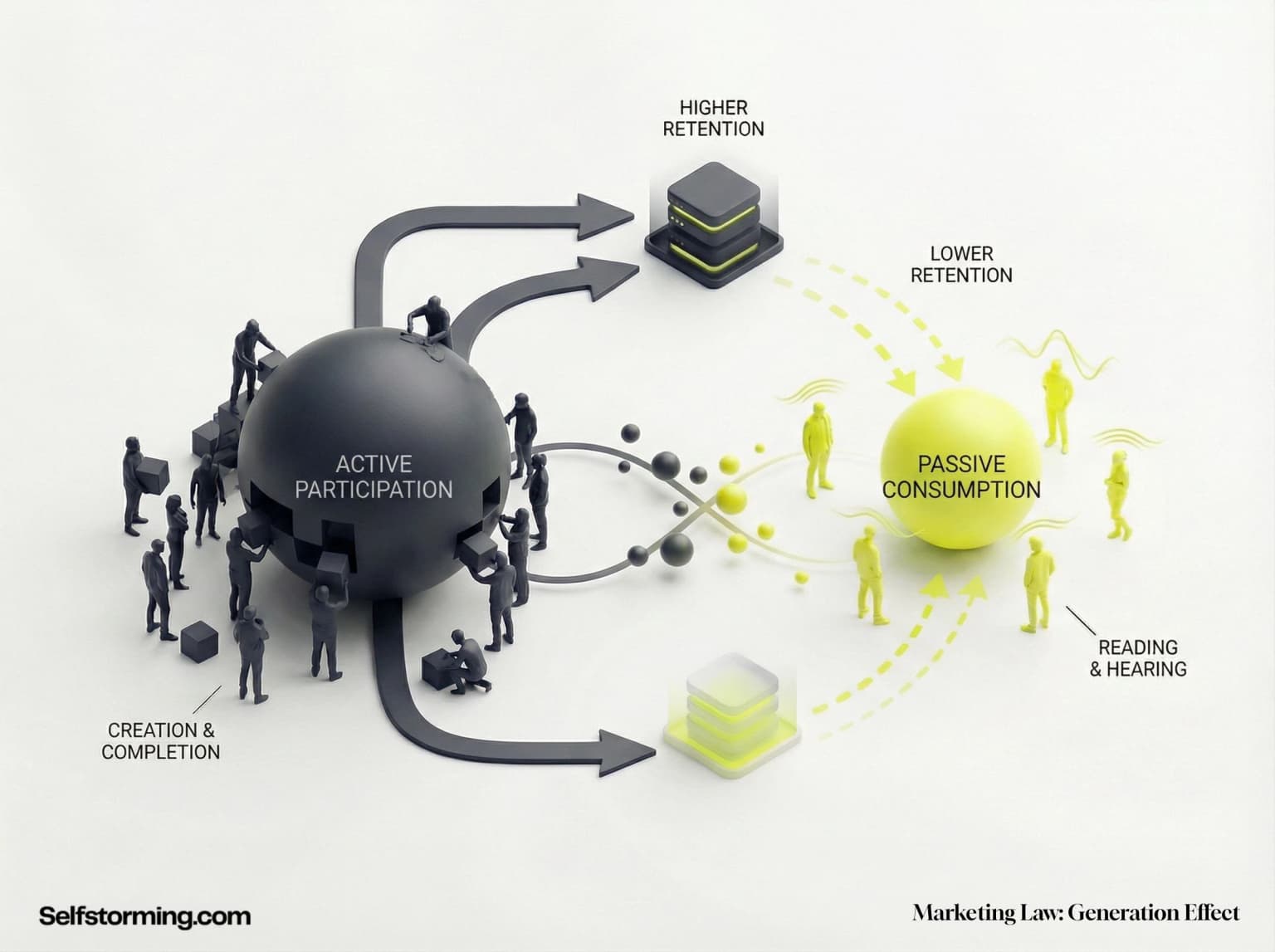
The Generation Effect is a robust cognitive phenomenon where information is significantly better remembered when it is actively generated by an individual rather than passively perceived. In the context of Marketing Science, this law challenges the prevailing 'frictionless' dogma. It posits that by introducing 'desirable difficulties'—such as missing letters in a headline, riddles in a social post, or interactive elements in a digital experience—marketers can force the brain to allocate more cognitive resources to the brand message. This increased mental effort leads to deeper semantic encoding and more durable memory structures. While passive consumption (reading a clear statement) is easy, active generation (solving the statement) creates a proprietary neural connection between the consumer and the information, making the brand far more likely to be retrieved during the buying situation.

THE GENERATION EFFECT

Information is retrieved more effectively when individuals participate in the creation or completion of the material rather than simply reading or hearing it.

The Generation Effect marketing law: Participation builds better memory. - Visual illustration showing key concepts and examples

Key Takeaways

  • Passive reading is for losers; active generation builds unshakeable brand memories.
  • Strategic friction in messaging beats 'seamless' content for long-term recall.
  • The 'Aha!' moment of solving a puzzle creates a proprietary neural brand hook.
  • Leave the last 10% for the consumer to finish; they'll value it more.
  • Memory is a muscle; make your audience flex it if you want to stay.
  • Friction in the message, ease in the transaction—never confuse the two.

Genesis & Scientific Origin

The Generation Effect was first formally identified and named by Norman J. Slamecka and Peter Graf in 1978. Their foundational research was conducted at the University of Toronto and published in the Journal of Experimental Psychology: Human Learning and Memory. Slamecka and Graf sought to understand why self-produced information had a higher recall rate than information presented by an external source. While earlier psychologists like Wilhelm Wundt had touched on the idea of active learning, Slamecka and Graf provided the first rigorous empirical framework. They demonstrated that the act of 'generating' a response from a cue (e.g., being given 'Sea-O____' and having to think of 'Ocean') created a more distinct memory trace than simply reading the word pair 'Sea-Ocean'. Their work laid the groundwork for modern cognitive psychology's understanding of how active participation influences long-term memory retention.

Self-generated information is remembered up to 37% better than passively read data (Slamecka & Graf, 1978).

The Mechanism: How & Why It Works

The psychological foundation of the Generation Effect lies in the 'Levels of Processing' framework and the concept of 'Desirable Difficulty.' When a consumer encounters a standard advertisement, they often engage in 'shallow processing'—the brain recognizes the shapes and sounds but doesn't deeply integrate the meaning. However, when a message requires 'generation,' the brain is forced into 'deep processing.'

Mathematically and statistically, the effect can be viewed as an increase in the number of retrieval paths to a single memory node. When you solve a puzzle to uncover a brand name, you aren't just storing the name; you are storing the logic used to find it, the effort expended, and the 'Aha!' moment of resolution. This creates multiple 'hooks' in the long-term memory.

From a neurological perspective, generation activates the prefrontal cortex and the hippocampus more intensely than passive reading. This is often linked to the 'Self-Reference Effect'—because you were the one who completed the thought, the information becomes 'yours' rather than 'theirs.' Furthermore, the effort required to bridge the gap in a message acts as a filter; it ensures that the brain prioritizes that specific information as 'important' enough to warrant the energy expenditure. In a world of infinite scroll and passive consumption, the Generation Effect acts as a cognitive speed bump that forces the brain to save the data rather than discard it as background noise.

The Generation Effect mechanism diagram - How The Generation Effect works in consumer behavior and marketing strategy

Empirical Research & Evidence

In the seminal study published in the Journal of Experimental Psychology: Human Learning and Memory (Slamecka & Graf, 1978), researchers conducted a series of experiments to quantify the memory advantage of generation. In one representative experiment, participants were split into two groups: the 'Read' group and the 'Generate' group. Both groups were presented with word pairs. The 'Read' group saw pairs like 'Rapid-Fast' (synonyms). The 'Generate' group saw 'Rapid-F____' and were required to generate the synonym themselves.

The results were staggering: across five different types of word relationships (synonyms, opposites, rhymes, etc.), the 'Generate' group consistently outperformed the 'Read' group in both recognition and recall tests. Specifically, the researchers found that participants in the 'Generate' condition remembered between 15% and 37% more words than those in the 'Read' condition. The effect was found to be independent of the difficulty of the generation task, provided the task was successfully completed. This study proved that the cognitive act of completion—no matter how simple—shifts the information from transient short-term memory into more stable long-term structures. This research has been replicated hundreds of times, most notably by Richard Shotton in 'The Choice Factory,' where he demonstrated that consumers were significantly more likely to remember a brand name in an ad if a single letter was missing from the headline.

Real-World Example:
The Economist

Situation

The Economist faced the challenge of being perceived as an 'elite' and 'difficult' publication. Instead of simplifying their message to appeal to the masses (the standard 'frictionless' approach), they leaned into the Generation Effect through their iconic 'White out of Red' billboard campaign designed by Abbott Mead Vickers BBDO.

Result

The campaign featured cryptic, witty headlines that required the reader to spend a few seconds 'solving' the joke or the insight. One famous ad simply said: 'I never read The Economist. — Management Trainee, aged 42.' The reader has to connect the dots: if you don't read it, you'll be stuck in a junior role forever. By making the audience 'generate' the punchline, The Economist built a massive 'Mental Availability' advantage. The campaign ran for decades, resulting in a circulation increase of over 50% and establishing the brand as a badge of intelligence. The 'friction' of the ads didn't turn people away; it made the brand's core value proposition unforgettably sticky.

Strategic Implementation Guide

1

Budgeting

Allocate 20% of your creative budget specifically for 'high-engagement' assets that utilize the Generation Effect. This isn't just 'interaction'; it's cognitive participation. Don't waste money on 'easy' ads that get 100% reach but 0% recall.

2

Creative Concepting

Apply the '10% Gap' rule. Design your headlines or visual metaphors so they are 90% complete. Leave the final 10% for the consumer to solve. Use missing letters, visual puns, or 'fill-in-the-blank' social media captions.

3

Targeting

Deploy 'Generation' creative to your 'Light Buyers.' Since they don't think about you often, you need the extra cognitive 'stickiness' to ensure that when they finally enter the market, your brand is the one that pops into their head.

4

Media Planning

Use 'High-Attention' environments for these ads. The Generation Effect requires a few seconds of focus. OOH (billboards) in high-traffic/slow-moving areas or long-form print are better than 2-second 'skip' ads on YouTube.

5

CTA Strategy

Instead of a boring 'Buy Now,' use a CTA that requires a choice or a completion. 'Which one fits your style?' or 'Solve your [Problem] here.' Force a micro-decision to cement the intent in memory.

6

A/B Testing

Always test a 'Frictionless' version against a 'Generation' version. Measure 'Brand Recall' at 24 and 48 hours, not just immediate click-through rates. You'll likely find that the 'harder' ad has lower CTR but much higher long-term recall.

7

UX/UI Design

Don't over-sanitize. In onboarding, let users 'build' their profile or 'discover' features through small tasks. The 'IKEA Effect' (valuing what you build) is just the Generation Effect with a screwdriver.

Frequently Asked Questions

Doesn't introducing friction reduce conversion rates in the short term?

Yes, it might. If you make it harder to click a button, fewer people will click. However, the Generation Effect isn't about making the *transaction* hard; it's about making the *encoding* active. You want friction in the message, not the checkout. The goal is to trade a tiny bit of immediate 'click-bait' for a massive increase in long-term memory and brand preference.

Is there a risk that the audience won't 'get it' and will just ignore the ad?

Absolutely. This is the 'Alienation Paranoia' trap. If the puzzle is too hard, they'll quit. The sweet spot is 'Desirable Difficulty'—a task that is easy enough to solve in 2-3 seconds but requires more than 0 seconds of thought. If they can't solve it, the effect fails. If it's too easy, it's just passive reading.

Does this work for low-involvement FMCG products like soap or bread?

It works *better* for them. Low-involvement brands struggle with being ignored. By using a small visual 'glitch' or a missing word in a soap ad, you force the brain to pay attention to a category it usually ignores. You are essentially 'hacking' the brain's filter for boring information.

How does this relate to the 'IKEA Effect'?

The IKEA Effect is the labor-based cousin of the Generation Effect. While the Generation Effect is about *information* processing, the IKEA Effect is about *physical* effort and ownership. Both rely on the principle that 'effort creates value and memory.' If you help build it, you like it more and remember it longer.

Can I use the Generation Effect in audio ads like radio or podcasts?

Yes. Use 'Theater of the Mind.' Ask a question and leave a 2-second pause before answering it. Or use a familiar jingle but cut the last note short. The listener's brain will 'generate' the missing sound, creating a much stronger memory of the brand than if they had heard the full melody.

We use cookies on our site to enhance your user experience, provide personalized content, and analyze our traffic. Cookie Policy