Context Effects
Context changes how we see value.
Look, your product is fine. Probably. But if you're trying to sell it in a vacuum, you're an idiot. Most marketers waste their lives polishing features while ignoring the fact that a $5 coffee feels like a steal in a five-star hotel but an insult in a gas station. Context isn't just the 'vibe'—it's the actual engine of value. People don't know what things are worth; they only know what they're worth relative to the crap standing next to them. If you don't control the environment, the environment will control your margins. Stop tweaking your specs and start fixing the frame.
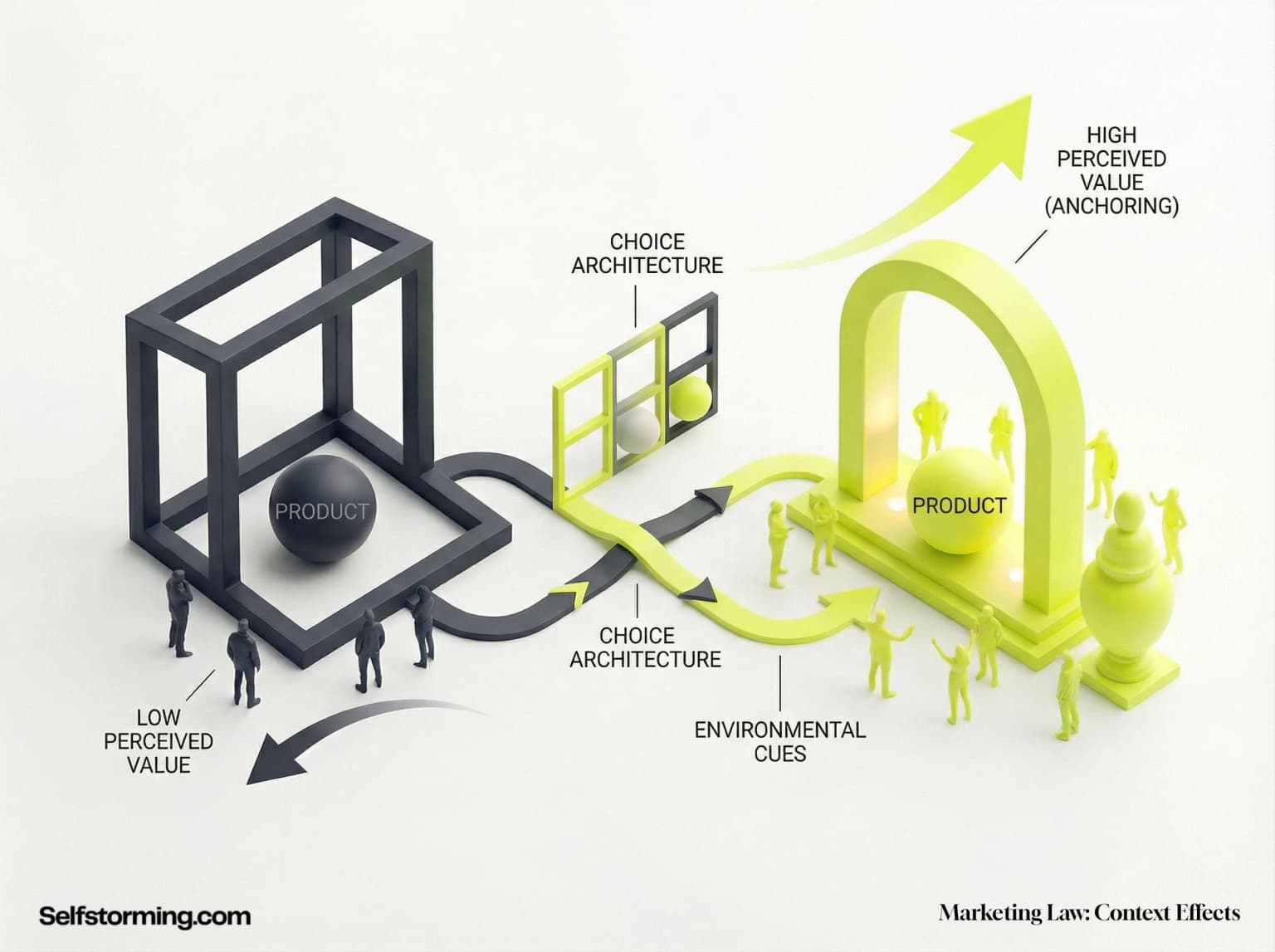
Context Effects represent the psychological reality that human beings lack an internal 'value meter' for products and services. Instead, we evaluate worth based on environmental cues, comparative sets, and the physical or digital setting of a purchase. This law, championed by figures like Rory Sutherland and Dan Ariely, posits that the 'frame' surrounding a product—its price relative to others, its packaging, and its point of sale—often influences purchase decisions more than the product's objective utility. By mastering choice architecture and anchoring, brands can significantly increase perceived value without changing the product itself. In a world of infinite choice, the context in which a brand appears dictates its mental availability and price elasticity, making environmental design a core strategic lever rather than a cosmetic afterthought.
CONTEXT EFFECTS
“Perceived utility and economic value are not fixed properties of an object but are dynamically constructed through the influence of environmental cues, comparative sets, and framing effects.”

Key Takeaways
- •Value is relative, never absolute; the 'frame' dictates the price people will pay.
- •Use high-priced anchors to make your core products appear as high-value bargains.
- •Strategic decoys simplify decision-making by making one option look clearly superior.
- •Environmental cues like music and lighting directly influence purchase behavior subconsciously.
- •Changing the category context can allow commodity products to command luxury margins.
Genesis & Scientific Origin
The scientific foundation of Context Effects is rooted in the early work of Amos Tversky and Daniel Kahneman in the 1970s and 80s, specifically their research into Prospect Theory and the Framing Effect. However, its specific application to modern marketing strategy and the 'irrational' perception of value was significantly popularized by Rory Sutherland, Vice Chairman of Ogilvy, in his 2019 book 'Alchemy: The Surprising Power of Ideas That Don't Make Sense'. Sutherland, building on decades of behavioral science from institutions like the London School of Economics and MIT’s Media Lab, argues that the psychological value of a product is highly malleable. He posits that humans are 'context-dependent' evaluators, a trait evolved for survival where relative comparison is more efficient than absolute calculation. This law bridges the gap between traditional economics, which assumes rational utility, and the reality of consumer behavior.
“Playing national music in stores can shift wine sales by up to 300% (North et al., 1999).”
The Mechanism: How & Why It Works
The mechanism of Context Effects operates through several psychological pillars: Anchoring, The Decoy Effect, and Environmental Priming.
1. Anchoring: The human brain relies heavily on the first piece of information offered (the 'anchor') when making decisions. If a consumer sees a $2,000 watch first, a $500 watch suddenly feels like a bargain, regardless of its manufacturing cost. The context of the high price point re-calibrates the consumer's internal scale of value.
2. The Decoy Effect (Asymmetric Dominance): This occurs when a third, less attractive option is introduced to make one of the other two options seem superior. A classic example is the popcorn pricing at cinemas: a Small for $4 and a Large for $8 makes the Large look expensive. But add a Medium for $7, and the Large suddenly feels like a 'steal' for just a dollar more. The Medium exists solely to provide context for the Large.
3. Environmental Priming: Physical and digital cues—such as music, lighting, or even the font on a website—activate specific neural pathways. Slow music in a supermarket encourages longer browsing times and higher spend, while high-end packaging for a commodity product (like artisanal salt) signals a luxury context that justifies a 1000% price markup.
4. Social Context: The presence or behavior of others serves as a contextual cue. A crowded restaurant is perceived as 'better' than an empty one, even if the food is identical. The context of 'popularity' acts as a heuristic for quality, reducing the cognitive load of decision-making.
5. Temporal Context: The timing of an offer changes its value. An umbrella is worth $5 on a sunny day but $20 during a downpour. The context of 'need' and 'scarcity' overrides the product's baseline cost-plus valuation.

Empirical Research & Evidence
One of the most cited studies on context-driven behavior is the 'Wine and Music' research conducted at the University of Leicester. Journal of Applied Psychology (North, Hargreaves, & McKendrick, 1999). In this experiment, researchers displayed French and German wines of similar price and sweetness in a British supermarket. Over a two-week period, they alternated between playing stereotypical French accordion music and German 'Oompah' brass band music. The results were staggering: when French music was played, French wine outsold German wine by a ratio of 3:1. When German music was played, German wine outsold French wine by a ratio of 2:1. Despite the massive shift in purchasing behavior, only 6 out of 44 customers who agreed to be interviewed mentioned the music as a factor in their choice. This study demonstrates that subtle environmental context can bypass conscious deliberation and directly influence high-level consumer choices, even when the consumers themselves remain unaware of the influence.
Real-World Example:
Nespresso
Situation
In the 1990s, coffee was largely viewed as a commodity sold in large tins at supermarkets for a few cents per cup. Nespresso faced the challenge of selling coffee at a significantly higher price point—roughly $0.50 to $0.70 per capsule, which is a massive markup on the per-gram price of ground coffee.
Result
By changing the context, Nespresso revolutionized the category. Instead of selling 'coffee,' they sold 'an espresso experience.' They moved the product out of the supermarket aisle and into high-end 'boutiques' that mimicked luxury jewelry stores or Apple stores, complete with concierge service and minimalist design. They used George Clooney as a brand ambassador to provide a context of Hollywood sophistication. By framing the product as a 'capsule' rather than a 'bag of grounds,' they shifted the consumer's price anchor from the $10 tin of Maxwell House to the $4 latte at Starbucks. In the context of a $4 latte, a $0.60 capsule feels like a 85% saving, whereas in the context of a supermarket tin, it looks like a 500% markup. Today, Nespresso is a multi-billion dollar business that thrives entirely on the mastery of context.
Strategic Implementation Guide
Audit Your Environment
Map out every touchpoint where a customer encounters your price or product. Is the digital 'room' (your website) or physical 'room' (your store/shelf) signaling the value you want to command?
Establish a High Anchor
Never lead with your cheapest option. Present a 'Premium' or 'Enterprise' tier first to set a high price anchor, making your core offering feel like a rational, mid-range choice.
Introduce a Strategic Decoy
If you want to push a specific product, introduce a 'decoy' that is slightly worse but nearly the same price. This creates a clear 'no-brainer' choice for the consumer.
Control the Comparative Set
In digital retail, ensure your product isn't being compared solely on price. Use 'Related Products' or 'Compare' features to surround your item with more expensive or less feature-rich alternatives.
Leverage Sensory Priming
If you have a physical presence, use scent, sound, and lighting to match your brand's desired price tier. If digital, use high-resolution imagery and 'premium' UI patterns to signal quality.
Frame the Narrative
Shift the conversation from 'what it is' to 'what it's for.' A $100 bottle of water is a ripoff; a $100 'hydration recovery system' for elite athletes is a specialized tool.
Contextualize the Transaction
Use packaging and 'unboxing' experiences to reinforce the value after the purchase, reducing buyer's remorse and increasing the likelihood of repeat purchase through positive memory building.
Frequently Asked Questions
Does context still matter if my product is objectively better than the competition?
Yes, arguably even more so. If you have a superior product but sell it in a 'cheap' context, consumers will experience cognitive dissonance. They may even suspect your quality claims are fraudulent because the environmental cues don't match the promise. Context is the 'proof' that allows consumers to believe in your objective superiority.
Is the Decoy Effect ethical, or is it just price manipulation?
It's choice architecture. You aren't forcing a choice; you're helping a confused brain make a comparison. Humans struggle with absolute values. By providing a decoy, you're giving the brain the comparative data it craves to feel confident in a decision. Whether that's 'manipulation' or 'good UX' is a philosophical debate for people who don't have a sales target.
How does Context Effects apply to B2B SaaS marketing?
In B2B, context is often the 'company you keep.' Being featured in a Gartner Magic Quadrant or having logos of Fortune 500 clients on your site provides the 'institutional context' that justifies a high contract value. The 'room' in B2B is your reputation and the caliber of your existing client base.
Can context effects backfire if the environment is too luxury for a mass-market product?
Absolutely. This is called 'over-framing.' If a budget brand tries to act like a luxury brand, it creates 'alienation paranoia.' Consumers may feel the brand is 'not for them' or that they are being overcharged for fluff. The context must align with the brand's core promise, not just aim for the ceiling.
What is the 'Center Stage Effect' in choice architecture?
The Center Stage Effect is a contextual bias where consumers are more likely to choose the middle option in a set of three, regardless of its specific attributes. People subconsciously assume the middle option is the 'safe' or 'standard' choice, avoiding the perceived risks of the extremes (too cheap/low quality or too expensive/over-specced).
Sources & Further Reading
Related Marketing Laws
Social Proof Effect
People copy the behavior of others, especially in uncertainty.
Pratfall Effect
Admitting a weakness increases credibility and likability.
The Generation Effect
People remember better what they've actively completed themselves.
Peak-End Rule
People judge experiences by their peak moment and ending, not the average.