Decoy Effect
Guide choices with a clever decoy.
You think your customers are rational actors weighing utility against price? That’s cute. In reality, they’re lost toddlers looking for any excuse to stop thinking and just pick something. The Decoy Effect is the ultimate cheat code for when you want to nudge people toward the high-margin option without actually improving the product. It’s not manipulation; it’s just helping the cognitively lazy feel smart about overpaying. Welcome to the world of asymmetric dominance, where your third-best option is actually your most important sales tool.
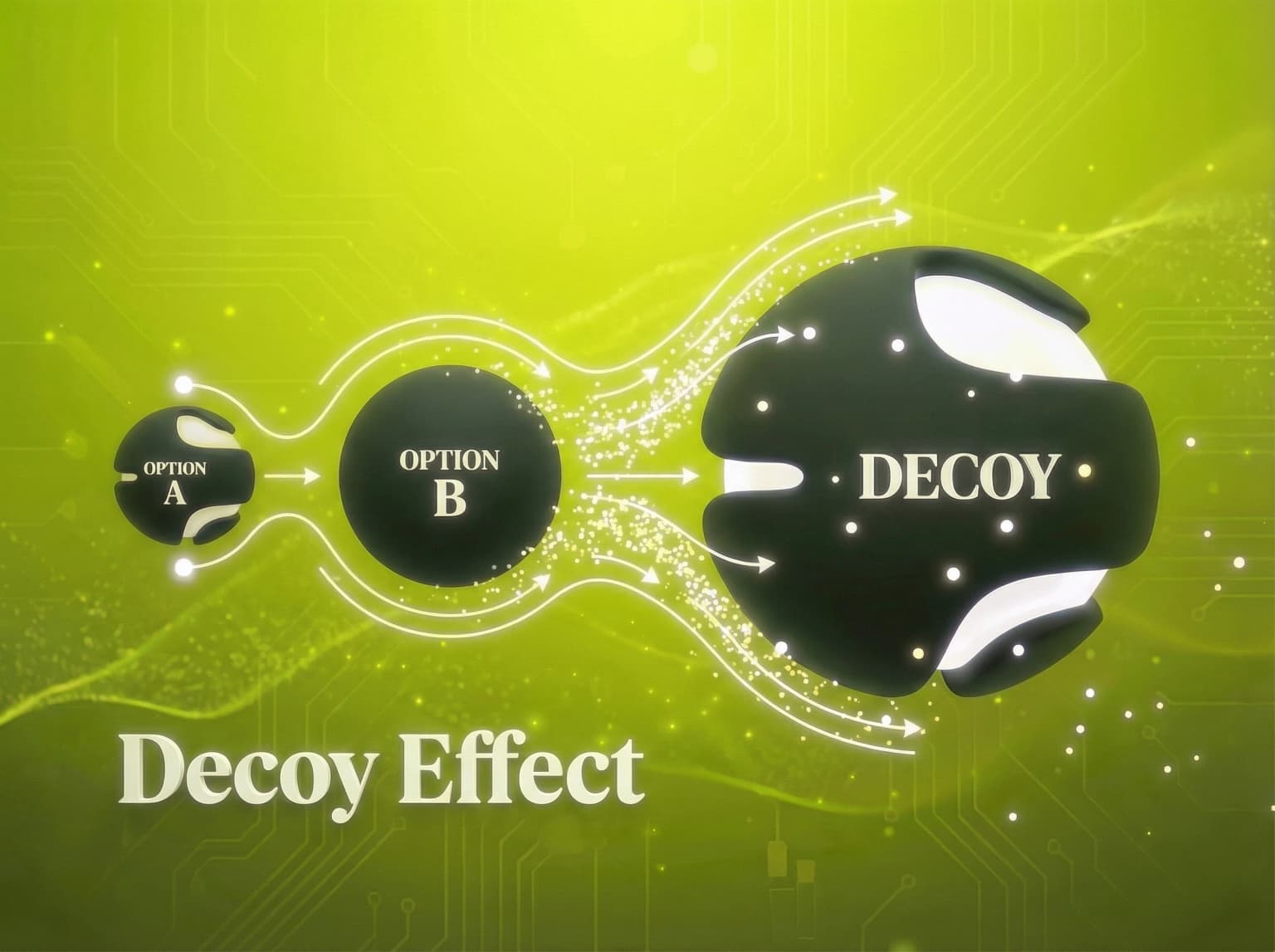
The Decoy Effect, technically known as the Asymmetric Dominance Effect, describes a phenomenon where consumers change their preference between two options when presented with a third, strategically inferior option. This 'decoy' is designed not to sell, but to make one of the original options (the 'target') appear significantly more attractive than the other (the 'competitor'). By being strictly inferior to the target in all dimensions but only partially inferior to the competitor, the decoy provides a 'reason to choose' that bypasses complex value calculations. In marketing science, this represents a fundamental violation of the 'regularity principle,' which suggests that adding an option should never increase the probability of choosing an existing one. For practitioners, it is a cornerstone of choice architecture, particularly effective in subscription models, software-as-a-service (SaaS) pricing tiers, and high-end consumer electronics.
DECOY EFFECT
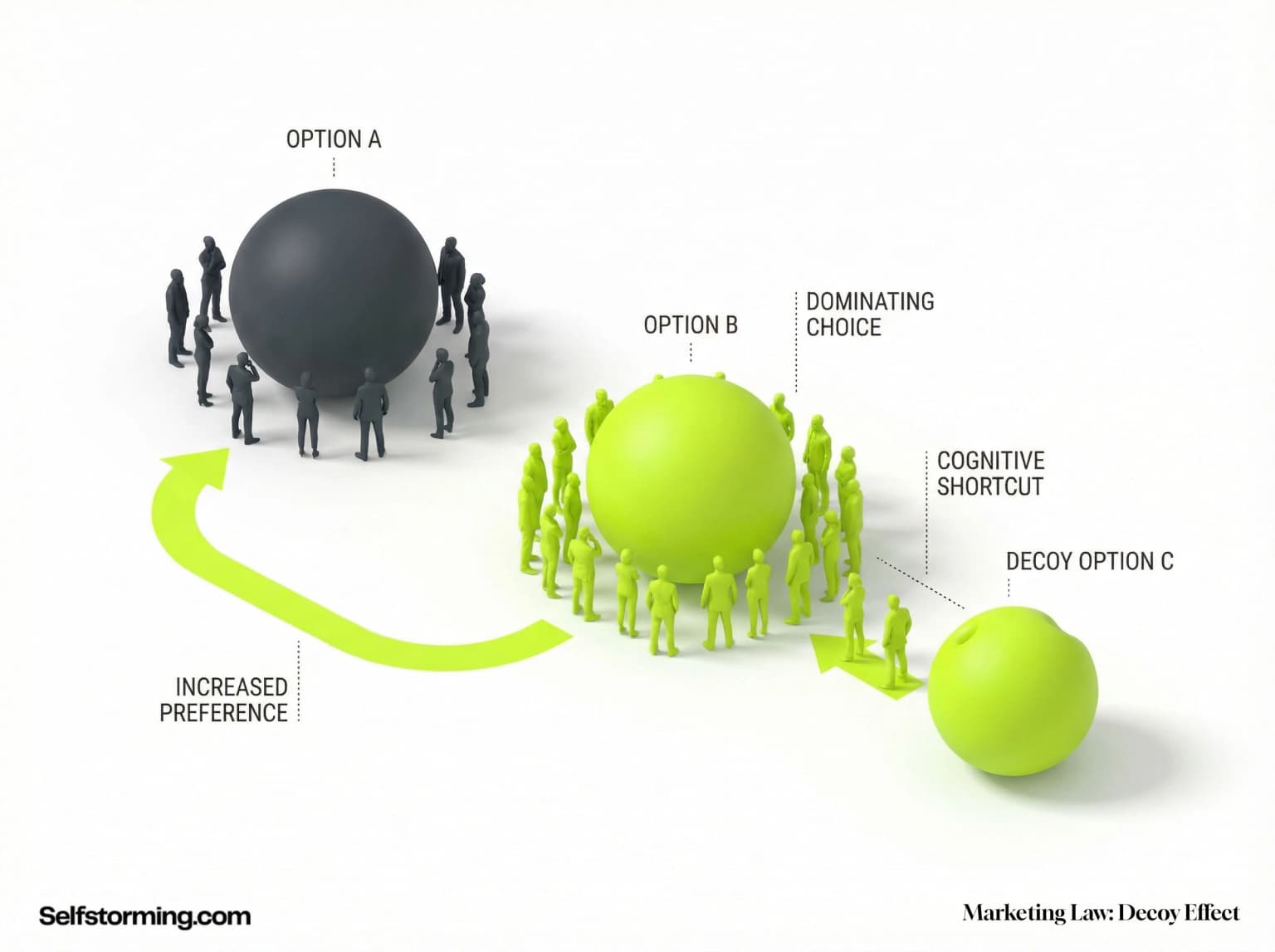
“Preferences between two options change significantly when a third, asymmetrically dominated option is introduced, providing a cognitive shortcut that increases the perceived value of the dominating choice.”

Key Takeaways
- •Consumers don't choose in a vacuum; they choose based on relative comparison.
- •A decoy must be asymmetrically dominated to effectively nudge the target choice.
- •Adding a third, inferior option can increase the sales of your highest-margin product.
- •The Decoy Effect simplifies complex decisions by providing a clear 'reason to buy.'
- •Effective decoys make the target's price premium feel like a 'free' value upgrade.
Genesis & Scientific Origin
The formal academic foundation of the Decoy Effect was established by Joel Huber, John Payne, and Christopher Puto in 1982. Their seminal paper, 'Adding Asymmetrically Dominated Alternatives: Violations of Regularity and the Similarity Hypothesis,' published in the Journal of Consumer Research, challenged the prevailing economic theories of the time. Before this study, the 'Regularity Principle' dominated economic thought, asserting that the market share of an existing product cannot be increased by adding a new product to the choice set. Huber and his colleagues conducted experiments across multiple categories—including cars, restaurants, beer, and film—demonstrating that a 'decoy' (an option that is clearly inferior to one option but not the other) consistently shifted preferences toward the dominating option. This research was further popularized and expanded upon by Dan Ariely, particularly in his 2008 book 'Predictably Irrational,' where he demonstrated the effect's power in modern digital contexts, most notably through his analysis of The Economist's subscription models. The Decoy Effect is now recognized as a primary pillar of Behavioral Economics and Choice Architecture, frequently cited by the MIT Sloan School of Management and the Stanford Graduate School of Business as a critical lever in pricing strategy.
“Introducing a decoy can increase the preference for the target option by as much as 40% (Ariely, 2008).”
The Mechanism: How & Why It Works
The Decoy Effect operates through the psychological mechanism of 'Asymmetric Dominance.' To understand the machinery, one must look at how the human brain processes value. We are notoriously bad at calculating absolute value; instead, we rely on relative comparisons. When a consumer is presented with two options—Option A (High Quality, High Price) and Option B (Lower Quality, Lower Price)—they experience 'choice conflict.' The brain must weigh the trade-off between quality and cost, which is cognitively taxing.
Enter the Decoy (Option C). The decoy is engineered to be 'asymmetrically dominated.' This means it is completely inferior to Option A (the target) in both price and quality, but only inferior to Option B (the competitor) in one dimension (e.g., quality) while perhaps being more expensive. This creates a 'dominance relationship' that the brain can easily identify. Because Option A is clearly better than Option C in every way, the brain uses this easy comparison as a heuristic, or mental shortcut. This 'Attraction Effect' makes Option A feel like the logical, 'smart' choice, effectively neutralizing the appeal of Option B.
Furthermore, the mechanism is supported by the 'Range-Frequency Theory,' which suggests that our perception of an attribute depends on the range of available values. By introducing a decoy with an extreme price or a specific lack of features, marketers redefine the 'range' of what is acceptable, shifting the consumer’s internal anchor. This also leverages 'Loss Aversion'; by making the target look like a bargain relative to the decoy, the consumer feels that failing to choose the target results in a 'loss' of potential value. The decoy acts as a lightning rod for comparison, simplifying a complex multi-attribute decision into a simple binary choice between 'the good one' and 'the obviously worse one.'

Empirical Research & Evidence
In the foundational research published in the Journal of Consumer Research (Huber, Payne, & Puto, 1982), the authors conducted a controlled experiment involving 153 students who were asked to make choices in six different product categories. In one specific trial regarding beer, participants were initially offered two options: a 'Bargain Beer' (Price: $1.80, Quality Rating: 50) and a 'Premium Beer' (Price: $2.60, Quality Rating: 70). Initially, the split was relatively even. However, when a decoy was introduced—a 'Super Premium' beer priced at $3.40 with a quality rating of 70 (the same quality as the Premium, but more expensive)—the preference for the $2.60 Premium Beer increased significantly.
Another critical study is Dan Ariely's (2008) research published in his book 'Predictably Irrational' (referencing his MIT experiments). Ariely presented 100 MIT students with subscription options for The Economist. In the first scenario, they had two choices: a Web Subscription for $59 and a Print Subscription for $125. In this case, 68 students chose the $59 web option and 32 chose the $125 print option. In the second scenario, a third 'decoy' option was added: a Print & Web Subscription for $125. Now, the choice set was: Web ($59), Print-only ($125), and Print & Web ($125). No one chose the print-only option (the decoy). However, its mere presence shifted the results: only 16 students chose the $59 web option, while 84 students chose the $125 Print & Web option. The decoy turned a $125 expense into a perceived 'free' upgrade, increasing the revenue of the experiment by 43% without changing the price of the target product.
Real-World Example:
Apple (iPad Pricing Strategy)
Situation
Apple faced the challenge of upselling customers from the base model iPad to higher-storage, higher-margin models. If they only offered a 64GB model for $499 and a 256GB model for $749, many price-sensitive consumers would default to the $499 version, perceiving the $250 jump as too steep.
Result
Apple introduced a 'decoy' structure. By offering a base 64GB model, a mid-tier model with slightly better specs but significantly higher price, and a top-tier Pro model that made the mid-tier look like a steal, they manipulated the choice set. More effectively, in many product lines, they use 'storage gaps.' By making the base model's storage just slightly too low for modern needs (the 'competitor') and offering a massive jump for a relatively moderate price increase (the 'target'), they make the higher-priced option the only 'logical' choice. This strategy has consistently maintained Apple's high Average Selling Price (ASP) despite the availability of cheaper competitors, as the decoy (the low-storage base model) makes the expensive upgrade feel like an essential value play.
Strategic Implementation Guide
Identify Your Target
Determine which specific product or service tier has the highest profit margin. This is the 'Target' you want the majority of customers to buy.
Identify the Competitor
Locate the entry-level or budget option that most customers currently default to. This is the 'Competitor' you want to draw them away from.
Design the Decoy
Create a third option that is 'asymmetrically dominated.' It must be clearly inferior to your Target in at least two dimensions (e.g., slightly more expensive and with fewer features), but only partially inferior to the Competitor.
Calibrate the Pricing
Ensure the price of the Decoy is very close to the Target. The goal is to make the Target look like an incredible 'value' for just a few dollars/pounds more, effectively making the extra features feel 'free.'
Visual Hierarchy
In your pricing table or on the shelf, place the Decoy next to the Target. Use visual cues like 'Most Popular' or 'Best Value' tags on the Target to further reduce cognitive load.
Limit the Choice Set
Do not exceed 3 or 4 options. The Decoy Effect works because it simplifies a choice; adding too many decoys leads to 'Choice Overload,' causing the consumer to freeze and buy nothing.
Monitor and Iterate
Use A/B testing to find the 'sweet spot' for the decoy's price. If the decoy is too cheap, it might cannibalize the target; if it's too expensive, it loses its power as a comparison point.
Frequently Asked Questions
Does the Decoy Effect work in B2B sales or just B2C?
It is arguably more powerful in B2B. Professional buyers often need to justify their decisions to stakeholders. A decoy provides a clear, logical rationale for why the chosen option is the 'best value.' By presenting a proposal with three tiers where the middle (target) tier is clearly superior to a slightly cheaper 'decoy' tier, you give the buyer the ammunition they need to defend the higher spend to their CFO.
Can the decoy ever be the most expensive option?
Yes. This is often called 'Top-Down Pricing.' By placing a ridiculously expensive 'Super-Premium' option at the top of the menu, you make the second-most expensive option (your real target) look reasonable. In this case, the high-end outlier acts as a decoy that anchors the price perception for the rest of the list.
What is the difference between the Decoy Effect and the Compromise Effect?
They are siblings but not twins. The Compromise Effect occurs when people choose the 'middle' option to avoid extremes. The Decoy Effect occurs because one option is specifically designed to be 'worse' than another, making the target look like a dominant bargain. The Decoy Effect is about dominance; the Compromise Effect is about safety.
Is using the Decoy Effect unethical manipulation?
Look, all marketing is a nudge. If you’re providing a product that actually solves a problem, you’re just helping the customer overcome their own indecision. However, if the decoy is a 'phantom' (an option that doesn't actually exist or can't be bought), you're entering the 'Dark Pattern' territory. Keep the decoy real, even if you don't want people to buy it.
Will the Decoy Effect work if customers are aware of it?
Surprisingly, yes. Even when people know about cognitive biases, the underlying psychological pull of relative comparison is incredibly difficult to override. The brain is hardwired for efficiency, and the decoy provides an efficient path to a decision, even if the 'rational' mind knows it's being nudged.
Sources & Further Reading
Related Marketing Laws
Anchoring Effect
The first number you see influences all subsequent judgments.
Price-Quality Heuristic
Higher price signals higher quality in consumers' minds.
Loss Aversion
Losses hurt twice as much as equivalent gains feel good.
Pain of Paying
Payment method affects perceived value and spending behavior.