Anchoring Effect
Influence the price before the sale.
You think your customers are rational actors weighing the intrinsic value of your product against their hard-earned cash. Cute. In reality, their brains are lazy shortcut machines, latching onto the first digit they see like a drowning man to a lead weight. If you aren't setting the anchor, your competitor is—or worse, some irrelevant number from a news headline is doing it for you. Stop pretending value is objective; it's a hallucination controlled by the first mover. This isn't just pricing; it's psychological warfare for the 'fair' price position in a consumer's mind.
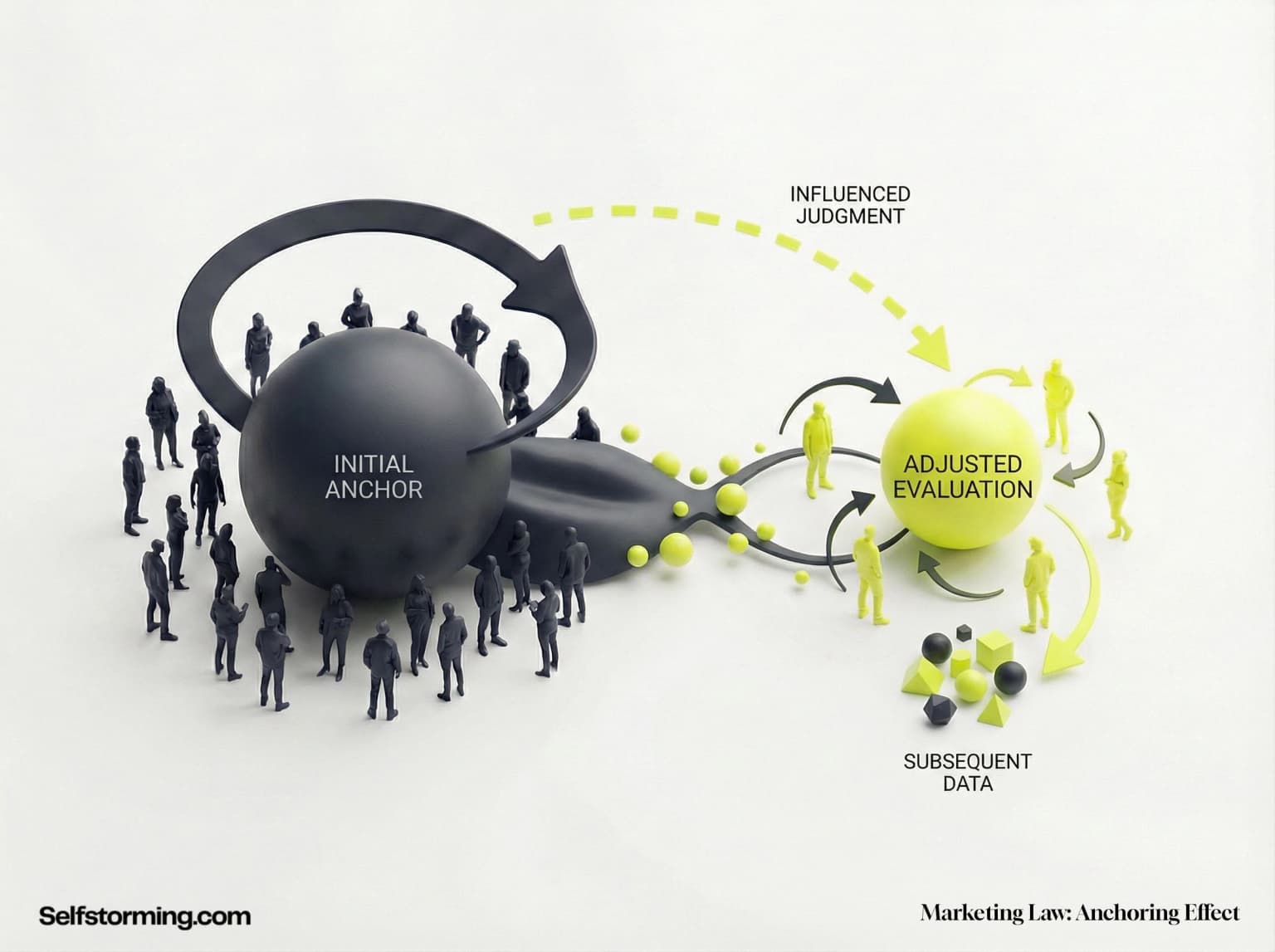
The Anchoring Effect is a cognitive bias where the first piece of information encountered (the 'anchor') serves as a mental reference point for all subsequent judgments and decisions. In marketing and pricing, this means the initial price, quantity, or even an unrelated number presented to a consumer dictates their perception of 'value' and 'fairness' for the remainder of the transaction. Because the human brain struggles to evaluate absolute value, it relies on relative comparison. By strategically placing a high anchor—such as a 'was' price, a premium tier, or a purchase limit—marketers can shift the consumer's internal scale, making subsequent prices seem like a bargain. Failure to set an anchor allows the consumer to default to the lowest available market price, eroding margins and brand equity.
ANCHORING EFFECT
“Cognitive processing is disproportionately influenced by the initial piece of information offered, which serves as a mental reference point against which all subsequent data is evaluated and adjusted.”

Key Takeaways
- •The first number seen dictates the perceived value of every following number.
- •Insufficient adjustment ensures consumers stay close to your initial high anchor.
- •Use premium decoy products to inflate the perceived value of standard offerings.
- •Quantity limits act as anchors that significantly increase average transaction volume.
- •Always present prices from highest to lowest to maximize the anchoring index.
Genesis & Scientific Origin
The Anchoring Effect was first formally identified and rigorously documented by psychologists Amos Tversky and Daniel Kahneman in their seminal 1974 paper, 'Judgment under Uncertainty: Heuristics and Biases,' published in the journal Science. While the concept of 'reference points' had existed in economic theory, Tversky and Kahneman demonstrated that even completely irrelevant, random numbers could serve as anchors for complex estimations. In one of their most famous experiments, they asked participants to spin a 'wheel of fortune' (rigged to land on 10 or 65) and then estimate the percentage of African nations in the United Nations. Those who saw the number 10 guessed 25% on average, while those who saw 65 guessed 45%. This proved that the human mind does not filter out irrelevant data when forming judgments; it integrates it into the cognitive framework. Later, researchers like Dan Ariely and Richard Shotton expanded this into the commercial realm, demonstrating how anchors dictate everything from soup purchases to luxury car options.
“Anchoring can increase purchase quantities by over 110% when limits are introduced (Wansink et al., 1998).”
The Mechanism: How & Why It Works
The mechanism of anchoring operates through two primary psychological processes: Anchor-and-Adjust and Selective Accessibility.
1. Anchor-and-Adjust (System 2): This occurs when people start at an initial value and then consciously adjust away from it to reach a final answer. However, the adjustment is almost always insufficient. Because the starting point (the anchor) is so salient, the 'mental movement' stops as soon as the individual reaches a range that feels 'plausible,' staying much closer to the anchor than they would have otherwise.
2. Selective Accessibility (System 1): This is a more subconscious process. When an anchor is presented, the brain immediately tests the hypothesis that the anchor is the correct answer. To do this, it selectively retrieves information from memory that is consistent with the anchor. For example, if you see a $2,000 price tag for a watch, your brain starts searching for reasons why a watch might be worth $2,000 (craftsmanship, materials, prestige). Even if you decide $2,000 is too high, your brain is now primed with 'high-value' attributes, making a $500 watch seem incredibly cheap by comparison.
Mathematically, the 'Anchoring Index' is used to measure the strength of this effect. It is calculated by dividing the difference between the mean estimates of two groups by the difference between the anchors they were given. In many consumer studies, this index reaches 50% or higher, meaning half of the difference in anchors is directly reflected in the final price the consumer is willing to pay. This is why a 'premium' option that nobody buys still increases the revenue of the 'standard' option—it shifts the anchor.

Empirical Research & Evidence
A landmark study on the power of anchoring in a retail environment was conducted by Wansink, Kent, and Hoch (1998) and published in the Journal of Marketing Research. The researchers tested the impact of 'purchase quantity limits' on consumer behavior in a supermarket setting. They placed a sign on Campbell’s Soup displays that read either 'No limit per person' or 'Limit of 12 per person.' The product and price remained identical. The results were staggering: customers who saw the 'Limit of 12' anchor bought an average of 7 cans—an increase of 112% compared to the 'No limit' group, who bought an average of 3.3 cans. The number '12' acted as a powerful anchor, shifting the internal perception of a 'normal' amount to buy from 2 or 3 cans to a much higher figure. This study demonstrated that anchors do not just affect price perception; they affect volume and usage frequency by setting a new 'normal' for consumption levels.
Real-World Example:
Apple (iPad Launch 2010)
Situation
When Steve Jobs introduced the original iPad, he spent several minutes discussing what the price should be. He displayed a giant '$999' on the screen, citing 'experts' who said it should be priced just under a thousand dollars. This established a high anchor in the minds of the audience.
Result
After letting the $999 anchor sink in for several minutes, Jobs announced that the iPad would actually start at $499. By the time the $499 price appeared, it felt like a steal—a 50% discount on the 'expected' value. Had he started at $499 without the $999 anchor, the audience might have compared it to cheaper netbooks or e-readers. Instead, he anchored it against high-end laptops, making the actual price seem like a revolutionary bargain. The iPad went on to sell 300,000 units on its first day.
Strategic Implementation Guide
Establish the 'MSRP' or 'Was' Price Immediately
Never show a discounted price in isolation. Always present the higher reference price first to establish the value ceiling before revealing the 'deal.'
Introduce a 'Decoy' Premium Tier
Create a high-priced 'Professional' or 'Enterprise' tier that includes features most people don't need. Its primary job isn't to sell; it's to make your 'Standard' tier look reasonably priced.
Use Quantity Anchors for Volume
Instead of 'Buy some,' use 'Limit 10 per customer' or 'Stock up with 5.' The number you mention becomes the mental starting point for the purchase decision.
Order Your Pricing Tables from High to Low
Most marketers list prices from cheapest to most expensive. This is a mistake. List the most expensive option on the left (or top). This ensures the first number the customer sees is the highest, anchoring the value of the entire category.
Anchor with Unrelated High Numbers
In creative execution, mention large numbers (e.g., '1 million satisfied customers' or '10,000 hours of testing') before discussing price. Even unrelated large numbers can prime the brain for higher price acceptance.
Contextual Anchoring
Place your product next to more expensive items in a retail or digital environment. A $100 bottle of wine looks expensive next to a $20 bottle, but like a bargain next to a $400 bottle.
Negotiate with Precise Numbers
When setting an anchor in B2B or high-ticket sales, use a precise number (e.g., $12,450) rather than a round one ($12,000). Precise numbers suggest more thought and 'weight,' making them harder to adjust away from.
Frequently Asked Questions
Does the Anchoring Effect work on experts who know the market price?
Yes, though the effect is slightly diminished. Research shows that even professional real estate agents and car dealers are influenced by anchors. While they have a better 'internal' reference, the external anchor still pulls their final estimate toward it. Expertise provides a 'buffer,' but it doesn't grant immunity to System 1 heuristics.
Can an anchor be too high and backfire?
Absolutely. If an anchor is perceived as 'out of the realm of possibility,' it can lead to 'anchor defiance' or reactance. If you try to anchor a candy bar at $500, the consumer ignores the number entirely because it lacks credibility. The anchor must be high, but within the outer orbit of plausibility to be effective.
Does the Anchoring Effect work in digital environments as well as physical ones?
It actually works better in digital environments. In a physical store, there are many competing stimuli (other products, smells, lighting). In a digital interface, you have total control over the sequence of information. By controlling the scroll and the visual hierarchy, you can ensure the anchor is the first and most dominant thing the brain processes.
Is anchoring ethical, or is it just price manipulation?
Look, all pricing is a construct. There is no such thing as an 'objective' price for a software subscription or a cup of coffee. You are providing the context the brain needs to make a decision. If you don't provide it, the consumer will use a different, potentially worse anchor. It's not manipulation; it's architecture.
Can you 're-anchor' a customer who already has a price in mind?
It’s difficult but possible. To re-anchor, you must change the 'category' of the product in the consumer's mind. Starbucks re-anchored coffee by moving it from a 'diner commodity' (50 cents) to an 'experience' ($4.00). By changing the environment, the terminology, and the ritual, they broke the old anchor and set a new one.
Sources & Further Reading
Related Marketing Laws
Social Proof Effect
People copy the behavior of others, especially in uncertainty.
Pratfall Effect
Admitting a weakness increases credibility and likability.
The Generation Effect
People remember better what they've actively completed themselves.
Peak-End Rule
People judge experiences by their peak moment and ending, not the average.