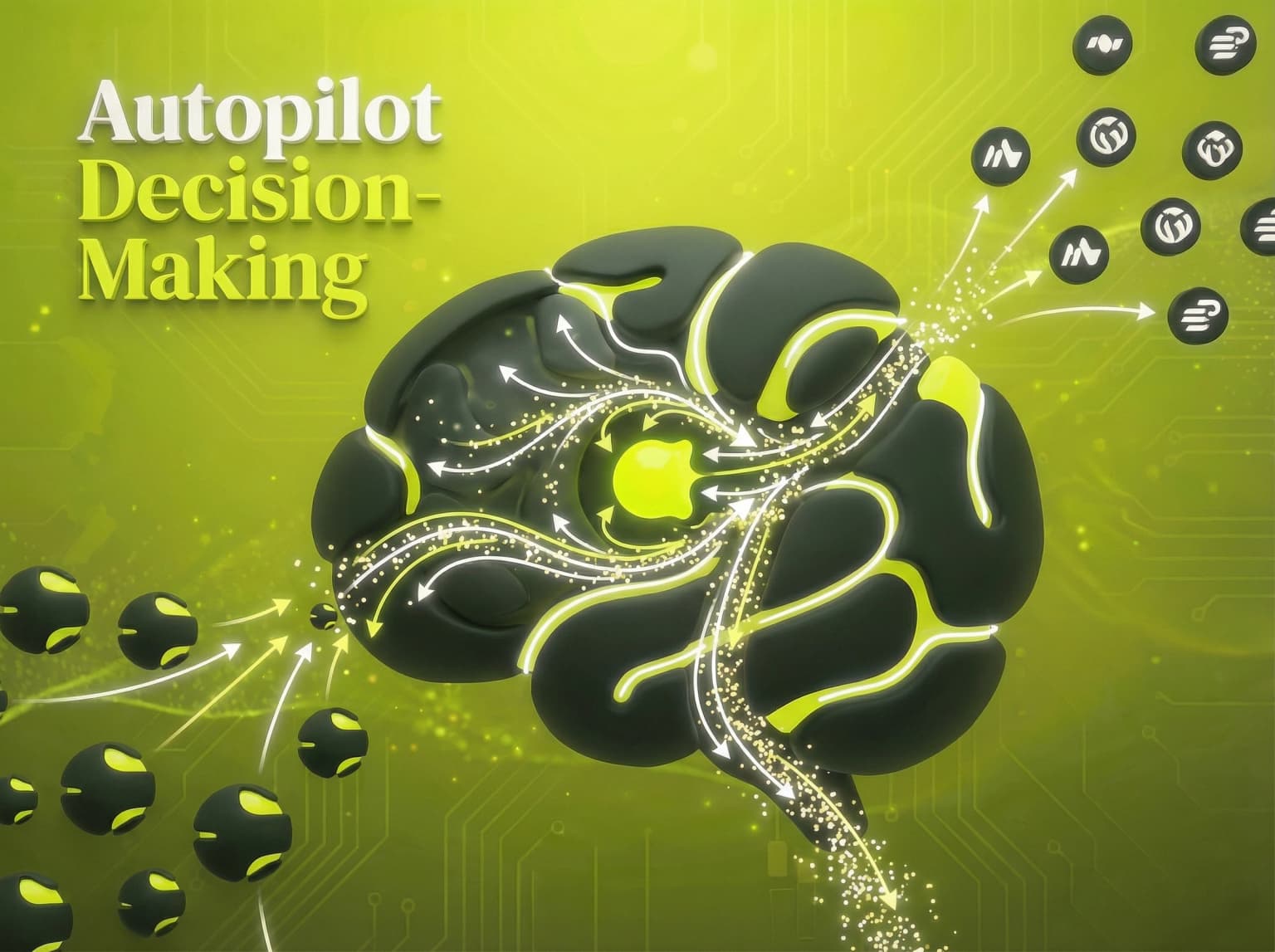
Autopilot Decision-Making

Most buying happens on autopilot.

You’re sitting in a boardroom, sweating over a 50-page brand manifesto, convinced that consumers are weighing your 'brand purpose' against your competitor’s 'sustainability pillars.' Newsflash: they aren't. They’re standing in the aisle with a crying toddler, grabbing the red box because it’s the red box they always grab. They aren't thinking; they're reacting. Autopilot isn't just a feature of consumer behavior; it is the engine of the global economy. If you aren't designing for the brain-dead version of your customer, you aren't designing for reality. Welcome to the world of evidence-based marketing, where your 'meaningful differentiation' goes to die in the face of a well-placed end-cap and a familiar logo.
Autopilot Decision-Making refers to the psychological reality that the vast majority of consumer purchases are driven by non-conscious, habitual, and heuristic-based processes rather than rational deliberation. Rooted in Daniel Kahneman’s 'System 1' thinking and popularized in marketing science by the Ehrenberg-Bass Institute, this law posits that consumers are 'cognitive misers' who seek to minimize mental effort. Instead of comparing features or weighing value propositions, buyers rely on mental availability (how easily a brand comes to mind) and physical availability (how easy it is to find). For marketers, this means that growth is achieved not by 'convincing' the consumer through complex logic, but by building strong, consistent memory structures and distinctive assets that allow the brand to be chosen reflexively. When a brand breaks this autopilot—through inconsistent packaging or complex messaging—it risks immediate sales decline.

AUTOPILOT DECISION-MAKING

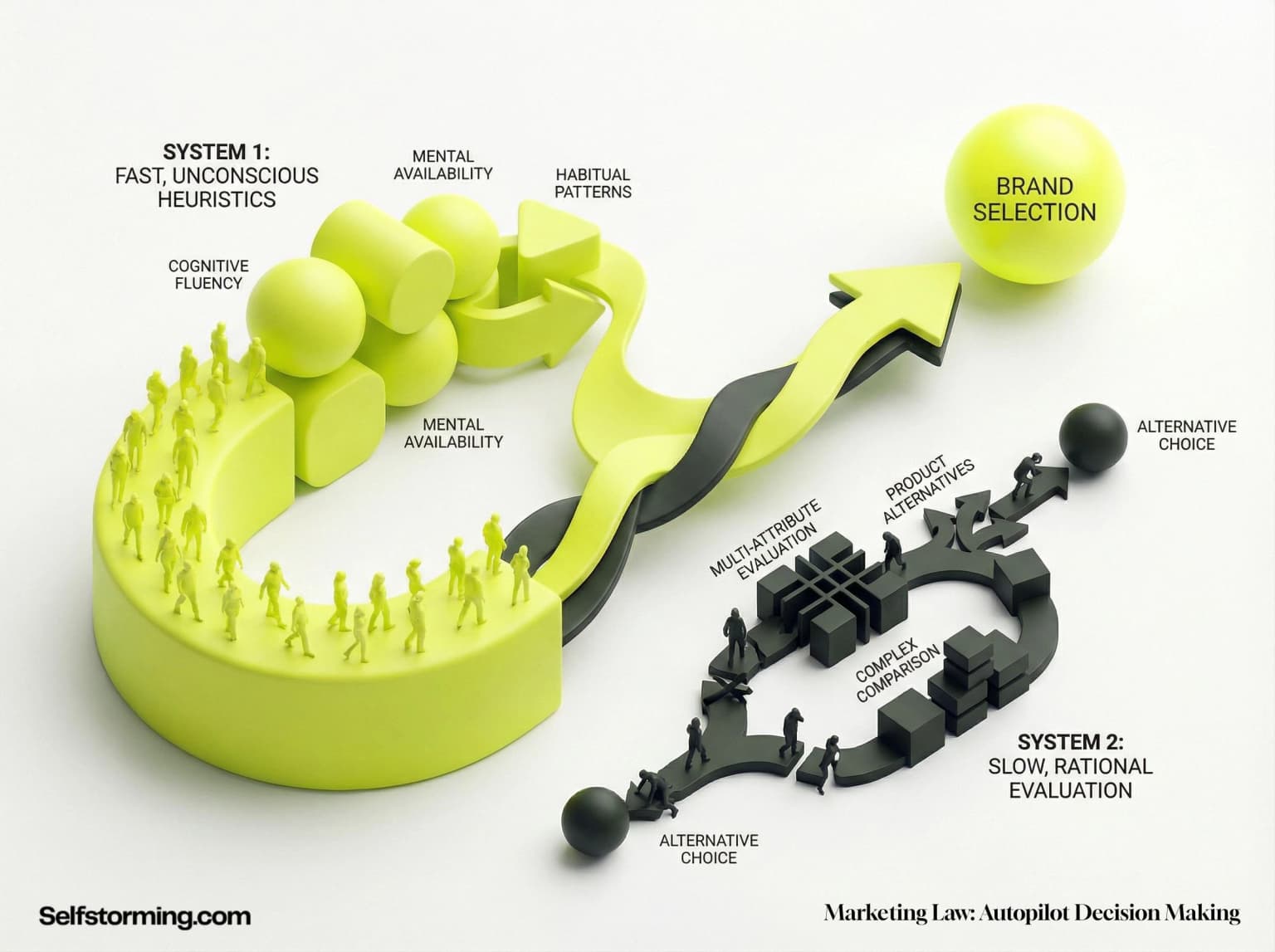
Cognitive processing in brand selection is predominantly driven by rapid, non-conscious heuristics—specifically System 1 thinking—which prioritizes cognitive fluency, mental availability, and habitual patterns over the rational, multi-attribute evaluation of product alternatives.

Autopilot Decision-Making marketing law: Most buying happens on autopilot. - Visual illustration showing key concepts and examples

Key Takeaways

  • 95% of purchase decisions are made subconsciously via System 1.
  • Consumers are 'cognitive misers' who avoid the pain of thinking.
  • Recognition and fluency are more profitable than 'meaningful' differentiation.
  • Breaking distinctive brand assets is the fastest way to kill sales.
  • Growth comes from being the easiest brand to find and buy.

Genesis & Scientific Origin

The intellectual architecture of Autopilot Decision-Making was constructed across several decades, merging behavioral economics with empirical marketing science. The foundation was laid by Herbert Simon in the 1950s with his concept of 'Satisficing'—the idea that humans seek 'good enough' solutions rather than optimal ones due to cognitive limitations. However, the concept was formalized into its modern iteration by Daniel Kahneman and Amos Tversky, specifically through their work on dual-process theory. Kahneman’s 2011 synthesis, 'Thinking, Fast and Slow,' categorized these autopilot behaviors as 'System 1'—fast, instinctive, and emotional—contrasted with the slow, logical 'System 2.' In the realm of marketing, the Ehrenberg-Bass Institute for Marketing Science, led by Professor Byron Sharp and Professor Jenni Romaniuk, translated these psychological insights into a hard marketing law. Their research, particularly in the seminal text 'How Brands Grow' (2010), demonstrated that brand choice is rarely the result of a 'brand love' or deep loyalty, but rather a result of mental and physical availability. They argued that because consumers have repertoires of brands they find acceptable, the 'choice' is often a semi-random selection from that repertoire based on what is most easily recognized at the moment of purchase.

95% of our purchase decisions are made subconsciously (Zaltman, 2003).

The Mechanism: How & Why It Works

The mechanism of Autopilot Decision-Making is a biological necessity. The human brain accounts for approximately 2% of body weight but consumes 20% of its energy. To survive, the brain has evolved to be a 'cognitive miser,' delegating as many tasks as possible to the basal ganglia (habit center) to avoid taxing the prefrontal cortex (deliberative center). This leads to three core psychological pillars: 1. Cognitive Fluency: The brain prefers information that is easy to process. If a brand is easy to recognize (due to distinctive assets like a specific color or shape), the brain assigns it a 'fluency' bonus, which is often misattributed as 'quality' or 'trust.' 2. The Recognition Heuristic: If one of two objects is recognized and the other is not, then people infer that the recognized object has the higher value. In a crowded marketplace, being 'known' is statistically more important than being 'better.' 3. Associative Memory Structures: Brands exist in the mind as nodes in a network. When a 'Category Entry Point' (CEP) is triggered—such as 'I need a refreshing drink for a hot day'—the brain doesn't scan a database of all drinks. It follows the strongest neural path to the brand most closely associated with that situation. This process happens in milliseconds, long before the conscious mind can intervene. Marketing, therefore, is the process of 'refreshing' these neural pathways so that the brand remains the path of least resistance. When a consumer is on autopilot, they aren't looking for a reason to buy; they are looking for a reason to stop looking. The brand that provides the quickest 'mental click' wins.

Autopilot Decision-Making mechanism diagram - How Autopilot Decision-Making works in consumer behavior and marketing strategy

Empirical Research & Evidence

A landmark study published in Science (Dijksterhuis, Bos, Nordgren, & van Baaren, 2006) titled 'On Making the Right Choice: The Deliberation-Without-Attention Effect' provides the empirical backbone for this law. The researchers conducted a series of experiments investigating whether conscious thought (System 2) or unconscious thought (System 1/Autopilot) led to better decision-making in complex situations. Participants were asked to choose the best car from a set of four, based on various attributes. In the 'simple' condition (4 attributes), conscious thinkers performed well. However, in the 'complex' condition (12 attributes), participants who were distracted and forced to rely on their 'unconscious thought' (autopilot) significantly outperformed those who were given time to deliberate. The study concluded that the conscious mind has a low capacity, leading to 'weighted' errors where people focus on unimportant details, whereas the unconscious mind is adept at integrating large amounts of information to reach a 'gut' feeling that is statistically more accurate. This explains why consumers in a supermarket—a high-complexity environment with 30,000+ SKUs—must rely on autopilot to function. Further supporting data from the Ehrenberg-Bass Institute shows that the average time spent at a grocery shelf before selection is less than 13 seconds, with many categories seeing selections in under 2 seconds, leaving zero time for the 'rational' processing that most marketing departments assume is happening.

Real-World Example:
Tropicana (PepsiCo)

Situation

In 2009, Tropicana launched a $35 million rebranding campaign, replacing its iconic 'straw in an orange' imagery with a clean, modern, minimalist design and a new cap. The goal was to 'refresh' the brand and appear more premium.

Result

The result was a catastrophic 20% drop in sales within seven weeks, costing the brand over $30 million in lost revenue. The failure was not because the new design was 'ugly,' but because it broke the consumer's autopilot. By removing the distinctive orange-with-a-straw asset, Tropicana became unrecognizable to its loyal but 'brain-dead' shoppers. Consumers standing in the juice aisle, operating on System 1, literally could not find the product. They didn't think, 'Oh, Tropicana has a new look'; they thought, 'Tropicana is out of stock,' or they didn't see it at all, and their hand moved to the next familiar 'orange juice' cue (often a private label). PepsiCo was forced to revert to the original design within months. This serves as the ultimate warning: never interrupt the autopilot unless you want to stop the cash flow.

Strategic Implementation Guide

1

Audit Your Distinctive Assets

Identify the colors, shapes, fonts, and sounds that consumers use to identify you in 0.5 seconds. If you don't know what they are, you're dangerous to your own brand.

2

Prioritize Radical Consistency

Stop 'freshening up' your look every two years. Every time you change your visual identity, you are essentially deleting the GPS coordinates in your customer's brain.

3

Own Category Entry Points (CEPs)

Don't market 'who you are'; market 'when you are.' Link your brand to specific, mundane moments (e.g., 'the 3 PM slump' or 'Friday night treat') to build the associative paths that autopilot follows.

4

Maximize Physical Availability

Autopilot only works if the product is there. If the reflexive choice isn't on the shelf, the brain will instantly switch to the next most fluent option without a second thought.

5

Minimize Cognitive Load in Creative

Your ads should be 'easy to look at,' not puzzles to be solved. Use high-contrast visuals, clear branding early in the execution, and avoid complex metaphors that require System 2 to decode.

6

Test for 'Findability' Not 'Likeability'

When testing new packaging or creative, don't ask people if they like it. Put it on a simulated shelf for 1 second and see if they can find it. Speed of recognition is the only metric that matters for autopilot growth.

7

Short-Circuit the Comparison

Use pricing and packaging cues that make your brand the 'obvious' choice. If a consumer has to pull out a calculator or read a back-label, you have already lost the autopilot battle.

Frequently Asked Questions

Does Autopilot Decision-Making only apply to cheap, 'low-involvement' products?

Absolutely not. While it's more obvious in the cereal aisle, autopilot governs B2B software, luxury cars, and healthcare. Even in high-stakes decisions, the human brain still uses heuristics to narrow down the 'shortlist.' A CTO doesn't evaluate every piece of code in a SaaS platform; they rely on the 'fluency' of the brand name and the 'recognition' of the provider to minimize the perceived risk of a complex choice.

If people are on autopilot, does advertising even matter?

It matters more than ever, but not for the reasons you think. Advertising isn't there to 'persuade' or 'convince' the conscious mind. Its job is to 'refresh' memory structures and keep the brand's distinctive assets 'mentally available.' Advertising is maintenance for the autopilot's map. If you stop advertising, the pathways fade, and the autopilot stops at your competitor's house instead.

Can we intentionally wake a consumer up to 'System 2' to make them switch brands?

You can try, but it's expensive and risky. This is called 'interruption marketing,' and while it can work for disruptors, it requires massive emotional or cognitive friction (like a shocking claim or a price war). Most consumers find being forced into System 2 annoying. It's much more effective to 'hijack' the existing autopilot by mimicking the cues of the category leader while adding a distinctive twist.

Is 'Autopilot' just another word for 'Brand Loyalty'?

No. Brand Loyalty implies a deep, emotional commitment. Autopilot is often the opposite—it's 'loyalty' based on laziness or habit. Most people buy the same brand of toothpaste for 10 years not because they love it, but because they haven't thought about toothpaste since 2014. Understanding this distinction is key: you don't need to make them love you; you just need to make it hard for them to ignore you.

How does digital shopping affect the autopilot?

Digital shopping actually amplifies the autopilot. Because of the infinite choice and 'information overload' online, the brain leans even harder on familiar cues. This is why 'Brand Search' is so dominant in e-commerce. If a consumer has to scroll past the first three results, their System 1 starts screaming. The 'Buy Again' button is the ultimate digital manifestation of the autopilot law.

We use cookies on our site to enhance your user experience, provide personalized content, and analyze our traffic. Cookie Policy