Effort Minimisation

People choose the path of least effort.

Listen, your R&D team spent three years perfecting a formula that’s 4% better than the market leader. Congratulations, nobody cares. Humans aren't logic-driven optimization machines; we're lazy primates looking for the path of least resistance. If I have to think for more than three seconds to buy your product, I’m buying the one next to it. Efficiency isn't a feature; it's the only reason you're still in business. You’re not competing on quality; you’re competing against the metabolic cost of a customer’s brain cells firing. Spoilers: the brain usually chooses to stay off.
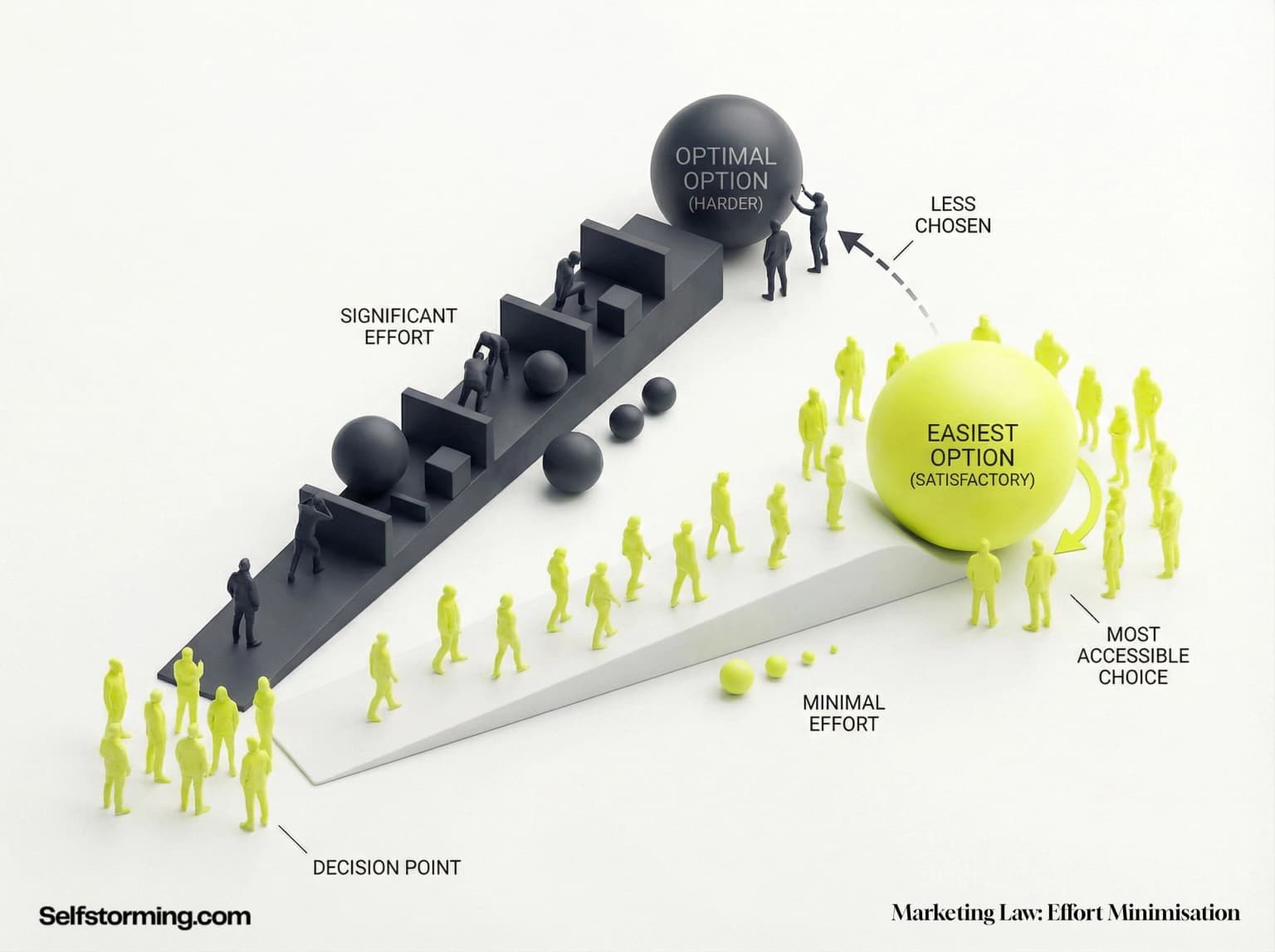
Effort Minimisation is a foundational law of marketing science stating that consumers do not seek the 'best' possible solution (optimizing), but rather the most easily accessible solution that meets a minimum threshold of acceptability (satisficing). Rooted in evolutionary biology and behavioral economics, this law suggests that cognitive and physical friction are the primary inhibitors of purchase. A brand's growth is less dependent on its 'unique selling proposition' and more on its 'ease of acquisition.' In a competitive landscape, the brand that requires the least mental energy to remember and the least physical effort to purchase will inevitably capture the largest market share, regardless of minor quality differentials.

EFFORT MINIMISATION

Human decision-making is governed by the principle of least effort, where individuals consistently select the most accessible satisfactory option over the objectively optimal alternative to conserve cognitive and physical resources.

Effort Minimisation marketing law: People choose the path of least effort. - Visual illustration showing key concepts and examples

Key Takeaways

  • Consumers are 'satisficers' who choose the first acceptable option they find.
  • Cognitive friction is a silent killer of conversion rates and market share.
  • Mental Availability makes your brand the 'easiest' one to remember.
  • Physical Availability makes your brand the 'easiest' one to actually buy.
  • Reducing effort is statistically more effective than increasing perceived product quality.

Genesis & Scientific Origin

The intellectual lineage of Effort Minimisation traces back to the 'Principle of Least Effort,' formally articulated by linguist George Kingsley Zipf in 1949. Zipf observed that individuals naturally organize their behavior to minimize the total expenditure of energy. This concept was later refined into the theory of 'Satisficing' by Nobel laureate Herbert Simon in 1956, who argued that due to limited cognitive capacity and time, humans seek 'good enough' rather than 'perfect.' In the late 20th and early 21st centuries, Daniel Kahneman and Amos Tversky integrated these ideas into their work on heuristics and biases, specifically 'System 1' thinking—the fast, instinctive, and effortless mode of thought. Most recently, Byron Sharp and the Ehrenberg-Bass Institute for Marketing Science have applied these psychological foundations to brand growth, demonstrating that Physical and Mental Availability—the two pillars of 'ease'—are the primary drivers of market share, effectively codifying Effort Minimisation as a non-negotiable law of Evidence-Based Marketing.

30% of consumers will abandon a purchase if they have to create a new user account (Baymard Institute, 2023).

The Mechanism: How & Why It Works

The mechanism of Effort Minimisation operates on three distinct levels: metabolic efficiency, cognitive fluency, and environmental architecture.

Firstly, at a biological level, the human brain accounts for approximately 2% of body mass but consumes 20% of its energy. Thinking is metabolically expensive. Consequently, evolution has selected for 'cognitive misers'—organisms that preserve energy by avoiding complex calculations whenever a simple heuristic will suffice. When a consumer faces a supermarket shelf with 50 types of toothpaste, the 'optimal' choice requires a multi-variate analysis of price-per-gram, active ingredients, and packaging recyclability. The 'easy' choice is simply grabbing the red box they recognize.

Secondly, Cognitive Fluency refers to the ease with which the brain processes information. When a brand is familiar (Mental Availability), it is processed with high fluency, which the brain misinterprets as safety, trust, and quality. This is why 'fame' is a more effective marketing metric than 'persuasion.' If a message is easy to understand and a brand is easy to recall, the 'effort' of choosing it drops to near zero.

Thirdly, the law is enforced by Physical Availability. This is the structural reality of distribution. If your product is 10% better but requires a 15-minute drive to a specialty store, while a mediocre competitor is available at the local gas station, the competitor wins. The 'Acceptable Option' threshold is surprisingly low; as long as the product doesn't fail catastrophically, convenience will trump quality in almost every high-frequency purchase category. Marketing, therefore, is not the art of convincing people you are better; it is the logistics of ensuring you are the path of least resistance.

Effort Minimisation mechanism diagram - How Effort Minimisation works in consumer behavior and marketing strategy

Empirical Research & Evidence

A landmark study illustrating the power of Effort Minimisation is the 'Jam Study' conducted by researchers at Columbia and Stanford Universities, published in the Journal of Personality and Social Psychology (Iyengar & Lepper, 2000). The researchers set up a tasting booth in an upscale grocery store, alternating between a display of 24 varieties of jam and a display of only 6 varieties. While the 24-jam display attracted more initial interest (60% of passersby vs. 40%), the conversion data told a different story. Only 3% of those who encountered the 24-variety display actually made a purchase. In contrast, 30% of those who encountered the 6-variety display bought a jar of jam. By reducing the cognitive effort required to compare options and make a decision, the 6-variety display achieved a sales rate ten times higher than the 'superior' choice set. This research demonstrates that 'more choice'—often framed as a benefit—actually increases the cognitive effort of decision-making to the point of total paralysis, proving that consumers prioritize the minimisation of effort over the maximization of variety.

Real-World Example:
Amazon

Situation

In the late 1990s, online shopping was plagued by high friction: multiple forms, repeated entry of credit card details, and complex checkout flows.

Result

Amazon developed and patented '1-Click Ordering' in 1997. By storing user data and allowing a purchase with a single action, they removed almost all physical and cognitive effort from the transaction. This didn't make their products better or cheaper; it made buying from Amazon the 'easiest acceptable option.' Apple later licensed this technology for iTunes because they recognized that the music industry's biggest competitor wasn't other stores, but the 'effort' of buying vs. the 'ease' of pirating. Amazon's dominance is built not on a love for their brand, but on the fact that it is now harder to *not* use Amazon than it is to use it.

Strategic Implementation Guide

1

Kill the Choice Paradox

Audit your product range. If you have 15 versions of the same thing, you're taxing your customer's brain. Cut the bottom 20% of SKUs that cause decision fatigue.

2

Default the Desired Action

Use the power of inertia. Pre-select the most common shipping option, pre-fill forms where possible, and set up subscription models. The easiest choice is the one the customer doesn't have to make at all.

3

Master Mental Fluency

Stop trying to be 'clever' or 'edgy' with your copy. Use simple language, high-contrast visuals, and consistent brand assets. If they have to squint or think to understand your ad, you've already lost.

4

Maximize Physical Proximity

Your marketing budget is wasted if your product isn't where the customer is. Invest in distribution, SEO (being at the top of the 'easy' list), and point-of-sale visibility.

5

Remove 'Micro-Friction'

Walk through your buying process like a tired, angry person. Every click, every form field, and every 'are you sure?' prompt is a reason for them to quit. Delete them ruthlessly.

6

Leverage Heuristics

Use 'Best Seller' badges or 'Staff Pick' labels. Give the customer a cognitive shortcut so they can choose your brand without having to evaluate it.

Frequently Asked Questions

Doesn't this law only apply to cheap, low-involvement products like soap or milk?

Absolutely not. While the 'effort' in low-involvement goods is physical, the 'effort' in high-involvement goods (like B2B software or cars) is cognitive. Even a CEO buying a $1M platform will choose the 'easiest acceptable' option—usually the one that won't get them fired and has the simplest implementation process—rather than the 'best' one that requires 6 months of training.

If I make my product too 'easy' to buy, will it lose its premium 'luxury' feel?

Luxury is about exclusivity, not difficulty. You can make a $10,000 watch easy to buy (concierge service, 1-click high-value transfers) without making it 'cheap.' Friction is not a proxy for quality; it's just a proxy for bad operations.

How does Effort Minimisation relate to brand loyalty?

Most 'loyalty' is actually just 'habitual laziness.' Customers stay with a brand because switching requires the effort of researching alternatives, setting up new accounts, and learning new interfaces. Loyalty is often just the absence of a reason to exert effort elsewhere.

Does this mean I should stop innovating on product quality?

No, but it means quality has diminishing returns. Once your product is 'acceptable' (it does what it says on the tin), every dollar spent on making it 1% better is usually less effective than a dollar spent on making it 10% easier to find or buy.

Is 'Easy' the same as 'Cheap'?

No. 'Easy' refers to the total expenditure of resources, including time and mental energy. People will often pay a higher price (more money) to save time and cognitive effort (less effort). This is the entire business model of convenience stores and Uber Eats.

We use cookies on our site to enhance your user experience, provide personalized content, and analyze our traffic. Cookie Policy