Fluency Over Persuasion

Don't be smart, just be easy.

You’re still laboring under the delusion that your customers are rational creatures weighing the pros and cons of your SaaS features or your organic kombucha. Newsflash: they aren’t. They’re tired, distracted, and looking for the path of least resistance. While you’re sweating over 'persuasive' copy that reads like a legal brief, your competitor just used a recognizable color and a catchy jingle to steal your market share. Fluency isn't about being 'dumb'; it's about being effortless. If they have to think, you’ve already lost the sale. Welcome to the reality of the lizard brain.
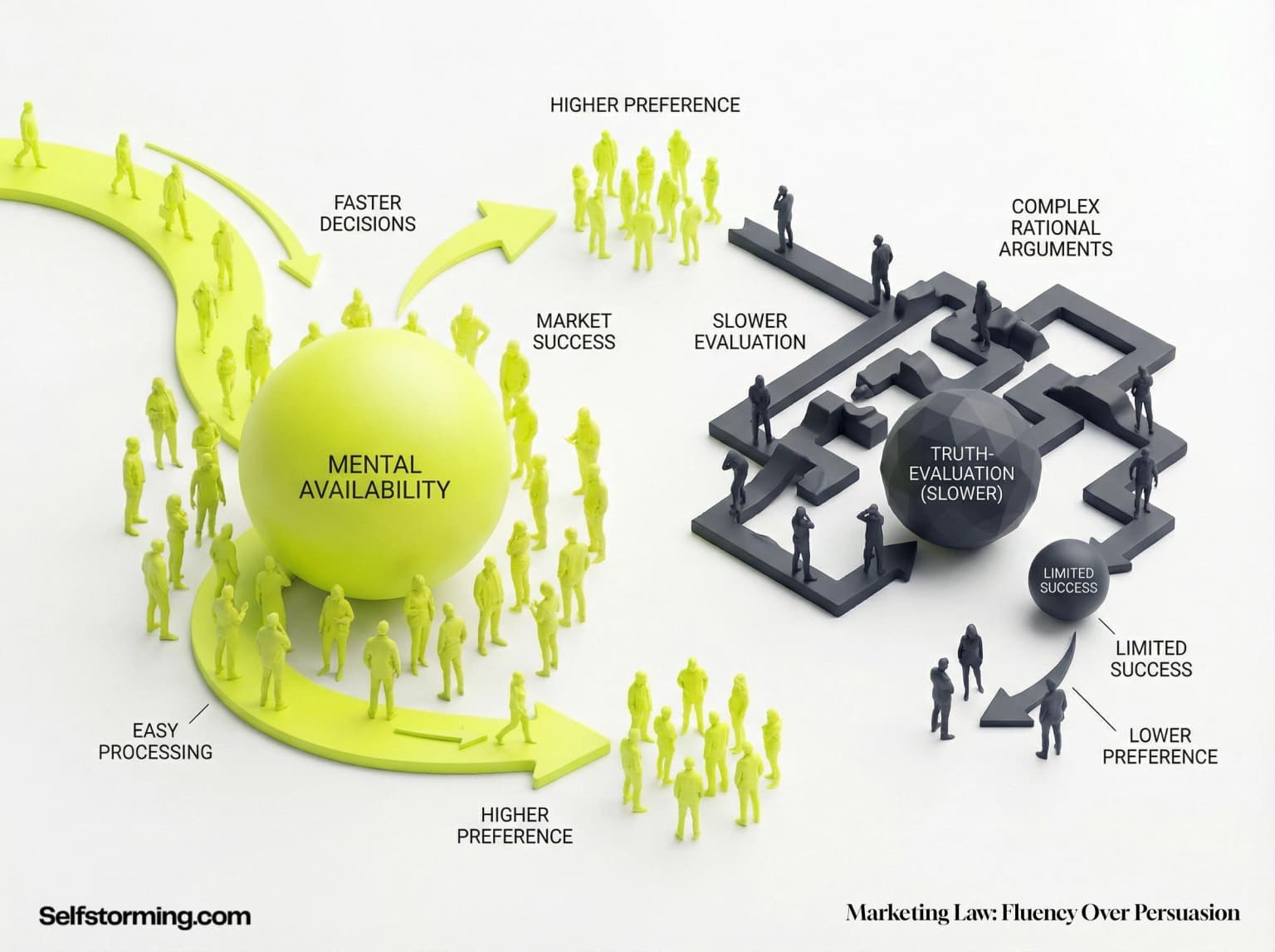
Fluency Over Persuasion is the marketing law stating that the ease with which a message is processed (cognitive ease) is more important than the factual strength of its arguments. Rooted in Daniel Kahneman’s System 1 thinking, this principle posits that humans use 'fluency' as a proxy for truth, safety, and preference. In a branding context, specifically championed by Orlando Wood and System1 Group, this means that brands with high 'Brand Fluency'—those using distinctive assets, emotional storytelling, and right-brain engagement—build greater mental availability. When a brand is easy to think of and its ads are easy to process, it bypasses the critical 'System 2' filters that scrutinize claims, leading to faster decision-making and higher market share. Essentially, making a brand 'famous' and 'fluent' is more effective than making it 'better' through rational persuasion.

FLUENCY OVER PERSUASION

The cognitive ease with which a brand's identity and messaging are processed serves as a primary heuristic for consumer preference, truth-evaluation, and mental availability, making processing speed more predictive of market success than the strength of rational arguments.

Fluency Over Persuasion marketing law: Don't be smart, just be easy. - Visual illustration showing key concepts and examples

Key Takeaways

  • Processing ease is a subconscious proxy for brand trust and truth.
  • System 1 dominates choice; if they have to think, you've already lost.
  • Right-brain features (character, context, narrative) drive higher fluency than left-brain features.
  • Distinctive assets are the primary drivers of brand fluency and recognition.
  • Fame is a byproduct of high fluency; famous brands are easier to choose.

Genesis & Scientific Origin

The concept of cognitive fluency emerged from cognitive psychology, most notably popularized by Daniel Kahneman in his seminal work 'Thinking, Fast and Slow' (2011), where he distinguished between System 1 (fast, intuitive, emotional) and System 2 (slow, rational, effortful). However, its specific application to marketing science was crystallized by the System1 Group (formerly BrainJuicer), led by John Kearon and Orlando Wood. Wood’s landmark publications for the IPA, 'Lemon' (2019) and 'Look Out' (2021), provided the empirical bridge between cognitive science and advertising effectiveness. Wood's research specifically highlighted how modern advertising has shifted toward a 'left-brain' bias—focusing on literal, decontextualized, and highly persuasive intent—which actually reduces brand fluency and long-term effectiveness compared to 'right-brain' creative that favors atmosphere, character, and distinctive assets.

Ads with high 'Fluency' scores have a 0.8 correlation with market share growth. (System1 Group, 2020)

The Mechanism: How & Why It Works

The mechanism of Fluency Over Persuasion operates on the principle of 'Cognitive Ease.' When the brain processes information smoothly, it experiences a positive affective state. This 'glow' of ease is misattributed to the object itself; we don't think 'this ad is easy to read,' we think 'this brand is trustworthy.'

There are three primary layers to this mechanism:

1. Processing Fluency: This is the ease of perceiving the physical form of the message. High contrast, legible fonts, and clear audio aren't just 'good design'—they are truth signals. If an ad is hard to read, System 2 is alerted, skepticism rises, and the message is rejected as 'risky' or 'false.'

2. Conceptual Fluency: This relates to how easily a brand fits into existing mental structures. This is where Orlando Wood’s work on 'Right-Brain' features becomes critical. The right hemisphere of the brain is responsible for understanding context, relationships, and metaphors. Advertising that uses 'betweenness'—the subtle interactions between people, a sense of place, and recurring characters—is processed more fluently because it mirrors how we naturally experience the world. In contrast, 'Left-Brain' advertising (text on screen, rhythmic cutting, close-ups of products) feels jarring and requires more cognitive 'heavy lifting,' which kills fluency.

3. Brand Fluency (Fame & Assets): This is the speed of recognition. A brand with high fluency has 'Distinctive Brand Assets' (DBAs) that trigger the brand name in the consumer's mind without them having to see the logo. If I see a specific shade of orange, I think Hermes; if I hear a specific 'ta-dum,' I think Netflix. This speed of recognition is a shortcut to choice. In a buying situation, the brain doesn't search for the 'best' brand; it selects the most 'fluent' brand—the one that comes to mind most easily and feels the most familiar (Mental Availability).

Persuasion, by contrast, requires System 2 engagement. It asks the consumer to weigh evidence, compare features, and reach a logical conclusion. This is cognitively expensive. Most consumers are 'cognitive misers'—they will avoid this effort whenever possible. Therefore, a brand that is 'fluent' (easy to process) will beat a brand that is 'persuasive' (requires thinking) in almost every low-to-medium involvement category.

Fluency Over Persuasion mechanism diagram - How Fluency Over Persuasion works in consumer behavior and marketing strategy

Empirical Research & Evidence

The most compelling evidence for Fluency Over Persuasion comes from Orlando Wood's analysis of the IPA Databank, published in 'Lemon' (2019). Wood analyzed thousands of award-winning campaigns and compared their creative style to their business results. The research found that ads featuring 'Right-Brain' elements—which enhance fluency through character, narrative, and lived-in environments—achieved a significantly higher 'Star Rating' (a measure of emotional response and long-term brand growth) than 'Left-Brain' ads. Specifically, Wood noted that since 2006, there has been a 20% increase in 'Left-Brain' creative features (abstract imagery, text-heavy slides, decontextualized product shots), which has correlated with a documented decline in advertising's effectiveness.

Further supporting this is the research of Schwarz and Vaughn (2002) published in the 'Handbook of Motivation and Cognition', which demonstrated the 'Illusion of Truth' effect. Their study showed that participants were more likely to rate a statement as true simply because it was presented in a high-contrast, easy-to-read font compared to a low-contrast one. In a marketing context, this implies that the 'how' of the message (fluency) often carries more weight than the 'what' (the actual claim). Furthermore, System1 Group's 'Test Your Ad' database shows that ads with high 'Fluency' (measured by the speed of brand recognition) have a 0.8 correlation with market share growth, whereas 'Persuasion' scores (measured by stated intent to buy) show a much weaker correlation with long-term brand health.

Real-World Example:
Guinness

Situation

In the late 1990s, Guinness moved away from purely functional or 'persuasive' messaging about the quality of the brew and leaned into high-fluency, high-emotion creative.

Result

The 'Surfer' campaign (1999) is a masterclass in fluency. It used no rational arguments, no 'reasons to believe,' and no product features. Instead, it used a powerful metaphor, a distinct visual rhythm, and a 'right-brain' narrative about waiting. By building intense brand fluency and emotional resonance, Guinness transformed from a 'dusty' old-man's drink into a global icon of patience and quality. The campaign didn't persuade people that Guinness tasted better; it made the brand feel inevitable and 'right.' It remains one of the most effective campaigns in history, driving massive increases in mental availability and market share.

Strategic Implementation Guide

1

Kill the 'Reasons to Believe'

Stop cluttering your creative with three bullet points of features. Your customers won't read them, and if they do, they'll start looking for reasons to disagree. Pick one emotional truth and stick to it.

2

Weaponize Distinctive Assets

Identify your non-logo assets (colors, sounds, shapes, characters) and use them obsessively. The goal is for a consumer to know it's your brand within 0.5 seconds, before they've even processed the 'message'.

3

Prioritize Right-Brain Creative

Use 'Look Out' features—people interacting, a sense of place, dialogue, and recurring characters. Avoid the 'Modern Left-Brain' trap of flat backgrounds, rhythmic montages, and heavy on-screen text.

4

Minimize Friction in Copy

Use simple language. If a 10-year-old can't understand your value proposition in 3 seconds, it's too complex. Fluency is the enemy of the thesaurus.

5

Optimize for the 'Glimpse'

Most people will see your ad for a fraction of a second while scrolling. If the brand isn't immediately recognizable (high fluency), the impression is wasted. Don't save the reveal for the end.

6

Measure 'Fame' and 'Fluency', Not 'Recall'

Traditional recall metrics favor 'shocking' but brand-light ads. Use System1 testing to measure how quickly people recognize the brand and how it makes them feel.

7

Consistency Over Novelty

Changing your 'creative platform' every year kills fluency. The brain loves familiarity. Stick to your assets until they are so fluent they become part of the cultural shorthand.

Frequently Asked Questions

Does fluency mean I have to make 'dumb' ads?

Absolutely not. Fluency isn't about the intelligence of the audience; it's about the architecture of the message. Some of the most sophisticated ads in history (like Apple's '1984' or Guinness' 'Surfer') are high-fluency because they use powerful imagery and narrative rather than complex logical arguments. It's about making the *processing* easy, not the *content* shallow.

Isn't persuasion necessary for high-ticket B2B items?

Even in B2B, the 'final' decision might involve a spreadsheet, but the 'shortlist' is created by System 1. If a brand isn't fluent—meaning it doesn't come to mind easily or feel familiar—it won't even be considered. You can't persuade someone who hasn't already 'accepted' you into their mental repertoire via fluency.

How does fluency relate to 'Mental Availability'?

They are two sides of the same coin. Mental Availability is the probability that a brand comes to mind in a buying situation. Fluency is the 'grease' that makes that happen. The more fluent your brand assets and messaging, the more easily the brand 'pops' into the consumer's mind when the category trigger occurs.

Can an ad be too fluent and become 'invisible'?

This is a common fear called 'Alienation Paranoia.' Marketers fear that being consistent and fluent is 'boring.' However, the IPA data shows that 'wear-in' is a much bigger factor than 'wear-out.' Most ads are pulled long before they reach peak fluency. You want your assets to be 'invisible' in the sense that they are processed subconsciously and instantly.

What is the 'Left-Brain' bias Wood talks about?

Orlando Wood argues that modern digital-first creative is increasingly 'left-brained'—it's literal, focused on the product in isolation, uses lots of text, and has a fast, rhythmic 'beat.' This style is great for short-term 'activation' but terrible for building long-term 'fluency' because it doesn't engage the right brain's capacity for empathy, context, and memory-building.

We use cookies on our site to enhance your user experience, provide personalized content, and analyze our traffic. Cookie Policy