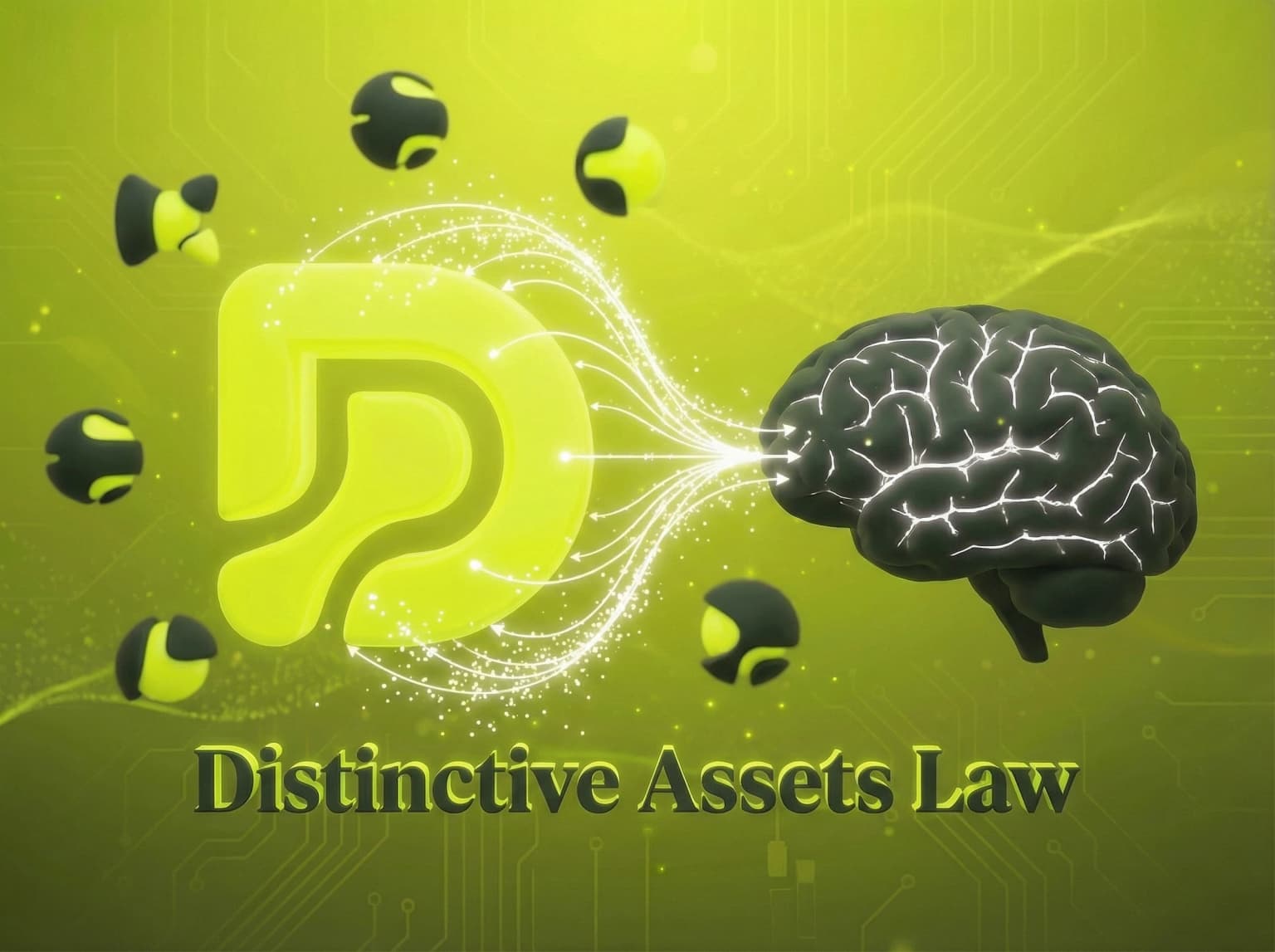
Distinctive Assets Law

Assets matter more than brand personality.

Listen, your 'unique selling proposition' is a hallucination. While you're busy polishing a benefit that 14 other competitors also claim, your customers are walking past your product because they don't recognize your face. Stop trying to be different and start trying to be recognizable. If I can't spot your brand from thirty feet away while squinting, you don't have a strategy; you have a prayer. Distinctive assets are the only thing standing between your budget and the void of consumer indifference. It’s time to stop 'persuading' and start being seen.

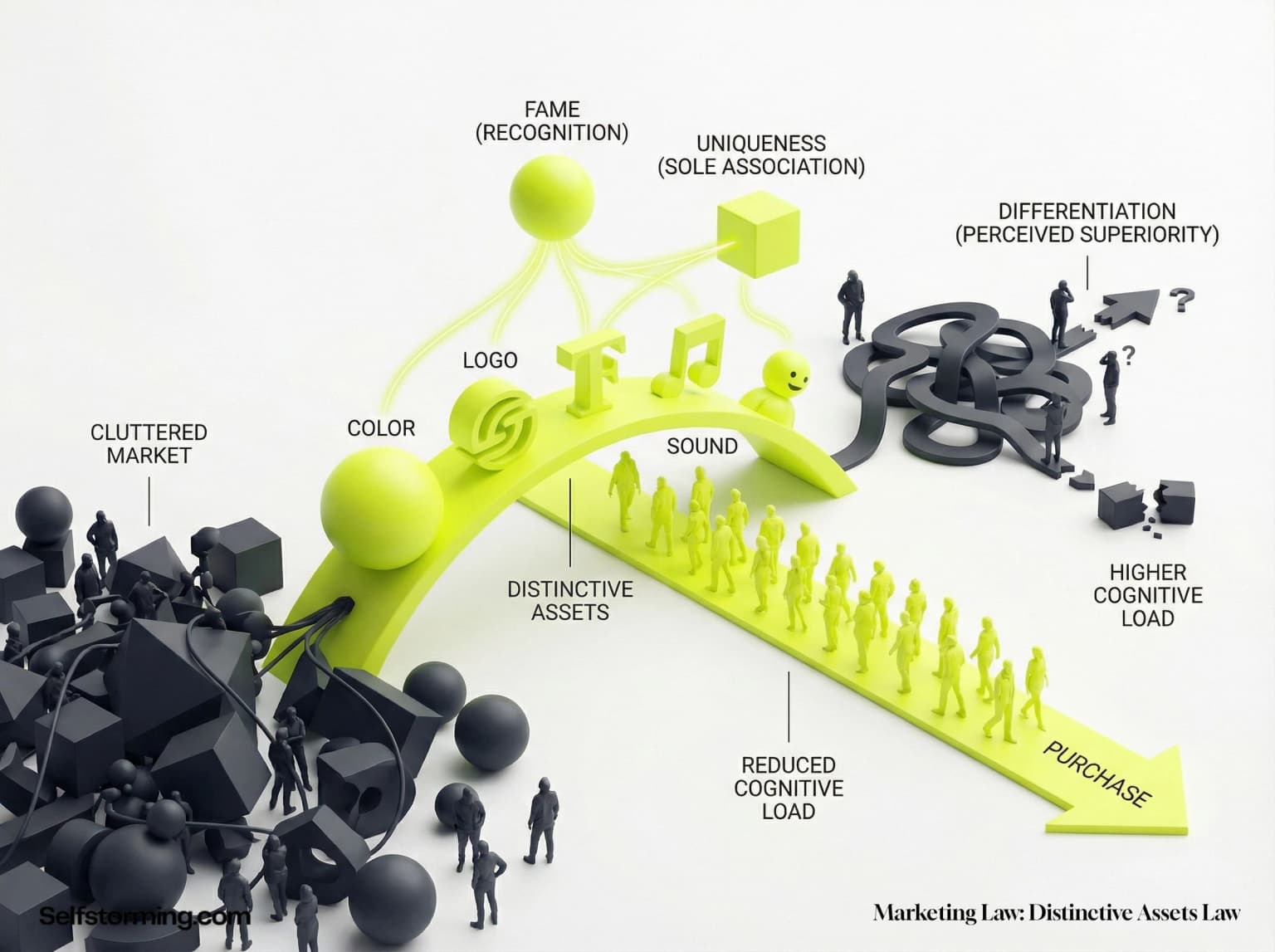
The Distinctive Assets Law posits that brand growth is driven by the creation and maintenance of non-brand name elements—colors, logos, characters, fonts, and sounds—that trigger immediate brand recognition. Unlike 'differentiation,' which attempts to convince consumers your product is better, 'distinctiveness' ensures consumers can identify you in a cluttered environment. Research from the Ehrenberg-Bass Institute shows that consumers rarely perceive brands as 'meaningfully different'; instead, they buy what they recognize. By building high 'Fame' (recognition) and 'Uniqueness' (sole association) for specific assets, brands reduce the cognitive load of purchase, ensuring they are the easiest option to choose in the moment of truth.

DISTINCTIVE ASSETS LAW

Non-brand name elements such as colors, logos, characters, and taglines serve as sensory shortcuts that trigger brand recall and facilitate faster consumer decision-making by reducing cognitive search costs.

Distinctive Assets Law marketing law: Assets matter more than brand personality. - Visual illustration showing key concepts and examples

Key Takeaways

  • Distinctiveness beats differentiation for long-term brand growth and market share.
  • Assets must be measured by Fame and Uniqueness among category buyers.
  • Consistency over time is the only way to build strong neural brand links.
  • Non-verbal cues (colors, shapes) are processed faster than text-based claims.
  • Protect powerhouse assets from 'creative' updates that erode brand recognition.

Genesis & Scientific Origin

The formalization of the Distinctive Assets Law is primarily attributed to Professor Jenni Romaniuk and the team at the Ehrenberg-Bass Institute for Marketing Science. While the concept of branding has existed for centuries, it was Romaniuk’s pioneering work in the early 2000s that shifted the focus from 'brand image' (what people think of you) to 'brand identity' (how people find you). Her research culminated in the seminal book 'Building Distinctive Brand Assets' (2018), which provided the first empirical framework for measuring the strength of brand cues. This work challenged the traditional Kotlerian view of 'Differentiation, Positioning, and Segmentation,' arguing instead that in competitive markets, brands are largely substitutes, and the winner is the one that is most easily identified and remembered. The law emerged from large-scale studies across multiple categories and countries, proving that the most successful brands aren't necessarily the ones with the most 'unique' benefits, but the ones with the most 'unique' and 'famous' visual and auditory signatures.

Brands with high distinctiveness are 2.4x more likely to be identified in cluttered environments.

The Mechanism: How & Why It Works

The mechanism of the Distinctive Assets Law is rooted in cognitive psychology and the concept of 'fluency.' Humans are cognitive misers; we prefer to make decisions using the least amount of mental energy possible. In a retail or digital environment, our brains use 'System 1' thinking—fast, instinctive, and emotional. Distinctive assets act as neural shortcuts. When a consumer sees a specific shade of 'Tiffany Blue' or hears the 'Intel Bong,' their brain retrieves the brand name instantly without the need for conscious processing.

### The Neuro-Statistical Foundation At a neurological level, these assets are stored in long-term memory as 'nodes' within a brand's associative network. The more often an asset (e.g., the Geico Gecko) is paired with the brand name (Geico) across various touchpoints, the stronger the synaptic connection becomes. This is known as Hebbian learning: 'neurons that fire together, wire together.'

### The Distinctive Asset Grid To quantify this, Romaniuk developed the Distinctive Asset Grid, which evaluates assets based on two metrics: 1. Fame: The percentage of the target market that links the asset to the brand. High fame means the asset is widely recognized. 2. Uniqueness: The percentage of people who link the asset only to your brand. High uniqueness means there is no 'signal interference' from competitors.

An asset with high Fame and high Uniqueness is a 'Powerhouse Asset.' It can eventually replace the brand name entirely in advertising (e.g., the Nike Swoosh or the Apple logo). Conversely, an asset with high Fame but low Uniqueness is 'Fragmented'—it reminds people of the category, but not specifically your brand (e.g., the color red in the cola category, shared by Coke and others).

### The Death of Meaningful Differentiation The law operates on the empirical reality that most 'differentiation' claims are temporary or easily copied. If you claim to be the 'fastest' delivery service, a competitor can eventually match that speed. However, they cannot legally or effectively copy your specific mascot or your unique jingle. Distinctive assets provide a sustainable competitive advantage because they are legally protected (trademarked) and psychologically 'owned' in the consumer's mind. They don't require the consumer to believe anything; they only require the consumer to recognize something.

Distinctive Assets Law mechanism diagram - How Distinctive Assets Law works in consumer behavior and marketing strategy

Empirical Research & Evidence

The empirical validation for this law is extensive, but a cornerstone study is 'Romaniuk and Sharp's (2004) research published in the Journal of Advertising Research', titled 'Conceptualizing and Measuring Brand Salience.' In this study, the researchers analyzed how brand cues impact 'Mental Availability'—the probability that a brand will come to mind in a buying situation.

### Key Findings from the Study: - Recognition Speed: Brands with high-performing distinctive assets were identified up to 2.4 times faster than brands relying on generic category cues. - Signal Interference: The study found that when brands used 'shared' category assets (e.g., a bank using the color blue), up to 45% of consumers misattributed the advertising to a larger competitor. This proves that 'differentiation' in messaging is useless if the visual 'distinctiveness' is weak. - The 50% Rule: Analysis of over 600 brand assets across multiple categories showed that fewer than 15% of brand assets reached the 'Powerhouse' quadrant (High Fame, High Uniqueness). Most brands were wasting millions on 'Shadow Assets'—elements that consumers either didn't recognize or associated with someone else.

Further research by the Ehrenberg-Bass Institute involving eye-tracking data in supermarkets demonstrated that consumers spend less than 2 seconds looking at a shelf before making a selection. In those 2 seconds, the brain does not read 'Unique Selling Propositions'; it scans for known shapes and colors. Brands that changed their packaging to be 'more modern' but lost their distinctive color or shape saw an immediate and significant drop in sales, often exceeding 10% in the first quarter post-launch.

Real-World Example:
Mastercard

Situation

In 2019, Mastercard faced a challenge: the world was moving toward digital, 'invisible' payments where the physical card was becoming less relevant. They needed to ensure their brand remained mentally available even when the word 'Mastercard' wasn't present.

Result

Applying the principles of the Distinctive Assets Law, Mastercard removed its name from its logo, leaving only the interlocking red and yellow circles. Having achieved near-perfect 'Fame' and 'Uniqueness' scores for these circles over decades, they moved into the 'Powerhouse' quadrant. They also launched a 'Sonic Brand'—a 1.3-second melody played at the point of sale. By doubling down on these non-verbal cues, Mastercard increased its 'Brand Power' index and ensured that even in a voice-activated or 'nameless' digital environment, the brand remained instantly recognizable. This move allowed them to occupy more 'mental real estate' than competitors who still relied on text-heavy logos.

Strategic Implementation Guide

1

Audit Your Assets

Use a representative sample of your category buyers to test your current assets (logos, colors, fonts, characters) for Fame and Uniqueness. Don't guess; use data.

2

Kill the 'Shadow Assets'

Identify elements that have low Fame and low Uniqueness. These are cluttering your communication and confusing your customers. Stop using them immediately.

3

Protect the 'Powerhouse'

If you have an asset with high Fame and high Uniqueness, never, ever change it for the sake of 'modernization' or a new CMO's ego.

4

Bridge the 'Fragmented' Assets

If an asset is famous but not unique (e.g., everyone thinks it's a competitor), you must pair it aggressively with your brand name for several years to 're-home' the asset in the consumer's mind.

5

Apply the 1-in-3 Rule

In every piece of creative, ensure at least one distinctive asset (beyond the logo) is present within the first 2 seconds to anchor the brand in the viewer's memory.

6

Commit to Decades, Not Quarters

Distinctive assets are built through reach and frequency over time. Changing your brand's 'look and feel' every two years is a form of marketing suicide.

7

Expand Beyond Visuals

Explore auditory (jingles), haptic (packaging texture), and even olfactory assets to create a multi-sensory 'moat' around your brand.

Frequently Asked Questions

Can a brand have too many distinctive assets?

Yes. While you want a 'palette' of assets, trying to make 20 different things 'famous' is a recipe for failure. Most global powerhouses focus on 3 to 5 core assets (e.g., a color, a shape, a sound, and a character). Any more than that dilutes your media spend and confuses the neural pathways you're trying to build.

Is distinctiveness the same as being 'different'?

No. Differentiation is about the *content* of the message (e.g., 'our soap is 20% more moisturizing'). Distinctiveness is about the *identity* of the sender (e.g., 'this is the soap in the dove-shaped bottle'). You don't need to be better to be chosen; you just need to be recognized as the brand the consumer usually buys.

Does this law apply to B2B brands?

Absolutely. B2B buyers are humans with the same cognitive limitations as B2C shoppers. In a sea of 'corporate blue' websites and stock photos of people shaking hands, a B2B brand with a distinctive color (like Hilti's red) or a unique visual style has a massive advantage in mental availability.

What happens if we need to rebrand?

Rebranding is dangerous. If you must do it, identify your most 'portable' assets—the ones that carry the most equity—and use them as a bridge to the new identity. If you change everything at once, you effectively become a 'new' brand with zero mental availability, and you'll have to pay to re-acquire every single customer.

How long does it take to build a powerhouse asset?

It depends on your media weight, but typically it takes 3 to 5 years of consistent, high-reach application. There are no shortcuts. This is why consistency is the most underrated virtue in marketing.

We use cookies on our site to enhance your user experience, provide personalized content, and analyze our traffic. Cookie Policy