The Distinctiveness Law
Don't be different, just be distinctive.
We often see this pattern: your brand isn't a snowflake, and your customers aren't sitting around contemplating the soul of your product. You’ve spent your entire career chasing the Unique Selling Proposition like it’s the Holy Grail, but here’s the brutal truth: nobody cares how you’re different. They just need to be able to find you in the three seconds they spend looking at the shelf. While you're busy polishing your brand purpose, your competitors are winning by simply being easier to recognize. It's time to stop sniffing your own exhaust and start building memory structures that actually move the needle.
THE DISTINCTIVENESS LAW
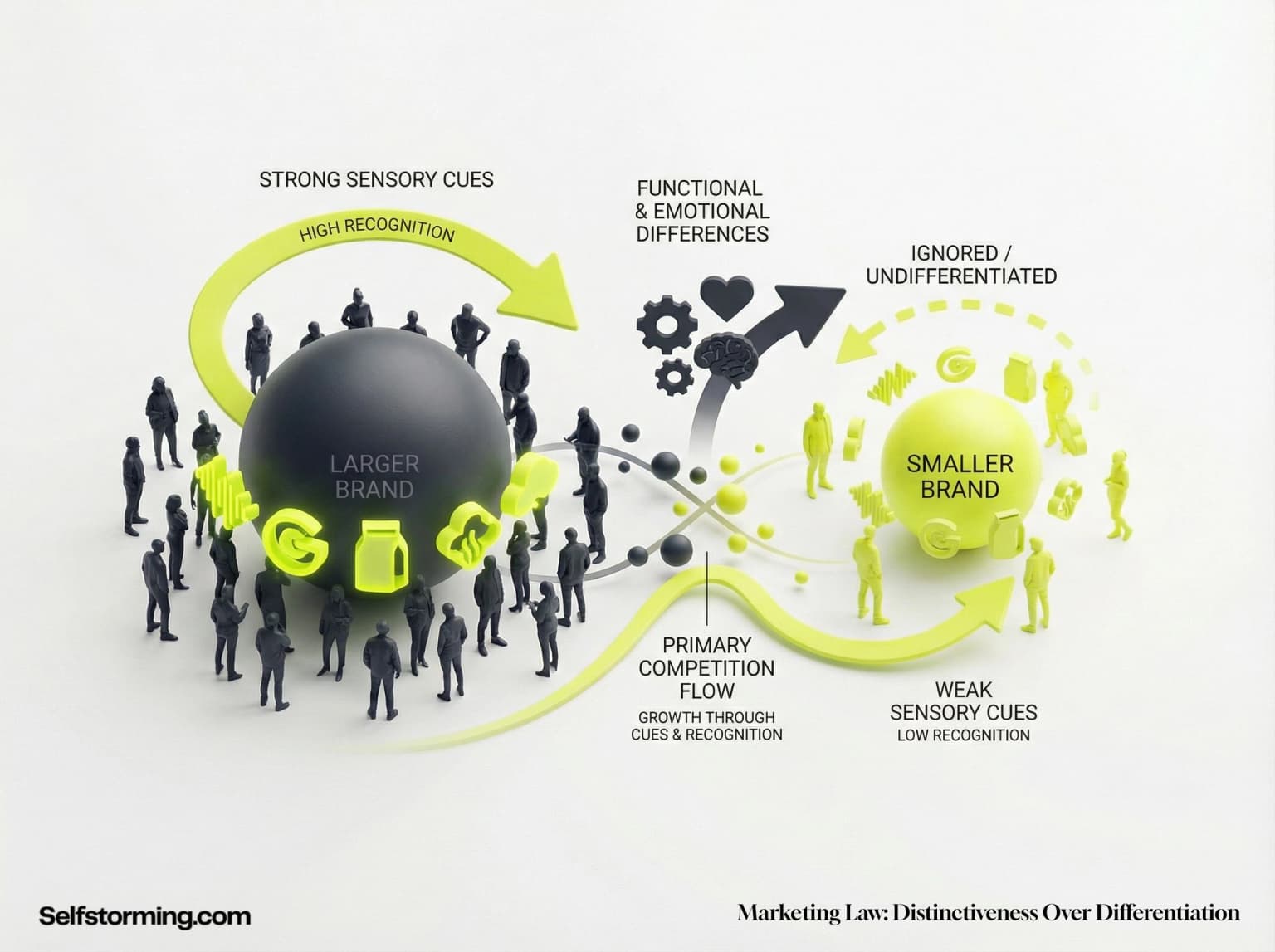
“Brands win by being instantly recognizable through unique visual and sensory cues - not by being perceived as meaningfully different from competitors.”
The Law of Distinctiveness Over Differentiation, pioneered by the Ehrenberg-Bass Institute, challenges the traditional marketing dogma that brands must be meaningfully different to succeed. Evidence suggests that consumers rarely perceive brands within a category as uniquely different; instead, they buy the brands that are most mentally and physically available. While differentiation is often a subjective mirage created by marketers, distinctiveness - achieved through consistent use of sensory cues like colors, logos, and taglines - is a functional necessity. Brands grow not by convincing people they are better or different, but by being more recognizable and easier to recall during a purchase occasion. This shift moves the focus from abstract brand positioning to the rigorous management of Distinctive Brand Assets (DBAs) that trigger brand retrieval in competitive environments.
Key Takeaways
- Differentiation is a marketer's obsession; distinctiveness is a consumer's shortcut.
- Consumers buy brands they recognize, not necessarily brands they think are better.
- Distinctive assets must be unique to your brand and famous across the category.
- Consistency over time is more valuable than meaningful brand positioning updates.
- Mental availability is built through the relentless repetition of sensory brand cues.
Consequences Of Applying The Law
| Aspect | When Applied | When Not Applied |
|---|---|---|
| Visual Identity & Brand Assets | The brand consistently utilizes a limited set of Distinctive Brand Assets (colors, shapes, characters) across all touchpoints. This builds strong memory structures, ensuring the brand is instantly recognizable even when the logo is obscured. It maximizes System 1 recognition at the point of purchase. | The brand frequently changes its look, feel, or campaign style to stay fresh or reflect different product benefits. This prevents the formation of long-term memory structures, making the brand invisible in a crowded environment and forcing consumers to expend cognitive effort to find it. |
| Advertising Messaging | Ads prioritize brand identification and fame over complex persuasion. Messaging is simple and serves to refresh the link between the brand and its distinctive assets. The goal is for the consumer to say Thats a [Brand Name] ad' within the first two seconds, increasing mental availability. | Ads focus on communicating a Unique Selling Proposition (USP) or complex meaningful differences. This often leads to vampire creativity where the consumer remembers the clever message or story but fails to attribute it to the specific brand, effectively subsidizing the entire category. |
| Media Planning & Targeting | Media is planned for broad reach to refresh memory structures among the entire category buyer base, including light buyers. High-frequency, low-complexity touchpoints ensure the brand remains top of mind when a Category Entry Point (CEP) is triggered. | Marketing focuses on hyper-targeting loyal segments with complex differentiation stories. Because differentiation is often invisible to the average buyer, this strategy fails to recruit the light buyers who drive market share growth according to the Dirichlet distribution. |
| Product Innovation | New products are designed to reinforce Brand Codes. Physical packaging uses the same distinctive assets (e.g., the specific shape of a bottle or a signature color) to ensure the new SKU benefits from the existing mental availability of the parent brand. | New products are launched with unique, differentiated packaging to signal a new benefit or niche. This fragments the brand's visual equity, making the new product harder to find on the shelf and failing to leverage the brand's established shortcuts in the consumer's brain. |
| Competitive Strategy | The brand focuses on being unmistakable relative to the category leader. It audits its assets for Uniqueness (only this brand uses it) and Fame (most buyers link it to the brand), ensuring it occupies a clear, distinct space in the consumer's mental map. | The brand engages in a features war, attempting to be better than competitors. Since competitors quickly copy functional advantages, the brand remains a functional substitute with no visual or mental anchor, leading to price-driven competition rather than recognition-driven choice. |
| Measurement & KPIs | Success is measured by Mental Availability and Asset Strength (fame and uniqueness). Marketers track how many Category Entry Points the brand is linked to and how quickly consumers can identify the brand from its non-logo assets. | Success is measured by Brand Image attributes or Perceived Differentiation scores. These metrics are often mirage metrics that reflect market share rather than cause it, providing no actionable insight into whether the brand is actually easier to buy. |
Genesis & Scientific Origin
The formalization of the Distinctiveness Over Differentiation principle is most prominently associated with the work of Professor Byron Sharp and Professor Jenni Romaniuk at the Ehrenberg-Bass Institute for Marketing Science. While the concept of differentiation has been the cornerstone of marketing strategy since the mid-20th century - popularized by figures like Rosser Reeves (USP) and Jack Trout (Positioning) - empirical data increasingly showed that these theories did not align with actual buyer behavior. In the landmark book How Brands Grow (2010), Sharp synthesized decades of research to demonstrate that brand users actually see very little difference between the brands they buy. The genesis of this law lies in the shift from perception-based marketing (asking people what they think) to behavior-based marketing (observing what people actually do). Romaniuk later expanded on this in Building Distinctive Brand Assets (2018), providing the framework for how brands should identify, protect, and invest in the sensory elements that make them recognizable, rather than chasing the phantom of meaningful differentiation.
“According to the Ehrenberg-Bass Institute, brand user profiles typically differ by less than 5% across competing brands.”
The Mechanism: How & Why It Works
The mechanism behind this law is rooted in cognitive psychology and the concept of Cognitive Fluency. The human brain is designed to conserve energy; it favors information that is easy to process. In a crowded marketplace, differentiation requires a consumer to engage in high-level cognitive processing - comparing features, weighing benefits, and understanding a brand's unique why. Most purchase decisions, however, are made using System 1 thinking: fast, instinctive, and emotional. Distinctiveness leverages this by building Memory Structures. When a brand consistently uses a specific color (e.g., Tiffany Blue), a shape (e.g., the Coca-Cola bottle), or a sound (e.g., the Intel bong), it creates a shortcut in the consumer's brain. These assets act as anchors. When a Category Entry Point (CEP) is triggered - such as I need a refreshing drink for a hot day - the brain scans its memory for the most available brand. If a brand has high distinctiveness, it surfaces immediately. Differentiation fails because it is often invisible at the point of purchase; distinctiveness succeeds because it is unmistakable. Mathematically, this is supported by the fact that brand profiles within a category are nearly identical. If differentiation were the primary driver of choice, we would see vastly different buyer profiles for different brands, but we don't. We see that brands share customers in line with their market share (Dirichlet distribution), proving that they are largely functional substitutes distinguished only by their visibility.
Real-World Example:
Apple (The Think Different Paradox)
Situation
For decades, Apple has been the poster child for differentiation. Marketers point to its Think Different campaign and its unique ecosystem as proof that being different is the key to success.
Result
Upon closer scientific inspection, Apple’s growth is a masterclass in distinctiveness, not differentiation. While Apple fans claim they buy because it's better or different, the data shows Apple’s buyer profile is almost identical to Samsung’s in terms of demographics and attitudes. Apple succeeded by building the most powerful Distinctive Brand Assets in history: the glowing logo, the white earbuds (a massive distinctiveness play in a world of black cords), the unique retail architecture, and the consistent UI. These aren't different benefits; they are sensory cues that make Apple the most mentally available brand in the tech space. When people buy Apple, they aren't making a complex rational choice about differentiation; they are responding to the most fluently processed brand in the category. Apple's differentiation is a narrative they sell, but their distinctiveness is what people actually buy.
Strategic Implementation Guide
Audit Your Assets
Stop guessing. Use the Romaniuk Grid to measure your brand assets on two scales: Fame (how many people link the asset to your brand) and Uniqueness (how many people link it ONLY to your brand).
Identify Your Non-Negotiables
Pick 2-3 assets (a color, a typeface, a character) and commit to them for the next decade. If you change your logo every time a new CMO joins, you are effectively deleting your brand from the consumer's brain.
Kill the Brand Purpose Slide
Stop trying to find a social cause that makes you different. Unless you're a non-profit, your customers don't care. Spend that energy ensuring your packaging is visible from 10 feet away in a dark aisle.
Map Your Category Entry Points (CEPs)
Identify the internal and external cues that lead someone to buy in your category (e.g., I’m bored at the airport, I need to impress my boss). Ensure your distinctive assets are present at these moments.
Prioritize Reach Over Relevancy
Differentiation strategy usually leads to targeting a small niche. Distinctiveness strategy requires reaching the entire category. You can't be distinctive to people who never see you.
Fight the Urge for Novelty
Marketers get bored of their own ads long before consumers even notice them. Consistency is the engine of distinctiveness. If you’re tired of your brand colors, you’re finally starting to reach the consumer.
Protect Your Assets Legally
Treat your distinctive assets like intellectual property. If a competitor starts using your specific shade of purple, sue them. They are stealing your mental real estate.
Frequently Asked Questions
Does this mean my product doesn't need to be good?
No, you still need a seat at the table. Your product must work and meet the category's functional requirements. But being good is just the entry fee. Once you meet the baseline, being better has diminishing returns compared to being more recognizable. Don't use distinctiveness as an excuse for a crappy product; use it as the reason people choose your good product over the other five good products.
Isn't distinctiveness just another word for branding?
Not exactly. Branding is a vague term that often includes brand soul, values, and personality. Distinctiveness is a cold, hard, scientific focus on sensory triggers. It’s about the physical and mental hooks that allow a brain to retrieve your brand. Branding is the what; distinctiveness is the how of being found.
Can a small brand afford to be distinctive?
A small brand *can't afford not to be*. Small brands have limited budgets, which means they can't afford to waste a single cent on ads that people don't immediately associate with them. If a small brand tries to differentiate with a complex message, they'll be ignored. If they pick one weird, bright asset and stick to it, they might actually stand a chance.
Wait, what about Unique Selling Propositions (USP)?
The USP is largely a myth in modern, mature categories. Most USPs are easily copied within weeks, or they are differences that dont make a difference. The consumer's brain doesn't have the bandwidth to track 50 different USPs. It tracks the red one, the one with the gecko, or the one that sounds like a lightsaber.'
How do I know if I'm being different or distinctive?
If you're explaining *why* you're better, you're trying to differentiate. If you're using a specific visual or auditory cue that makes people say Oh, thats [Brand Name] before they even see the logo, you're being distinctive. Differentiation lives in the argument; distinctiveness lives in the recognition.
Sources & Further Reading
Related Marketing Laws
Distinctive Assets Law
Consistent brand cues drive recognition faster than differentiation claims.
The Law Of Emotion Over Reason
Emotional advertising drives stronger long-term effects than rational ads.
The Law Of Fame
Being noticed matters more than convincing people with arguments.
The Law Of Alienation Paranoia
Marketers overestimate how many people they'll offend by being distinctive.