Optimization Kills Distinctiveness
Testing for perfection creates boring brands.
Congratulations, you’ve optimized your way into total invisibility. You’ve A/B tested your creative into a puddle of grey sludge that offends no one and interests even fewer. If your goal was to blend into the background like a shy chameleon at a concrete convention, you’re winning. But if you actually wanted to grow a brand, you’ve just committed statistical suicide. You’re so obsessed with the 0.01% lift in your click-through rate that you’ve forgotten your brand is currently as memorable as a glass of lukewarm water. You’ve polished the stone until there’s no stone left. It’s time to stop looking at the dashboard and start looking at the sea of sameness you’ve helped create.
The law of Optimization Kills Distinctiveness posits that the modern obsession with iterative, data-driven testing (A/B testing, multivariate analysis) inevitably leads to the 'regression to the mean.' When marketers optimize for immediate clicks or conversions, the algorithms and consumer feedback loops favor the familiar and the 'safe.' Over time, this erodes a brand's unique visual and cognitive cues—its Distinctive Brand Assets—making it indistinguishable from competitors. While optimization can improve short-term efficiency, it acts as a tax on long-term mental availability. To build a brand that survives, marketers must resist the urge to smooth out the 'weird' edges that actually drive recognition, as these non-optimized elements are often what make the brand 'stick' in the consumer's memory.
OPTIMIZATION KILLS DISTINCTIVENESS
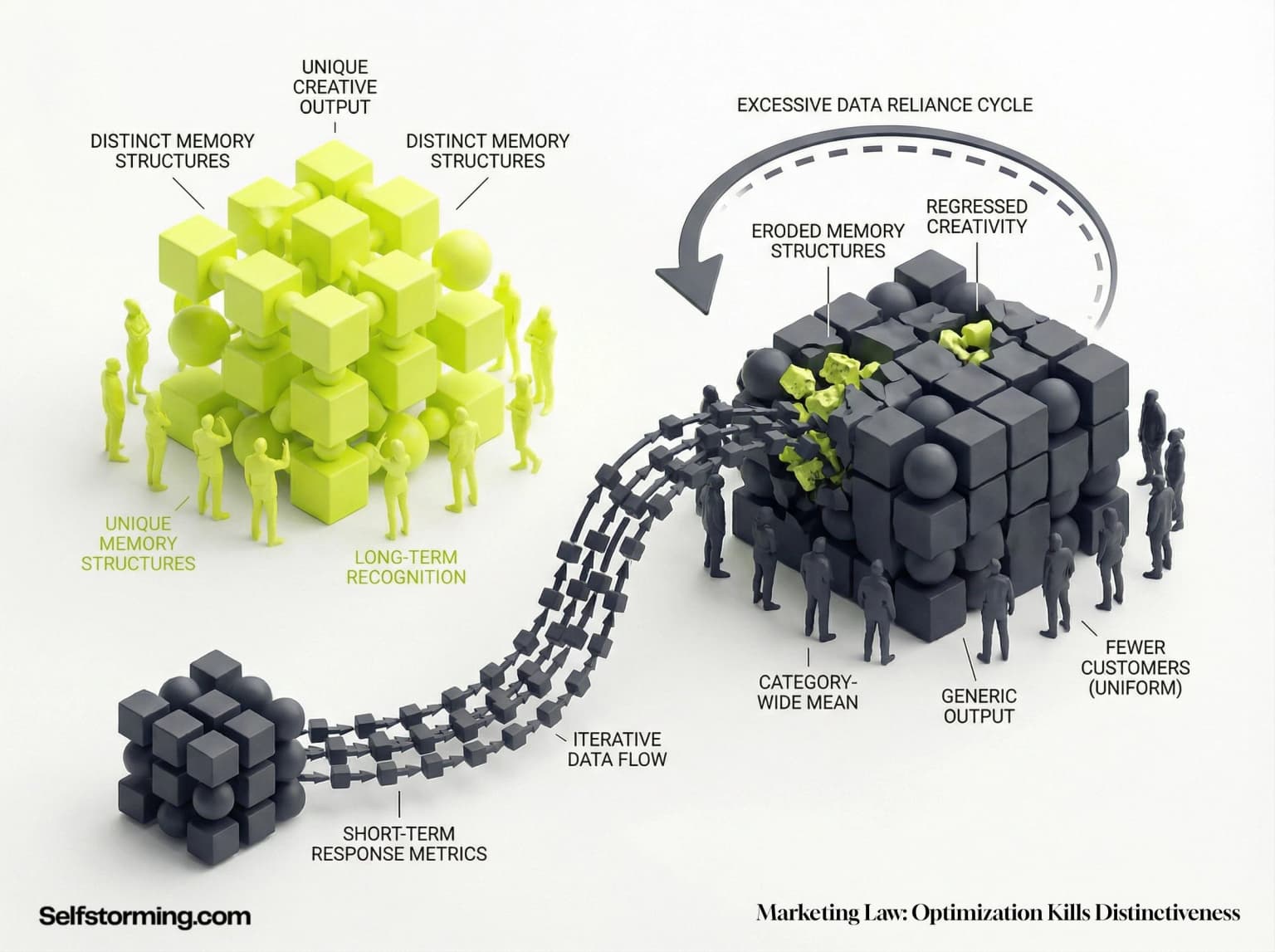
“Excessive reliance on iterative performance data and short-term response metrics inevitably regresses creative output toward a category-wide mean, eroding the unique memory structures required for long-term brand recognition and mental availability.”

Key Takeaways
- •Optimization targets local maxima, but distinctiveness captures global market attention.
- •Iterative testing regresses creative work to a boring, category-wide average.
- •The 'winning' ad in a short-term test often erodes long-term brand memory.
- •Blanding is the inevitable result of following data without a creative soul.
- •Protect your brand's 'weirdness'; it is your only defense against commodity pricing.
Genesis & Scientific Origin
The foundational observations for this law emerged from the longitudinal analysis of the IPA Databank, specifically the work of Les Binet and Peter Field. In their seminal 2013 report, 'The Long and the Short of It,' and subsequent 2019 update, 'The Crisis in Creative Effectiveness,' they identified a disturbing trend: as the industry shifted toward digital 'activation' and data-driven optimization, the overall effectiveness of marketing campaigns began to decline. Further theoretical weight was added by the Ehrenberg-Bass Institute for Marketing Science, which emphasized that 'distinctiveness'—being easily recognized—is the primary driver of brand growth, rather than 'differentiation.' The term 'Optimization Kills Distinctiveness' has since become a rallying cry for Evidence-Based Marketers who recognize that the mathematical pursuit of a 'local maximum' often prevents the discovery of a 'global maximum' in brand fame.
“Creatively awarded campaigns are 11x more efficient at driving market share growth than non-awarded ones (Field, 2019).”
The Mechanism: How & Why It Works
The mechanism behind this law is rooted in the statistical concept of 'Regression to the Mean' and the psychological 'Mere Exposure Effect.' When a marketer A/B tests two creative executions, they are looking for the one that generates the highest immediate response. Usually, the version that 'wins' is the one that feels most familiar to the audience or fits their existing mental schema of the category. This is because consumers process familiar stimuli with less cognitive load (Fluency). However, the goal of brand building is not just to be processed easily, but to be remembered uniquely.
Mathematically, optimization is a hill-climbing algorithm. It seeks the highest point in the immediate vicinity of the current data set. If you test 'Red Button' vs. 'Blue Button,' you might find that 'Red' performs 2% better. But this iterative process never allows for the 'Giant Fire-Breathing Dragon'—a creative leap that might initially perform poorly in a sterile test environment but would build massive mental availability in the real world. By constantly shaving off the 'underperforming' edges of a campaign, you are essentially removing the very things that make the work distinctive.
Furthermore, the algorithms used by platforms like Meta and Google are designed to find the 'average' person likely to click. When creative is optimized by these algorithms, it is shaped to appeal to the broadest, most generic common denominator. This results in 'Blanding'—the phenomenon where all tech startups use the same sans-serif fonts and all fashion brands use the same minimalist aesthetic. In the pursuit of the 'perfect' ad, marketers create the 'invisible' ad.

Empirical Research & Evidence
The most compelling evidence for this law is found in the 'The Crisis in Creative Effectiveness (Field, 2019)' published by the Institute of Practitioners in Advertising (IPA). Field’s research analyzed over 600 case studies from the IPA Databank, comparing the business impact of 'creatively awarded' campaigns versus 'non-awarded' or 'optimized' campaigns. The data revealed that the 'effectiveness multiplier' of creative work—the ability of a campaign to generate market share growth per unit of share-of-voice—had fallen to its lowest level in 24 years. Specifically, Field found that campaigns focused on short-term optimization and 'activation' were significantly less likely to drive long-term brand health or pricing power.
Additionally, a study titled 'Journal of Advertising Research (Teixeira & Wedel, 2010)' utilized eye-tracking technology to show that 'high-entropy' (highly distinctive/unpredictable) visual elements were essential for capturing and maintaining consumer attention. When ads were 'optimized' to follow standard category conventions (low entropy), consumers’ eyes skipped over the brand-identifying elements entirely. The research proved that the very elements that 'optimization' usually removes—the surprising, the weird, and the non-standard—are the primary drivers of visual salience.
Real-World Example:
Airbnb
Situation
For years, Airbnb followed the standard Silicon Valley playbook, pouring hundreds of millions of dollars into performance marketing and search engine optimization (SEO/SEM). Their creative was highly optimized for conversion, focusing on specific listings and price points. However, they found that they were effectively 'renting' their customers from Google, with no lasting brand equity being built.
Result
In 2020 and 2021, Airbnb made a radical shift. They slashed their performance marketing budget by over 50% and pivoted toward 'brand-building' campaigns that emphasized their distinctiveness as a category of one (e.g., the 'Made Possible by Hosts' campaign). Instead of optimizing for the next click, they optimized for the next memory. The result? 90% of their traffic became direct or organic, and they achieved their most profitable year ever. By stopping the 'optimization' of their ads to fit Google's algorithms, they reclaimed their distinctiveness and built a moat that competitors couldn't buy their way across.
Strategic Implementation Guide
Step 1
Identify your Distinctive Brand Assets (DBAs) using a quantitative audit. Know exactly which colors, fonts, and characters are yours before you start testing them into oblivion.
Step 2
Adopt the 70/20/10 rule for creative. 70% of your budget goes to proven DBAs, 20% to experimental variations, and 10% to 'Wildly Non-Optimized' creative that breaks every category rule.
Step 3
Stop A/B testing 'big ideas' against 'safe ideas' in small sample sizes. Pre-testing favors the familiar; the 'weird' needs time and frequency to build memory structures.
Step 4
Shift your primary KPIs from short-term (CTR, CPA) to long-term (Mental Availability, Share of Search). If the 'winning' ad in a test doesn't feature your brand assets prominently, it's a losing ad.
Step 5
Protect the 'Useless' elements. If a creative element doesn't have a direct 'functional' purpose but makes the brand feel unique, it is the most valuable part of the ad. Do not let the data scientists cut it.
Step 6
Mandate a 'Category Audit' every quarter. Lay your ads next to your top 5 competitors. If you can swap the logos and the ad still makes sense, you have optimized your way into a crisis.
Step 7
Measure 'Attention Seconds' rather than just 'Impressions.' Optimization usually increases reach but decreases the quality of the attention received.
Frequently Asked Questions
Does this mean I should stop A/B testing altogether?
No, it means you need to know what you're testing for. A/B testing is great for 'activation'—improving the plumbing of a checkout page or a lead form. It is lethal when applied to 'brand building.' Use data to optimize the friction out of the purchase, but never use it to optimize the friction out of the creative. Distinctiveness is, by definition, a form of friction that catches the eye.
If the data says 'Option A' performs better, why would I choose 'Option B'?
Because your data is likely measuring 'Short-Term Click Propensity' and not 'Long-Term Memory Encoding.' Option A might get more clicks today because it looks like a generic 'Sale' ad, but Option B builds the brand equity that allows you to sell at a premium for the next five years. You’re trading your future for a 2% lift in today’s dashboard.
How do I explain this to a CFO who loves data?
Tell them that optimization is a 'commodity trap.' If every brand in the category uses the same data to optimize their ads, every brand will eventually look identical. When products look identical, consumers buy on price alone. Therefore, optimization is a direct threat to the brand's margins and pricing power.
Can a brand be 'too' distinctive?
Only if it’s no longer recognizable as being in the category. This is the 'Alienation Paranoia' trap. Marketers fear being 'too weird' will drive people away, but the evidence shows that being ignored is a much bigger risk than being disliked. You need enough category cues to be relevant, but enough distinctiveness to be noticed.
Is 'Blanding' a result of this law?
Absolutely. Blanding is the visual manifestation of Optimization Kills Distinctiveness. Brands are optimizing for 'readability' on mobile screens and 'cleanliness' in UI, which leads them all to use the same geometric sans-serif fonts and minimalist layouts. They’ve optimized for 'usability' but killed 'identifiability.'
Sources & Further Reading
Related Marketing Laws
Differentiation Is Overclaimed
Most brands are less unique than they believe.
Loyalty Programs Rarely Drive Growth
They mostly reward existing behavior without changing it.
Brand Purpose Rarely Drives Choice
Purpose matters more internally than in buying decisions.
Strategy Is Not Messaging
A slogan is not a strategy.