Being Ignored Is the Biggest Risk
The biggest risk is being ignored.
You’re so worried about 'brand safety' and 'consistent messaging' that you’ve managed to achieve the one thing worse than being hated: being invisible. Your $10M media buy is currently functioning as a very expensive screen-saver for people scrolling to find something—anything—remotely interesting. If your creative doesn't provoke a pulse, you aren't 'playing it safe'; you're setting fire to the CFO's budget while they watch. In a world of infinite content, 'neutral' is a death sentence, and 'safe' is just a polite word for 'useless'. Stop nodding and start worrying, because nobody is looking at you.
The law 'Being Ignored Is the Biggest Risk' posits that the single greatest source of waste in marketing is not 'inefficiency' or 'poor targeting,' but creative invisibility. In an attention-starved economy, advertising that fails to evoke an emotional response or break the consumer's perceptual filter is functionally non-existent. Research from the IPA and System1 demonstrates that 'neutral' or safe advertising—work that avoids controversy and adheres to category tropes—consistently underperforms bold, polarizing, or distinctive work. While marketers often fear 'alienating' potential buyers, the statistical reality is that the vast majority of advertising goes unnoticed. Therefore, the risk of being ignored far outweighs the risk of being disliked. Effectiveness is a direct byproduct of salience, and salience requires the bravery to be noticed in a sea of beige corporate messaging.
BEING IGNORED IS THE BIGGEST RISK
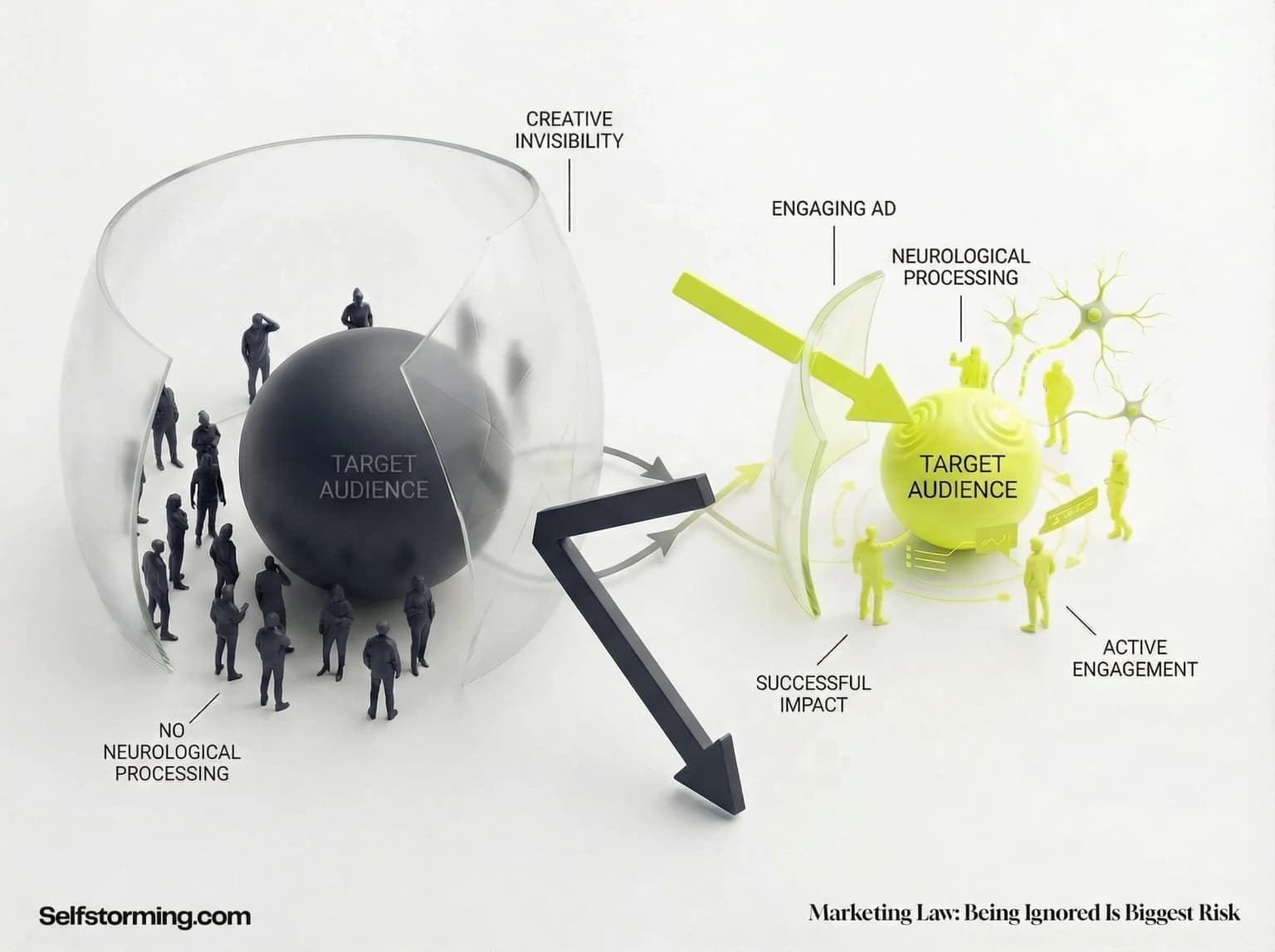
“The primary failure of advertising is not the delivery of an incorrect message, but the failure to secure any neurological processing from the target audience due to creative invisibility.”

Key Takeaways
- •Neutrality is the most expensive mistake a marketer can make.
- •If your creative doesn't provoke an emotional response, it won't build memory.
- •The risk of being hated is smaller than the risk of being invisible.
- •Bold creative acts as a media spend multiplier, lowering your effective CPM.
- •Safety in advertising is a statistical illusion that leads to zero growth.
Genesis & Scientific Origin
The formalization of this law stems from the longitudinal analysis of the IPA Databank, specifically the collaborative work of Peter Field and Les Binet, alongside the behavioral research of Orlando Wood and the System1 Group. In Wood’s seminal works, 'Look Out' (2019) and 'Lemon' (2019), he identifies a systemic decline in advertising effectiveness correlating with a shift toward 'left-brain' advertising—work that is literal, transactional, and devoid of the 'human' elements that capture broad-beam attention. System1’s database of over 100,000 ads reveals a staggering truth: approximately 50% of ads generate zero brand growth because they fail to elicit any emotional response. This research was further solidified by the work of Karen Nelson-Field on 'Attention Elasticity,' which proves that reach is a vanity metric if the creative fails to secure the initial 'mental entry' required for memory encoding. The consensus among these institutions is that 'creative waste' is the primary driver of poor ROI, and that waste is almost always caused by invisibility.
“50% of all advertising generates zero long-term brand growth due to creative neutrality (System1, 2019).”
The Mechanism: How & Why It Works
The mechanism behind this law is rooted in the neurobiology of attention and the economic principle of 'Attention Elasticity.' Human cognition is governed by a filter known as the Reticular Activating System (RAS), which prioritizes stimuli that are novel, emotionally charged, or personally relevant. Most 'safe' advertising utilizes category-standard imagery (e.g., a bank showing a happy couple, a car on a winding road), which the brain treats as 'background noise.' This results in 'inattentional blindness,' where the consumer physically sees the ad but the brain fails to process or store the information.
Mathematically, the 'Cost of Invisibility' can be expressed as an effective CPM (Cost Per Thousand). If a brand pays for 1,000 impressions but 90% of the audience ignores the creative because it is too neutral, the effective CPM is 10 times the nominal rate. Conversely, bold creative that secures attention acts as a 'media multiplier.' This is what Orlando Wood describes as the 'Look Out' effect—creative that uses 'right-brain' features like humor, character, and narrative to bypass the brain’s defensive filters.
Furthermore, there is a psychological threshold for memory encoding. Neutral advertising fails to reach the 'Arousal' threshold required to trigger the hippocampus. Without this trigger, the brand cannot build 'Mental Availability.' The risk of 'alienation'—the fear that a bold ad might turn people off—is statistically insignificant compared to the 'risk of the void.' Because consumers are repertoire buyers (buying from a set of brands), being noticed and disliked by 10% of the population while being loved/remembered by 30% is a vastly superior outcome to being 'ignored' by 100%. Boldness creates a 'marmite effect' that ensures the brand occupies a distinct node in the consumer’s memory structure, whereas safety ensures the brand remains a commodity.

Empirical Research & Evidence
In the research published in 'Look Out' by Orlando Wood (2019), System1 analyzed the relationship between 'Star Rating' (an emotional response metric) and long-term market share growth. The study revealed that ads scoring 1-star (neutral or negative response) resulted in 0% market share growth, regardless of the media spend. Crucially, the data showed that 'safe' ads—those that were technically proficient but emotionally flat—consistently fell into this 1-star category. Further validation is found in the IPA Databank (Field & Binet, 2013), which shows that 'fame-seeking' campaigns (those designed to get the brand talked about) are significantly more effective at driving profit and market share than campaigns focused on 'information' or 'persuasion.' Specifically, fame-based campaigns were found to be 4 times more likely to drive large business effects than non-fame campaigns, proving that the risk of being 'loud' is the only way to secure a commercial return.
Real-World Example:
Liquid Death
Situation
The bottled water category is the ultimate 'sea of beige,' dominated by images of mountains, clear springs, and 'pure' health-focused messaging. Most brands in this space are functionally invisible, competing solely on price and distribution.
Result
Liquid Death ignored all category conventions, using heavy-metal aesthetics, the slogan 'Murder Your Thirst,' and aggressive, often 'offensive' humor. While traditional marketers warned that the brand would alienate families and health-conscious buyers, the result was a $700M valuation in just three years. By refusing to be ignored, they achieved more 'Mental Availability' with a fraction of the media budget of giants like Dasani or Aquafina. Their 'boldness' acted as a massive reach multiplier, proving that being polarizing is the fastest route to category dominance.
Strategic Implementation Guide
Kill the Consensus Committee
Innovation and boldness die in 'alignment meetings.' If everyone in the room likes the creative, it’s probably too safe. Look for the idea that makes the most conservative person in the room uncomfortable.
Budget for Bravery
Allocate a '10% Chaos Fund' for creative that breaks category rules. This isn't just for testing; it's for ensuring you aren't just buying 'polite' reach.
Measure Attention, Not Just Impressions
Move away from GRPs and CPMs as your primary success metrics. Use attention-based metrics (e.g., dwell time, emotional trace, or 'fame' scores) to evaluate creative effectiveness.
Embrace the 'Marmite' Effect
Accept that if some people don't hate your ad, nobody will love it. Polarizing creative is a sign that you have broken through the perceptual filter.
Prioritize Right-Brain Features
Incorporate characters, dialogue, narrative arc, and humor. Avoid the 'left-brain' trap of flat, rhythmic, and overly literal product demonstrations.
Audit for Category Tropes
List the 5 most common visual clichés in your industry. If your creative uses any of them, start over. You cannot be distinctive by following the herd.
Focus on Mental Entry
Your ad's first job is to stop the scroll or the skip. If you don't win the first 2 seconds with something 'risky,' the rest of your $50,000 production budget is wasted.
Frequently Asked Questions
Does 'being bold' mean we have to be offensive or controversial?
Not necessarily. Boldness is about being 'distinctive' and 'noticeable,' not 'offensive.' It means breaking the expected patterns of your category. For a B2B software company, boldness might be using hand-drawn animation in a world of stock photography. The goal is to be 'unignorable,' which is a creative challenge, not just a shock-value challenge.
What if our bold creative leads to a negative PR cycle?
The 'Alienation Paranoia' law teaches us that marketers vastly overestimate how much people care. Most 'outrage' is fleeting and localized. For 99% of brands, the problem isn't that people are talking about them negatively—it's that people aren't talking about them at all. A small PR ripple is often a sign that you’ve finally reached enough people to matter.
How do I justify 'risky' creative to a CFO who wants ROI?
Show them the math of the 'Invisibility Tax.' If your neutral ad has a 0.1% engagement rate and a bold ad has a 1.0% engagement rate, the bold ad is 10x more cost-effective. 'Safety' is the most expensive strategy because it requires massive media weight to compensate for creative weakness. Boldness is a budget multiplier.
Can a brand be 'too' bold and damage its equity?
Only if the boldness is disconnected from the brand’s core distinctive assets. If you are 'bold' in a way that makes people forget who is talking, you've failed. The 'Risk' is being ignored; the 'Goal' is being remembered. Ensure your brand cues (logo, colors, tone) are woven into the bold creative.
Is this law applicable to B2B or 'serious' industries?
It is arguably *more* important in B2B. Because B2B marketing is notoriously boring and 'safe,' the first brand to show a personality or use humor gains a massive competitive advantage. B2B buyers are still humans with the same neurobiological filters as B2C consumers.
Sources & Further Reading
Related Marketing Laws
Distinctive Assets Law
Consistent brand cues drive recognition faster than differentiation claims.
Emotion Outperforms Rational Messaging
Emotional advertising drives stronger long-term effects than rational ads.
Fame Beats Persuasion
Being noticed matters more than convincing people with arguments.
Alienation Paranoia
Marketers overestimate how many people they'll offend by being distinctive.