Differentiation Is Overclaimed

Unique selling points are mostly myths.

You’ve spent six months and half the annual budget in a 'war room' trying to find your brand’s 'soul,' haven't you? Spoiler alert: your customers don't care. To them, you're a functional utility they grab because you're there, not because your 'artisanally-sourced' values resonate with their inner child. Differentiation is the security blanket marketers hug when they’re too scared to admit they’re just selling stuff to busy people who can’t tell them apart from the competition. It's time to stop smelling your own farts and look at the data: your brand isn't a snowflake; it's just another option in a crowded aisle.
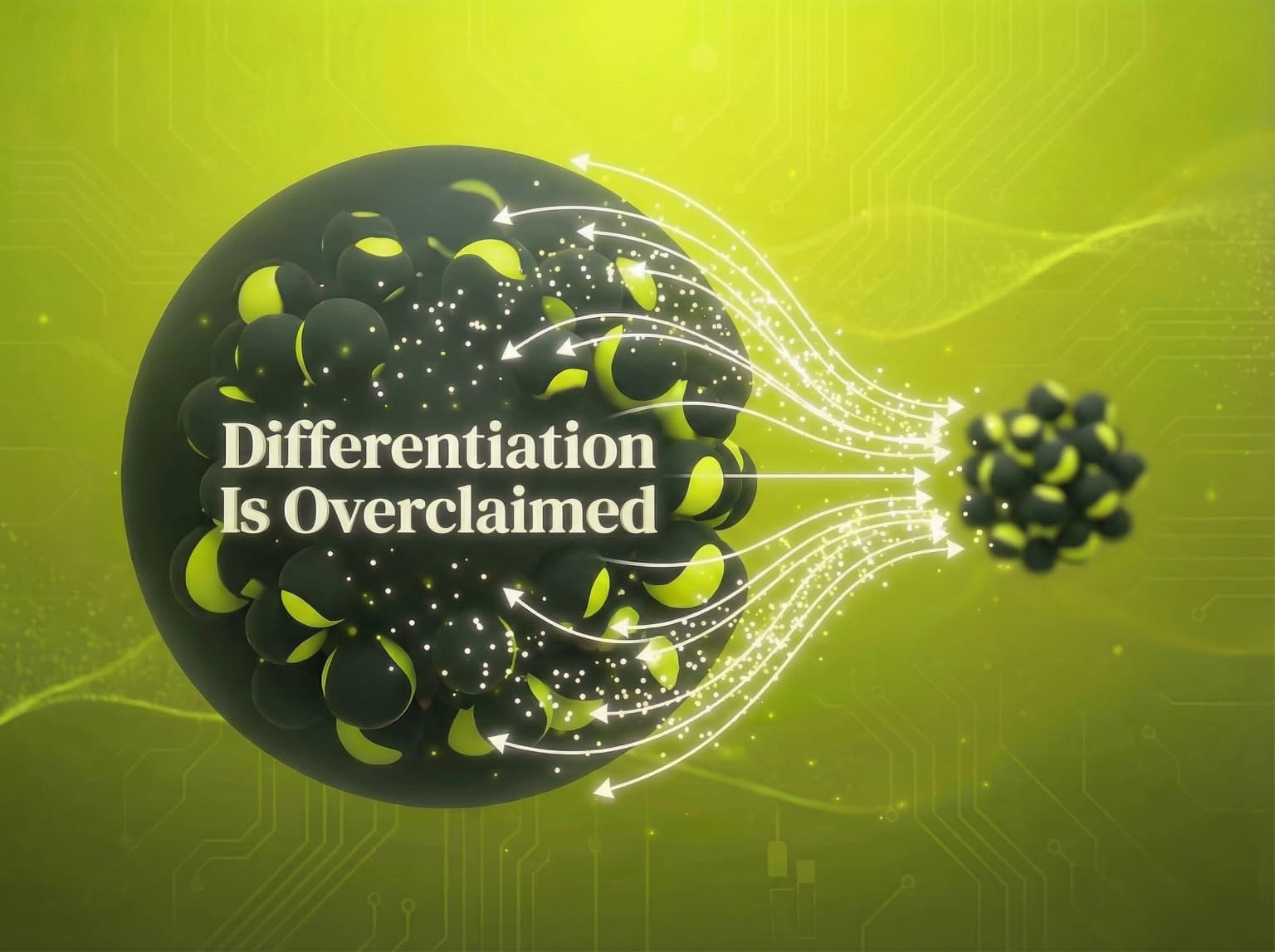
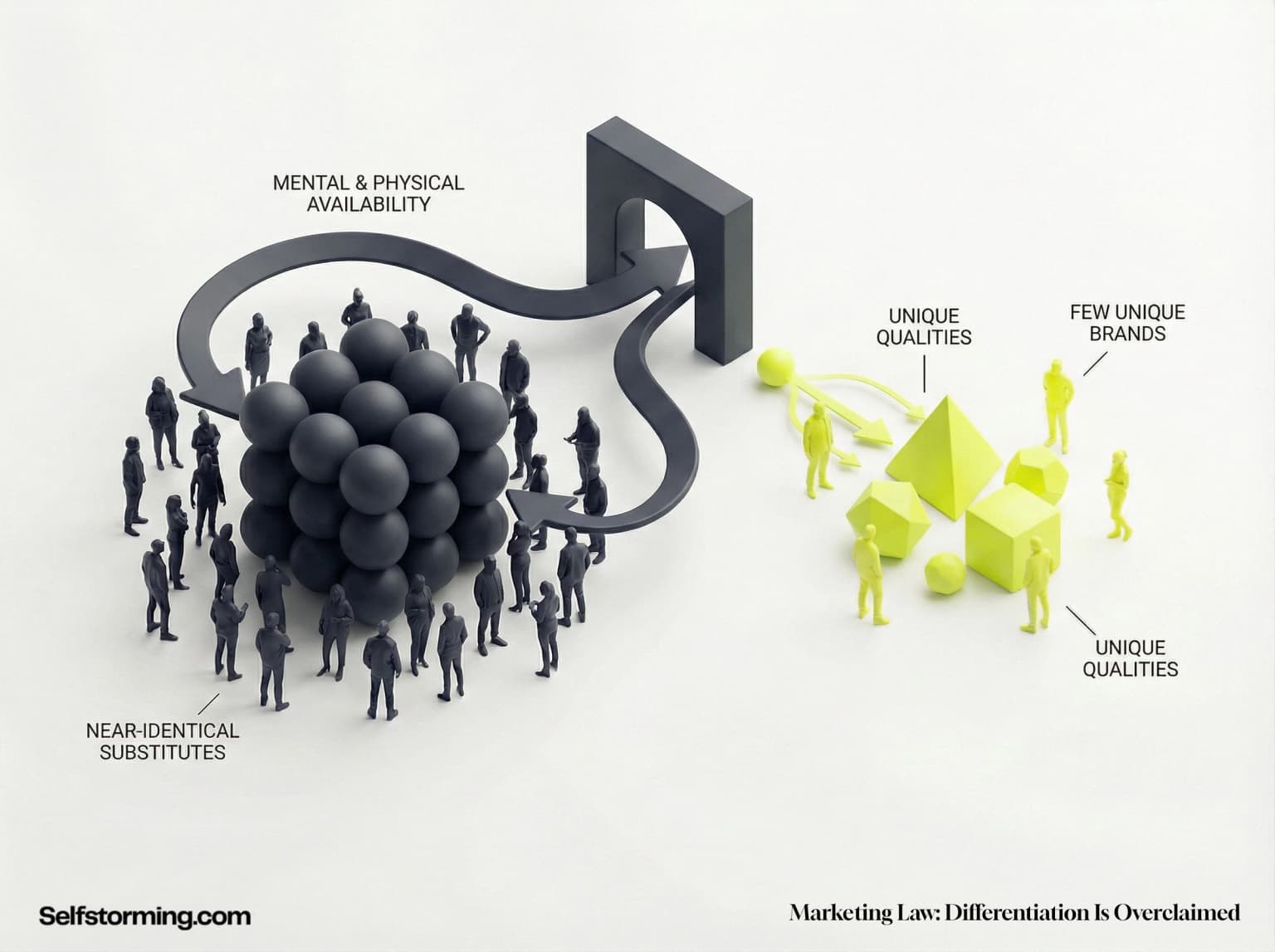
The law of Differentiation Is Overclaimed states that most brands are perceived as near-identical substitutes by the vast majority of consumers. While marketers obsess over 'Meaningful Differentiation'—the idea that a brand must be uniquely better or different in a way that matters—empirical evidence shows that competitive brands share nearly identical customer bases and that perceived uniqueness is extremely low. Growth is not driven by convincing people you are 'different,' but by building 'Distinctiveness' (being easily recognizable) and 'Availability' (being easy to find). When consumers are asked why they bought a brand, 'uniqueness' is rarely the driver; instead, brands succeed because they are mentally and physically present during a buying occasion. Chasing differentiation often leads to niche positioning that limits reach and stalls growth.

DIFFERENTIATION IS OVERCLAIMED

Most brands within a category are perceived by the majority of consumers as near-identical substitutes, with very few possessing unique qualities that drive preference independently of mental and physical availability.

Differentiation Is Overclaimed marketing law: Unique selling points are mostly myths. - Visual illustration showing key concepts and examples

Key Takeaways

  • Consumers see most brands as interchangeable substitutes within a category.
  • Meaningful differentiation is rarely the primary driver of consumer choice.
  • Brand growth relies on distinctiveness (recognition) rather than differentiation (uniqueness).
  • Competitive brands share almost identical customer profiles regardless of positioning.
  • Focus on being 'easy to think of' and 'easy to find' instead of 'different'.

Genesis & Scientific Origin

The principle that 'Differentiation Is Overclaimed' was formalized through the extensive longitudinal research of the Ehrenberg-Bass Institute for Marketing Science. While the concept of the 'Unique Selling Proposition' (USP) was popularized by Rosser Reeves in the 1950s, it was Byron Sharp and Jenni Romaniuk who systematically dismantled it in the early 21st century. Their foundational work, most notably published in the book 'How Brands Grow' (2010), synthesized decades of consumer behavior data across hundreds of categories and multiple countries. The law emerged as a direct challenge to the traditional 'STP' (Segmentation, Targeting, Positioning) model taught in business schools, which assumes that brands must occupy a unique 'slot' in the consumer's mind to survive. Instead, the Institute's research proved that brands compete in a giant 'mush' of substitution where size, not uniqueness, dictates loyalty and perception.

Less than 15% of a brand's loyal customers perceive it as 'unique' (Romaniuk & Sharp, 2004).

The Mechanism: How & Why It Works

The mechanism behind this law is rooted in human cognitive economy and the structural reality of modern markets. Consumers are 'cognitive misers'; they do not have the time, energy, or inclination to evaluate the nuanced differences between sixteen different brands of laundry detergent or B2B software. Instead, they use heuristics to simplify decision-making.

Firstly, there is the 'Functional Equivalence' factor. In any mature category, the baseline quality required to stay in business is high. Whether you buy a Ford or a Toyota, a MacBook or a Dell, the product performs the same core function to a similar level of satisfaction. This 'sameness' is a feature of competitive markets, not a bug.

Secondly, the 'Law of Substitution' dictates that brands within a category share their customer bases in proportion to their market share (the Duplication of Purchase Law). If brands were truly differentiated, they would attract unique 'types' of people. In reality, a brand's user base looks almost exactly like its competitor's user base.

Thirdly, the 'Perception-Reality Gap' in marketing teams is massive. Marketers are 'high-involvement' observers of their own brand, spending 40+ hours a week thinking about it. The average consumer spends maybe 2 seconds. This leads to 'Narcissism of Small Differences,' where marketers believe a 2% faster charging port or a 'commitment to sustainability' makes them a different species, while the consumer just sees 'a phone' or 'a company.'

Mathematically, the 'differentiation' perceived by consumers is usually a result of brand size, not the cause of it. This is a 'Halo Effect': because a brand is big and famous, people assume it must be better or different, rather than buying it because it is different.

Differentiation Is Overclaimed mechanism diagram - How Differentiation Is Overclaimed works in consumer behavior and marketing strategy

Empirical Research & Evidence

A pivotal study supporting this law is the research published in the Journal of Advertising Research (Romaniuk & Sharp, 2004) titled 'Conceptualizing and measuring brand salience.' In this study, researchers analyzed consumer perceptions of brand 'uniqueness' across multiple categories. They found that even for brands with very strong 'positioning' in the minds of marketers, the percentage of the brand's own customer base that perceived it as 'unique' or 'different' was shockingly low—often between 10% and 15%.

Furthermore, the research demonstrated that the 'reasons for buying' cited by consumers were almost identical across competing brands. For example, in the banking sector, customers of 'Brand A' (which marketed itself on 'personal service') and 'Brand B' (which marketed itself on 'innovation') both cited 'convenience' and 'reliability' as their primary reasons for purchase at nearly identical rates. The data showed that 70% to 90% of a brand's buyers do not see it as different from other brands they also use. This study effectively proved that 'meaningful differentiation' is a rare exception rather than the rule of brand growth.

Real-World Example:
Apple (iPhone)

Situation

Apple is often cited by traditional marketers as the ultimate example of differentiation through 'innovation' and 'lifestyle.' Marketers argue that Apple users are a 'tribe' who see the brand as fundamentally different from 'utilitarian' Android brands.

Result

When Ehrenberg-Bass researchers analyzed the data, they found that Apple's user base follows the same laws as every other brand. Apple shares its buyers with Samsung in almost exact proportion to Samsung's market share. Furthermore, when Apple users were surveyed on why they bought an iPhone, their answers (e.g., 'it works,' 'I'm used to it,' 'good camera') were largely the same as the reasons Samsung users gave. While Apple has high 'Distinctiveness' (the logo, the UI, the retail stores), its 'Differentiation' is largely a post-rationalization of its massive market share and physical availability. Most people buy it because it is the 'default' premium choice, not because they perceive a unique philosophical alignment.

Strategic Implementation Guide

1

Stop the 'Unique' Search

Stop wasting budget on focus groups trying to find a 'meaningful' difference that doesn't exist. Accept that you are a substitute.

2

Prioritize Distinctiveness

Instead of being 'different' (better/unique), focus on being 'distinct' (recognizable). Invest in colors, logos, fonts, and taglines that make you impossible to miss.

3

Broaden Your Reach

Since you don't have a 'unique' customer segment, stop hyper-targeting. You need to reach all buyers in the category, because anyone who buys the category is a potential buyer for you.

4

Focus on Category Entry Points (CEPs)

Identify the situations where people buy your category (e.g., 'I need a quick snack,' 'I need to secure my data') and ensure your brand is the first one they think of in those moments.

5

Max out Physical Availability

You can't be 'different' if you aren't there. Ensure you are on the shelf, at the top of the search results, and easy to buy.

6

Simplify the Message

Don't use complex arguments to prove you're better. Use simple, consistent cues to remind people you exist.

7

Audit Your 'Differentiation' Claims

Look at your competitors' ads. If you can swap your logo for theirs and the ad still makes sense, your 'differentiation' is a myth. Move to distinctive assets instead.

Frequently Asked Questions

If differentiation doesn't matter, why do brands have different personalities?

Brand 'personality' is mostly a construct of the marketing department. While a brand might have a 'rebel' or 'caregiver' vibe in its ads, consumers don't actually use that as a primary filter for buying. They buy what is familiar and available. 'Personality' is just a creative vehicle for distinctiveness, not a driver of preference.

Does this mean I should stop innovating?

No. Innovation is vital for maintaining 'Functional Equality.' If you stop innovating, you become 'meaningfully worse,' which is a real thing. You innovate to stay in the game, not necessarily to 'differentiate' yourself permanently, because your competitors will copy your 'unique' feature in six months anyway.

What about 'Lovemarks' and brand loyalty?

The data shows that 'brand love' is a result of buying a brand frequently, not the cause of it. People feel 'loyal' to big brands because they use them more often. Loyalty is a function of market share (Double Jeopardy Law), not a result of being 'different' or 'special.'

Can a small brand survive without differentiation?

Small brands survive by being distinct in a small niche or local area, but they only grow by expanding their mental and physical availability to the wider market. If a small brand stays 'different,' it usually stays small.

Isn't 'Distinctiveness' just another word for 'Differentiation'?

No. Differentiation is about *why* you are better or different (the 'meaning'). Distinctiveness is about *how* I recognize you (the 'look'). You can be 100% identical in function to a competitor but 100% distinct in appearance. Growth comes from the latter.

We use cookies on our site to enhance your user experience, provide personalized content, and analyze our traffic. Cookie Policy