Long and Short of It
Balance the quick wins and long games.
Look, your CMO is currently stroking a dashboard full of 'performance' metrics while your actual brand health is circling the drain. You're addicted to the immediate dopamine hit of a 4:1 ROAS on a search campaign, ignoring the fact that you're just harvesting demand someone else created years ago. You’re eating your seed corn and wondering why next year’s harvest looks like a desert. Binet and Field proved a decade ago that brand building and sales activation are two different beasts that require different strategies, yet most of you are still trying to win a marathon by sprinting the first hundred meters until your heart explodes. It’s time to stop playing house with your attribution models and start understanding how money is actually made.

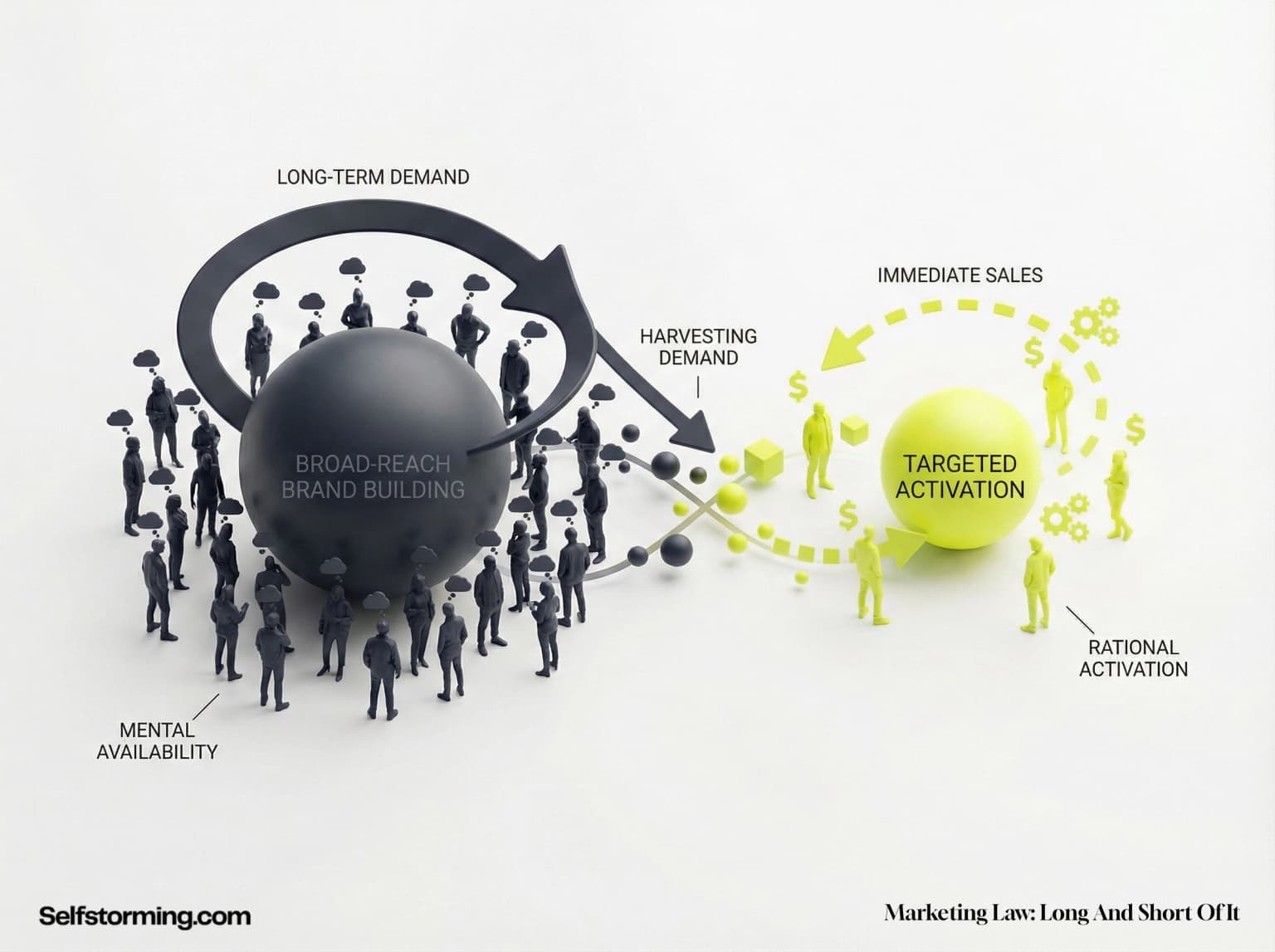
The 'Long and Short of It' is a foundational marketing principle established by Les Binet and Peter Field, asserting that brand building and sales activation serve distinct, non-interchangeable functions. Brand building (the 'Long') creates mental availability and reduces price sensitivity over years through broad-reach, emotional storytelling. Sales activation (the 'Short') converts existing demand into immediate transactions through rational, targeted, and time-bound prompts. The law posits that an over-reliance on short-term activation leads to 'brand decay,' where the base level of sales stagnates or declines because the brand is no longer being built in the minds of new category buyers. For optimal growth, the research suggests a general budget split of 60% brand building and 40% activation, though this varies by category and maturity.
LONG AND SHORT OF IT
“Sustainable commercial growth requires a dual-strategy approach where broad-reach emotional brand building creates long-term demand and mental availability, while targeted rational activation harvests that demand for immediate sales.”

Key Takeaways
- •Brand building creates long-term demand; activation harvests it for immediate sales.
- •A 60/40 budget split is the empirically proven baseline for maximum profitability.
- •Over-investing in short-term activation leads to brand decay and increased price sensitivity.
- •Emotional creative drives long-term brand effects; rational creative drives short-term activation.
- •Brand building must target the entire category, not just current 'in-market' buyers.
Genesis & Scientific Origin
The law was formally codified by Les Binet (Head of Effectiveness at adam&eveDDB) and Peter Field (Marketing Consultant) in their seminal 2013 publication, 'The Long and the Short of It: Balancing Short and Long-Term Marketing Strategies.' This research was commissioned by the Institute of Practitioners in Advertising (IPA) and utilized the IPA Databank, which contains thousands of case studies of marketing effectiveness spanning decades. Their work was a response to the increasing 'short-termism' observed in the digital age, where marketers began prioritizing immediate, measurable returns over long-term brand health. The study analyzed over 700 brands across 80 categories, making it one of the most robust empirical analyses in the history of marketing science.
“Brands that optimize for the long term are 2x more likely to report 'very large' profit growth.”
The Mechanism: How & Why It Works
The mechanism behind this law is rooted in the different psychological and statistical ways consumers respond to stimuli.
1. The Decay Rate Difference: Sales activation (e.g., a '20% off' coupon or a 'Buy Now' search ad) has a high, immediate peak but a very fast decay. Once the offer ends, sales return to the baseline almost instantly. Brand building, conversely, has a slow initial impact but a very shallow decay rate. Each brand campaign builds upon the previous one, creating a compounding 'baseline' of sales that exists even when no ads are running.
2. Mental Availability vs. Physical Prompt: Brand building works by creating 'Mental Availability'—it ensures that when a consumer enters a buying situation (the 'Category Entry Point'), your brand is the first one that comes to mind. This is achieved through emotional priming, which creates stronger, more resilient neural pathways than rational arguments. Activation works by providing a physical or digital prompt to act on an existing memory or need.
3. Price Elasticity: This is the secret weapon of the 'Long.' Effective brand building makes a brand less 'price elastic.' This means consumers are willing to pay a premium because they value the brand beyond its utility. Short-term activation, which often relies on discounts, actually increases price sensitivity, training consumers to wait for the next sale and eroding margins over time.
4. The Equilibrium Point: Binet and Field identified that if you spend too much on activation, you reach a point of diminishing returns where you've harvested all available demand. Without brand building to 're-fill the tank' with new potential customers who are aware of and biased toward your brand, your growth will plateau and eventually decline as your competitor's brand building efforts take hold.

Empirical Research & Evidence
The foundational evidence is found in the research published by the Institute of Practitioners in Advertising (Binet & Field, 2013). Their analysis of the IPA Databank revealed that campaigns focused on long-term brand building (3+ years) were significantly more likely to report major improvements in profit, share, and penetration than those focused on short-term activation. Specifically, the data showed that the '60/40 Rule'—allocating approximately 60% of the budget to brand-building and 40% to activation—maximized the probability of achieving 'very large' business effects. Furthermore, 'The Long and the Short of It: Balancing Short and Long-Term Marketing Strategies (Binet & Field, 2013)' demonstrated that emotional campaigns outperformed rational ones on every single business metric over the long term, precisely because emotional memory is more durable and reaches a broader audience of non-customers who aren't currently 'in-market.'
Real-World Example:
Adidas
Situation
For years, Adidas heavily pivoted its marketing budget toward digital 'performance' marketing (activation), with a split that reached roughly 77% performance and 23% brand. They were obsessed with attribution models that showed search and social ads were driving the most immediate revenue.
Result
While short-term sales looked healthy, the brand's overall growth began to stall. In 2019, Adidas's Global Media Director, Simon Peel, admitted they had 'over-invested' in digital performance at the expense of brand building. They discovered that their attribution models were flawed—crediting digital ads for sales that would have happened anyway because of existing brand strength. By neglecting the 'Long,' they were failing to recruit new customers into the brand funnel. They subsequently rebalanced their budget toward broad-reach, emotional brand storytelling to restore long-term growth and reduce their reliance on expensive, competitive search auctions.
Strategic Implementation Guide
Audit Your Current Split
Use your last 24 months of data to categorize every dollar spent as either 'Brand' (broad reach, emotional, no immediate CTA) or 'Activation' (targeted, rational, price/offer-led). If you're 80% activation, you're in the danger zone.
Adopt the 60/40 Baseline
Start with a 60% brand / 40% activation split as your North Star. Adjust slightly based on your category (B2B often leans 50/50, while high-consideration luxury might go 70/30).
Differentiate Creative Strategies
Stop putting 'Shop Now' buttons on your brand films. Brand creative should be emotional, story-driven, and designed for people who aren't buying today. Activation creative should be clear, rational, and focused on removing the final barrier to purchase.
Expand Your Targeting
Brand building must reach the 'whole category'—even people who won't buy for another year. Activation should be tightly targeted to 'in-market' buyers using intent data.
Change Your Measurement Windows
Do not judge brand campaigns on a 7-day or 30-day attribution window. Measure brand health via Mental Availability, Salience, and Baseline Sales over 6-12 month periods. Use activation metrics (CPA, ROAS) only for the 40% of the budget dedicated to the 'Short.'
Protect the Brand Budget During Downturns
When the economy dips, the instinct is to cut brand and double down on sales. This is a mistake. Brands that maintain their 'Long' investment during recessions gain massive market share because their competitors' mental availability shrinks.
Fix Your Attribution Models
Move away from Last-Click attribution, which inherently biases toward activation. Use Marketing Mix Modeling (MMM) to understand the true long-term contribution of brand spend to the bottom line.
Frequently Asked Questions
Can't I just do 'brand-led activation' to save money?
No. Trying to make one ad do both jobs usually results in a 'muddled middle' that fails at both. Brand building needs time and emotional resonance to sink into long-term memory; activation needs a clear, urgent prompt. When you mix them, you dilute the emotional impact and clutter the call to action. It's better to have two distinct streams of creative running simultaneously.
Does this law apply to B2B or is it just for FMCG?
It is arguably more important in B2B. Research by the LinkedIn B2B Institute (also featuring Binet and Field) suggests a 50/50 split is often optimal. Because B2B buying cycles are long and involve multiple stakeholders, building a 'brand' that is known and trusted before the RFP even starts is the only way to avoid a race to the bottom on price.
We are a startup; surely we need 100% activation to survive?
Startups often start with 100% activation to prove the model and generate cash flow, which is fine for the 'survival phase.' However, you will hit a 'performance plateau' very quickly. If you don't start shifting toward brand building once you have initial traction, your customer acquisition costs (CAC) will eventually exceed your lifetime value (LTV) because you aren't building any organic demand.
Is digital media only for the 'Short'?
Absolutely not. Video platforms (YouTube, Netflix), social media, and even high-impact display can be used for brand building if the creative is emotional and the targeting is broad. The 'Short' isn't a channel; it's a strategy. You can do brand building on TikTok and activation on TV, though some channels are naturally better suited to one or the other.
How do I explain to my CFO that I want to spend 60% of the budget on things that don't show immediate ROI?
Frame it as 'Reducing Price Elasticity' and 'Protecting Future Cash Flow.' Show them the Adidas case study or the 'S-curve' of brand growth. Explain that activation is 'harvesting' while brand is 'planting.' If you only harvest, you eventually run out of crops. Brand building is an investment in the business's ability to maintain margins and reduce future CAC.
Sources & Further Reading
Related Marketing Laws
60/40 Rule (Contextual)
Long-term brand investment typically outperforms short-term activation alone.
Short-Term ROI Bias
Short-term metrics undervalue long-term brand effects.
Brand Effects Compound
Long-term brand investment creates compounding returns over time.
Maintain Investment in Downturn
Brands that don't cut during recession grow faster after.