Short-Term ROI Bias

Short-term ROI is a long-term trap.

Look, I get it. Your ROAS looks like a vertical line and your CFO is actually smiling for once. But while you’re busy high-fiving over last-click attribution, your brand is quietly suffocating in the background. You’ve mistaken 'efficiency' for 'growth,' and you’re about to hit a performance plateau so hard it’ll leave a mark on your career. You aren't building a business; you're running a digital garage sale, and eventually, you’re going to run out of people to yell at.
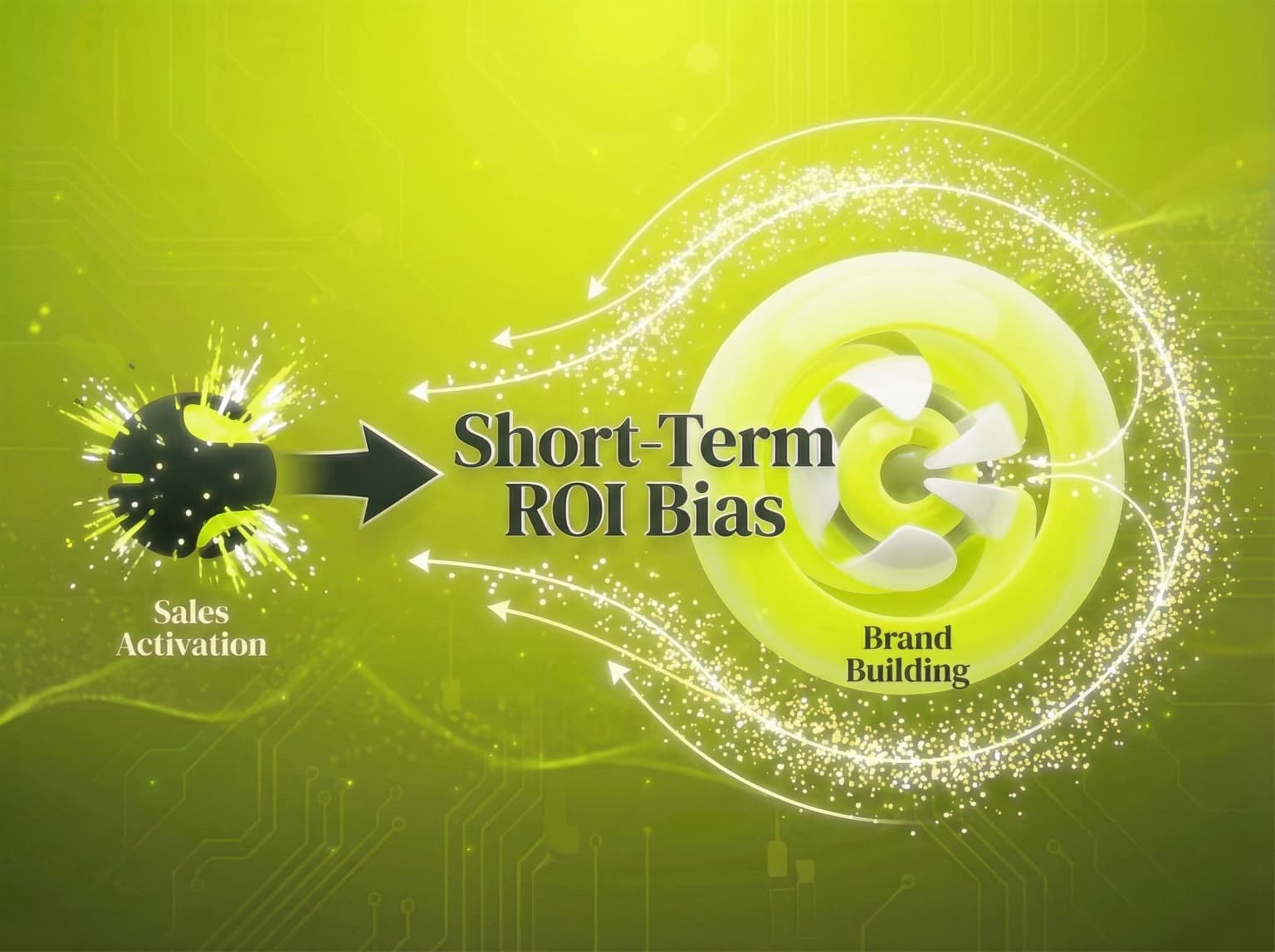
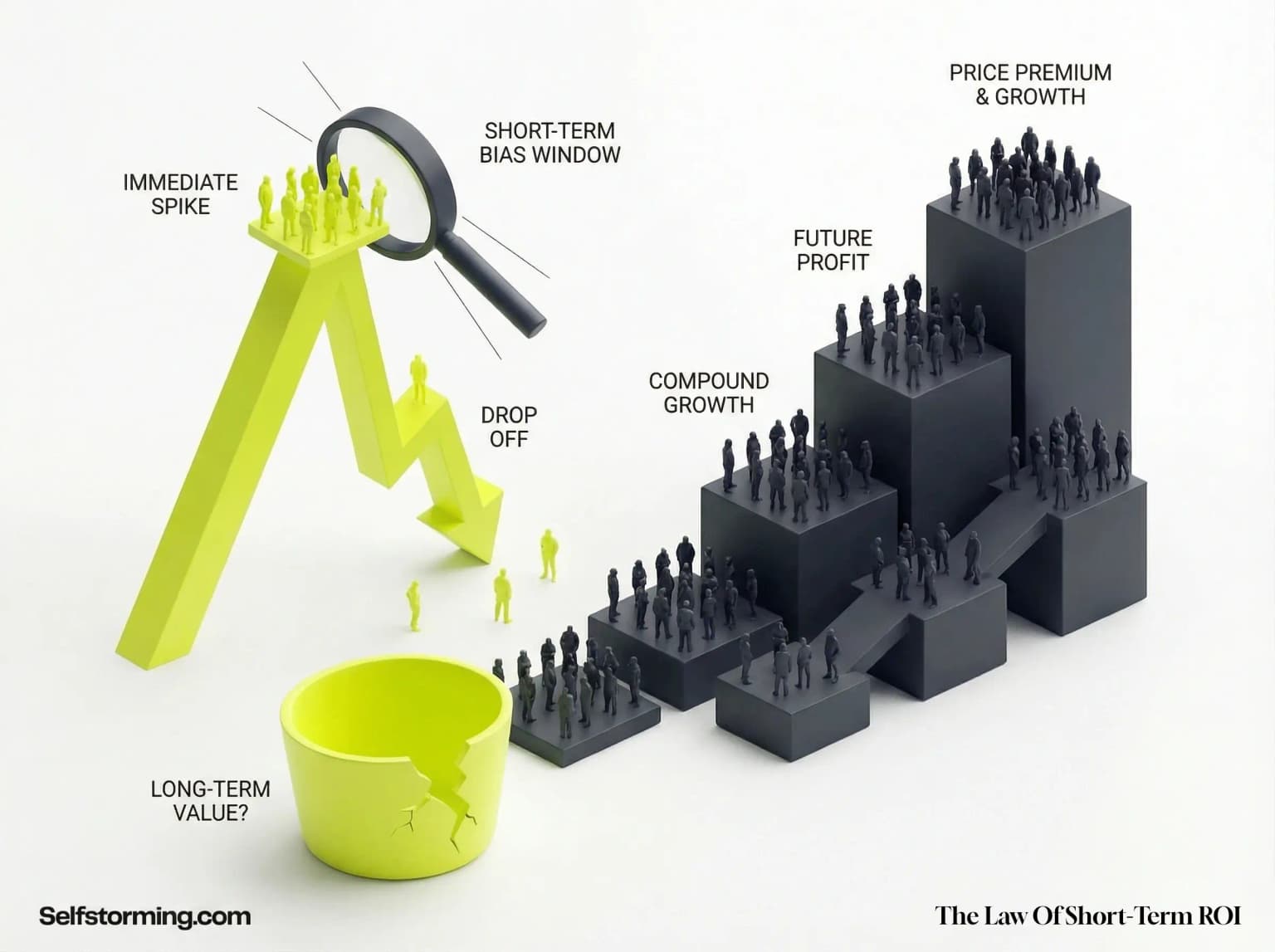
Short-Term ROI Bias is the systematic tendency for marketers to over-invest in immediate sales activation tactics because they are easier to measure, while under-investing in long-term brand building which generates the majority of future profit. This bias stems from reliance on short-term attribution windows (7-30 days) and financial reporting cycles that favor immediate returns. Marketing science, led by Binet and Field, proves that brand-building effects decay slowly and compound over time, whereas activation effects provide a sharp spike followed by an immediate drop. Over-reliance on short-term metrics leads to a 'performance trap' where a brand loses its ability to command a price premium and fails to recruit new category buyers, ultimately resulting in stagnant or declining market share despite high 'efficiency' scores.

SHORT-TERM ROI BIAS

Marketing measurement systems frequently undervalue long-term brand effects because the temporal lag between brand exposure and behavioral response exceeds standard reporting windows, leading to a misallocation of resources toward immediate sales activation.

Short-Term ROI Bias marketing law: Short-term ROI is a long-term trap. - Visual illustration showing key concepts and examples

Key Takeaways

  • Short-term ROI is a measure of efficiency, not a strategy for long-term growth.
  • Attribution models are biased toward activation because they ignore the long-term decay of brand.
  • Brand building creates future demand; activation harvests existing demand. You need both.
  • The 60/40 budget split is the empirically proven sweet spot for most brands.
  • Relying on short-term metrics leads to price erosion and a performance growth plateau.
  • Brand effects take 6+ months to manifest but offer compounding returns over time.

Genesis & Scientific Origin

The formal conceptualization of Short-Term ROI Bias emerged from the longitudinal analysis of the Institute of Practitioners in Advertising (IPA) Effectiveness Awards database. While the tension between short-term and long-term marketing has been discussed for decades, it was the seminal work of Les Binet and Peter Field that provided the empirical foundation for this law. Their 2013 publication, 'The Long and the Short of It: Balancing Short and Long-Term Marketing Investment,' published by the IPA, analyzed nearly 1,000 campaigns over 30 years. They identified a growing trend toward 'short-termism'—a focus on immediate sales spikes at the expense of long-term brand health. This research was further refined in 'Effectiveness in Context' (2018), which highlighted how digital platforms and real-time data have exacerbated the bias by providing a constant feedback loop of short-term metrics that trick marketers into believing they are more successful than they actually are. The bias is now recognized by leading institutions like the Ehrenberg-Bass Institute and WARC as one of the primary threats to modern brand sustainability.

Brand-building campaigns are 2.5 times more likely to drive large profit growth than activation-only campaigns. (Binet & Field, 2013)

The Mechanism: How & Why It Works

To understand why Short-Term ROI Bias is so dangerous, we have to look at the mathematical divergence between Sales Activation and Brand Building.

1. The Decay Rate Discrepancy: Sales activation (search ads, discounts, 'buy now' social ads) works like a drug. It targets people already in the market—the 5% of consumers ready to buy today. The effect is immediate and the ROI looks spectacular because the denominator (time) is small. However, the effect decays almost the moment the ad stops. Brand building (emotional storytelling, fame-based creative) works on the 95% of consumers not currently in the market. It builds memory structures that influence future purchases. These effects decay much more slowly, creating a 'floor' of base sales that grows over time.

2. The ROI Paradox: ROI is a ratio: (Revenue - Cost) / Cost. Because brand building requires broad reach and high-quality creative, the 'Cost' is high and the 'Return' is delayed. In a 3-month window, the ROI of brand building will always look lower than activation. If you optimize for the highest ROI in the short term, you will naturally cut brand spending. However, this is a race to the bottom. Without brand building to create new demand, your activation tactics become more expensive as you fight harder for a shrinking pool of existing demand.

3. Attribution Blindness: Most digital attribution models (Last Click, Linear, U-Shaped) only look at a 7-day to 30-day window. They are physically incapable of seeing the 18-month influence of a brand film that made a consumer feel a certain way about a car or a software suite. The model attributes the sale to the final click, ignoring the years of mental availability that made the consumer click in the first place.

4. The Price Premium Erosion: Brand building allows you to charge more. Activation (often tied to promotions) trains consumers to wait for a deal. Short-term ROI bias shifts the strategy toward volume-based growth through discounting, which erodes margins and destroys the brand's long-term ability to command a price premium.

Short-Term ROI Bias mechanism diagram - How Short-Term ROI Bias works in consumer behavior and marketing strategy

Empirical Research & Evidence

The most definitive evidence for Short-Term ROI Bias is found in the research published in the IPA (Binet & Field, 2013) titled 'The Long and the Short of It'. Their analysis of the IPA Databank showed that while short-term activation campaigns (measured over 6 months or less) could produce high sales spikes, they were significantly less effective at driving long-term market share growth and profit. Specifically, the data revealed that campaigns focused on 'Brand Building' were 2.5 times more likely to report 'very large' profit growth over a 3-year period compared to those focused purely on 'Activation'. Furthermore, the research established that the 'optimal' balance for maximum effectiveness is roughly a 60/40 split—60% of the budget dedicated to long-term brand building and 40% to short-term activation. A separate study, 'Effectiveness in Context (Field & Binet, 2018)', demonstrated that in the digital age, the bias toward short-termism has actually reduced the overall effectiveness of marketing by approximately 20% compared to the pre-digital era, as brands have shifted too far toward activation.

Real-World Example:
Adidas

Situation

In 2019, Adidas made a public admission that they had fallen victim to Short-Term ROI Bias. For years, the sportswear giant had heavily over-invested in digital performance marketing and sales activation, driven by short-term attribution models that suggested digital was their most 'efficient' channel. They focused on 'efficiency' (CPA and ROAS) rather than 'effectiveness' (market share and brand health). They were spending 77% of their budget on performance and only 23% on brand.

Result

The result was a performance plateau. While their ROAS looked excellent on paper, their overall growth slowed. They realized that their performance ads were only reaching people who were already going to buy, while they were failing to recruit the next generation of buyers. Upon re-evaluating their data using econometrics (MMM) rather than last-click attribution, they discovered that brand building was actually driving 65% of their sales across all channels. Adidas subsequently pivoted back to a more balanced 60/40 investment strategy, reinvesting in top-of-funnel brand storytelling to fuel long-term growth.

Strategic Implementation Guide

1

Step 1

Stop looking at Last-Click Attribution for strategic planning. It's a measurement of credit, not causality. Use it for tactical tweaks, not budget allocation.

2

Step 2

Adopt Econometrics (Market Mix Modeling). MMM is the only way to see the 'unseen' effects of brand building and how they interact with activation over 12-24 months.

3

Step 3

Implement the 60/40 Rule as a baseline. Start with 60% of your budget in broad-reach, emotional brand building and 40% in targeted activation. Adjust based on your category's digital maturity.

4

Step 4

Measure 'Base Sales' vs. 'Incremental Sales'. Your goal is to grow the base sales—the sales you get when you aren't running a promotion or a heavy ad flight. That is the true measure of brand strength.

5

Step 5

Differentiate your KPIs. Brand campaigns should be measured on Reach, Mental Availability, and Fame. Activation campaigns should be measured on Conversion, CPA, and ROAS. Do not judge a brand ad by a conversion metric.

6

Step 6

Extend your reporting window. If you only report monthly or quarterly, you are biologically wired to favor short-termism. Create a 'Long-Term Effectiveness' report that looks at rolling 12-month and 24-month trends.

7

Step 7

Educate your CFO. Explain that brand building is a capital investment in future cash flow, while activation is an operating expense for today's revenue. Use the Adidas example to show how efficiency can kill growth.

Frequently Asked Questions

Does this mean I should stop doing performance marketing entirely?

Absolutely not. That’s like saying you should stop breathing because you need to eat. Activation is vital for harvesting the demand that brand building creates. Without activation, you’re leaving money on the table. The problem isn’t performance marketing; the problem is doing *only* performance marketing and expecting it to build a brand. You need both to work in tandem.

My ROAS is 10x. Why would I change anything?

Because a 10x ROAS usually means you’re just shouting at people who were already standing in line to buy. It’s a measure of efficiency, not growth. If you keep optimizing for ROAS, you will eventually find the 'perfect' audience of 10 people who love you, and your business will never grow beyond them. You’re trading scale for a pretty number on a spreadsheet.

Can't I build a brand through performance ads?

Rarely. Performance ads are usually rational, high-friction, and 'click-heavy.' Brand building requires emotional resonance and low-friction exposure to build long-term memory. If your ad says 'Buy Now' or '20% Off,' it’s activation. It’s not building a 'feeling' or a 'memory' that lasts until the next purchase cycle.

How do I explain this to a boss who only cares about this month's targets?

Show them the 'Performance Plateau.' Map your spend against your growth over the last 2 years. If your spend is going up but your market share is flat despite a high ROAS, you’ve hit the limit of activation. Explain that you are currently 'mining' your brand equity and eventually the mine will run dry unless you start 'planting' new demand.

Does the 60/40 rule apply to B2B or small startups?

The ratio might shift, but the principle doesn't. In B2B, the 'Long' might actually be more important because purchase cycles are longer. For a tiny startup, you might need more activation (say 50/50) to keep the lights on, but the moment you stop brand building, you become a commodity that can be easily replaced by a cheaper competitor.

We use cookies on our site to enhance your user experience, provide personalized content, and analyze our traffic. Cookie Policy