60/40 Rule (Contextual)

The golden ratio for brand growth.

You’re currently strangling your brand with a spreadsheet, and honestly, it’s painful to watch. You’ve spent the last eight quarters chasing 'performance' like a desperate gambler at a 2 AM slot machine, wondering why your CAC is climbing while your market share stays flatter than a lukewarm beer. Here’s the reality: your obsession with immediate ROI is a statistical suicide note. The 60/40 Rule isn't a friendly suggestion from some ivory tower academic; it’s the cold, hard physics of how money actually works in the real world. Stop looking for 'hacks' and start building a brand before there’s nothing left to activate but your own bankruptcy filing.

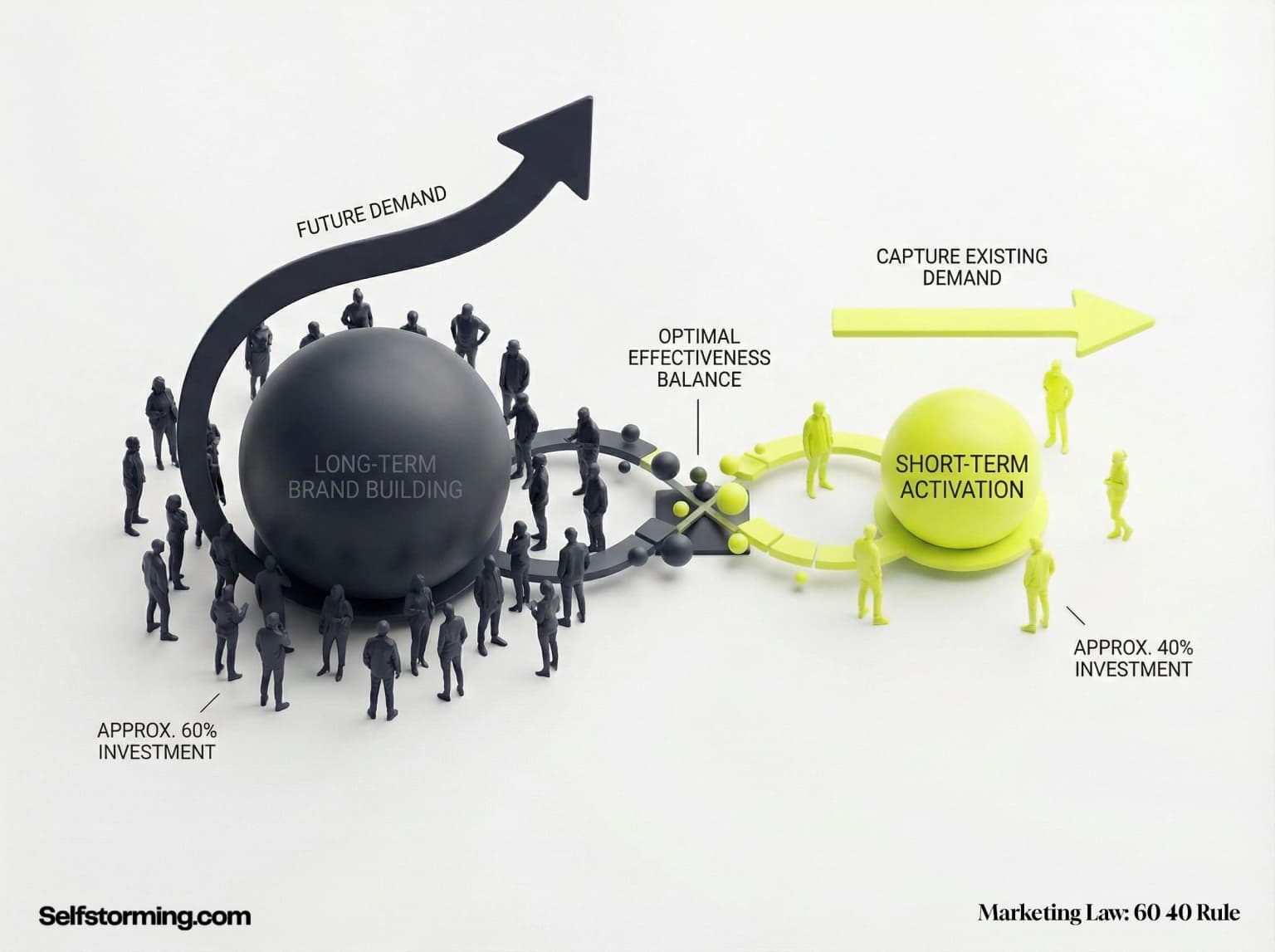
The 60/40 Rule is the gold standard for marketing effectiveness, established through decades of empirical data. It posits that for optimal, sustainable growth, a brand should typically allocate roughly 60% of its budget to long-term brand-building (emotional, broad-reach, memory-building) and 40% to short-term sales activation (rational, targeted, direct-response). While activation drives immediate spikes, its effects decay almost instantly. Brand building, conversely, creates 'mental availability' that compounds over time, reducing price sensitivity and ensuring future sales. This ratio is 'contextual'—it fluctuates based on category, brand maturity, and digital penetration—but the fundamental tension remains: over-investing in the short term leads to 'activation sensitivity,' where the brand only sells when it's on sale, eventually eroding margins and long-term viability.

60/40 RULE (CONTEXTUAL)

Optimal marketing effectiveness is achieved by balancing investment such that approximately 60% of resources are dedicated to long-term brand-building activities that create future demand, while 40% are allocated to short-term activation tactics that capture existing demand.

60/40 Rule (Contextual) marketing law: The golden ratio for brand growth. - Visual illustration showing key concepts and examples

Key Takeaways

  • Brand building creates future demand; activation harvests current demand.
  • The 60/40 split is the empirical 'sweet spot' for long-term profit growth.
  • Activation effects are immediate but decay quickly; brand effects compound over time.
  • Over-investing in the short term leads to 'activation sensitivity' and margin erosion.
  • Emotional, broad-reach creative is essential for the 60% brand-building portion.

Genesis & Scientific Origin

The 60/40 Rule was pioneered by researchers Les Binet and Peter Field, often referred to as the 'Godfathers of Marketing Effectiveness.' Their work is primarily based on the analysis of the Institute of Practitioners in Advertising (IPA) Databank, which contains over 30 years of detailed case studies on marketing campaigns. The rule was most famously articulated in their seminal 2013 report, 'The Long and the Short of It: Balancing Short and Long-Term Marketing Strategies.' This research was commissioned by the IPA to investigate the growing trend of short-termism in the marketing industry. Binet and Field analyzed nearly 1,000 campaigns across 700 brands in 80 categories, identifying a clear divergence between strategies that drive immediate sales and those that drive long-term profit and market share growth. Their subsequent work, including 'Media in Focus' (2017) and 'Effectiveness in Context' (2018), further refined these findings, acknowledging that while the 60/40 split is a robust average, the 'ideal' ratio can shift depending on the business environment (e.g., B2B vs. B2C, online vs. offline retail).

Campaigns optimized for long-term profit growth allocate an average of 62% to brand building. (Binet & Field, 2013)

The Mechanism: How & Why It Works

To understand why the 60/40 Rule works, one must understand the distinct mechanics of 'Brand Building' versus 'Sales Activation.' Brand building works by creating mental structures—associations and memories—that increase the probability of a brand being thought of in a buying situation (Mental Availability). This process is slow, relies heavily on emotional resonance, and requires broad reach to influence future buyers who aren't in the market today. Mathematically, brand effects follow a compounding S-curve; they start slowly but build momentum, eventually creating a 'floor' of base sales that do not rely on promotions. Sales activation, however, is designed to 'harvest' existing demand. It uses rational triggers (discounts, 'buy now' buttons, limited-time offers) to convert people who are currently in the market. Activation effects are immediate and often show high ROI on paper, but they have a rapid decay rate. Once the promotion ends, sales return to the baseline. The 'Activation Trap' occurs when a brand over-invests in the short term: because activation doesn't build long-term memory, the brand becomes 'activation sensitive.' You end up needing more and more 'hits' of activation to achieve the same sales volume, leading to a 'hamster wheel' effect where profit margins are eaten by rising CAC and constant discounting. The 60/40 split represents the equilibrium point where the compounding growth of the brand 'long' curve provides enough momentum to make the 'short' activation spikes more efficient and profitable. Furthermore, brand building reduces price sensitivity; people are willing to pay a premium for brands they feel an emotional connection to, whereas activation often trains people to wait for a deal.

60/40 Rule (Contextual) mechanism diagram - How 60/40 Rule (Contextual) works in consumer behavior and marketing strategy

Empirical Research & Evidence

The most definitive evidence for this law is found in the IPA's research publication 'The Long and the Short of It: Balancing Short and Long-Term Marketing Strategies' (Binet & Field, 2013). The researchers analyzed 996 campaigns from the IPA Databank and found that campaigns focusing primarily on brand-building (long-term) were significantly more likely to report very large effects on profit, market share, and price elasticity than those focused on activation (short-term). Specifically, they found that the most effective campaigns—those that achieved the highest levels of long-term profit growth—had an average budget split of 62% brand and 38% activation. Furthermore, Field and Binet's (2017) research published in 'Media in Focus' demonstrated that in the digital age, the ratio has actually shifted slightly higher toward brand (approx. 65/35) for some categories, because the extreme efficiency of digital activation means you need less spend to capture demand, but more spend to counteract the 'noise' and build a brand that people actually search for by name.

Real-World Example:
Adidas

Situation

In 2019, Adidas's Global Media Director, Simon Peel, publicly admitted that the company had over-invested in digital performance marketing (short-term activation) at the expense of brand building. They were focused on 'efficiency' (ROI/ROAS) rather than 'effectiveness.' They believed that 77% of their sales were driven by performance marketing because that's what their attribution models showed.

Result

After conducting deep econometric modeling, Adidas discovered that 65% of their sales were actually driven by brand activity, not the performance ads they were pouring money into. Their over-reliance on short-term digital tactics led to a 'plateau' in growth and declining brand health. By pivoting back toward the 60/40 principle—reinvesting in broad-reach, emotional storytelling—they were able to revitalize their long-term growth trajectory and reduce their dependency on expensive, bottom-of-the-funnel performance channels.

Strategic Implementation Guide

1

Audit Your Current Split

Stop lying to yourself. Calculate your actual spend on 'Brand' (broad reach, emotional, no CTA) vs. 'Activation' (targeted, rational, direct CTA). Most digital-native brands are at 20/80; if you're there, acknowledge you're in the danger zone.

2

Separate Your KPIs

Do not judge brand campaigns by activation metrics (CPA, ROAS). Brand building should be measured by Mental Availability, Share of Search, and Unprompted Awareness over 6-12 month windows.

3

Embrace Broad Reach

Brand building requires talking to people who aren't buying today. Stop hyper-targeting. If you only talk to 'in-market' buyers, you aren't building a brand; you're just fighting for the scraps of existing demand.

4

Fix the Creative Balance

Brand ads need to be emotional and distinctive to build long-term memory. Activation ads should be simple, clear, and easy to act upon. Do not try to make one ad do both jobs; it will fail at both.

5

Adjust for Category Context

If you're B2B, your ratio might be closer to 50/50 because the 'short term' sales cycle is longer. If you're a high-frequency FMCG brand, you might need 70/30. Use 60/40 as the starting point, not a suicide pact.

6

Resist the 'ROI Trap'

Short-term ROI is a measure of efficiency, not growth. High ROI often indicates you are under-investing. Accept lower immediate ROI on brand spend to secure higher total profit in the long run.

7

Educate the C-Suite

Use the 'Long and Short' charts to show your CFO why the performance 'sugar high' is leading to long-term margin erosion. If they only care about this quarter, show them the rising CAC trends.

Frequently Asked Questions

Does the 60/40 Rule still apply in the age of TikTok and instant commerce?

Yes, and arguably more than ever. Digital platforms have made activation incredibly cheap and easy, which means everyone is doing it. This creates a 'sea of sameness.' In a world of frictionless buying, the only thing that protects your margins is the brand preference created in the 60% of your budget. If you don't build a brand, you're just a commodity at the mercy of an algorithm's CPC.

I'm a startup with zero budget; how can I afford 60% brand investment?

Startups often have to over-index on activation to survive the first year—that's the reality of cash flow. However, the 60/40 Rule is the 'growth' formula. If you stay at 90/10 activation, you will eventually hit a growth ceiling where your CAC equals your LTV. You must transition toward 60/40 as soon as you have 'product-market fit' if you want to become a category leader.

Can't I just do 'Brand-led Activation' or 'Performance Branding'?

This is a common myth used to sell agencies' services. While creative can have elements of both, the psychological mechanisms are different. Brand building requires repetition and emotional priming over time. Activation requires a 'nudge' to act now. Trying to blend them usually results in a 'mushy middle' ad that isn't emotional enough to remember and isn't clear enough to convert.

How do I know if my specific ratio should be 50/50 or 70/30?

Context matters. Binet and Field's research shows that brands with high 'online' sales components often need a higher brand ratio (up to 70%) because digital competition is more intense. B2B brands often sit closer to 50/50. If you have high brand loyalty/subscription, you might lean more into activation to keep the churn low, but generally, the further you are from a commodity, the more you need brand investment.

What happens if I ignore the 60/40 rule and stick to 100% performance?

You will see great ROI for about 6-12 months. Then, your 'base sales' will start to decline. You'll notice that to keep sales flat, you have to increase your ad spend. Your brand will become 'invisible' to anyone not currently looking to buy, and you'll eventually be disrupted by a competitor who actually built a relationship with the audience.

We use cookies on our site to enhance your user experience, provide personalized content, and analyze our traffic. Cookie Policy