Brand Effects Compound
Brand effects build over time.
Look, if you’re still chasing the dopamine hit of a 4:1 ROAS on a Tuesday morning while your brand awareness is flatlining, you’re not a marketer; you’re an addict. You’re burning the furniture to keep the house warm. Brand effects aren't a 'nice to have' for when the budget is flush; they are the literal compounding interest of the marketing world. Stop treating your brand like a vending machine and start treating it like an asset. This isn't fluff—it's math. If you can't see past the next fiscal quarter, you’re just managing a slow-motion car crash. Let’s look at the data before you bankrupt the company.
The Brand Effects Compound principle dictates that marketing investment should be viewed as a capital expenditure rather than a transactional cost. While short-term 'activation' marketing (search ads, promotions, direct response) delivers immediate, transient spikes in sales that quickly decay to baseline, brand-building activities (emotional storytelling, broad reach, creative consistency) create durable memory structures. These structures accumulate over time, gradually lifting the 'base' sales—the sales that happen without any immediate promotional pressure. This compounding effect means that the efficiency of every marketing dollar spent increases over years, not weeks. Brands that over-index on short-termism suffer from 'activation sensitivity,' where they must spend more each year just to maintain static volume, whereas brand-builders enjoy widening margins and lower customer acquisition costs as the brand becomes the 'default' mental choice for the category.
BRAND EFFECTS COMPOUND
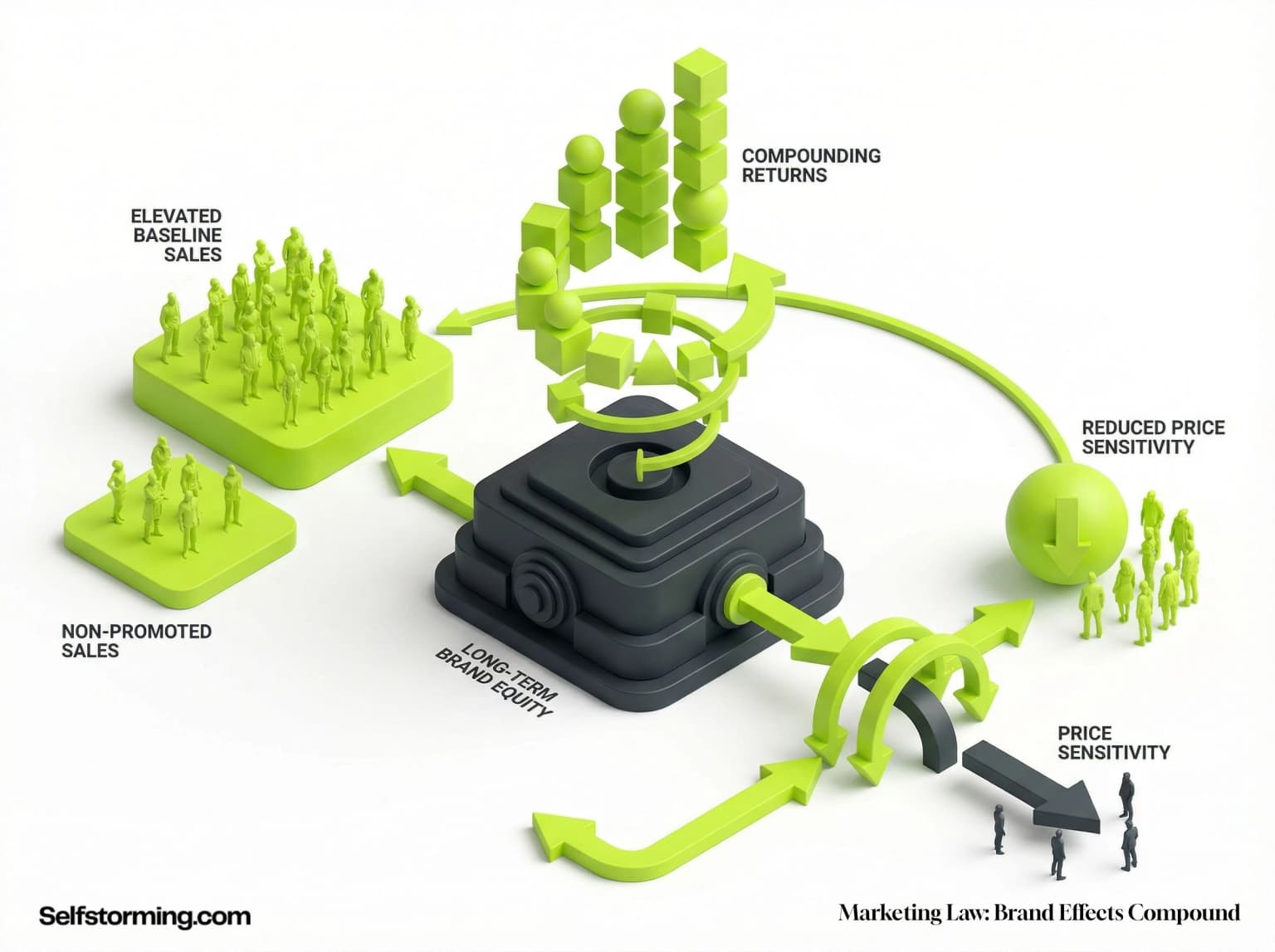
“Long-term brand equity functions as a capital asset that generates cumulative, compounding returns by elevating the baseline of non-promoted sales and reducing price sensitivity across the total market.”

Key Takeaways
- •Brand building is a capital investment, not a short-term transactional cost.
- •Activation delivers immediate spikes; brand building creates a rising sales baseline.
- •Compounding requires 2-3 years of creative consistency to manifest in profit.
- •The 60/40 rule is the empirical 'Goldilocks' zone for sustainable growth.
- •Emotional messaging creates durable memory structures that drive compounding returns.
Genesis & Scientific Origin
The empirical foundation of the Brand Effects Compound was solidified by Les Binet and Peter Field through their extensive analysis of the IPA (Institute of Practitioners in Advertising) Databank. Their seminal work, 'The Long and Short of It' (2013), examined nearly 1,000 award-winning campaigns over 30 years. They identified a distinct divergence between short-term 'activation' effects and long-term 'brand' effects. While activation produces quick volume, it does not build the 'brand equity' necessary for long-term growth. The compounding nature of brand effects was further supported by the Ehrenberg-Bass Institute for Marketing Science, specifically the work of Byron Sharp and Jenni Romaniuk, who linked long-term growth to the continuous building of mental and physical availability.
“Brand-building campaigns are 14 times more likely to drive large profit gains than activation-only campaigns over a 3-year period (IPA).”
The Mechanism: How & Why It Works
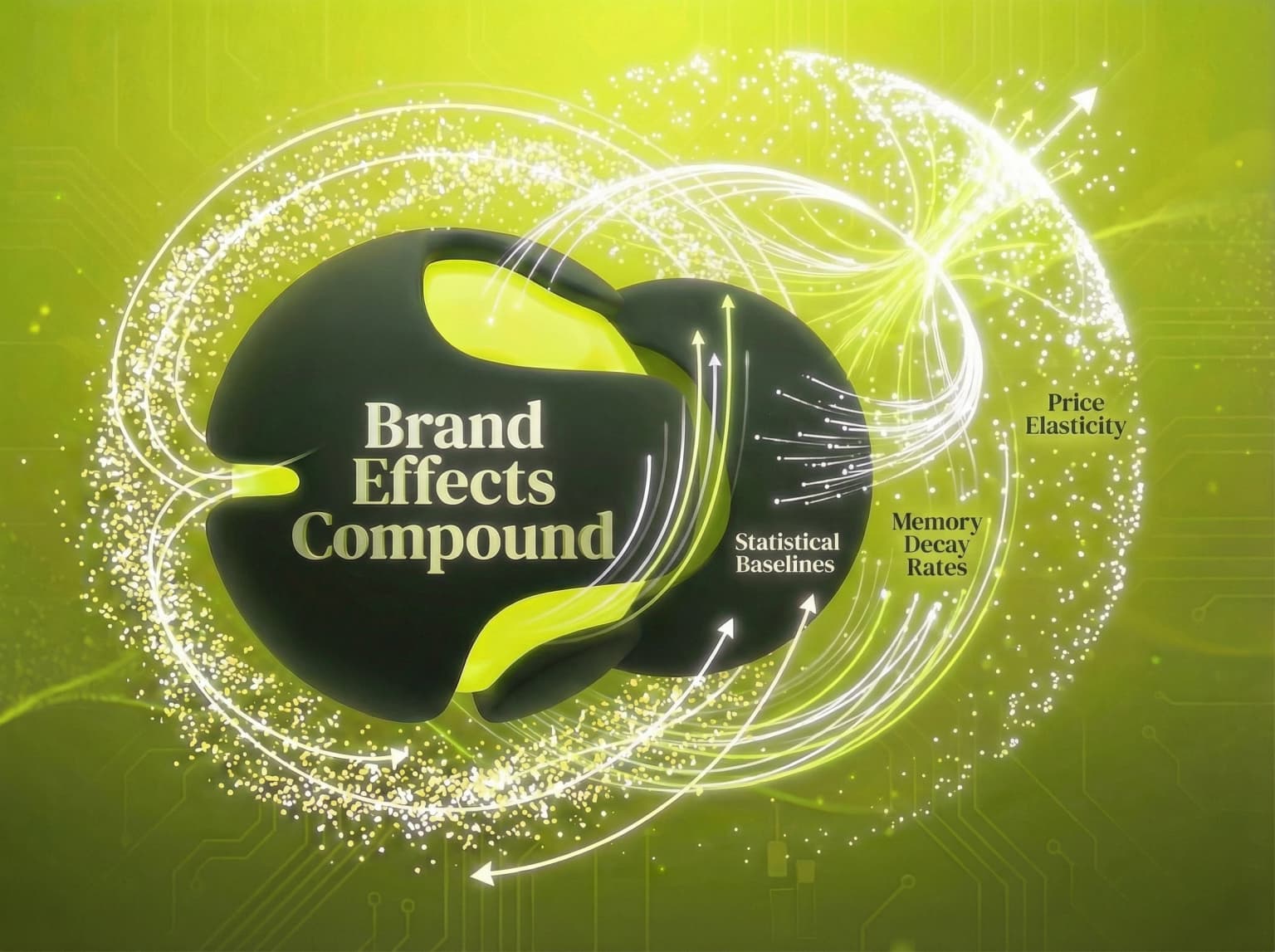
The mechanism of compounding brand effects operates through three primary structural layers: Statistical Baselines, Memory Decay Rates, and Price Elasticity.
1. The Rising Baseline: Every marketing activity has a decay rate. Short-term activations (e.g., a 20% off coupon) have a near-vertical decay; once the offer ends, sales return to the previous level. Brand building, however, targets the 'non-buyers' and 'light buyers' through emotional priming. This creates memory structures that do not decay instantly. When these efforts are repeated, the 'decay' of the previous campaign hasn't finished before the next one starts, leading to a 'step-up' effect in base sales. Over 3-5 years, this rising baseline becomes the primary driver of volume, making the brand less dependent on expensive 'buy-now' tactics.
2. Mental Availability and Heuristics: Compounding occurs because the human brain uses 'fluency'—the ease with which a brand comes to mind—as a proxy for quality and safety. As a brand consistently invests in distinctive assets (logos, colors, characters) and emotional narratives, it occupies more 'nodes' in the consumer's associative memory. This creates a 'winner-takes-most' dynamic. The more a brand is thought of, the more it is bought; the more it is bought, the more it is thought of. This is the 'Double Jeopardy' law in action, fueled by the compounding nature of memory.
3. The Price Premium Compound: Perhaps the most vital mechanism is the reduction of price sensitivity. Short-term activation (discounts) teaches consumers to wait for a deal, effectively training them to be price-sensitive. Long-term brand building increases the 'willingness to pay' by reducing the perceived risk of the purchase. As brand strength compounds, the company can maintain or increase prices without a corresponding drop in volume, leading to exponential growth in profitability that activation-only brands can never achieve.

Empirical Research & Evidence
The most definitive evidence comes from the 'The Long and Short of It: Balancing Short and Long-Term Marketing Strategies' (Binet & Field, 2013). Their research published by the IPA (Institute of Practitioners in Advertising) demonstrated that while short-term activation effects are easy to measure and produce immediate ROI, they do not contribute to long-term growth. Specifically, they found that the 'optimum' balance for compounding growth is approximately 60% brand building and 40% activation. Campaigns that followed this '60/40 Rule' saw significantly higher levels of 'very large' business effects (profit, share, penetration) compared to those focused purely on short-term metrics. Crucially, the data showed that brand effects typically take 6 to 12 months to surpass the volume generated by activation, but once they do, the rate of growth is significantly steeper and more sustainable.
Real-World Example:
O2 (Telecommunications)
Situation
In the early 2000s, the UK mobile market was a commodity bloodbath. Competitors were obsessed with handset subsidies and 'minutes' packages—pure short-term activation. O2 (formerly BT Cellnet) pivoted to a long-term brand strategy centered on the 'O2' blue bubbles and the 'See what you can do' emotional platform.
Result
By consistently investing in brand-building (sponsorship of the O2 Arena, emotional creative) while maintaining a 60/40 balance, O2 didn't just gain share; they created a compounding effect in loyalty and price premium. While competitors saw high churn and falling ARPU (Average Revenue Per User), O2 maintained the lowest churn in the industry for over a decade. The compounding brand equity allowed them to charge more for the same 'minutes' as their rivals because the brand had become a durable mental shortcut for 'reliability' and 'cool,' resulting in billions in incremental value compared to a discount-led strategy.
Strategic Implementation Guide
Adopt the 60/40 Budget Split
Allocate 60% of your budget to broad-reach, emotional brand building and 40% to direct sales activation. This ensures you are harvesting existing demand while simultaneously planting the seeds for future demand.
Prioritize Reach Over Targeting
Brand compounding requires reaching 'all buyers in the category,' including those who won't buy today. Hyper-targeting 'in-market' buyers only captures the short-term spike and fails to build the long-term baseline.
Invest in Distinctive Assets
Choose 2-3 visual or auditory cues (colors, shapes, sounds) and use them relentlessly for years. Compounding requires memory consistency; if you change your 'look and feel' every year, you are resetting your compound interest to zero.
Measure 'Base Sales' Trends
Stop looking at 'Last-Click ROI' as your primary metric. Instead, track your 'Base Sales' (sales achieved without promotions) over a 24-month rolling window. If this line isn't moving up, your brand isn't compounding.
Use Emotional Priming
Activation ads should be rational and urgent, but brand ads must be emotional. Emotions are the 'glue' that makes memories stick in the brain for the long term, allowing the compounding effect to take hold.
Resist the 'New CMO' Syndrome
The greatest enemy of compounding is the desire to 'make a mark' by changing strategy. Every time you change the brand platform, you abandon the accumulated memory structures of your audience.
Frequently Asked Questions
Can I start brand building after I've scaled my performance marketing?
You can, but it’s much more expensive. If you wait until performance marketing hits a ceiling (where CAC exceeds LTV), you're starting from a position of weakness. Compounding works best when started early; the longer you delay brand investment, the more 'activation-dependent' your business becomes, leading to a margin-crushing addiction to discounts.
Does the 60/40 rule apply to B2B or small startups?
The ratio might shift slightly (B2B often leans closer to 50/50 or even 70/30 depending on the category), but the principle is identical. Small startups often ignore brand because they need cash flow, but without brand investment, they eventually hit a 'growth wall' where the cost of acquiring the next customer is higher than the profit they generate.
How do I explain 'compounding effects' to a CFO obsessed with weekly ROI?
Stop talking about 'brand' and start talking about 'Price Elasticity' and 'Base Sales.' Show them the decay curves of your search ads versus the steady growth of non-attributed organic traffic. Explain that brand building is a capital investment in 'future demand' that reduces the future cost of sales.
Does 'Brand' mean I can't have a Call to Action (CTA)?
Not at all, but the CTA isn't the hero. In a brand-building ad, the 'hero' is the emotional connection or the distinctive asset. The CTA is just a courtesy. If the ad is 90% 'Buy Now' and 10% brand, it won't compound. It’s a transaction, not a memory.
How long does it actually take to see the compounding effect?
The 'crossover point' where brand effects begin to outperform activation is typically between 6 and 12 months. However, the true compounding 'hockey stick' usually requires 2-3 years of consistent investment without a major change in strategy.
Sources & Further Reading
Related Marketing Laws
Long and Short of It
Brand building and activation do different jobs and require different strategies.
60/40 Rule (Contextual)
Long-term brand investment typically outperforms short-term activation alone.
Short-Term ROI Bias
Short-term metrics undervalue long-term brand effects.
Maintain Investment in Downturn
Brands that don't cut during recession grow faster after.