Double Jeopardy Law
Small brands suffer twice.
I get it. You spent half your budget on a shiny rewards app because some overpaid consultant told you it's cheaper to keep a customer than find a new one. Newsflash: that consultant lied, and your data is laughing at you behind your back. The Double Jeopardy Law is the marketing equivalent of gravity - it doesn't care about your feelings, your brand love manifestos, or your fancy CRM. Big brands don't just have more customers; they have slightly more loyal ones too. You can't fix loyalty without fixing size first. Stop trying to date your customers and start trying to meet more of them, or you’ll just be the most loved brand on the way to the graveyard of bankrupt startups.
DOUBLE JEOPARDY LAW
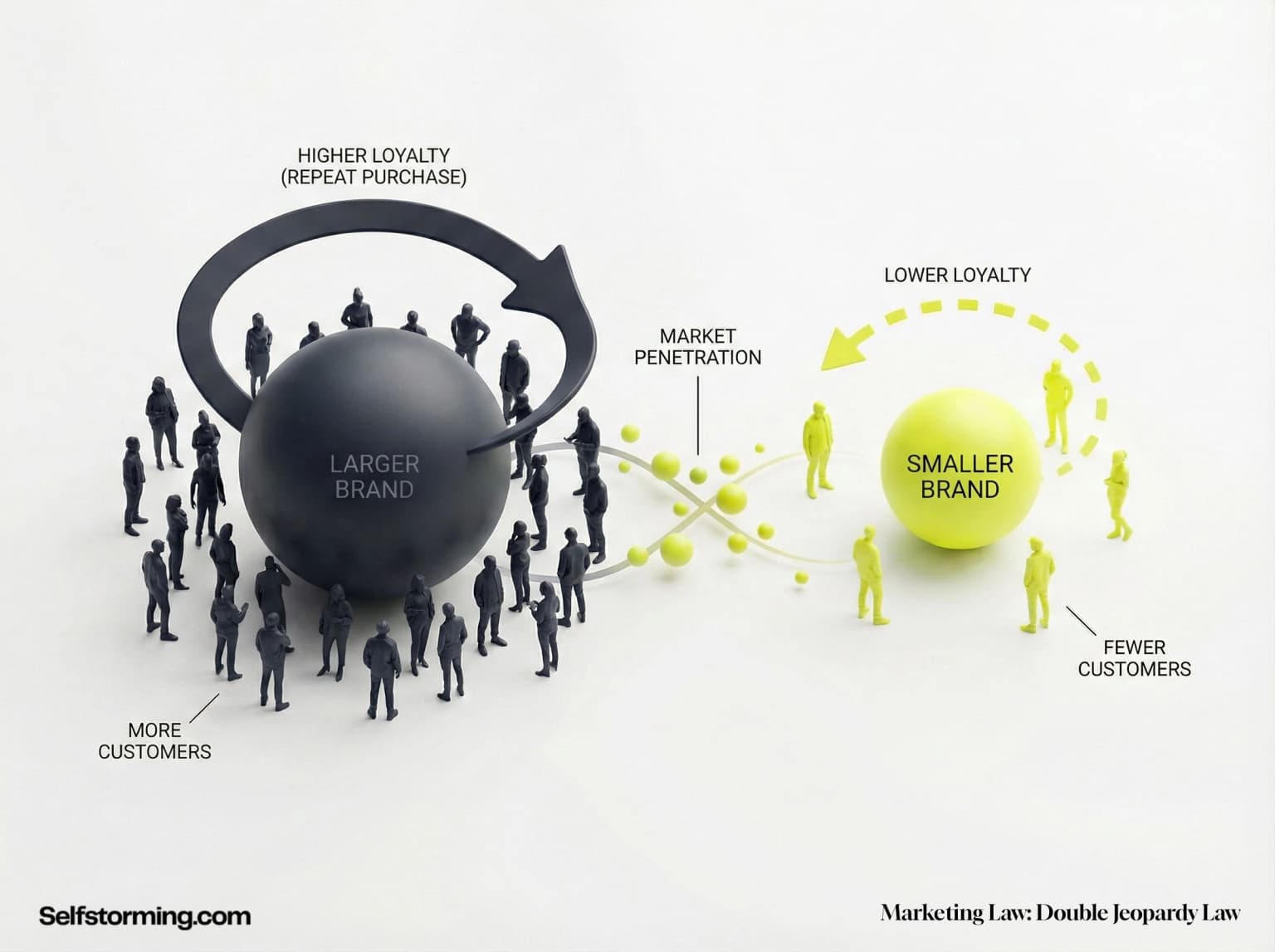
“Small brands get hit twice: they have fewer buyers, and those buyers also purchase less often. Big brands win on both counts.”
The Double Jeopardy Law is a structural phenomenon in marketing science stating that brands with lower market share suffer twice: first, by having fewer buyers (low penetration), and second, by those fewer buyers purchasing the brand slightly less often (low loyalty). Conversely, market leaders enjoy both the largest customer base and the highest average purchase frequency. This law proves that loyalty is not a result of clever retention strategies or emotional bonding, but a mathematical byproduct of market share. For marketers, this means that attempts to grow a brand through loyalty-focused retention strategies are statistically doomed. Growth is almost exclusively driven by increasing penetration - reaching more light and non-buyers - which naturally drags loyalty metrics upward as a side effect. It is a law of market structure, not a choice of brand strategy.
Key Takeaways
- Market share is driven by the number of customers, not how often they buy.
- Small brands suffer twice: fewer buyers and lower repeat purchase rates.
- Loyalty is a mathematical byproduct of brand size and market penetration.
- Growth requires reaching light and non-category buyers, not just heavy users.
- Retention-focused strategies offer significantly lower ROI than acquisition-focused strategies.

Consequences Of Applying The Law
| Aspect | When Applied | When Not Applied |
|---|---|---|
| Growth Strategy | Focuses primarily on increasing market penetration (customer acquisition). The brand understands that loyalty metrics will naturally improve as a byproduct of gaining more buyers. | Focuses on loyalty-first or retention-led growth. Resources are wasted on CRM and rewards programs for a small customer base, failing to realize that small brands cannot have high loyalty. |
| Targeting Strategy | Adopts a sophisticated mass-marketing approach, targeting all category buyers including light and non-buyers to maximize the brand's presence in more consumer repertoires. | Niche or hyper-targets heavy users or brand fans. This ignores the long tail of light buyers who provide the bulk of growth potential and market share stability. |
| Media Planning | Prioritizes high-reach media to build mental availability across the entire category. Campaigns are designed to ensure the brand is easy to think of for occasional purchasers. | Prioritizes high frequency over reach, repeatedly messaging existing customers. This results in preaching to the converted and fails to recruit the new buyers necessary to offset natural churn. |
| KPI & Measurement | Uses penetration and the number of new light buyers as primary success metrics. Benchmarks loyalty scores against the Dirichlet distribution to set realistic, size-adjusted expectations. | Sets arbitrary goals for increasing repeat purchase rate or reducing churn without growing share. This leads to frustration when small brands fail to achieve big-brand loyalty levels. |
| Brand Positioning | Focuses on building Distinctive Brand Assets (DBAs) that make the brand easily identifiable. Messaging emphasizes category entry points to increase the probability of being chosen. | Attempts to differentiate through brand love or deep emotional engagement. This ignores that most buyers are repertoire buyers who prioritize convenience and salience over meaningful differentiation. |
| Budgeting & Resource Allocation | Allocates budget toward physical and mental availability. Investment is directed at being easy to find and easy to buy for the widest possible audience. | Over-invests in niche product variants or community building initiatives. This starves the core brand of the mass-market visibility required to overcome the double jeopardy disadvantage. |
Genesis & Scientific Origin
The phenomenon was first identified and named by social scientist William McPhee in 1963 in his work Formal Theories of Mass Behavior. McPhee observed this pattern while studying the popularity of radio presenters and comic strips, noting that the less popular options were not only known by fewer people but also liked less by those who did know them. However, it was Professor Andrew Ehrenberg and his colleagues at the Ehrenberg-Bass Institute for Marketing Science who rigorously applied this to consumer goods. Over several decades, Ehrenberg developed the Dirichlet model of repeat buying, which provides the mathematical foundation for Double Jeopardy. The law was later popularized for a mainstream marketing audience by Professor Byron Sharp in the seminal book How Brands Grow (2010), which synthesized decades of Ehrenberg-Bass research to challenge the prevailing loyalty-first marketing paradigms.
“If you have a 5% market share, you cannot have the loyalty levels of a brand with 40% market share.”
The Mechanism: How & Why It Works
The Double Jeopardy Law is not a suggestion; it is a statistical regularity described by the Dirichlet distribution, a mathematical model that predicts how frequently people buy different brands within a category. The mechanism is rooted in the nature of repertoire buying behavior. Most consumers are not monogamously loyal to one brand; instead, they buy from a small set of acceptable brands (a repertoire). Larger brands have higher market share because they are more mentally available (easier to think of) and physically available (easier to find). Because they are more available, they are included in more consumer repertoires.
Mathematically, the loyalty part of Double Jeopardy - the purchase frequency - is a function of the brand's penetration. As a brand's penetration increases, it naturally attracts more buyers who have the brand in their repertoire. Because these buyers encounter the brand more often in stores and in their own minds, they buy it slightly more frequently. Small brands suffer Double Jeopardy because their lack of availability means they are in fewer repertoires, and even those few customers who do buy them will inevitably buy the market leaders more often simply because the leaders are more available. There is very little variation in loyalty across brands once you control for market share. If you have a 5% market share, you cannot have the loyalty levels of a brand with 40% market share. The math simply won't allow it.
Real-World Example:
Harley-Davidson
Situation
Marketers often cite Harley-Davidson as the exception to Double Jeopardy, claiming that despite a smaller market share than global giants like Honda, they have super-loyal fans who tattoo the logo on their bodies. This was used to justify a strategy focused on deepening the relationship with existing fans rather than expanding the base.
Result
When the Ehrenberg-Bass Institute analyzed the actual buying data for the motorcycle category, they found that Harley-Davidson followed the Double Jeopardy Law perfectly. While their brand fans were vocal, the actual purchase frequency and repeat-buying rates were exactly what would be predicted for a brand of its market share. When Harley-Davidson faced growth plateaus, it wasn't because they lacked loyalty; it was because they had reached the limit of their penetration within a specific demographic. To grow, they were forced to launch models like the Pan America to reach new, non-traditional buyers - proving that even cult brands cannot escape the requirement of penetration for growth.
Strategic Implementation Guide
Stop the Retention Obsession
Fire the Loyalty Manager or at least change their KPIs. You cannot grow by talking to people who already buy you. Your growth is sitting in the pockets of people who currently don't know you exist.
Target the Whole Market
Forget tightly defined personas. Stop targeting Eco-conscious Millennial Urbanites. Target anyone who has a pulse and a need for your category. Sophisticated mass marketing is about reach, not exclusion.
Prioritize Physical Availability
If you aren't on the shelf (or the first page of search), you don't exist. Double Jeopardy proves that being easy to buy is the primary driver of the penetration that eventually creates loyalty.
Build Mental Availability
Use distinctive brand assets (colors, logos, characters) consistently. You want to be the brand that pops into a light buyers' head when they have a sudden category need. They don't need to love you; they just need to remember you.
Measure Penetration, Not NPS
Net Promoter Score is a vanity metric that often just tracks how many heavy buyers you have. Focus your analytics on Category Penetration and New Customer Acquisition rates.
Avoid the Niche Trap
Don't convince yourself that being a small, high-loyalty brand is a viable long-term strategy. It’s a statistical myth. If you stay small, you will always have lower loyalty than the big guys. Grow or die.
Budget for Reach
Allocate your media spend toward channels that reach the lightest buyers of your category. These people are the most numerous and provide the greatest headroom for growth.
Frequently Asked Questions
Can a small brand ever have higher loyalty than a big brand?
In 99% of cases, no. There are rare niche exceptions where a brand has restricted distribution (e.g., a specific regional brand or a brand sold only through a specific club), but these are anomalies of physical availability, not better marketing. Once that brand expands, it will fall right back into the Double Jeopardy pattern.
Does this mean loyalty programs are a complete waste of money?
Mostly, yes. They are often just subsidies for your heaviest buyers - paying people for what they were going to do anyway. They don't attract new buyers, and they rarely change the structural purchase frequency of the category. They are a defensive cost of doing business, not a growth engine.
How does Double Jeopardy apply to B2B or SaaS models?
It applies almost identically. Large software providers have more clients AND those clients tend to renew at higher rates or use more seats compared to small, niche providers. The switching cost argument doesn't break the law; it just slows down the cycle. Penetration is still the primary driver of B2B growth.
If loyalty is just a function of size, why do we bother with customer service?
Customer service is part of Physical Availability - making the brand easy to keep using. Bad service creates a leak that forces you to work twice as hard on penetration just to stand still. You don't do it to build love; you do it to remove friction.
Does Brand Purpose help overcome Double Jeopardy?
There is zero empirical evidence that having a purpose allows a small brand to achieve the loyalty metrics of a large brand without first achieving the penetration of a large brand. Purpose is just another way to build mental availability; it doesn't bypass the math.
Sources & Further Reading
Related Marketing Laws
The Growth By Penetration Law
Brands grow mainly by reaching more buyers, not by increasing loyalty.
Light Buyer Law
Most sales come from buyers who purchase infrequently, not heavy users.
The Law Of Repertoire Buying
Consumers buy from a set of acceptable brands, not one favorite.
The Law Of Profit And Market Share
Larger brands tend to be more profitable due to scale advantages.