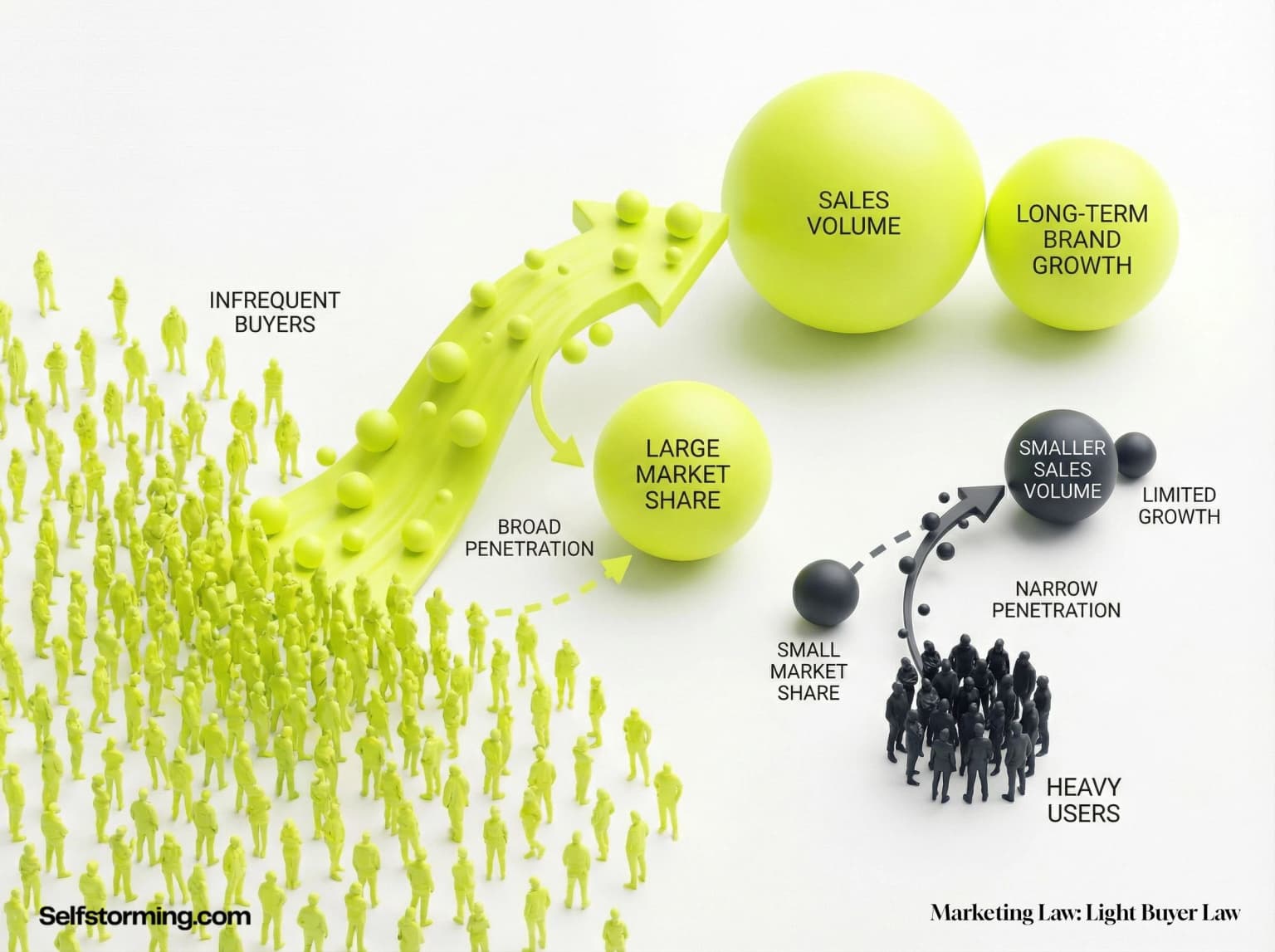
Light Buyer Law

Success is built on the occasional buyer.

You’ve spent your entire career chasing the 'heavy user' like some desperate ex, convinced that if you just squeeze them a little harder, your bonus will materialize. Newsflash: it won’t. While you're busy pampering the 20% who already buy you, you’re ignoring the massive ocean of people who barely know you exist—and that’s exactly why your growth has stalled. It’s time to stop worshipping the whales and start counting the minnows, because in the real world, scale is built on the backs of people who don't care about you. If you think your 'loyalists' are the key to the kingdom, you're not just wrong; you're mathematically illiterate.

The Light Buyer Law, pioneered by the Ehrenberg-Bass Institute, dictates that the vast majority of a brand's sales volume and growth potential resides within its 'light' and 'non-buyer' segments. Contrary to the popular (and often misapplied) Pareto Principle, which suggests 80% of sales come from 20% of customers, empirical evidence across nearly all consumer categories shows a much more balanced distribution where the 'long tail' of infrequent purchasers is the primary engine of market share. This law highlights the 'Law of Buyer Moderation,' where heavy buyers tend to regress toward the mean (buying less over time), while light buyers provide the only sustainable pool for penetration-led growth. For marketers, this necessitates a shift from 'loyalty' and 'retention' schemes toward broad-reach, sophisticated mass marketing designed to increase mental and physical availability for those who only buy the brand once or twice a year.

LIGHT BUYER LAW

Sales volume and long-term brand growth are primarily generated by the large number of consumers who purchase a brand infrequently, rather than by a small group of heavy users.

Light Buyer Law marketing law: Success is built on the occasional buyer. - Visual illustration showing key concepts and examples

Key Takeaways

  • Growth comes from many people buying occasionally, not few people buying frequently.
  • Heavy buyers naturally buy less over time; light buyers are your growth engine.
  • The 'long tail' of infrequent purchasers often matches the volume of heavy users.
  • Penetration is the most important metric for sustainable brand health and scale.
  • Sophisticated mass marketing is more effective than narrow, loyalty-based targeting.

Genesis & Scientific Origin

The Light Buyer Law is a fundamental pillar of the Dirichlet model of consumer behavior, extensively documented and popularized by Professor Byron Sharp and the researchers at the Ehrenberg-Bass Institute for Marketing Science. While the statistical foundations date back to Andrew Ehrenberg’s work in the 1950s and 60s regarding the Negative Binomial Distribution (NBD) of purchase frequency, it was the publication of 'How Brands Grow' (Sharp, 2010) that brought this principle into the mainstream marketing consciousness. The law emerged from decades of analyzing panel data across hundreds of product categories—from soap to banking—revealing a consistent pattern: brands are built by many people buying them occasionally, not a few people buying them frequently. This research effectively dismantled the 'Loyalty Myth' that had dominated marketing departments since the 1980s.

For most brands, the lightest 50% of buyers contribute 20-25% of total volume.

The Mechanism: How & Why It Works

The mechanism behind the Light Buyer Law is rooted in two core statistical realities: the Negative Binomial Distribution (NBD) and the Law of Buyer Moderation.

Firstly, the NBD describes the shape of brand purchase frequency. In any given period (a year, for example), a brand will have a few heavy buyers, some medium buyers, and a massive number of light buyers, followed by an even larger number of non-buyers. When you visualize this, it creates a 'long tail.' Because the pool of light buyers is so much larger than the pool of heavy buyers, their collective contribution to total sales often equals or exceeds that of the heavy users.

Secondly, the Law of Buyer Moderation (a form of regression to the mean) explains why focusing on heavy buyers is a failing strategy. Heavy buyers are often 'heavy' due to temporary life circumstances—they are hosting a party, buying for an office, or in a high-consumption phase of life. Over time, these individuals naturally revert to average consumption levels. Conversely, light buyers and non-buyers represent the only segment with significant 'upward' mobility. If you market only to your heavy users, you are targeting a group that is statistically likely to buy less of you next year regardless of your efforts. To grow, a brand must constantly replenish its base by reaching light buyers and converting non-buyers into light buyers. This is why penetration—the number of people who buy you at least once—is the primary metric of brand health, not 'loyalty' or 'share of wallet' among the elite few.

Light Buyer Law mechanism diagram - How Light Buyer Law works in consumer behavior and marketing strategy

Empirical Research & Evidence

A definitive study illustrating this law is found in the research published in the Journal of Advertising Research (Romaniuk & Sharp, 2004). The researchers analyzed the buying patterns of over 80 consumer packaged goods (CPG) brands using longitudinal panel data. The study found that for a typical brand, the bottom 50% of its customer base (the lightest buyers) accounted for approximately 20% to 25% of total sales volume. While this might seem to support a Pareto-like view at first glance, the researchers demonstrated that the 'heavy' 20% of buyers are highly volatile and their loyalty is not exclusive.

Further evidence presented by the Ehrenberg-Bass Institute showed that for a brand like Coca-Cola, the 'typical' buyer purchases the product only once or twice a year. In a 12-month period, light buyers (those buying 1-2 times) make up the overwhelming majority of the customer count. Specifically, data indicated that if a brand increased its penetration by just 1% among the 'lightest' segment, the resulting volume growth significantly outperformed attempts to increase the purchase frequency of existing heavy buyers by 10%. The math is simple: there are millions more light buyers than heavy ones, making them the more efficient lever for scale.

Real-World Example:
Coca-Cola

Situation

For years, the soft drink giant was pressured by consultants to focus on 'heavy users'—the teenagers and gamers who drank multiple cans a day—under the assumption that these were the only customers that mattered for ROI. Marketing efforts were skewed toward high-frequency usage occasions and loyalty rewards.

Result

Upon applying the principles of the Light Buyer Law, Coca-Cola shifted its strategy toward 'sophisticated mass marketing.' They realized that their growth didn't come from getting a 'super-fan' to drink a 5th Coke; it came from getting a 'light buyer' who drinks Coke twice a year to drink it a third time. By pivoting to broad-reach media (Super Bowl ads, global packaging consistency) and maximizing physical availability (vending machines in every corner of the globe), they ensured they were 'easy to buy' for the person who only thinks of them once every six months. This focus on penetration and the 'long tail' of light buyers is what maintains their dominant market share, as it counters the natural attrition of heavy users.

Strategic Implementation Guide

1

Discard Niche Segmentation

Stop segmenting your audience based on 'heavy usage' or 'brand love.' Your target is anyone who enters the category. If they buy your category, they are a potential light buyer for your brand.

2

Prioritize Broad Reach

Shift your media budget away from 'retargeting' existing customers and toward high-reach channels (TV, Outdoor, Digital Video) that hit the entire category. You need to reach the people who aren't looking for you.

3

Simplify the Message

Light buyers don't care about your brand's complex 'purpose' or 15 product benefits. Use distinctive assets and a single, clear message to build mental availability so they remember you in the 2.5 seconds they spend at the shelf.

4

Maximize Physical Availability

Ensure your product is present where light buyers shop. Light buyers will not go out of their way to find you; if you aren't there, they will simply buy a competitor. Distribution is your best marketing.

5

Audit Your Loyalty Program

If your loyalty program only rewards people who were going to buy you anyway (heavy users), it's a cost center, not a growth engine. Re-evaluate it as a data collection tool rather than a 'retention' strategy.

6

Monitor Penetration Metrics

Stop obsessing over 'average transaction value' or 'loyalty scores.' Make 'Penetration' (total number of unique buyers) your primary North Star metric for brand health.

7

Embrace the 'Law of Buyer Moderation'

Accept that your heavy buyers will likely buy less next year. Don't panic; instead, ensure your top-of-funnel is wide enough to catch the new light buyers who will replace that lost volume.

Frequently Asked Questions

Doesn't the Pareto Principle (80/20 rule) mean heavy users are more important?

The 80/20 rule is often a 60/20 or 50/20 rule in marketing, and more importantly, it's a snapshot in time. Because of the Law of Buyer Moderation, the heavy 20% this year won't be the same heavy 20% next year. If you only target the current 20%, you are targeting a shrinking asset. Light buyers are the only group large enough to provide sustainable growth and replace the natural decline of heavy users.

Are light buyers even profitable if acquisition costs are high?

This is a common fallacy. While the cost to acquire a single light buyer might seem high, the aggregate value of millions of light buyers is what builds market share. Market share, in turn, drives economies of scale in production and distribution, which is the real driver of profitability. You can't have the high margins of a big brand without the volume of the light buyers.

Should we stop talking to our heavy users entirely?

No, but you shouldn't pay a premium to 'target' them. Because heavy users buy the category frequently, they will naturally be exposed to your broad-reach marketing. You don't need a separate, expensive strategy for them—they are already 'caught' in your net. Focus your 'extra' effort on the people who are harder to reach: the light buyers.

Does this law apply to B2B or just FMCG?

The law is remarkably robust across B2B, services, and even luxury goods. In B2B, most of your 'future' revenue comes from companies that currently use you for minor projects or don't use you at all. The distribution of 'heavy' vs 'light' clients follows the same NBD pattern. Growth still comes from increasing the number of 'light' accounts.

How does 'Mental Availability' relate to the Light Buyer Law?

They are inseparable. Light buyers, by definition, don't think about your brand often. Therefore, you must build 'Mental Availability'—memory structures that link your brand to buying situations—so that when that infrequent buying moment occurs, your brand is the one that pops into their head. You need to be 'easy to think of' for people who don't want to think about you.

Sources & Further Reading

We use cookies on our site to enhance your user experience, provide personalized content, and analyze our traffic. Cookie Policy