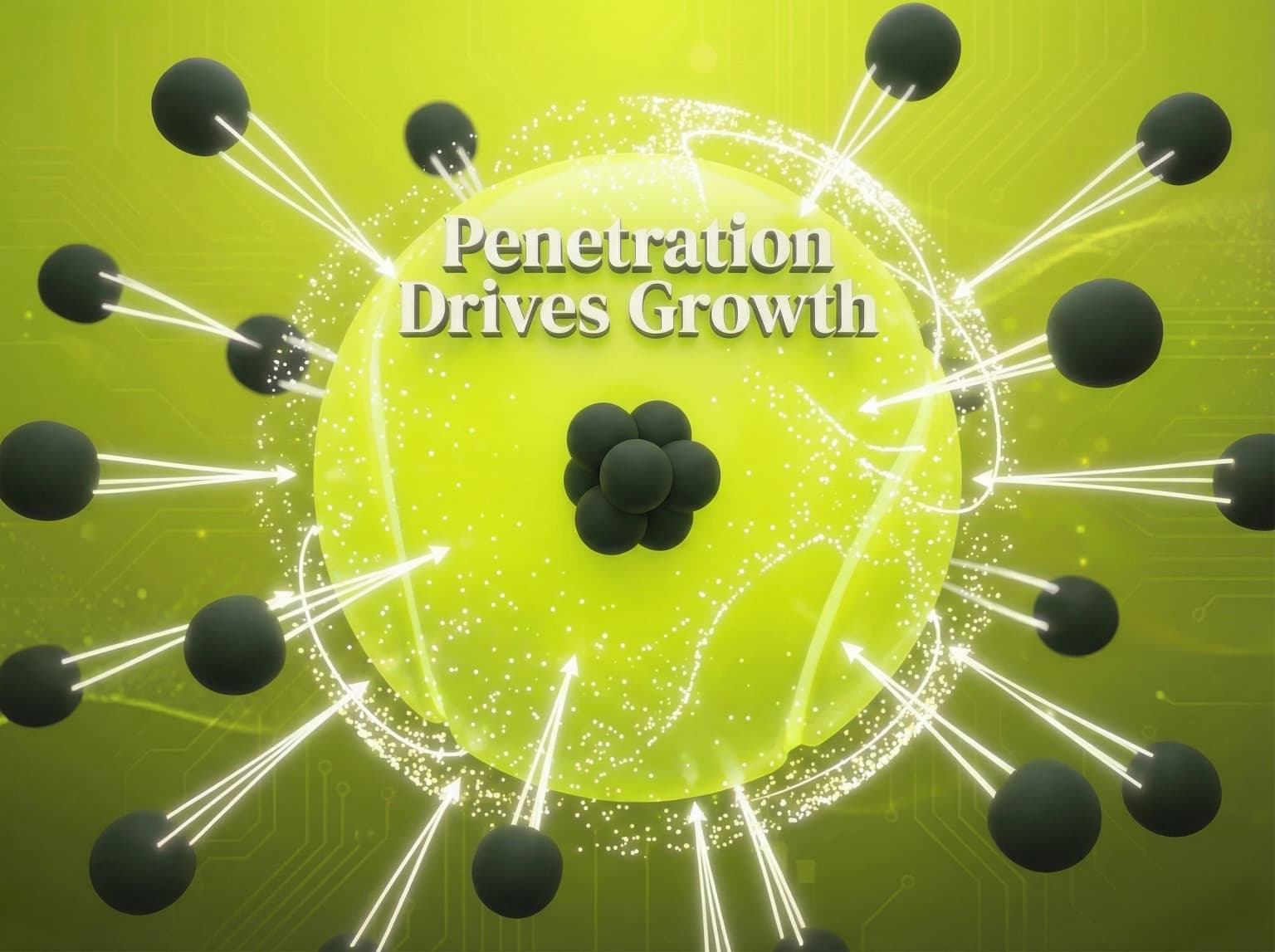
Penetration Drives Growth
Acquisition beats retention every single time.
Look, I know your brand manager is currently weeping into a PowerPoint about 'emotional loyalty' and 'advocacy loops.' It’s cute. It’s also a one-way ticket to stagnation. The reality is that your 'loyal' customers are a statistical rounding error in the grand scheme of growth. If you want to actually get bigger—like, 'private jet' bigger, not 'free office snacks' bigger—you need to stop obsessing over the few who love you and start hunting the millions who barely know you exist. Growth isn't about depth; it's about breadth. It’s a numbers game, and right now, you’re playing with a broken calculator.
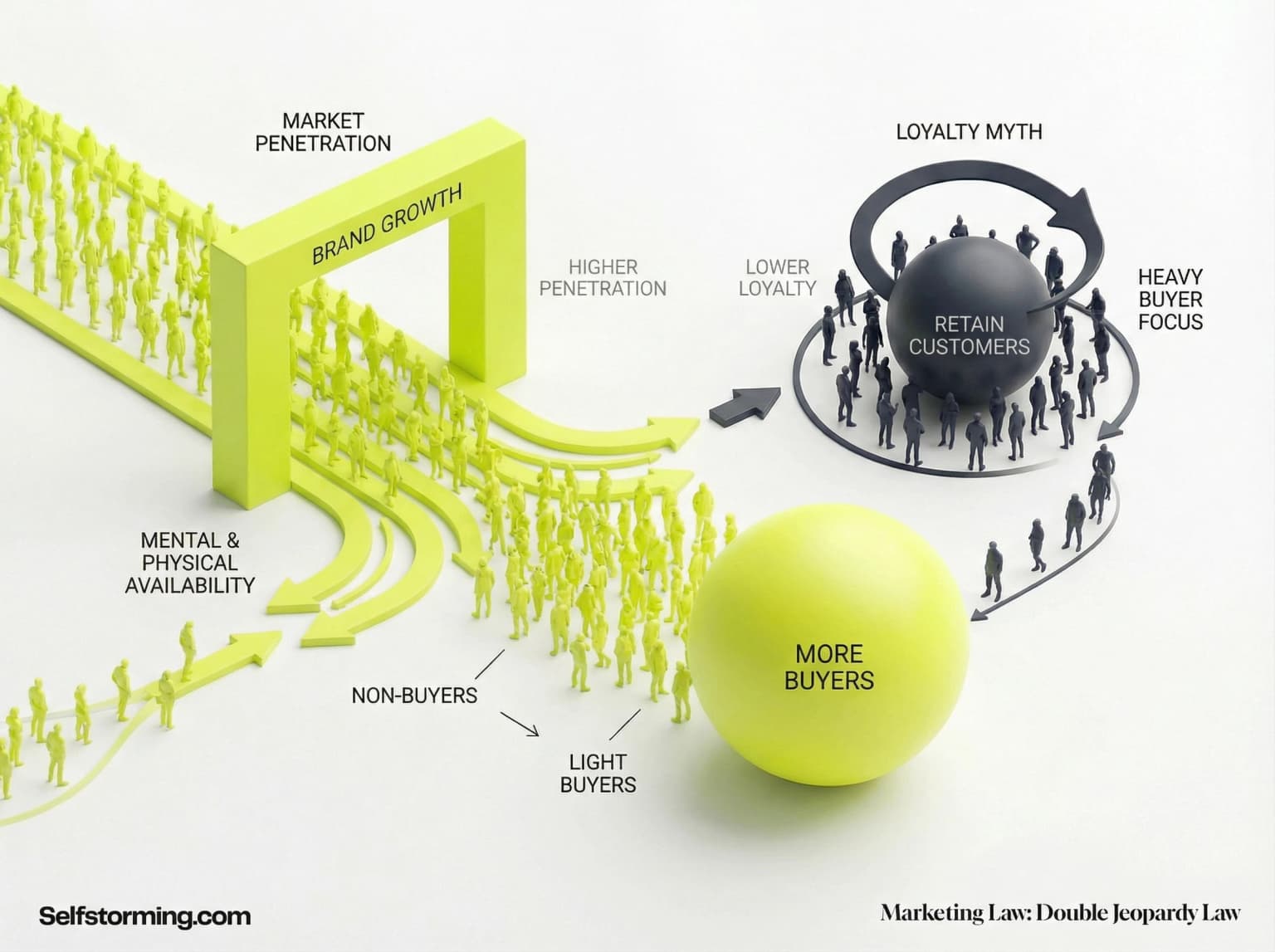
The Law of Penetration states that brand growth is almost entirely a function of increasing the number of people who buy your brand at least once in a given period. While the 'loyalty myth' suggests it is cheaper to retain customers than acquire new ones, empirical evidence from the Ehrenberg-Bass Institute shows that loyalty (measured by purchase frequency) is largely a fixed property of market share. Big brands have more buyers who also happen to be slightly more loyal (Double Jeopardy), but the primary lever for expansion is penetration. To grow, marketers must prioritize reach, mental availability, and physical availability over retention programs or 'heavy buyer' strategies, as the vast majority of growth comes from moving non-buyers into light buyers.
PENETRATION DRIVES GROWTH
“Market share growth is primarily achieved by increasing the size of a brand's customer base rather than increasing the average purchase frequency or loyalty of existing customers.”

Key Takeaways
- •Growth is a numbers game: more buyers always beats 'better' buyers.
- •The 'Loyalty Myth' is a budget-wasting trap for stagnant brands.
- •Light buyers are the secret engine of market share expansion.
- •Double Jeopardy means small brands suffer twice—size is the only cure.
- •Prioritize reach and availability over engagement and depth of relationship.
Genesis & Scientific Origin
The empirical foundation for this law was established by Andrew Ehrenberg and his colleagues at the London Business School, later institutionalized by the Ehrenberg-Bass Institute for Marketing Science. While the marketing world was obsessed with Philip Kotler’s focus on segmentation and targeting in the 1970s and 80s, Ehrenberg was busy looking at actual buying data. He discovered that buying behavior follows predictable mathematical patterns, specifically the Negative Binomial Distribution (NBD) and the Dirichlet model. These findings were later popularized and brought into the mainstream by Professor Byron Sharp in his seminal 2010 book, 'How Brands Grow: What Marketers Don't Know.' The law effectively debunked the 'Retention over Acquisition' mantra that had dominated marketing departments for decades, proving that the growth of brands like Coca-Cola, Nike, and Unilever was driven by the sheer scale of their customer base, not the intensity of their fans' devotion.
“Correlation between market share and brand penetration is typically >0.9 across all categories.”
The Mechanism: How & Why It Works
The mechanism behind 'Penetration Drives Growth' is rooted in the Double Jeopardy Law and the statistical distribution of purchase frequencies. To understand why penetration is the lead driver, one must first accept that loyalty is not a variable that marketers can easily manipulate in isolation. In any given category, brands differ significantly in their penetration (how many people buy them) but only slightly in their loyalty (how often those people buy them). This is the 'Double Jeopardy' effect: smaller brands suffer twice; they have fewer buyers, and those few buyers buy them slightly less often.
Mathematically, the NBD-Dirichlet model shows that the vast majority of a brand's potential for growth lies in the 'long tail' of the market—the light buyers and non-buyers. Most people who buy a brand buy it very infrequently (e.g., once or twice a year). If a brand focuses on increasing the purchase frequency of its 'heavy buyers,' it is targeting a group that is already near its ceiling of consumption. Conversely, moving a tiny percentage of the massive pool of non-buyers into the category of 'light buyers' results in massive volume increases.
Psychologically, this works because consumers have 'repertoires.' Most people are not 'loyal' to one brand; they have a set of brands they find acceptable. Growth occurs when a brand manages to enter more of these repertoires. This requires maximizing 'Mental Availability' (being the brand that comes to mind in a buying situation) and 'Physical Availability' (being easy to find). Because human memory is fragile and competitive, broad-reach advertising is necessary to constantly refresh the memory structures of the millions of light buyers who don't think about your brand daily. Focusing on loyalty programs or CRM for existing fans ignores the statistical reality that these fans are already maxed out, while the rest of the world is waiting to be reminded you exist.

Empirical Research & Evidence
One of the most comprehensive demonstrations of this law is found in the Journal of Advertising Research (Romaniuk & Sharp, 2016). The researchers analyzed 21 consumer goods categories across multiple years to determine the correlation between market share, penetration, and purchase frequency. The study found that the correlation between market share and penetration was consistently above 0.9, while the correlation between market share and purchase frequency (loyalty) was significantly lower, usually hovering around 0.3 to 0.4. Specifically, in a study of the UK shampoo market, the leading brand had a penetration of 25% and an average purchase frequency of 2.1 times per year. The fifth-ranked brand had a penetration of 5% and a purchase frequency of 1.6. The difference in market share was almost entirely explained by the 5x difference in penetration, not the marginal 0.5 difference in frequency. This data confirms that you cannot have high market share without high penetration.
Real-World Example:
Dove (Unilever)
Situation
In the early 2000s, Dove was a steady but aging soap brand. Standard marketing wisdom suggested they should focus on their 'super-fans' with anti-aging claims or deep loyalty rewards to prevent churn to competitors like Olay.
Result
Instead, Dove launched the 'Real Beauty' campaign. This wasn't just a 'purpose' play; it was a massive penetration play. By broadening the brand's appeal to every woman regardless of age or body type, they exploded their 'Mental Availability' among non-users. They didn't tell existing users to wash twice as much; they told millions of women who had never bought Dove that the brand was 'for them.' The result was a decade of double-digit growth, with global sales jumping from $2 billion to over $4 billion. The growth was driven by millions of new light buyers entering the brand's orbit, proving that broad reach and universal appeal beat niche loyalty every time.
Strategic Implementation Guide
Stop the 'Heavy Buyer' Obsession
Redirect your budget away from loyalty programs and CRM systems that talk to people who already buy you. They aren't where the growth is. You're just subsidizing their existing behavior.
Maximize Reach in Media
Switch from 'high frequency' targeting to 'maximum reach.' If your media plan shows your ads hitting the same person 10 times, you're wasting 9 impressions. Hit 10 different people once instead.
Build Distinctive Assets
Since you're targeting light buyers who don't care about you, you need to be instantly recognizable. Invest in colors, logos, and sounds that scream your brand name so they don't accidentally buy a competitor.
Expand Physical Availability
If you aren't on the shelf (digital or physical), penetration is impossible. Audit your distribution. If a light buyer has to do 'work' to find you, they will simply buy whatever is closer.
Simplify the Message
Light buyers have zero interest in your brand's complex origin story. Use 'Fluency Over Persuasion.' Give them one easy-to-digest reason to buy, or better yet, just make them feel something so they remember you.
Measure Penetration, Not NPS
Fire whoever is reporting Net Promoter Score as a growth metric. Start tracking 'Category Penetration' and 'Brand Penetration.' If your penetration isn't moving, you're just rearranging deck chairs on the Titanic.
Ignore the 'Niche' Temptation
Don't try to be the 'organic, gluten-free, left-handed soap' for a tiny group. Be the soap for everyone. Penetration requires a big tent.
Frequently Asked Questions
Doesn't it cost 5x more to acquire a new customer than to retain an old one?
This is the most persistent lie in marketing. This 'stat' usually comes from consultants trying to sell you CRM software. In reality, customers 'churn' for reasons often beyond your control (they move, they die, their needs change). If you stop acquiring, your brand will eventually shrink to zero. You don't 'choose' acquisition over retention; you do acquisition so that you have someone left to retain. Furthermore, the cost of 'retention'—discounts, loyalty points, constant email spam—often exceeds the margin of the sales they generate.
What about the 80/20 rule? Don't 20% of customers provide 80% of revenue?
In most categories, it's actually closer to 50/20, and that 20% of 'heavy buyers' is highly unstable. Today's heavy buyer is tomorrow's light buyer. If you ignore the 80% of light buyers, you lose the pool from which your future heavy buyers will emerge. Growth comes from the 'long tail' of people who buy you once a year or once every two years.
Can't we grow by getting our fans to buy more often (increasing frequency)?
Mathematically, it's almost impossible. Purchase frequency is largely a category characteristic. If people wash their hair three times a week, you aren't going to convince them to wash it six times a week just because they like your brand. You grow by being the brand they choose for one of those three washes more often than the other guys.
Is loyalty a complete myth then?
No, loyalty exists, but it's a 'passive' loyalty. People buy the same brand because it's easy, not because they have a deep emotional bond. Big brands have higher loyalty simply because they are more available and familiar (Double Jeopardy). Loyalty is a consequence of growth, not a cause of it. Focus on getting big, and the loyalty will follow.
Does this apply to B2B or just toothpaste and soda?
It applies to everything from cloud computing to jet engines. The Ehrenberg-Bass Institute has shown that B2B buying behavior follows the same Dirichlet patterns. Big B2B firms have more customers; small ones have fewer. The path to B2B growth is still through increasing the number of accounts (penetration), not just 'upselling' existing ones.
Sources & Further Reading
Related Marketing Laws
Double Jeopardy Law
Big brands have more buyers and higher repeat rates. Loyalty follows size, not strategy.
Light Buyer Law
Most sales come from buyers who purchase infrequently, not heavy users.
Repertoire Buying Behaviour
Consumers buy from a set of acceptable brands, not one favorite.
Market Share Predicts Profitability
Larger brands tend to be more profitable due to scale advantages.